

What if a rainy forecast is actually the secret to passing your driving exam on the first try? Most students see dark clouds as a reason to panic, but a downpour is a professional platform to show an examiner you can handle real-world hazards with precision. It's natural to feel anxious about hydroplaning or struggling with a foggy windshield while trying to spot road signs. Learning how to prepare for a road test in the rain ensures you won't just survive the weather; you'll master it.
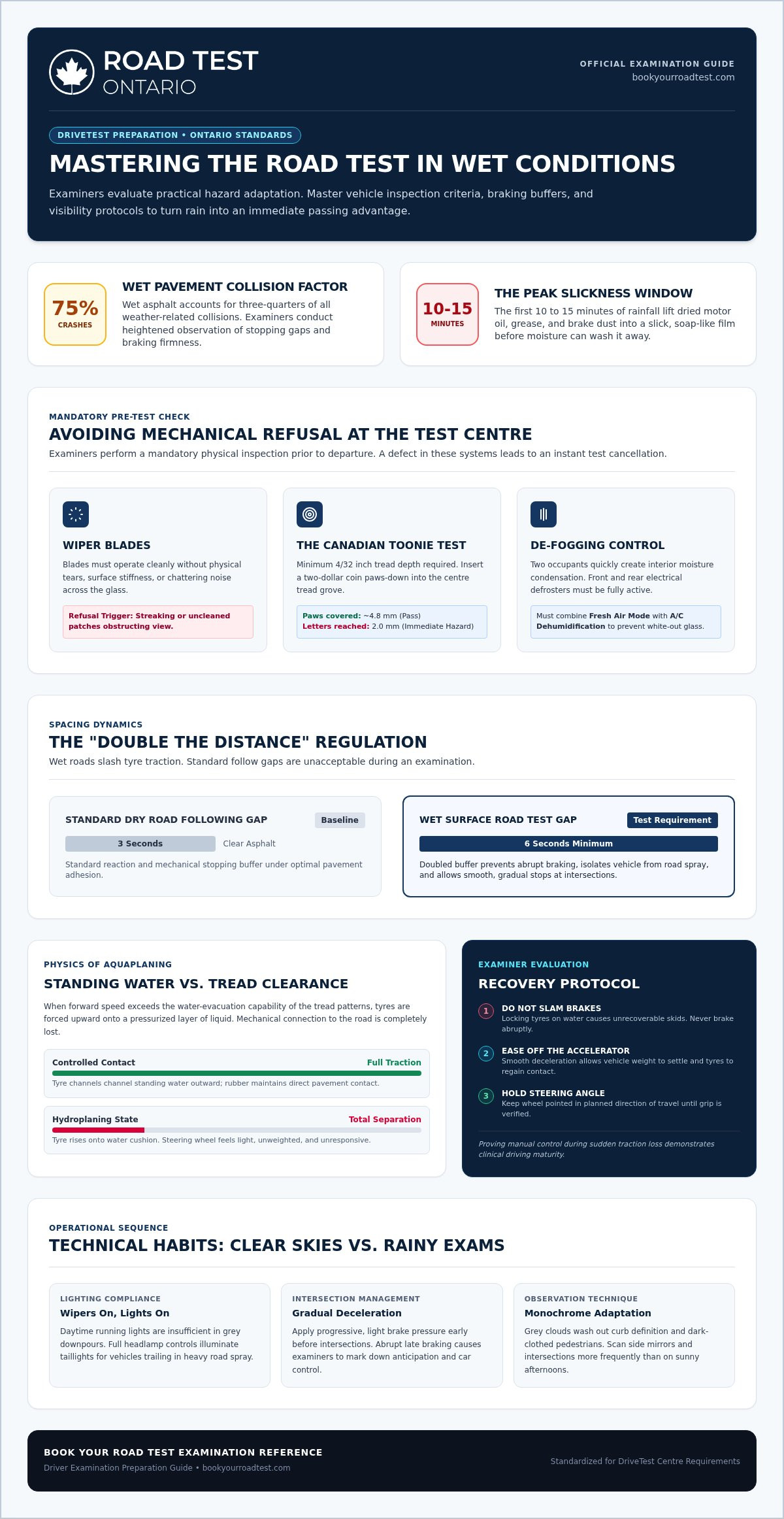
We understand that wet pavement accounts for 75 percent of weather-related crashes, which makes your examiners extra observant during a storm. This guide provides a functional strategy to turn these conditions into your advantage. You will learn a clear checklist for vehicle safety, including why you need at least 4/32 of an inch of tire tread for wet roads. We also explain how to adjust your following distance to six seconds and manage defroster controls to maintain perfect visibility. This preparation replaces test-day nerves with the clinical confidence required to secure your licence, regardless of the weather.
Key Takeaways
- Perform a critical pre-test vehicle inspection to ensure your wipers and defrosters meet the strict standards required to avoid a mechanical refusal.
- Apply the "Double the Distance" rule to manage stopping gaps and avoid the common error of braking too abruptly on slick pavement.
- Learn exactly how to prepare for a road test in the rain by mastering the legal "wipers on, lights on" mandate to avoid technical failures.
- Identify the specific signs of hydroplaning and demonstrate the manual steering adjustments that prove your competence to the examiner.
- Access professional strategies for managing test-day anxiety and navigating booking logistics if the weather forecast requires a schedule adjustment.
Understanding the Challenges of Driving in Wet Weather
Driving in the rain isn't just about turning on your wipers. It fundamentally changes the three pillars of safe operation: visibility, traction, and communication. When raindrops hit the asphalt, they mix with accumulated motor oil, grease, and brake dust. This chemical reaction creates a slick, soap-like layer that is most dangerous during the first 10 to 15 minutes of a storm before the grime eventually washes away. If you don't adjust your habits immediately, you risk losing control before the test even leaves the neighbourhood.
For a beginner, the most intimidating concept is hydroplaning. Think of it as your car trying to surf. When you drive too fast over standing water, your tires cannot push the liquid out of the way fast enough. Instead of gripping the road, the car rises up on a thin cushion of water. To understand the physics behind this, you can study aquaplaning and hydroplaning dynamics, but for your test, just remember that speed is the primary trigger. If the car feels light or unresponsive, you've lost that vital connection to the ground.
Your examiner knows the weather is out of your control. They aren't looking for a perfect performance; they are looking for proactive adaptation. If you drive exactly the same way in a downpour as you do on a sunny afternoon, you've already failed the mental part of the test. Learning how to prepare for a road test in the rain means showing you respect the hazards by adjusting your technique before a mistake occurs. Proactive drivers stay calm because they anticipate how the car will react.
Visibility and Environmental Awareness
Grey skies turn the world into a monochrome blur. This makes it harder to distinguish between the pavement and the curb or to spot pedestrians in dark clothing. Road spray from larger vehicles, like buses or trucks, can instantly coat your windshield in a layer of grime that obscures lane markings. Reduced visibility during a road test is any condition where environmental factors prevent you from seeing traffic signs or hazards at their usual distances. You must compensate by scanning more frequently and keeping your eyes moving to identify potential threats early.
The Science of Traction and Braking
Wet pavement is unforgiving to sudden movements. You must treat the accelerator and brake pedal with a gentle touch to avoid skidding. Since 75 percent of weather-related crashes happen on wet pavement, your examiner will watch for "smooth" stops. If you slam on the brakes at a red light, your tires might lose their grip. This suggests a lack of foresight. You must demonstrate that you understand the relationship between your speed and the water-evacuation capability of your tires by slowing down well before you reach an intersection. Proving you can stop safely on a slick surface is the best way to earn an examiner's trust.
Essential Vehicle Maintenance for Rainy Road Tests
Your road test begins long before you put the car in gear. Examiners conduct a mandatory mechanical inspection to ensure your vehicle is safe for the current conditions. If your equipment fails to meet standards during a downpour, the examiner will issue a mechanical postponement. This means your test ends immediately. Understanding how to prepare for a road test in the rain involves verifying that your vehicle can handle reduced friction and poor visibility without compromise.
The Exterior Checklist: Wipers, Tires, and Lights
Visibility is your primary defence against accidents. Inspect your wiper blades for cracks, stiffness, or "chattering" against the glass. If they leave streaks or missed spots, replace them immediately. Examiners will reject a vehicle if the wipers cannot provide a clear view of the road. Additionally, check your tires using the "Toonie Test." Insert a Canadian two-dollar coin into the tread with the bear's paws facing down. If the tread reaches the paws, you have approximately 4.8 mm of depth. If it only covers the silver letters, you are near the 2 mm limit. Official FHWA road weather safety data indicates that wet pavement significantly reduces friction, so having healthy tread is vital for clearing water and maintaining grip. Finally, wipe down your headlights and taillights to ensure they are visible through the grey road grime.
The Interior Checklist: Controls and Defrosting
Cabin fogging is a silent hazard that causes instant test failure. When two people sit in a cold, damp car, the windows can opaque in seconds. You must know how to operate your front and rear defrosters before you arrive at the centre. Set your climate control to "fresh air" mode and engage the air conditioning. The A/C acts as a dehumidifier, pulling moisture out of the cabin to keep the glass crystal clear. Check these items before your appointment:
- Washer Fluid: Ensure the reservoir is full to clear muddy spray from other vehicles.
- Control Familiarity: Be ready to activate wipers and lights instantly upon the examiner's command.
- Tire Pressure: Under-inflated tires are more prone to hydroplaning on pooled water.
If your current vehicle isn't up to the task or you need more time to prepare your equipment, you can use a road test cancellation finder to secure a later date. This allows you to focus on maintenance so you can arrive with a reliable vehicle.
Adjusting Your Driving Technique for Wet Conditions
Passing a road test in a storm requires more than just avoiding a collision. You must actively demonstrate that you understand how water affects your vehicle's physics. Examiners look for specific, visible modifications to your speed and spatial awareness. Part of learning how to prepare for a road test in the rain is mastering the "Double the Distance" rule. While a three-second gap is sufficient on dry pavement, wet roads require a six-second following distance to account for the 43 percent increase in stopping distance seen on worn tires.
Mastering Speed and Following Distance
Speed limits are designed for ideal conditions. In heavy rain, driving five to ten km/h below the posted limit is often a "safety pass" because it aligns with the Basic Speed Law. To calculate your gap, pick a stationary object like a telephone pole or road sign. Start counting "one-thousand-and-one" when the vehicle ahead passes it. If you reach that same marker before you hit six seconds, gently ease off the accelerator. Following NHTSA tire safety and tread guidelines ensures your car is capable of stopping, but this extra space provides the time needed for smooth, non-emergency braking. If a driver tailgates you, don't feel pressured to speed up. Maintain your forward cushion so you can brake gradually, giving the driver behind you more time to react without a rear-end collision.
Demonstrating Proactive Safety to the Examiner
The examiner cannot read your mind. You must make your safety decisions obvious through the "Check and Verbalize" method. Turn your head clearly during mirror and blind spot checks so the examiner sees your engagement. Signal your intentions at least 100 metres before a turn to give other drivers ample warning in low-visibility conditions. If you encounter a large puddle, don't just slow down silently. Say, "I am reducing my speed slightly to avoid hydroplaning through this standing water." This verbal cue proves you are making a conscious safety choice rather than driving hesitantly. Use your low-beam headlights whenever your wipers are active. It makes your vehicle significantly more visible to others in the grey mist.
Common Mistakes to Avoid During a Rainy Road Test
The pressure of an exam often causes students to overlook technical legal requirements that only surface during inclement weather. One of the most frequent errors is the failure to activate low-beam headlights when windshield wipers are in continuous use. Even if your car has "automatic" lights, these systems often fail to trigger in daytime rain. Manually turning your lights on is a requirement in many jurisdictions; failing to do so demonstrates a lack of situational awareness. Mastering how to prepare for a road test in the rain involves treating your headlights as a primary communication tool, not just a night-time convenience.
The "Speed Limit" Trap
Many applicants believe that as long as they stay below the number on the sign, they are safe. This is a dangerous misconception. The posted speed limit is legally defined for "ideal conditions" only. Driving 50 km/h in a 50 zone during a heavy downpour can be classified as a "Critical Driving Error" if the road is saturated or visibility is low. Examiners judge your "reasonable speed" based on the flow of traffic and the amount of standing water. Light rain typically reduces freeway speeds by 2 to 13 percent. If you fail to mirror this reduction, you appear reckless. You must balance caution with confidence; driving excessively slow can be seen as hesitation, which is also a point deduction.
Intersection and Lane Change Errors
Rain creates a reflective glare that can make white and yellow paint virtually invisible. "Lane drifting" is a common automatic failure during rainy tests. You must use other cues, such as the position of the curb or the tire tracks of the vehicle ahead, to stay centred. Mirrors often become covered in water droplets, which distorts your view of the blind spot. You must compensate with more pronounced shoulder checks to ensure a lane change is safe. Intersections present the highest risk for skidding. Braking too late and too hard is the #1 mistake students make. To avoid this, focus on these three safety markers:
- Early Deceleration: Begin braking much earlier than you would on dry pavement to account for increased stopping distances.
- Limit Line Discipline: Ensure you come to a complete stop behind the thick white line; sliding over it is marked as a failure to stop.
- Surface Awareness: Avoid braking heavily on painted markings or metal utility covers, which become exceptionally slick when wet.
Managing these risks is easier when you aren't rushed. If the current forecast feels overwhelming, you can use our G2 road test booking service to find a date with better conditions. Focus on mastering these small details to ensure you don't become part of the 47 percent of weather-related crashes that happen during active rainfall.
Managing Test Day Stress and Booking Logistics
Rain on your test day is a mental game as much as a physical one. If you've learned how to prepare for a road test in the rain, you already have the technical skills. Now, you need the focus to execute them. Examiners often prefer testing in the rain because it reveals a student's true defensive driving instincts. Instead of viewing the grey skies as a disadvantage, visualize them as a tool that allows you to stand out from less-prepared candidates. A calm driver who adapts to the environment is exactly what a professional evaluator wants to see.
Stress-Relief Techniques for Nervous Drivers
Confidence comes from familiarity. If the forecast looks wet, schedule a "dry run" practice session during a similar downpour. Feeling the car's response to wet pavement in a low-stakes environment removes the fear of the unknown. If the anxiety of a specific date is too much, using a road test cancellation finder Ontario can help you secure an earlier date when you feel most ready. This allows you to take control of your schedule rather than feeling at the mercy of the weather. Visualization is also key; imagine yourself successfully navigating a slick intersection rather than worrying about the potential for a skid.
Simplifying the Booking Process
Logistics are often the hidden source of test-day stress. Traffic slows down by 10 to 25 percent during heavy rain, so plan to arrive at the centre at least 30 minutes early. This gives you time to wipe your mirrors and lights without rushing. While standard rain won't stop an exam, severe weather like localized flooding or tropical storm warnings can lead to cancellations. If the environment becomes genuinely dangerous, it's better to wait for a clearer window. Examiners will only cancel if they believe the conditions prevent a fair assessment of your skills.
We act as an autonomous third-party administrator to handle the paperwork so you can focus on your driving. This is especially vital for motorcycle candidates who are highly weather-sensitive and may need an M2 road test booking at a centre with better-maintained pavement. If you decide the current conditions are too daunting, BookYourRoadTest.com provides a simplified interface to find a new appointment. We charge a convenience fee to manage these logistics, ensuring you have a reliable facilitator during a high-pressure week. Focus on your training; we'll handle the admin.
Master the Elements and Secure Your Licence
Success on a rainy test day depends on your ability to adapt before the examiner asks you to. By maintaining a six-second following distance and ensuring your vehicle has at least 4/32 of an inch of tire tread, you demonstrate the proactive safety skills required for a pass. You've learned how to prepare for a road test in the rain by mastering defroster controls and avoiding the common trap of driving too fast for saturated conditions. These small adjustments prove you are a capable, safety-conscious driver who can handle real-world hazards with precision.
If the current forecast feels like an unnecessary hurdle, we provide an honest, transparent administrative service to help you manage your appointment. We offer access to over 60 centres and a specialized cancellation finder to help you secure an earlier date when the skies are clear. Book your road test with ease and let us handle the admin so you can focus entirely on your driving skills. You have the knowledge and the tools to succeed. Trust your training, stay focused, and you will earn your licence with confidence.
Frequently Asked Questions
Will the examiner cancel my road test if it is raining heavily?
Generally, examinations proceed in rain, drizzle, and standard wet conditions. Cancellations only occur during severe weather events like localized flooding, sustained storms, or freezing rain. If the environment is too dangerous for a fair assessment, the examiner will postpone the appointment. If you are uncomfortable with the weather forecast, using a third-party booking service to find a new date is a practical way to manage your schedule without added stress.
Do I need to drive below the speed limit if it is raining during my test?
Yes, you must adjust your speed based on the "Basic Speed Law." Posted limits are designed for ideal conditions only. In moderate to heavy rain, driving 5 to 10 km/h below the limit is often necessary to maintain safety. Research indicates that light rain reduces average freeway speeds by 2 to 13 percent. Failing to slow down for saturated roads can result in an automatic failure for reckless operation.
Can I fail for not having my headlights on in the rain?
Yes, failing to use low-beam headlights when wipers are active is a frequent reason for point deductions. Many jurisdictions mandate "wipers on, lights on" by statute to ensure vehicle visibility. Even if your car has automatic headlights, these systems don't always trigger during daytime rainfall. You must demonstrate situational awareness by manually turning on your lights so other drivers can see you through the mist and road spray.
What happens if my windshield fogs up during the road test?
You must clear the fog immediately using your vehicle's defroster controls. Driving with compromised visibility is a critical error that leads to an instant failure. Before starting, ensure you know how to set the climate control to fresh air and engage the air conditioning to dehumidify the cabin. Understanding these technical controls is a key part of how to prepare for a road test in the rain and stay safe.
Is it harder to pass a road test in the rain?
Not necessarily, but it requires more proactive adaptation. Examiners use rainy conditions to see if you can handle real-world hazards like reduced traction and poor visibility. Showing you can manage a 6-second following distance and smooth braking can actually make a better impression. Learning how to prepare for a road test in the rain provides a platform to prove you are a superior, safety-conscious driver compared to those testing in perfect weather.
Should I use cruise control if it is raining during my highway test?
No, never use cruise control on wet pavement. These systems cannot detect hydroplaning. If your tires lose contact with the road, the system might attempt to accelerate or downshift to maintain speed, causing a sudden loss of directional control. Engaging cruise control during a road test in wet weather will result in point deductions or an immediate failure for improper vehicle control and failing to adapt to the current road conditions.
How much extra following distance should I leave on wet roads?
You should increase your following distance to at least 5 or 6 seconds. On dry pavement, a 3-second gap is the standard, but wet roads require more space because stopping distances can increase by 43 percent. Use a stationary marker like a road sign to count the gap. This extra cushion gives you the time needed to brake gently and avoid skidding, which is vital for demonstrating competence to your examiner.
What should I do if I start to hydroplane during the exam?
Remain calm and ease your foot off the accelerator immediately. Do not slam on the brakes or jerk the steering wheel, as this can cause the vehicle to spin. Keep the wheels pointed in the direction you want to go until you feel the tires regain grip. Examiners look for a controlled, manual recovery. If you handle the situation safely without panicking, you demonstrate the high level of maturity required for licensing.


