

What if the most stressful part of your road test isn't the three-point turn, but the thirty minutes before you even start the car? Most candidates arrive at the examination building with a knot in their stomach because they don't know which line to join or if their identification is sufficient. It's natural to feel anxious when facing a rigid administrative process. Understanding exactly what to expect at drivetest centre locations is the most effective way to protect your focus for the road ahead.
As an autonomous service provider, we specialize in simplifying the path to your appointment through our independent booking platform and cancellation finder tool for a convenience fee. We've designed this 2026 survival guide to help you master the logistics of your examination day. You'll gain a clear mental map of the facility layout, a definitive checklist of required items, and the confidence to handle the administrative check-in with professional ease. We'll walk you through everything from parking protocols to the final residency declaration so you can arrive prepared and ready to succeed.
Key Takeaways
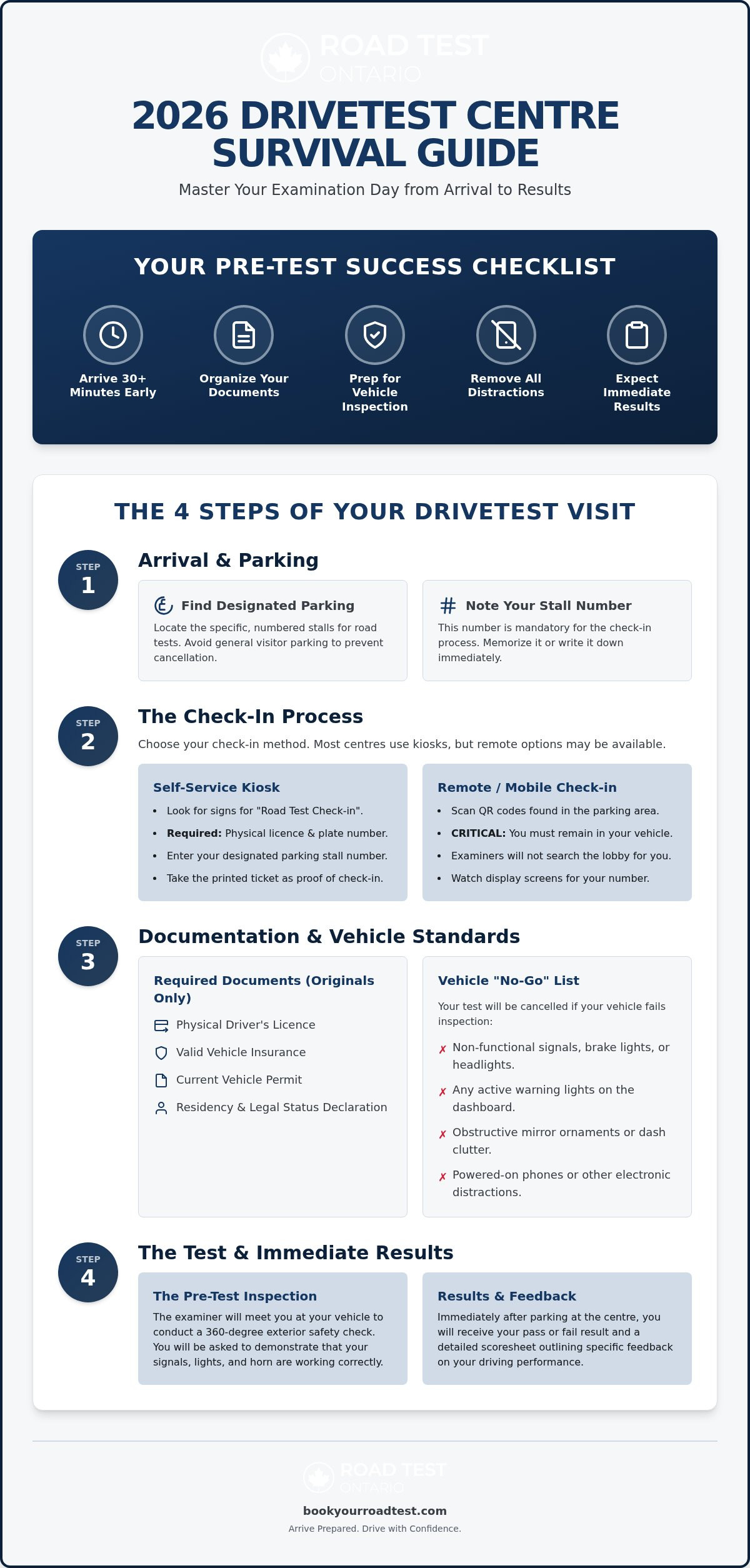
- Arrive at the facility at least 30 minutes early and locate the designated, numbered parking stalls to avoid administrative delays.
- Organize your physical driver's licence and vehicle permit beforehand to streamline what to expect at drivetest centre check-in desks.
- Prepare for a mandatory 360-degree exterior vehicle inspection where the examiner will verify your signals and safety equipment.
- Maintain a professional testing environment by removing mirror ornaments and ensuring all electronic distractions are powered down.
- Anticipate receiving your pass or fail result immediately after the test, along with specific feedback on your driving performance.
Navigating Your Arrival and the Check-in Process
Success starts before you turn the ignition. Plan to arrive at the facility at least 30 minutes before your scheduled time slot. This buffer handles unexpected traffic and gives you time to locate the correct parking area without rushing. Most locations feature designated road test parking spaces, which are clearly separated from general visitor stalls. These spots are usually numbered and located in a specific row. You must note your parking space number immediately. You will need this specific digit to complete your registration inside the building. If you park in a general spot, the examiner may not be able to find your vehicle, which could result in a cancelled appointment.
Once you've secured your spot, head toward the main entrance. Understanding what to expect at drivetest centre locations involves recognizing that the lobby is often divided into different service streams. Look for signs pointing to "Road Test Check-in" rather than general licensing renewals. This initial navigation is the first step in a stress-free experience. If you used an independent facilitator like BookYourRoadTest.com to manage your booking, ensure you have your confirmation details ready to verify your time slot.
Using the Self-Service Kiosks
Most modern centres utilize self-service kiosks to streamline the arrival process. These terminals are designed for speed and efficiency. Have your physical driver's licence and your vehicle's plate number ready for input. Digital copies or photos of your licence are not accepted for this step. Follow the on-screen prompts to confirm your identity and input your designated parking spot number. This tells the system exactly where the examiner should meet you. Take the printed ticket or receipt provided by the machine. This document is your proof of check-in and identifies your position in the examination queue. If the kiosk is out of order, proceed directly to the designated check-in counter for manual registration.
Remote Check-in and Modern Alternatives
Many locations now offer remote check-in options via smartphone to reduce indoor congestion. Look for QR codes posted on signs near the entrance or directly in the parking lot. Even if you use a mobile link to register, you must remain physically present in your vehicle once the process is complete. Your examiner will not search the lobby or the general parking area for you. Keep your mobile device visible or monitor the digital display boards visible through the centre windows. These screens provide real-time updates on examiner availability and current wait times. Staying in your car ensures you are ready the moment your examiner approaches, maintaining the momentum of your appointment.
Essential Documentation and Vehicle Safety Standards
The administrative portion of your day is just as critical as the driving portion. Once you've checked in at the kiosk, you must be ready to present your current physical driver’s licence. Digital versions or photos are not acceptable for examination purposes. Part of what to expect at drivetest centre counters is a strict adherence to physical documentation. You'll also need to provide valid vehicle insurance and a current vehicle permit (registration). These documents must be valid on the day of the test; expired paperwork will result in an immediate cancellation of your appointment.
Under 2026 regulations, candidates must now self-declare their residency and legal presence status during the check-in process. This is a mandatory confirmation required to maintain the integrity of the provincial licensing system. If you realize you are missing a key document or your vehicle isn't ready, it's better to use a road test cancellation finder to secure a later date rather than risking a refusal at the counter. Arriving with a complete, organized folder of originals ensures the administrative staff can process your file quickly.
The ID Checklist for 2026
Organization is your best defence against test-day anxiety. Bring your primary photo ID and any secondary documents if you're upgrading your classification. Ensure every document is an original. Photocopies will lead to an immediate refusal of service. Keep these items in a clear folder to avoid fumbling at the desk. This professional approach signals to the staff that you're prepared and serious about the process. Double-check your documents the night before to avoid a last-minute panic at the centre.
Vehicle Requirements: The "No-Go" List
The examiner will perform a safety check before they even enter your car. If your vehicle is deemed "out-of-order," your test is cancelled, and you may lose your booking fee. Understanding what to expect at drivetest centre inspections can save you from a wasted trip. Check your signal lights, brake lights, and headlights before leaving your driveway. A cracked windshield that obstructs the examiner's view or a non-functional horn is an automatic disqualification. Additionally, clean the interior, especially the passenger side. A cluttered footwell or dirty seat is unprofessional and can interfere with the examiner's ability to operate the secondary controls or observe your movements. Ensure the passenger door opens from both the inside and outside to meet safety protocols.
The Pre-Test Inspection and Meeting Your Examiner
Once your check-in is complete, return immediately to your vehicle and wait. Do not leave your car to look for your examiner or return to the lobby for snacks. The examiner identifies you based on the parking stall number you entered into the kiosk. If you aren't in the driver's seat when they arrive, they may move to the next candidate in the queue. This waiting period is the final moment to settle your nerves and ensure your "cockpit" is ready. Part of what to expect at drivetest centre facilities is a structured, silent transition from the administrative phase to the physical evaluation.
When the examiner approaches, they will first perform a 360-degree exterior audit of your vehicle. They are looking for a valid licence plate or digital validation as required by current provincial laws. While physical stickers have been phased out in many regions, examiners use their tablets to verify that your vehicle's registration is in good standing. They will also check for obvious safety hazards like leaking fluids or severely worn tires. This inspection is mandatory. If the vehicle fails this visual check, the test will not proceed.
Before the engine starts, the examiner will ask a series of qualifying questions. These typically cover your current health status and your recent driving experience. For those taking an advanced-level driving test, be prepared to provide specific details about your highway driving over the past few months. You must be able to state approximately how many times you've driven on major highways or high-speed expressways. Accuracy is vital here; if your experience doesn't meet the minimum requirements, the examiner cannot legally take you onto the highway.
The Exterior Light and Signal Check
The examiner will stand at the front and then the rear of your vehicle to verify your signals. You'll be asked to activate your left turn signal, right turn signal, and brake lights. Keep your driver-side window rolled down throughout this process so you can hear instructions clearly. They will also ask you to honk the horn to ensure it's audible. Check your tire tread depth before your test day; examiners may refuse the test if they notice "bald" tires that compromise safety in wet conditions. This phase is brisk and imperative, designed to ensure the vehicle is safe for both you and the evaluator.
Initial Interaction and Expectations
Your examiner will introduce themselves and provide a brief preamble regarding the rules of the road test. Listen carefully to these instructions. They will explain how they provide directions and what you should do if you don't hear a command. Realize that examiners are professional evaluators. They are there to facilitate a safe assessment, not to trick you or cause you to fail. If you don't understand a specific instruction, ask for clarification immediately before you put the car in gear. Clear communication at this stage prevents dangerous misunderstandings once the vehicle is in motion.
The Road Test Experience: Scoring and Communication
The evaluation begins the moment the examiner enters your vehicle. You must maintain a professional "cockpit" environment to ensure a focused assessment. This involves turning off the radio and removing any hanging ornaments or air fresheners from your rearview mirror. These items can be viewed as obstructions or distractions that compromise safety. Part of what to expect at drivetest centre evaluations is a clinical, objective observation of your driving habits. The examiner will use a tablet or a digital score sheet to record your performance in real time. Don't be distracted by frequent tapping or scrolling; they are simply documenting your technical execution as you progress through the route.
Your observation skills are a primary focus for the evaluator. Use exaggerated head movements when checking your mirrors and blind spots to ensure the examiner clearly sees your effort. If you only move your eyes, the examiner may assume you aren't checking your surroundings. For candidates preparing for a motorcycle evaluation, ensure your m2 road test booking is confirmed and your communication headset is fully functional. Clear audio is essential for receiving directions while you're navigating traffic on two wheels.
Interpreting Examiner Instructions
Examiners provide directions for turns, lane changes, and stops well in advance. They want you to have sufficient time to react safely and professionally. If you don't receive an instruction at an intersection, continue straight and follow all posted road signs and speed limits. Silence from the passenger seat is standard procedure. It doesn't indicate a pass or a fail; it simply means the examiner is focused on observing your technical execution and safety protocols without unnecessary chatter. If you're ready to secure your appointment, you can book your road test through our simplified administrative interface.
Common Scoring Pitfalls to Avoid
Rolling stops are a frequent reason for point deductions or automatic failure. You must ensure the vehicle comes to a complete, felt stop at every red light and stop sign before proceeding. Pay close attention to school zones and construction areas where speed limits change abruptly. These zones require immediate compliance the moment you pass the sign. Practice your parallel parking and three-point turns until you can perform them with confidence. These are high-value scoring components in what to expect at drivetest centre assessments, testing your spatial awareness and precise vehicle control in tight environments.
Post-Test Procedures: Results and Documentation
The evaluation concludes once you have successfully reversed into your parking stall. The examiner will typically provide your result immediately. This is the final stage of what to expect at drivetest centre visits, where the tension of the drive is replaced with administrative clarity. Listen carefully to the verbal feedback provided. Even if you pass, the examiner may highlight specific areas for improvement, such as your lane positioning or the timing of your mirror checks. These observations are designed to make you a safer driver, not to diminish your achievement.
If you are unsuccessful, don't be discouraged. Use a road test cancellation finder ontario to secure a new appointment as soon as the mandatory waiting period has passed. The examiner will provide instructions on whether you need to re-enter the building. In most cases, you will need to go inside to finalize your paperwork or update your current file. As an independent facilitator, BookYourRoadTest.com specializes in managing these scheduling complexities for a convenience fee, allowing you to focus on practicing the skills highlighted in your report.
If You Pass: Getting Your Temporary Licence
When you receive a passing grade, you must return to the counter inside the building to have your temporary paper licence printed. This document is valid for 90 days and allows you to drive legally while your permanent photo ID is being processed. Your new licence will be mailed to your registered home address within a few weeks. Verify that your mailing address on file is completely accurate before you leave the centre. If you've moved recently, this is the time to update your records to avoid delivery delays or lost documentation.
If You Fail: Understanding the Rebooking Process
Receiving a failing result is a common experience for many candidates. Review your digital performance report carefully to understand exactly where points were deducted or if a major error occurred. Provincial regulations require a mandatory waiting period, typically 10 days, before you can attempt the test again. This time is intended for additional practice. Consider using an independent booking service to handle the administrative hassle of finding a new time slot. We can help you navigate the system to find an earlier date that fits your schedule, ensuring you can return for your next attempt with minimal stress.
Take Control of Your Road Test Day
Navigating the logistics of your examination doesn't have to be a source of anxiety. By organizing your physical documentation and verifying your vehicle's safety standards before you arrive, you eliminate the most common administrative hurdles. Understanding what to expect at drivetest centre facilities allows you to focus entirely on your driving performance rather than the "unknowns" of the building layout or check-in kiosks. This mental map is your best tool for staying calm and professional throughout the entire process.
As an independent facilitator, we provide premium scheduling support across more than 60 examination locations for a convenience fee. We specialize in stress reduction through our simplified interface and a proprietary cancellation finder tool designed to help you secure earlier dates when you need them most. Book your road test through our simplified administrative portal today to manage your scheduling with professional ease. You've put in the practice hours; now let us handle the administrative heavy lifting. You're ready to get behind the wheel and earn your licence with confidence.
Frequently Asked Questions
How early should I arrive at the DriveTest centre for my road test?
You should arrive at least 30 minutes before your scheduled appointment time. This buffer allows you to locate the designated road test parking stalls and complete the check-in process at the self-service kiosk or desk. Arriving late often results in an automatic cancellation and the loss of your pre-paid fee. Understanding what to expect at drivetest centre locations includes preparing for potential queues at the entrance or administrative delays during peak hours.
What happens if my vehicle fails the pre-test inspection?
If your vehicle is deemed "out-of-order" during the pre-test inspection, the examiner will cancel your appointment immediately. Common reasons for failure include non-functional signal lights, cracked windshields, or bald tires. You will likely forfeit your test fee and must rebook for a later date once the repairs are completed. Our cancellation finder tool can help you secure a new date quickly if your vehicle fails this mandatory safety audit.
Can I bring a friend or family member with me in the car during the test?
No, you cannot have friends or family members in the vehicle during your road test. Only the applicant and the examiner are permitted in the car once the evaluation begins. In rare cases, a Ministry-approved supervisor or a staff member in training may ride along for quality control purposes. This policy ensures a professional testing environment free from distractions, allowing the examiner to focus entirely on your technical driving skills and safety protocols.
Do I need to bring my own vehicle for the road test?
Yes, you must provide your own vehicle for the road test. DriveTest centres do not have rental fleets or loaner cars available for examinations. The vehicle you bring must be in excellent mechanical condition and represent the class of licence you are applying for, such as a passenger car for G2 or G tests. Ensure your vehicle meets all provincial safety standards to avoid an immediate disqualification before the drive even begins.
What documents are required to check in at the DriveTest centre?
You must present your original, physical driver's licence to check in at the counter. Digital copies or photos are not accepted for identification. Additionally, you are required to show proof of valid vehicle insurance and a current vehicle permit (registration). Under 2026 regulations, you will also need to complete a residency declaration. Having these documents organized in a folder is a key part of what to expect at drivetest centre administrative desks.
How long does the actual road test portion usually take?
The actual driving portion of the test typically takes between 20 and 45 minutes, depending on the licence classification. A G2 or M2 road test usually lasts about 20 minutes, focusing on basic handling and residential driving. A full G or M road test is longer, often exceeding 30 minutes to include highway evaluations and more complex traffic scenarios. This time does not include the pre-test inspection or the post-test administrative processing inside the building.
What should I do if I am running late for my appointment?
If you are running late, your appointment will likely be cancelled. The system requires candidates to be checked in at least 30 minutes before their slot to ensure the examiner's schedule remains on track. If you miss your window, you'll need to pay a new fee to rebook. If an emergency occurs, it's best to use an independent booking service to handle the scheduling hassle and find a replacement date as soon as possible.
Is the road test result available immediately after the drive?
Yes, your road test result is provided immediately after you return to the centre and park the vehicle. The examiner will inform you if you have passed or failed and offer specific feedback on your performance. If you pass, you must go inside to receive your temporary paper licence. If you are unsuccessful, you can review your digital performance report to identify the errors that led to the point deductions before rebooking your next attempt.


