

A road-test car doesn’t have to belong to you. If you’re asking, “can I use my parents' car for the road test?”, the short answer is usually yes, provided you have permission and the vehicle meets the requirements for your test. The owner doesn’t necessarily have to come along, but a problem with the car or its paperwork could affect your appointment.
Requirements vary across Canada, so check the rules that apply to your province or territory and test class. This guide explains what to inspect, which documents to prepare, and what to consider when borrowing a car. It also explains the difference between booking an appointment and arranging a test vehicle. Book Your Road Test is an independent third-party scheduling service, not affiliated with any government licensing office or the Ministry of Transportation, and appointment scheduling does not include a test car.
Use the checklist to plan ahead, then confirm current requirements with the authority administering your test. That way, you can arrive with a suitable vehicle and the right documents, ready to focus on the drive.
Key Takeaways
- Wondering, “can I use my parents' car for the road test”? Ownership is only one consideration. You also need permission, and the vehicle must meet the applicable requirements.
- Check the vehicle, gather the required documents, and verify details with your provincial or territorial licensing authority.
- Compare a family car, driving-school vehicle, and rental by considering familiarity, eligibility, and who is responsible for arranging it.
- Use a preparation checklist to catch vehicle or paperwork problems before test day.
- Keep your appointment booking separate from your vehicle arrangements. Booking assistance does not supply a test car.
Can I Use My Parents’ Car for the Road Test?
Yes, you may be able to use a parent’s car if you have the owner’s permission and the vehicle meets the current requirements of the authority administering your test. The car generally does not have to be registered in your name just because you are taking the test. However, having permission to borrow it and meeting the vehicle requirements are separate matters. A car can be available to use but still be unsuitable for the test.
If you’re asking, “can I use my parents' car for the road test,” check three things: whether the vehicle type is accepted, whether the car is safe and ready for inspection, and whether you’re allowed to use it. Don’t assume the owner must attend because they own the car. Confirm any owner-attendance or accompanying-driver rules that apply to your test before test day.
Why a parent’s car may be an option
A privately owned vehicle can be a practical choice if it’s available, familiar to you, and accepted by the testing authority. Knowing the mirrors, controls, and handling may help you feel more comfortable, but familiarity alone doesn’t make the car eligible. You still need the owner’s consent, the required documents, and a vehicle that meets the current standards.
For example, borrowing a parent’s sedan doesn’t automatically qualify it. Nor does everyday use prove that it will pass a road-test inspection. The requirements for your test determine whether the car can be used.
Why road-test requirements differ across Canada
Road testing and graduated licensing are administered under provincial and territorial systems, not one uniform national process. The overview of Driver’s licences in Canada outlines those differences, but it isn’t a substitute for current instructions. Vehicle standards, required documents, and rules about who must accompany a candidate can vary.
Check the current instructions from the authority administering your test. Book Your Road Test is an independent third-party appointment-scheduling service. It is not affiliated with DriveTest or the Ministry of Transportation, and booking an appointment does not determine whether a particular car is eligible. You are responsible for arranging a compliant vehicle and following the testing authority’s instructions.
Before relying on a family car, verify the rules for your province or territory, your test class, and your appointment. This helps separate two questions: whether you can borrow the car, and whether that specific vehicle and arrangement meet the applicable requirements.
What Must a Parent’s Car Meet Before a Road Test?
The local testing authority decides which vehicles are acceptable, what documents are required, and what condition the car must be in. There isn’t one checklist for every road test in Canada. Confirm the rules for your province or territory and the test you’re taking. Then check that the car is eligible, its paperwork is ready, and its required safety equipment works.
Documents and permission to drive the borrowed car
Get the owner’s permission before using the car, then gather the documents required for your test. Registration and proof of insurance are commonly requested, but the exact documents and accepted formats can differ. For example, some testing authorities require the candidate’s learner’s licence, vehicle registration, proof of insurance, and booking confirmation. Treat these as possible requirements, not a Canada-wide list.
Don’t assume the parent must attend because the vehicle belongs to them. Check the authority’s instructions for any owner-attendance or accompanying-driver requirement. Permission to use the car and the owner’s presence are separate issues.
Basic vehicle condition and test-day suitability
Before the appointment, review the items the testing authority may inspect. Requirements can include working brakes, lights, turn signals, horn, wipers, and washer fluid, along with properly inflated tyres. Some authorities also specify mirror condition, tyre tread, or windshield visibility. Use the current checklist for your test rather than combining examples into a universal standard.
- Eligibility: Verify that the vehicle type is accepted for your test and that it meets any equipment or inspection rules.
- Documents: Set aside the candidate’s licence and the vehicle papers required locally. Keep the booking confirmation handy if it’s requested.
- Roadworthiness: Check the required safety equipment and look for issues that could affect visibility or safe operation. Regular use doesn’t guarantee that a car is ready for a road test.
For licensing information, consult the relevant government authority in your jurisdiction. Review your provincial or territorial ministry of transportation guidelines for official licensing and vehicle standards. Then confirm the road-test details that apply to your situation with the authority administering the test. This can help prevent a paperwork or vehicle issue from disrupting your appointment.
Arrange the appointment separately from the car. Book Your Road Test provides independent third-party appointment scheduling. The candidate remains responsible for bringing a suitable vehicle; scheduling assistance does not include a test car.
Parent’s Car, Driving-School Car, or Rental: What Should You Consider?
A parent’s car isn’t the only possible option, but each arrangement comes with different responsibilities. Compare how familiar the vehicle is, whether you have permission to use it, whether it meets the testing authority’s requirements, and who must arrange it. The authority responsible for your test decides whether a vehicle is acceptable, regardless of who owns it.
If you’re weighing up, “can I use my parents' car for the road test,” consider both convenience and readiness. A family vehicle may be readily available, while a driving-school vehicle or rental may require separate arrangements. None is automatically eligible just because it’s available.
When using a familiar family car may suit you
A car you’ve practised in may feel more predictable because you already know its mirrors, controls, and handling. That familiarity doesn’t replace the owner’s permission, required paperwork, or the testing authority’s vehicle rules. If you plan to use a parent’s car, arrange a practice drive in the same vehicle before test day, following the conditions on your licence.
What to understand about other vehicle arrangements
A driving school may arrange a vehicle for a student’s test, but the details depend on the school and the rules at the testing location. A rental may be another option, but the rental agreement could restrict test use, and the testing authority may set its own conditions. Review both sets of rules before relying on either arrangement.
Use these questions to compare your options:
- Familiarity: Which vehicle have you practised in, and are its controls comfortable for you to use?
- Permission: Do you have clear permission from the vehicle’s owner or the person responsible for the arrangement?
- Eligibility: Does the vehicle meet the current requirements for your test, regardless of who owns or supplies it?
- Availability: Will the vehicle be available when you need it, including for travel to the test?
- Responsibility: Who is arranging the vehicle, gathering its paperwork, and ensuring it can be used for the test?
These checks matter. A rental agreement might allow you to drive a car, but that alone doesn’t establish that the testing authority will accept it. Likewise, a school’s vehicle arrangement doesn’t remove the need to meet the authority’s requirements. Treat permission to drive, terms of use, and test eligibility as separate checks.
Choose the option you can prepare confidently instead of assuming one type of vehicle is always easier or more reliable. Confirm the applicable rules before settling on a plan, then make sure the person responsible for the car understands the timing and arrangements. Appointment scheduling and vehicle arrangements are separate tasks, so organize each one independently.
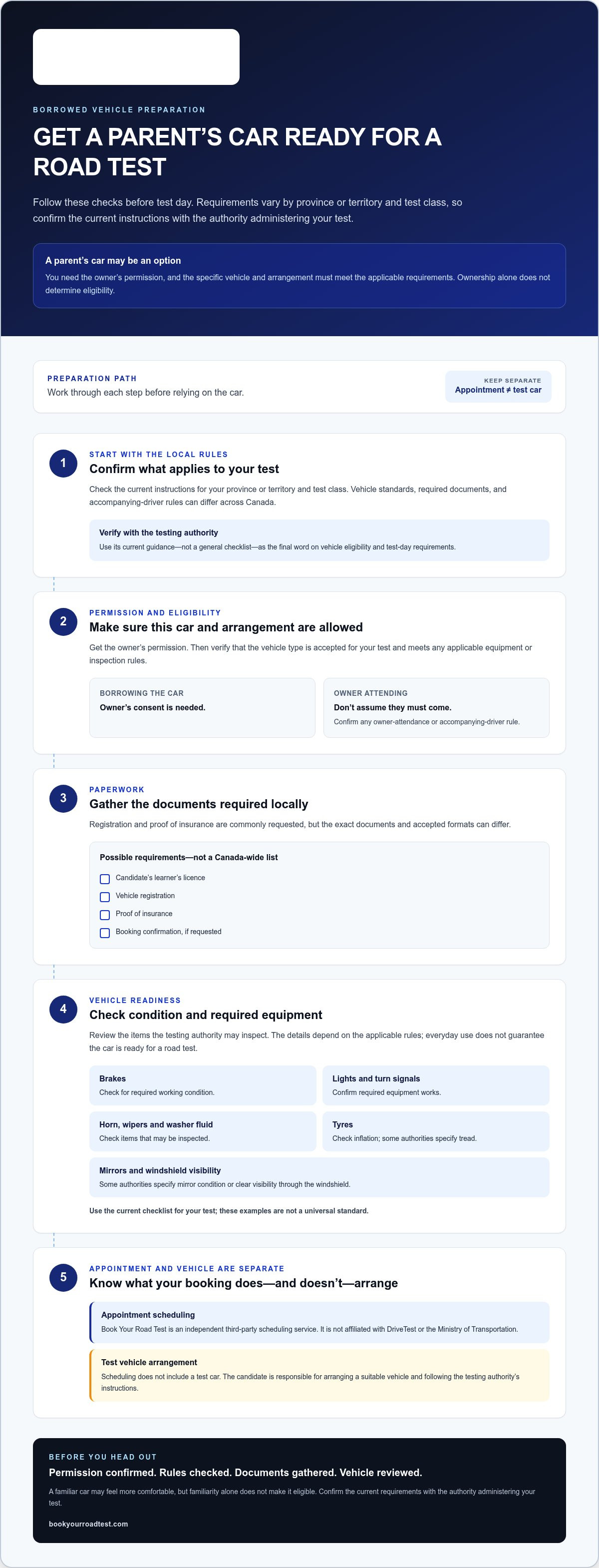
How to Get Your Parents’ Car Ready for Road-Test Day
A short preparation routine can help you catch paperwork gaps and vehicle problems before they disrupt your appointment. If you’re still asking, “can I use my parents' car for the road test,” use the steps below to confirm that the car is permitted and ready. Check the official requirements early rather than waiting until test day.
The day-before document and vehicle check
Start with your appointment details and the current vehicle checklist from the authority administering your test. Requirements vary, so don’t rely on a checklist from another jurisdiction or an old appointment. If anything is unclear, confirm it with the authority while there’s still time to make another plan.
- Confirm the rules. Check the vehicle requirements, required documents, and any instructions about the owner or accompanying driver.
- Get permission. Make sure your parent agrees to let you use the car for the test and that it will be available when needed.
- Gather documents. Collect the candidate’s licence and the vehicle documents required locally. Keep the appointment confirmation accessible if requested.
- Inspect the car. Use the official checklist to check the car’s condition and required safety equipment. Address obvious problems before setting out.
- Plan arrival. Confirm the test location and appointment time, then allow enough time to arrive without rushing.
A practice drive in the same car can help you get comfortable with its controls and handling. Arrange it beforehand and follow the restrictions on your licence. If you notice a problem, you’ll have more time to discuss it with the vehicle’s owner and address it before test day.
Avoiding common borrowed-car test-day problems
Don’t assume registration or insurance documents are unnecessary because the car belongs to a family member. The required paperwork depends on the jurisdiction, so check the official list and have the relevant documents ready. A car that’s driven regularly isn’t automatically suitable for a road test.
Separate what you can check yourself from what needs official confirmation. You can review appointment details, get the owner’s permission, gather available paperwork, and test the equipment listed on the authority’s checklist. The authority determines which documents and vehicle standards apply, including any eligibility conditions that may be less obvious. Resolve questions before the appointment where possible.
Quick checklist: Confirm the local rules, get permission, gather the required documents, inspect the car against the official checklist, practise in it if practical, and plan your arrival.
Once your vehicle plan is in place, arrange the appointment separately. Book Your Road Test is an independent third-party scheduling service and does not provide test vehicles. Arrange your road-test appointment while keeping responsibility for the car and its readiness in your own plan.
Book the Road Test Separately from Arranging the Car
A road-test appointment and a road-test vehicle are two separate arrangements. Booking a time doesn’t reserve a car, confirm that your parent’s vehicle is eligible, or replace the checks you need to complete before test day. If you’ve been asking, “can I use my parents' car for the road test,” keep your vehicle plan and appointment plan distinct: you’re responsible for arranging a suitable car, while scheduling assistance helps with the appointment itself.
What appointment-booking assistance does and does not do
Book Your Road Test is an independent third-party service that assists with scheduling G2, G, M2, and M road-test appointments at over 60 DriveTest centres. It is not affiliated with DriveTest or the Ministry of Transportation. The service also offers a cancellation finder that monitors the booking system for earlier openings.
The service handles appointment scheduling, not vehicle provision. You still need to arrange a car and make sure it meets the current requirements for your test. A booking doesn’t mean the testing authority has reviewed or approved your vehicle, documents, or permission to use it. Check those separately with the relevant authority.
There’s also a payment distinction to understand. The service charges an administration fee in addition to standard government test fees. Review the applicable information before completing a booking, and keep the government test fee distinct from the third-party service fee.
Choose your next step with the vehicle plan in place
Before test day, make sure the key parts of your plan are covered. Requirements differ across Canada, so verify the rules with the authority responsible for your test rather than relying on instructions intended for a different jurisdiction.
- Local rules: Confirm the current vehicle, document, and owner-attendance requirements for your jurisdiction and test class.
- Permission: Get the vehicle owner’s agreement to use the car for the road test.
- Documents: Gather the licence and vehicle paperwork required by the local authority.
- Vehicle condition: Check the car against the authority’s current safety and eligibility guidance.
Once you know how you’ll get to the test and have a suitable vehicle plan, you can focus on securing the appointment. Book Your Road Test assists with scheduling G2, G, M2, and M appointments. Booking support can help with the scheduling step; you remain responsible for bringing a compliant vehicle and following official test-day instructions.
Make Your Road-Test Plan Easy to Follow
Turn your preparation into a clear plan: know which car you’ll use, who has agreed to lend it, and what you still need to verify with your testing authority. If you’re still wondering, “can I use my parents' car for the road test,” confirm the details for your own test instead of relying on assumptions or advice from another jurisdiction. Arranging the appointment and getting the car ready are separate steps, and you can plan for each one.
Book Your Road Test assists with appointment scheduling and charges an administration fee in addition to government test fees. It’s an independent third-party service, not affiliated with DriveTest or the Ministry of Transportation. Booking an appointment is separate from arranging a compliant vehicle.
When you’re ready to book, schedule your road test with Book Your Road Test. With the vehicle plan and appointment handled separately, you can head into test day better prepared.
Frequently Asked Questions
Can I use my parents’ car for my road test in Canada?
Yes, you may be able to use a parent’s car if you have permission and it meets the requirements where you’re taking the test. Canada doesn’t have one nationwide vehicle checklist for every road test. Confirm the rules with the provincial or territorial authority responsible for your appointment, including any conditions tied to your licence class or vehicle type.
Does my parent have to come with me to the road test?
Not necessarily. Whether the vehicle owner must attend depends on the rules that apply to your test. Permission to borrow a car doesn’t automatically mean the owner must be present. Check the authority’s instructions for your test and distinguish any owner-attendance rule from a requirement for an eligible accompanying driver during your trip.
What documents do I need to bring when using someone else’s car?
Bring your required licence and the vehicle documents specified by the authority administering your test. The exact list can differ, so confirm which registration and insurance records are needed and whether digital copies are accepted. Before leaving, check that the paperwork belongs to the vehicle you’re bringing and is current. Keep your appointment details accessible as well.
Can I use a rental car for a road test?
Possibly, but don’t assume every rental can be used for a road test. The rental agreement may restrict who can drive the vehicle or how it may be used, while the testing authority may have separate eligibility rules. Review the terms and confirm the authority’s requirements before arranging the rental. If either set of rules excludes the car, plan another option.
What happens if the examiner says my car is not suitable?
The test may not go ahead if the vehicle fails the required inspection, and the consequences depend on the applicable rules. Confirm the cancellation, fee, and rescheduling policy for your test before test day so you understand what may happen if the car is found unsuitable.
Does the car need to be registered and insured for a road test?
Expect the vehicle to have valid registration and insurance, but confirm the exact requirements and accepted proof with your testing authority. These records relate to the car even if it belongs to a parent or someone else. Before travelling to the test, make sure you’re permitted to drive it under your licence conditions and the applicable insurance arrangements.
Can Book Your Road Test provide a car for my test?
No. Book Your Road Test is an independent third-party service that assists with road-test appointment scheduling; it does not provide vehicles. You’ll need to arrange a suitable car separately and ensure it meets the requirements for your test. The service isn’t affiliated with DriveTest or the Ministry of Transportation, and its administration fee is additional to government test fees.


