

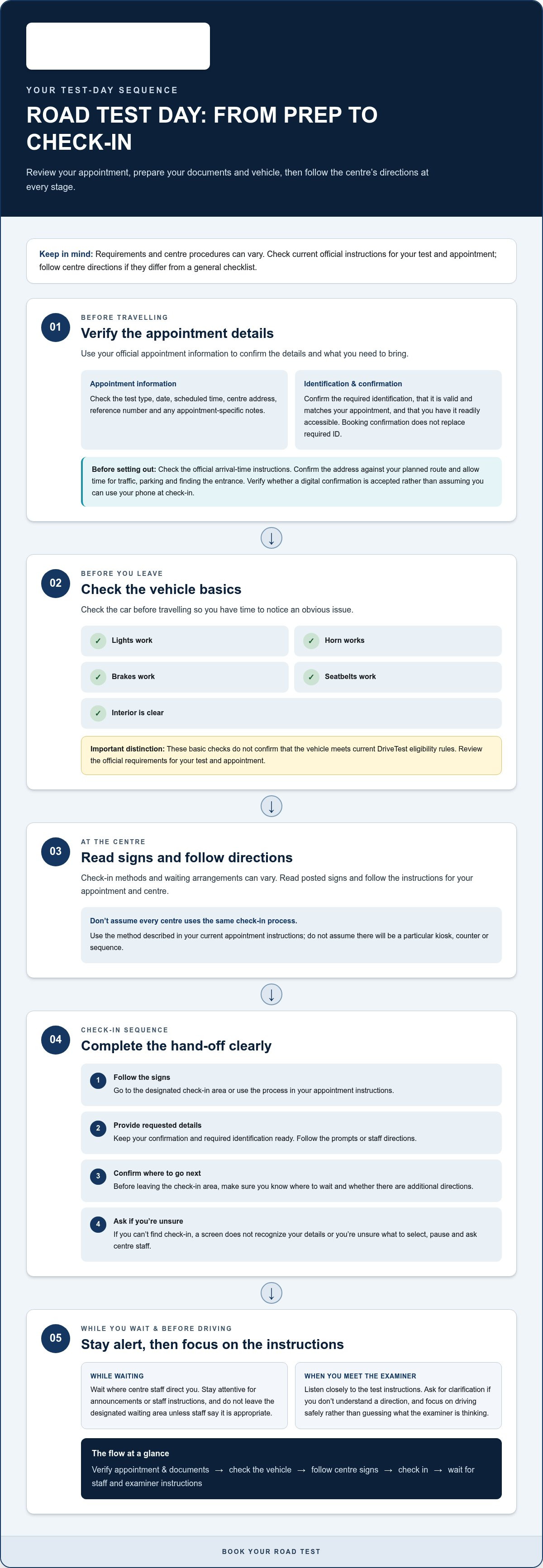
Your road test starts before the examiner gets in the car. If you’re wondering what to do when you get to the drivetest centre, review your appointment details, have your documents ready, and make sure your vehicle is road-test ready before you leave.
It’s normal to be unsure where to check in, what to show, or whether a vehicle issue could affect your appointment. The process is easier to manage when you know what to prepare and what to expect. Bring the identification and vehicle documents required for your test, along with your booking confirmation. At the centre, follow the check-in instructions and wait where staff direct you.
Before travelling, check that the lights, horn, brakes, and seatbelts work, and that the interior is clear. This checklist explains what to do before you go, how to check in, what to review about your vehicle, and what to expect after the test. It also covers what to do if you’re delayed, discover a missing document, or need another appointment, so you can focus on the drive instead of guessing about the process.
Key Takeaways
- Knowing what to do when you get to the drivetest centre starts with reviewing your appointment details and the latest official instructions before you leave.
- Follow posted directions and staff instructions so you know what to do at each stage of check-in.
- Separate basic vehicle checks from official eligibility requirements, and verify the current rules for your test.
- Listen carefully to the examiner, ask for clarification when needed, and focus on safe driving instead of trying to guess what they’re thinking.
- After the test, listen to the feedback and follow current official instructions for your result and next steps.
Before You Leave: The DriveTest Centre Documents and Details to Check
A quick review before you leave can help prevent avoidable surprises. DriveTest requirements may depend on your test and appointment, so read the current official instructions for your situation rather than relying only on a general checklist or an old confirmation email.
Which documents and appointment details should you have ready?
Check the official instructions to confirm which licence or identification you need for your test. Make sure it is valid, easy to access, and matches the details associated with your appointment. Your booking confirmation helps you verify the appointment, but it does not replace required identification.
Have your confirmation details ready in a format accepted by the centre. Check the date, scheduled time, centre location, test type, and any reference number or instructions included with the booking. If you’re unsure whether a digital copy is accepted, check current DriveTest guidance before travelling rather than assuming you can use your phone at check-in.
A practical road test is one part of the broader driving test process. This general overview provides background, but it does not set the requirements for your DriveTest appointment. Follow the official instructions for those details.
What should you check before travelling to the centre?
Confirm the centre address and appointment time using your official appointment information. Compare the location on your confirmation with your planned route, and check the official arrival-time requirement for your appointment. Allow enough time for traffic, parking, and finding the correct entrance.
Review any appointment-specific notes before setting out. Make sure you know what to bring and how to check in. If a detail has changed or your confirmation conflicts with current instructions, resolve the difference using official DriveTest information before you leave. That gives you time to address a missing item or clarify a requirement before reaching the centre.
Before leaving home, verify your test type, appointment time, centre address, required identification and documents, confirmation details, and official arrival-time instructions.
With these details in order, you’ll know what to do when you get to the DriveTest centre: follow posted directions, check in as instructed, and keep your appointment information accessible.
At the DriveTest Centre: Check In and Know What Happens Next
When you arrive, read the signs before deciding where to go. Check-in methods and waiting arrangements can vary, so follow the instructions for your appointment and any directions posted at the centre. If those directions differ from a general checklist, follow the centre’s instructions.
How do you check in for a road test?
Use the check-in method identified in the current instructions for your appointment. Keep your appointment details and required identification accessible, and present them when prompted by the process or a staff member. Do not assume every centre uses the same kiosk, counter, or sequence.
If a screen does not recognize your details, you’re unsure which option to select, or you can’t find the check-in point, pause and ask centre staff for help. Clarifying the process is better than guessing and missing an instruction.
- Follow the signs. Go to the designated check-in area or use the process described in your appointment instructions.
- Provide the requested details. Keep your confirmation and required identification ready, then follow the prompts or staff directions.
- Confirm what to do next. Before leaving the check-in area, make sure you know where to wait and whether you need to follow any additional directions.
- Stay attentive. Listen for announcements or instructions from staff, and respond promptly if you’re called or approached.
What happens while you wait for the examiner?
You may wait between check-in and meeting the examiner. The timing and hand-off process can vary, so follow the centre’s directions about where to wait and stay alert for announcements or staff instructions. Do not leave the designated waiting area unless staff tell you it’s appropriate.
Before the drive begins, the examiner will explain the test instructions. Listen closely and ask for clarification if you don’t understand a direction. You don’t need to guess what the examiner is thinking. Focus on the instructions you’re given and on driving safely.
Know who handles what: DriveTest administers the official road test and sets its centre procedures. Book Your Road Test is an independent third-party booking service, not affiliated with DriveTest or the Ontario Ministry of Transportation. Its booking support and cancellation finder are separate from the test itself.
If you need an appointment or are looking for an earlier opening, explore road test booking support. The service includes an additional administration fee.
Road-Test Vehicle Checklist: Confirm the Car Is Ready Before Check-In
A vehicle problem can disrupt test day, so check the car before travelling. These basic checks can help you spot obvious issues, but they do not confirm that a vehicle meets DriveTest’s current eligibility rules. Review the official requirements for your test type and appointment, and make sure your vehicle qualifies.
What should you check on the vehicle before the test?
Inspect the car in advance, not just after you reach the centre. Look for visible damage or warning lights that could signal a safety or operating problem. Make sure you can adjust the driver’s seat and mirrors, the seatbelt works, and nothing in the cabin blocks your view or interferes with the controls.
- Test the headlights, brake lights, turn signals, and horn.
- Check that the brakes respond normally and the steering feels controlled.
- Confirm the required seatbelts are present and working.
- Remove loose items that could move around or interfere with safe operation.
These practical checks are not a complete statement of official vehicle standards. Requirements may depend on the test and current DriveTest rules. Review those rules before appointment day, and address concerns early rather than assuming a vehicle will be accepted because it appears roadworthy.
What vehicle documents or arrangements may you need?
Review current official guidance for the vehicle documents and proof of insurance required for your road test. Confirm which documents apply to your situation, check that they’re current, and keep them accessible with your personal test documents. A general checklist does not replace the instructions for your appointment.
Plan your transportation in advance. A road-test appointment does not include a test vehicle, and Book Your Road Test does not provide one. You’re responsible for arriving with an eligible vehicle and any required vehicle documentation. If you’re using a borrowed vehicle, arrange access in advance and make sure you can bring the documents required under current DriveTest guidance.
Include the vehicle in your preparation for what to do when you get to the DriveTest centre: it should be ready before you set out, not just after you arrive. A failed light, an inoperative horn, or missing paperwork may create a problem at the centre. DriveTest’s current eligibility rules determine whether the vehicle can be used for the test.
Before travelling, check the vehicle’s basic condition and controls, confirm current eligibility standards, and verify the required insurance and vehicle documents. This gives you time to address an issue without relying on assumptions about what an examiner will accept.
When You Meet the Examiner: Listen, Ask Questions, and Follow Directions
Meeting the examiner is the hand-off from check-in to the practical test. A calm, respectful exchange can help you understand what happens next. You don’t need to anticipate every instruction. Focus on listening, asking for clarification when needed, and driving safely.
What should you do when the examiner approaches?
Respond politely and follow the examiner’s directions. There’s no special greeting or conversation you need to memorize. The examiner will explain the next steps and give instructions for the test. Listen carefully, including if you’re asked to complete a vehicle-related step before setting off.
If you don’t hear or understand something, say so before acting. Calmly ask the examiner to repeat or clarify a direction. Asking is better than guessing, especially before the vehicle is moving. Once you’re driving, keep your attention on the road and raise a concern only when it’s safe.
Following the examiner’s instructions helps you understand what’s expected at each stage.
What if you feel nervous or something is unclear?
Pause, listen to the full instruction, and then respond. If you feel flustered, take a moment before beginning the next step, as long as it’s safe and the examiner hasn’t directed you otherwise. Keep questions brief and specific. For example, say that you didn’t hear a direction rather than trying to interpret it from context.
If you have a practical concern before the test begins, explain it calmly and ask for clarification. The examiner can explain the instruction, but this process guidance is not driving coaching and cannot promise a particular result. Your task is to follow directions and demonstrate safe driving.
This is the final part of what to do when you get to the DriveTest centre: once you meet the examiner, shift your attention from appointment logistics to the instructions and the drive. Stay composed, communicate clearly, and avoid reading meaning into the examiner’s tone or expressions.
If you need to arrange a road-test appointment, book a road test through Book Your Road Test, an independent third-party service not affiliated with DriveTest or the Ontario Ministry of Transportation. Convenience services include an additional administration fee.
After the DriveTest: Understand the Result and Plan Your Next Step
The test doesn’t end as soon as the car stops. Listen to the examiner’s feedback, make sure you understand the result, and follow current official instructions for any licensing or documentation steps. If you’re unsure what to do next, ask for clarification before you leave instead of relying on assumptions or advice from another appointment.
What happens after you finish the road test?
The examiner will provide feedback and explain the outcome. Pay attention to any next steps they describe, and ask a concise question if an instruction or result isn’t clear. The administrative process can change, so use current DriveTest and Ontario licensing guidance for details about receiving or updating your licence.
If you pass, follow the official directions for the next stage of licensing. Current guidance states that successful candidates receive a temporary licence, with the permanent card mailed within four to six weeks. Confirm the process for your test and situation, including any instructions about documents or what you’re permitted to do while waiting for the card.
If you don’t pass, listen to the examiner’s feedback and note the areas to work on. You can arrange another road test, but a waiting period may apply. Check current booking and licensing procedures before choosing your next step. The examiner provides feedback on the test; arranging another appointment is separate.
What can you do if you need another or earlier appointment?
Use official booking channels to arrange a new appointment, and review current rescheduling rules before making changes. If you’re looking for an earlier date, a cancellation finder can monitor for openings, but an earlier appointment isn’t guaranteed. Keep any new confirmation details so you can prepare for the correct date and centre.
Book Your Road Test is an independent third-party scheduling service, not affiliated with DriveTest or the Ontario Ministry of Transportation. Its convenience services include an additional administration fee. If you need another appointment or want to search for an earlier opening, explore road test booking support.
Knowing what to do when you get to the DriveTest centre includes planning for after the drive. Take in the examiner’s feedback, follow official instructions, and handle any new booking separately from the test result.
Make Your Road-Test Day Easier With a Simple Plan
Knowing what to do when you get to the DriveTest centre starts with preparation: check your appointment details and current official instructions, bring the required documents, and make sure your vehicle meets current eligibility rules. At the centre, follow posted directions and staff instructions. When you meet the examiner, listen carefully, ask for clarification if needed, and focus on safe driving.
After the test, listen to the examiner’s feedback and follow official instructions for your result and next steps. If you still need to book a G2, G, M2, or M appointment, or want to look for an earlier date, the cancellation finder monitors for earlier openings.
Book Your Road Test is an independent third-party service, not affiliated with DriveTest or the Ontario Ministry of Transportation. Its convenience services include an additional administration fee. Explore road-test scheduling support.
Arrive prepared, take each step as it comes, and give yourself the best chance to approach test day with confidence.
Frequently Asked Questions
How early should I arrive at a DriveTest centre?
Arrive at least 30 minutes before your scheduled road test. That gives you time to find the centre, follow its check-in instructions, and be ready for the next steps. Check your appointment details and current official guidance before leaving, since instructions can vary by appointment or centre. If you’re unsure where to go after arriving, follow posted directions or ask centre staff for help.
What do I need to bring to a DriveTest road test?
Bring your valid driver’s licence, vehicle ownership permit, proof of insurance, and booking confirmation, either printed or on a mobile device. Check current official instructions for your test and appointment before leaving in case additional requirements apply. Keep the documents accessible, but remember that a booking confirmation does not replace required identification. Confirm the centre address and appointment time as part of your final check.
Can I use someone else’s car for my road test?
You may be able to use someone else’s car if it meets current DriveTest vehicle requirements and you have the required vehicle documents and insurance. Confirm the official eligibility rules for your test before appointment day. Arrange permission to use the car in advance, check that it’s in good working order, and make sure the required documents will be available.
What happens if I arrive late for my DriveTest appointment?
Contact DriveTest or follow the centre’s official instructions as soon as you realize you may be late. The outcome can depend on current policies and appointment circumstances, so don’t assume the test will still go ahead or that it will automatically be rescheduled. Ask staff what options apply. If you need to change an appointment, current guidance says cancellations or rescheduling must be made at least 48 hours ahead to avoid forfeiting the test fee.
Can I ask the examiner to repeat an instruction?
Yes. If you don’t hear or understand an instruction, politely ask the examiner to repeat or clarify it before acting. Listen to the full direction, then ask a brief, specific question if needed. During the drive, keep your attention on the road and raise a concern only when it’s safe. Knowing what to do when you get to the DriveTest centre includes communicating clearly instead of guessing at an instruction you missed.
What should I do if I fail my road test?
Listen to the examiner’s feedback and note the skills or decisions to work on before another attempt. You can book another test, but a waiting period may apply. Check current official licensing and booking instructions for the rules that apply to your test and situation before scheduling again. The examiner provides feedback, but arranging a new appointment is a separate step. Use the feedback to focus your preparation rather than rushing to rebook.
Is Book Your Road Test part of DriveTest?
No. Book Your Road Test is an independent third-party service and isn’t affiliated with DriveTest or the Ontario Ministry of Transportation. It offers scheduling support for G2, G, M2, and M road tests, plus a cancellation finder that monitors for earlier openings. These are convenience services, not official DriveTest services, and an additional administration fee applies. DriveTest remains responsible for administering the official road test and its centre procedures.


