

What if the safest response in a school or construction zone on your road test isn’t memorizing one speed, but noticing what’s changing around you? If you’re unsure when a posted limit applies or how to respond to pedestrians, workers and sudden traffic shifts, focus first on what the signs and road conditions show. School zone and construction zone rules for road test situations can vary by province or territory, so don’t rely on another driver’s experience as your guide.
This guide explains how to spot signs and changing conditions early, adjust your speed and position safely, and respond calmly during your test. You’ll learn practical habits for school-zone hazards, construction crews, lane changes and temporary traffic controls. Since posted limits and the conditions under which they apply vary, use your jurisdiction’s current official driver handbook to confirm the local rules.
Review the rules for your province or territory before test day, then practise scanning ahead and responding deliberately. That preparation can help you focus on the road instead of trying to recall a rule at the last moment.
Key Takeaways
- Spot regulatory and temporary signs early, and distinguish posted speed limits from advisory speeds before responding.
- Use the same calm routine in both zones: scan ahead, assess hazards, adjust your speed, position safely and keep observing.
- Learn how school-zone and construction-zone hazards differ so you can respond to pedestrians, workers and changing lane controls.
- The school zone and construction zone rules for road test situations vary by jurisdiction, so check your current official driver handbook for local requirements.
- Practise a school-crossing approach and a temporary lane shift before test day, then plan enough time to arrive.
School and construction zones on a road test: why early observation matters
You don’t need to memorize one Canadian speed for every special zone. Look ahead, identify signs and hazards, and make safe choices based on the conditions in front of you. The school zone and construction zone rules for road test situations vary across provinces and territories, so learn the current requirements for the jurisdiction where you’ll be tested.
A school zone is an area marked for drivers to take particular care around a school and people travelling nearby. A construction zone is a section of road where work is underway or traffic is managed around roadwork. Signs identify these areas, but their legal meanings, speed limits and operating conditions can differ by location. There’s no single Canadian speed rule for every school or construction zone. Check your provincial or territorial authority’s current guidance rather than relying on a rule from another part of the country.
Posted legal limit means the maximum speed allowed where that sign applies; safe speed means a speed suited to current conditions, which may be lower. A posted limit doesn’t remove the need to respond to what you can see ahead. For general background on the purpose and use of speed limits, see Speed limits.
What makes school and construction zones different?
In a school zone, children may be difficult to see between parked vehicles, and pedestrians can approach intersections or marked crossings. Watch for people near the roadway, vehicles stopping or pulling away, and anything that limits your view. In a construction zone, workers, equipment, barriers and temporary lane shifts may change where traffic flows. Signs or lane-control devices can indicate an altered path or traffic pattern. Either zone may call for more than noticing the posted speed: you may need to ease off, increase your following distance or adjust your position safely.
What can a road test assess in these zones?
These areas let you demonstrate safe-driving behaviours such as looking ahead, recognizing signs, controlling speed and leaving enough space to respond. For example, noticing a lane shift early gives you time to check nearby traffic and follow the indicated route smoothly. A pedestrian near a crossing calls for extra caution even if the road is otherwise clear.
These are sound driving practices, not a guaranteed scoring rubric. Road-test criteria are set by the relevant licensing authority and may differ by jurisdiction. Review your current provincial or territorial driver handbook for official test requirements, and focus on making deliberate, observant decisions rather than guessing what an examiner expects.
How to read school-zone and construction-zone signs before acting
Read the road in layers, not just the sign immediately in front of you. Scan well ahead for regulatory signs, temporary warnings, pedestrians, workers, cones, barriers and lane-control devices. Before changing speed or position, check your mirrors and nearby traffic. Early observation gives you time to respond smoothly instead of braking or steering suddenly.
Identify the sign, check the surroundings, then adjust speed and position safely. A posted speed limit sets the maximum legal speed where it applies; an advisory speed recommends a speed for a particular feature or condition. Don’t assume a sign’s colour or wording has the same legal meaning everywhere in Canada. Check the current rules in your province or territory, and remember that poor visibility, congestion or a hazard may call for a speed below the posted maximum.
How should drivers respond to school-zone signs?
Look for signs that mark the start and end of a school zone, along with any posted limits, hours or other conditions. These details vary by jurisdiction, so don’t assume one province’s schedule applies elsewhere. The RCMP’s school zone speed limits page offers background, but the applicable provincial, territorial or local rules determine what applies where you’re driving.
As you approach, check for children near the road, crossing guards, school buses and parked cars that can block your view. Be ready for a pedestrian to emerge from behind a vehicle or for traffic to stop unexpectedly. If sightlines are limited, ease off early and leave room to respond.
How should drivers respond to construction-zone signs?
Construction-zone signs often provide advance warning before a lane closure, temporary speed sign, cones or barriers. Keep scanning as you proceed because the route may shift again, and equipment or workers may be close to the travel lane. Follow posted signs and directions from traffic-control personnel, including flaggers where present. Don’t make a last-second lane change just because the road looks different ahead.
Apply the school zone and construction zone rules for road test that fit your jurisdiction, and reassess as conditions change rather than relying on memory. Book Your Road Test provides third-party road-test booking assistance. Its convenience service has an administration fee in addition to standard government test fees.
School zone vs. construction zone: choose a safe response, not a memorized speed
Both zones call for careful, predictable driving, but the main risks differ. Near a school, focus on people who may enter the roadway. At road work, the lane or traffic pattern itself may change. Use the signs and conditions you can see to decide what to do, rather than relying on a memorized speed.
| Zone | Main hazards | Signs to notice | Safe driver response |
|---|---|---|---|
| School zone | Children, crossing pedestrians, vehicles entering or leaving driveways, and sightlines blocked by parked vehicles. | Signs marking the zone, crossings, school buses, and any posted limits or conditions. | Scan sidewalks, crossings and gaps between parked vehicles. Ease off smoothly and be ready to stop if someone approaches or enters a crossing. |
| Construction zone | Workers, equipment, barriers, narrowed lanes, merging traffic and temporary changes in the road layout. | Advance warnings, temporary signs, cones, lane-control devices and directions from flaggers where present. | Look ahead for the lane’s path, maintain a safe following distance and merge when there’s a safe opportunity. Follow posted signs and traffic-control directions without forcing another vehicle to yield. |
The comparison reflects a broader road-safety goal: protecting people while adapting to changing road conditions. The Canadian Council of Motor Transport Administrators outlines Canada's Road Safety Strategy, while the specific rules for special zones depend on the applicable jurisdiction.
What should drivers prioritize around schools?
Look beyond the road directly ahead. Check sidewalks, crossings and driveways, and notice where parked vehicles could hide a child or pedestrian. If someone is near a crossing, reduce speed in a controlled way and stay ready to stop. Avoid sharp braking or accelerating; smooth decisions give you and other road users more time to respond.
What should drivers prioritize around road work?
Watch for workers and equipment, and track how the lane position changes. If a lane narrows or merges, check the traffic around you, signal as appropriate and move into the available space without cutting off another driver. Leave extra following distance when visibility, congestion or a rough surface limits your ability to react. Keep your attention on signs and traffic, not distractions inside the vehicle.
For the school zone and construction zone rules for road test, the practical distinction is simple: look for people near schools and changing paths near work crews. In both settings, calm observation and controlled actions help you respond to the hazard in front of you.
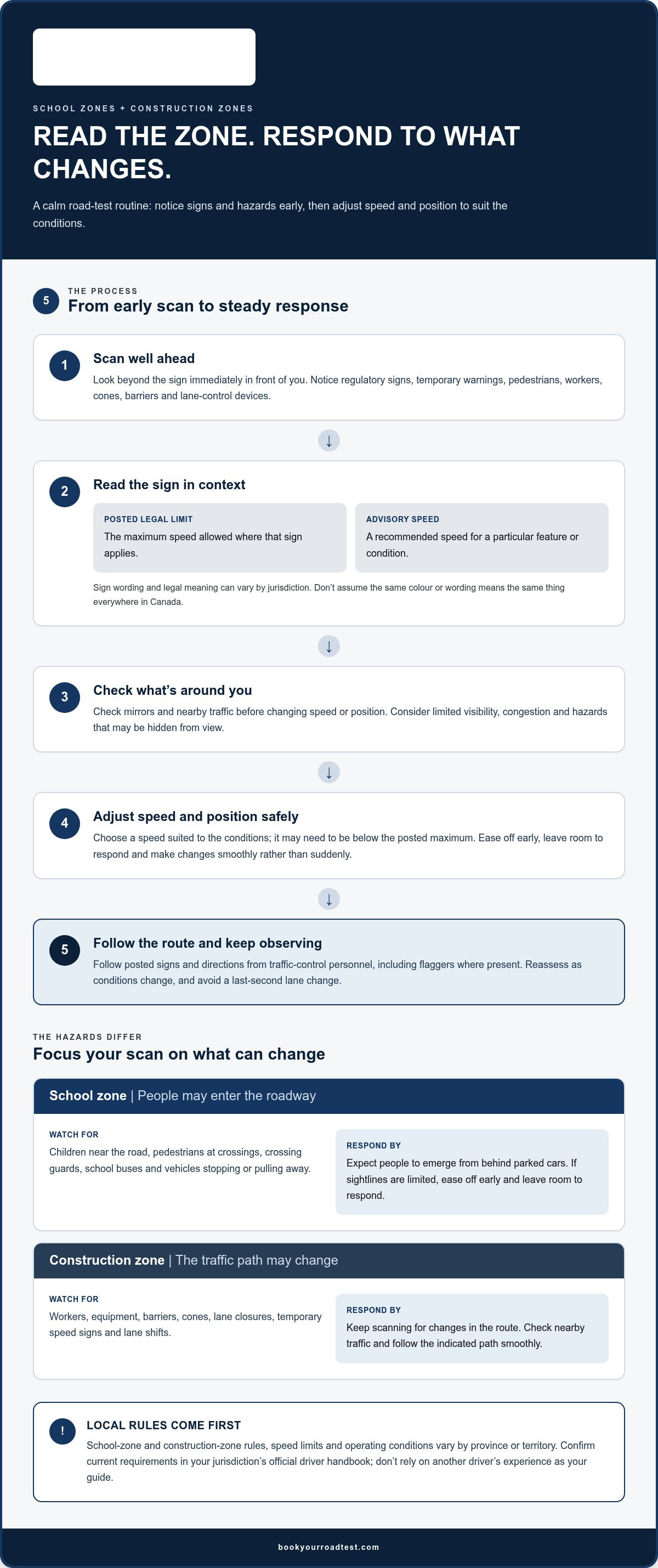
Road-test practice: a step-by-step routine for special zones
A steady routine can help you make decisions without rushing. Practise this sequence until it feels familiar, while still responding to the signs and road conditions you encounter:
- Scan ahead: Look beyond the vehicle in front for zone signs, crossings, workers and changes in the road.
- Identify signs: Read posted limits, warnings and temporary directions early.
- Assess hazards: Check for pedestrians, obstructed sightlines, equipment, barriers and traffic slowing ahead.
- Adjust speed: Slow smoothly when the sign or conditions call for it. Avoid abrupt braking.
- Position safely: Follow the lane markings and traffic directions, checking mirrors and blind spots before a move.
- Keep observing: Continue scanning because people, vehicles and work-zone layouts can change.
How can candidates practise school-zone awareness?
During supervised practice, try spotting school-zone signs before you reach them. Then scan sidewalks, crossings and gaps between parked cars for possible pedestrian movement. If someone is near a crossing, ease off and be ready to stop. You can cover the brake when appropriate, but don’t brake suddenly or unnecessarily. Review the current official driver handbook for local requirements, and use supervised practice to apply those rules on the road.
For example, if a parked vehicle blocks your view near a crossing, recognize the limited sightline early. Reduce speed smoothly and leave room to stop if a pedestrian appears.
How can candidates practise construction-zone decisions?
Look for temporary lane guidance well before cones or barriers begin, and keep a safe following distance so you have time to respond. Practise adjusting speed and lane position smoothly, checking mirrors and blind spots as appropriate. If a flagger or other traffic-control direction changes your route, stay attentive and follow the directions safely. Don’t force a merge or make a sudden move to catch a gap.
If you notice a sign or hazard late, prioritize safety over a rushed correction. Avoid sharp braking or swerving; maintain control, reassess the traffic around you and make the safest response available. If you can’t move safely into a lane, don’t force your way in.
This routine supports sound driving practice, but it doesn’t promise a particular road-test score. Official evaluation criteria can vary, so check your current provincial or territorial handbook.
Before test day: check local rules and plan your road-test booking
A short check before test day can replace last-minute guesswork with a clear plan. School-zone schedules, posted limits, sign meanings and construction traffic directions can vary by province, territory and local authority, so don’t rely on a number or rule you remember from somewhere else. Use the current official driver handbook and the applicable provincial or territorial authority as your references.
What should candidates verify before test day?
- Review local zone rules. Check how school-zone limits and operating periods are indicated, and what signs or directions apply in construction areas.
- Refresh test guidance. Read the current official handbook for your jurisdiction, including the road-test criteria published by its licensing authority.
- Practise observation. During supervised practice, look for zone signs, pedestrians, workers, lane changes and blocked sightlines early, then respond smoothly.
- Plan your arrival. Allow enough time to reach your test location without rushing. Keep your attention on traffic and posted requirements rather than trying to recall a memorized speed.
On test day, drive according to the signs and conditions you actually encounter. A limit that applies in one place or at one time may not apply in another. Poor visibility, a pedestrian near a crossing or a temporary lane shift may also call for a careful adjustment. The goal isn’t to predict every possible hazard, but to notice what’s developing and choose a safe, controlled response.
How does road-test booking assistance fit in?
Once you’re ready to schedule, Book Your Road Test provides independent third-party assistance with road-test bookings. It offers booking support for provincial graduated licensing stage road tests, along with a cancellation finder service that monitors for openings to help customers find earlier test dates. The service is not an official government licensing service and is not affiliated with any provincial ministry of transportation. An administration fee applies in addition to standard government test fees.
Booking support is separate from the safety advice in this guide. Keep using the current official handbook and applicable provincial or territorial authority for rules and test requirements, and rely on the signs and road conditions when you drive.
Prepare with confidence for your road test
Safe decisions in school and construction zones start with looking ahead. Scan for signs, people and changing traffic patterns, then adjust your speed and position to suit the conditions. Check the current official handbook and rules for your province or territory, since zone requirements aren’t identical across Canada.
The school zone and construction zone rules for road test are easier to apply when you practise a repeatable routine: observe early, assess the hazard and respond smoothly. If you spot a sign or change late, stay in control and prioritize a safe response over a rushed correction.
Ready to schedule your road test? Book Your Road Test offers booking assistance for G2, G, M2 and M road tests, as well as a cancellation finder service to monitor for earlier openings. It is an independent third-party service, not affiliated with the Ontario Ministry of Transportation or DriveTest. An administration fee applies in addition to standard government test fees.
Review your local guidance, keep practising attentive driving and approach test day one decision at a time. You can build confidence by focusing on what the road is telling you.
Frequently Asked Questions
Do school-zone speed limits apply during a road test?
Yes, follow the school-zone signs and rules that apply where your road test takes place. A road test doesn’t exempt you from posted limits or local conditions. Look for signs indicating where a zone begins, any applicable hours or conditions, and where it ends. Since requirements vary across Canada, review the current official driver handbook and local authority guidance before test day instead of relying on a memorized speed.
How should I drive through a construction zone on my road test?
Drive attentively, follow posted signs and traffic-control directions, and adjust smoothly to the road layout. Scan ahead for lane closures, cones, barriers, workers, equipment and merging traffic. Leave enough following distance to respond if vehicles slow or the route shifts. Check mirrors and blind spots before changing lanes, and don’t force a merge. Temporary work-zone layouts can change, so keep observing rather than assuming the road will stay the same.
Can I fail my road test for speeding in a school or construction zone?
Speeding or failing to respond safely to a zone could affect your road-test result, but the exact assessment criteria depend on the licensing authority and test circumstances. Don’t assume every situation leads to an automatic failure. Follow the applicable posted limit, reduce speed further if conditions call for it, and avoid abrupt corrections. Check your current provincial or territorial handbook for official test guidance rather than relying on informal accounts.
What should I do if a construction-zone sign appears suddenly?
Stay in control and avoid a sudden brake or swerve. Reduce speed smoothly if it’s safe, scan for the hazard and traffic around you, then follow the sign or traffic-control directions as soon as you can do so safely. Don’t make a rushed lane change or force your way into a gap. If you notice a sign late, prioritize a controlled response over trying to correct instantly.
Are school-zone rules the same across Canada?
No, school-zone rules can vary by province, territory and local authority. Sign meanings, speed limits and the times or conditions when a limit applies aren’t necessarily the same everywhere. Before your test, use the current official driver handbook and applicable provincial, territorial or local guidance for the test area. The same principle applies to construction zones: read the signs in front of you and follow the rules that apply there.
Should I drive below the posted speed limit in a school or construction zone?
Yes, if people, visibility, traffic or road conditions make a lower speed safer. A posted limit is not a target you must reach; it’s the maximum permitted where that limit applies. Slow down smoothly when hazards require it, while maintaining control and driving predictably. For example, a blocked sightline near a crossing or a narrow, changing work-zone lane may call for extra caution even when you’re already below the posted maximum.
Does Book Your Road Test provide driving lessons or road-test vehicles?
No. Book Your Road Test is an independent third-party service that helps with scheduling road tests; it doesn’t provide driving lessons, test vehicles or official licensing. It offers booking support for G2, G, M2 and M road tests, and isn’t affiliated with the Ontario Ministry of Transportation or DriveTest. An administration fee applies to its convenience services in addition to standard government test fees.


