

What if following the posted speed limit is actually the fastest way to fail your G2 road test? While it sounds counterintuitive, winter driving in Canada requires a shift from literal rule-following to what examiners call adjusted competence. We understand that the thought of navigating black ice or a sudden snow squall during your exam is incredibly stressful. You shouldn't have to guess whether to maintain 50 km/h during a storm or how to handle a skid while a professional evaluator marks your every move.
Our comprehensive 2026 checklist offers the specific tips for passing g2 test in winter that you need to stay calm and compliant. We'll show you how to master unique road hazards and prepare your vehicle to avoid an immediate disqualification before you even leave the parking lot. This guide breaks down the essential rules for winter road tests, explains how to manage weather-related cancellations, and provides a clear roadmap to help you earn your licence on the first attempt; regardless of the temperature outside. By the end of this article, you'll have the confidence to handle any conditions the season throws your way.
Key Takeaways
- Understand why driving below the posted speed limit is often a requirement for success when road conditions are poor.
- Ensure your vehicle meets exam standards by clearing all snow and ice from the roof and using winter-rated washer fluid.
- Master essential tips for passing g2 test in winter, including maintaining a six-second following distance and identifying obscured road signs.
- Discover how to demonstrate active observation through exaggerated head movements to account for limited visibility near snowbanks.
- Learn how to navigate weather-related test cancellations and use a cancellation finder to secure a new appointment quickly.
Understanding the Realities of a Winter G2 Road Test
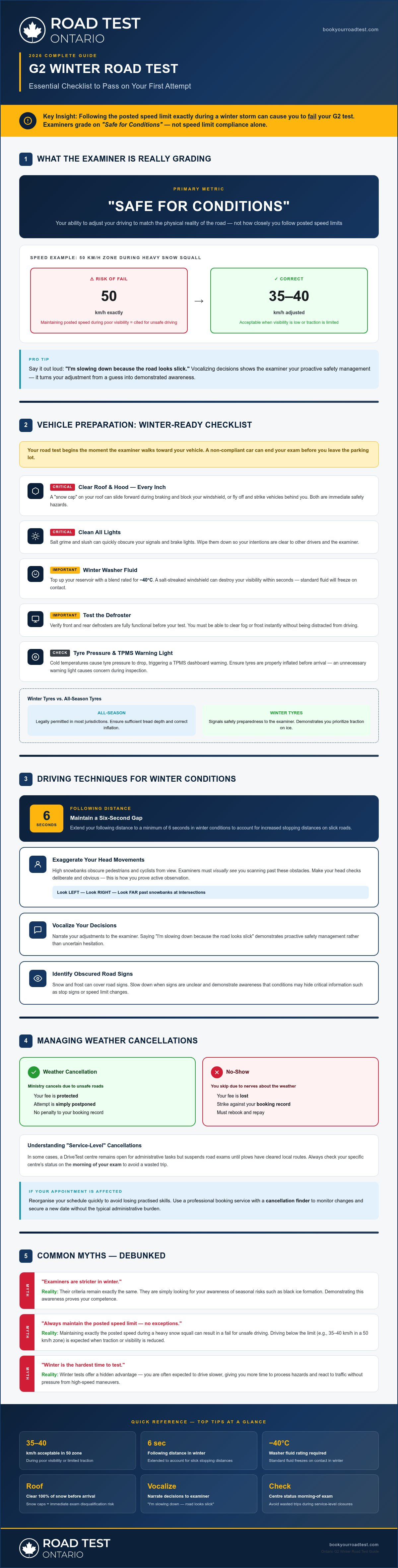
Success during a winter road test isn't measured by how closely you hug the speed limit. Instead, examiners focus on "Safe for Conditions" as the primary metric. This means your ability to adjust your driving to meet the physical reality of the asphalt. In many ways, a winter test offers a hidden advantage. You are often expected to drive slower, which gives you more time to process hazards and react to changing traffic patterns without the pressure of high-speed maneuvers.
One common myth is that examiners are stricter during the colder months. In reality, their criteria remain the same; they are simply looking for your awareness of seasonal risks like black ice formation and hazards. If you demonstrate that you can handle these variables, you prove you're a competent driver. It's also important to understand the financial side of weather events. A "weather cancellation" by the Ministry means your fee is protected and your attempt is simply postponed. Conversely, a "no-show" because you felt nervous about the flurries will result in a lost fee and a strike against your booking record.
The Examiner’s Priority: Safety Over Speed
If you are in a 50 km/h zone during a heavy snow squall, maintaining exactly 50 km/h might actually result in a fail for unsafe driving. Dropping to 40 km/h or even 35 km/h is acceptable when visibility is low or traction is limited. One of the best tips for passing g2 test in winter is to vocalize your choices. Telling the examiner, "I'm slowing down because the road looks slick," shows proactive safety management. You should also exaggerate your head movements. Examiners need to see you looking past high snowbanks for pedestrians or cyclists who might be obscured from view by the winter accumulation.
Will My Test Be Cancelled?
DriveTest centres follow standard protocols for closures during major snow events. If the roads are officially deemed unsafe, tests will be paused. You should check the status of your specific centre on the morning of your exam to avoid a wasted trip. Sometimes, centres implement "service-level" cancellations. In these cases, the office stays open for administrative tasks, but road exams are suspended until plows have cleared the local routes. If your appointment is affected by a storm, the priority is to re-organize your schedule quickly to ensure you don't lose the skills you've practiced. Using a professional booking service can help you monitor these changes and find a new date without the typical administrative headache.
Vehicle Preparation: The Winter-Ready Checklist
Your road test begins the moment the examiner walks toward your vehicle. If your car is encased in ice or lacks basic visibility, the exam could end before you even leave the parking lot. One of the most practical tips for passing g2 test in winter is to arrive early and perform a final sweep of your vehicle to ensure it meets the safety standards outlined in the official driver's handbook. Examiners have the authority to refuse a vehicle if they believe it poses a risk to themselves or the public.
Use this checklist to ensure your car is compliant:
- Clear the Roof and Hood: Remove every inch of snow. Leaving a "snow cap" on your roof is a major safety hazard, as it can slide forward during braking and block your view or fly off and hit vehicles behind you.
- Clean All Lights: Salt grime and slush can quickly obscure your signals and brake lights. Wipe them down so your intentions are clear to other drivers.
- Winter Washer Fluid: Ensure your reservoir is topped up with a blend rated for -40°C. A salt-streaked windshield can ruin your visibility in seconds.
- Test the Defroster: Verify that your front and rear defrosters are fully functional. You must be able to clear fog or frost quickly without being distracted from the road.
The Winter Tire Debate for Road Tests
A common point of confusion is whether winter tires are mandatory for the G2 test. Legally, all-season tires are permitted in most jurisdictions, but the practical reality is different. Winter tires demonstrate to your examiner that you prioritize safety and are prepared for black ice formation and hazards. If you choose to use all-seasons, ensure the tread depth is sufficient. Also, be aware that cold temperatures can cause your tire pressure to drop, which may trigger a TPMS warning light. Ensure your tires are properly inflated before you arrive so an unnecessary dashboard light doesn't cause concern during the inspection. If you are feeling overwhelmed by these technical requirements, you can book your G2 road test through a professional service that helps manage the administrative stress.
Visibility and Interior Comfort
Clear side windows are just as important as a clear windshield. During your blind-spot checks, you need an unobstructed view to see smaller vehicles or pedestrians. Inside the car, manage your temperature settings carefully. If the cabin is too warm, your windows may fog up. If this happens during the test, adjust the defroster immediately while keeping your eyes on the road. Finally, consider your footwear. While heavy winter boots are great for shovelling, they often lack the "pedal feel" required for the smooth braking and acceleration an examiner expects. Wear a pair of slim, comfortable shoes for the test and keep your boots in the trunk.
Driving Techniques for Snowy and Icy Roads
Driving on snow or ice requires a fundamental shift in your physical interaction with the car. One of the most critical tips for passing g2 test in winter is to expand your following distance significantly. While the standard dry-weather gap is two seconds, you must maintain at least a four-to-six-second buffer during winter conditions. This extra space provides the time needed for gradual deceleration. It prevents the wheels from locking up and keeps the vehicle stable. Applying these tips for passing g2 test in winter will demonstrate to your examiner that you possess the "adjusted competence" required for an Ontario licence.
Smoothness is your best friend during the exam. Abrupt movements are the most common cause of traction loss. You should apply the accelerator and brakes with deliberate, gentle pressure to avoid wheel spin or sliding. These techniques align with federal winter driving safety guidelines, which emphasize that slow and steady inputs are essential for maintaining control on slippery surfaces. Mastering the "slow-in, fast-out" approach is another vital skill. You should complete your braking while the wheels are still straight. Once you begin to turn, maintain a light, steady throttle. This keeps the weight of the car balanced and reduces the risk of understeer.
If the car does begin to skid, don't panic. Examiners look for a controlled recovery. Steer into the direction of the skid and avoid slamming on the brakes. Showing you can regain control safely is often more impressive than a perfect drive on dry pavement. It proves you can handle real-world hazards with composure and professional judgment.
Braking and Stopping Distances
Intersections are often the slickest parts of the road due to the heat from idling engines melting and refreezing snow. You must predict your stops much earlier than usual. Use the "creep and crawl" method when approaching stop lines. Slow down well in advance and let the car roll slowly to the final stopping point. If the painted stop line is buried under a snowbank, use the location of the stop sign or the edge of the sidewalk as your reference point. Stopping too far forward or back can result in a deduction, so you must stay observant of your surroundings at all times.
Lane Discipline and Changes
Snow often obscures painted lines, creating "invisible" lanes. In this scenario, follow the tracks of previous vehicles while maintaining a safe distance from the curb. Be wary of "lane drift" during turns. Slush can pull your tires outward, causing you to drift into the adjacent lane. When changing lanes, you will likely encounter a "slush ridge" between the paths. Cross this ridge with a firm grip on the wheel and a consistent speed. Avoid braking while crossing the slush; this can cause the car to pivot unexpectedly and lose alignment with the road.
Navigation and Observation: Passing the Eye Test
From an examiner's perspective, winter testing is less about your speed and more about your awareness. Evaluators are looking for visual proof that you've identified seasonal hazards before they become a problem. One of the most effective tips for passing g2 test in winter is to exaggerate your head movements. While a quick eye glance might suffice in the summer, winter requires a deliberate turn of the head. This shows the evaluator that you are actively scanning for black ice, obscured lane markings, and pedestrians hidden behind massive snowbanks. A 360-degree check is even more critical when visibility is compromised by falling snow or salt-streaked windows.
You must also be prepared for obscured infrastructure. If a stop sign or yield sign is covered in ice, you are still responsible for recognizing its shape and following the rule of the road. Maintaining a consistent space cushion is vital, especially when other drivers are being aggressive or tailgating. If you see a snowplow or salt truck, give them a wide berth. These vehicles have limited visibility and can throw salt or slush onto your windshield, which could momentarily blind you. Staying calm and showing you can navigate these distractions is a hallmark of a successful G2 candidate. If you are ready to put these skills to the test, you can book your G2 road test through our streamlined administrative platform today.
Pedestrian and Cyclist Awareness
Pedestrians are often more unpredictable during the winter months. They may have hoods up or scarves wrapped tightly, which limits their peripheral vision. They are also more likely to slip on icy sidewalks and fall into your path. You should apply the SIPDE method: Scan, Identify, Predict, Decide, and Execute. By predicting that a pedestrian might slip, you can decide to slow down early. Cyclists also need extra room. They often have to swerve to avoid frozen slush or ice patches; never pass them too closely on a narrowed, snow-lined street.
Intersections and Hidden Dangers
Intersections are high-risk zones during a winter road test. Even if you have a green light, you must perform a thorough left-centre-right scan before entering. Watch for "sliders," which are drivers on the cross-street who may not be able to stop in time for their red light. Another common challenge is the presence of high snow piles at corners. These piles can block your line of sight when you're trying to turn. In these cases, you must perform a "two-stage" stop: stop at the line first, then slowly creep forward until you can see past the snowbank to ensure the way is clear.
Managing Your Booking and Weather Delays
Winter weather in Ontario is notoriously volatile. If a major storm hits on your exam day, the Ministry of Transportation may decide to suspend road tests for safety. As an independent third-party booking service, we help you navigate these cancellations. When a test is officially cancelled due to weather, your exam fee is protected. You won't lose your money, and it won't count as a failed attempt. The Ministry simply converts your payment into a credit for a future booking. While this protects your wallet, it can disrupt your mental preparation and momentum. Re-organizing your schedule quickly is essential to ensure you don't let your skills go cold.
Interestingly, the winter season offers a unique tactical advantage for prepared drivers. While many people are afraid to drive in the snow and cancel their appointments, you can use this to your benefit. This creates a surge of last-minute openings that aren't available during the busy summer months. If you've studied our tips for passing g2 test in winter and feel confident, you can often secure a date much sooner than expected. It's about being proactive rather than waiting for the system to catch up with the backlog.
Recovering from a Cancelled Test
The moment you receive a cancellation notice, you should have a plan to get back on the schedule. Don't wait for the Ministry to contact you with a new date. Instead, use a road test cancellation finder ontario to identify immediate openings at your preferred centre. These tools are designed to spot cancellations as they happen, allowing you to jump back into the queue before the general public. You should remain test-ready during this period. Keep practising your winter manoeuvres so that when a slot opens up next week, you can accept it without hesitation.
Booking for Success
Strategic booking can significantly impact your test experience. We recommend avoiding the earliest morning slots when temperatures are at their lowest; this is the peak time for black ice. Similarly, late afternoon appointments can be difficult due to the low winter sun reflecting off white snow. Aim for a mid-morning slot between 10:30 AM and 1:30 PM. Road crews have usually cleared the main routes by this time, and visibility is at its peak. As an autonomous administrative provider, we help manage these logistical hurdles so you can focus on your driving. If you're prepared to handle the cold, Book your G2 road test today and take advantage of the shorter winter wait times.
Take the Wheel with Confidence This Winter
Earning your G2 licence during the coldest months is a significant achievement that demonstrates your ability to handle real-world Canadian driving conditions. By focusing on adjusted competence, you show examiners that you prioritize safety over the literal speed limit when the roads turn slick. Remember that proper vehicle preparation and exaggerated observation are your best tools for success. These tips for passing g2 test in winter ensure you are ready for the physical challenges of snow and ice, while our administrative tools handle the logistical stress of seasonal scheduling.
As an autonomous service provider, we help you navigate the complexities of the DriveTest system with transparency. Our platform is trusted by thousands of Canadian drivers and provides streamlined access to over 60 centres. We offer an automated cancellation finder to help you secure a new appointment quickly if a major storm causes a delay. Secure your winter G2 test date now with our easy booking service and move one step closer to your full licence. You have the skills and the right information, now it's time to show the examiner what you can do.
Frequently Asked Questions
Can I fail my G2 test for driving too slowly in the snow?
You won't fail for driving below the speed limit if the road conditions are hazardous. Examiners prioritize "safe for conditions" driving over literal limit-following. If visibility is low or the road is slushy, maintaining 40 km/h in a 50 km/h zone shows good judgment. It's helpful to vocalize your reasoning to the examiner. This ensures they understand you're being cautious rather than simply hesitant or unaware of the posted limit.
What happens if the road lines are not visible during my driving test?
When snow covers the painted lines, you should follow the tire tracks left by previous vehicles while maintaining a safe distance from the curb. Use external landmarks like stop signs, street lights, and the edge of the sidewalk to estimate your lane position. Examiners understand that infrastructure is frequently obscured in winter. They will judge you on your ability to maintain a logical and consistent path despite the lack of visible markings.
Do I need winter tires to pass my G2 road test in Ontario?
Ontario law does not mandate winter tires for a road test; however, using them provides a major practical advantage. They offer the traction needed to execute smooth turns and stops on hidden ice patches. If you use all-season tires, ensure they have deep tread and are properly inflated. Providing a well-equipped vehicle is one of the best tips for passing g2 test in winter because it builds immediate trust with your evaluator.
Will my road test be cancelled if it is snowing on the day of the exam?
Tests are only cancelled during severe weather events where road conditions are officially deemed unsafe for evaluation. If the plows haven't cleared the local routes or visibility is near zero, the centre may suspend road exams. If this happens, your fee remains as a credit on your account. You won't lose your money or your attempt. It is always best to check the status of your centre online before heading out in a storm.
How much extra following distance should I give during a winter road test?
You should increase your following distance to at least four to six seconds behind the lead vehicle. This is double the standard dry-weather requirement of two to three seconds. This extra space is necessary to account for significantly longer stopping distances on slippery asphalt. Demonstrating this expanded "space cushion" shows the examiner that you can predict hazards and react without needing to slam on your brakes, which is critical for stability.
What should I do if my car starts to skid during the G2 test?
If your vehicle begins to skid, you must demonstrate a controlled recovery by steering into the direction of the slide. Avoid the instinct to slam on the brakes, as this will lock the wheels and worsen the situation. Examiners don't necessarily fail you for a minor skid caused by road conditions. Instead, they evaluate how you handle it. A calm, professional recovery proves you are prepared for the unpredictable nature of Canadian winters.
Can I use a backup camera during my winter road test if my windows are frosty?
No, you cannot rely on a backup camera as a primary observation tool, and you definitely cannot use it as a substitute for clearing frost. You must remove all ice and snow from every window before the test begins. While you can glance at a camera, the examiner requires you to perform physical 360-degree checks and use your mirrors. Failing to clear your windows will result in an immediate disqualification for an unsafe vehicle.
How do I rebook my test quickly if it gets cancelled due to a storm?
The most efficient way to rebook after a weather washout is to use a professional cancellation finder. These services monitor the booking system for new openings that appear when other candidates reschedule. Since winter often leads to many last-minute changes, slots open up frequently. Following these tips for passing g2 test in winter includes staying "test-ready" so you can grab a newly available date and finish your licensing process without a long delay.


