

A mirror check can look thorough and still leave a vehicle, cyclist, or pedestrian hidden beside your car. If you’re searching for “how to properly check blind spots g2 test,” focus on knowing when a mirror check isn’t enough and making a brief shoulder check before you move.
Mirrors and shoulder checks serve different purposes. Mirrors help you monitor traffic around the vehicle, while a quick turn of your head lets you look into an area they may not show. Keep the movement deliberate and controlled, not rushed or so large that it affects your steering.
This guide explains when to check, where to look, and how to build a steady routine for lane changes, pulling away from the curb, and other movements. You’ll also learn how to make each observation useful while staying focused on the road and maintaining vehicle control.
Key Takeaways
- Mirrors and shoulder checks have different purposes. One does not replace the other.
- Use a consistent observation sequence before moving, and make each check relevant to the manoeuvre.
- Match your shoulder check to the direction you’re travelling, whether changing lanes or pulling away from the curb.
- Check close to the moment you move. An early check or mirror glance may not show how traffic has changed.
- Practise in a safe setting so your observations stay clear without disrupting vehicle control.
What Is a Blind Spot, and Why Does It Matter on Your G2 Test?
A blind spot is an area around a vehicle that you can’t adequately see using the mirrors. Mirrors show much of the space behind and beside the car, but may not reveal a vehicle, cyclist, or pedestrian travelling alongside it. A shoulder check adds a direct view of the relevant area when you’re preparing to move. For a basic overview of how these hidden areas occur, see this explanation of a vehicle blind spot.
On your G2 test, observation is part of driving safely, not a gesture to perform for its own sake. Before moving sideways or pulling away, check whether the space you intend to enter is clear, and maintain control of the vehicle as you look. Learning how to properly check blind spots g2 test situations starts with understanding what your mirrors can and can’t show.
Where are a car’s blind spots?
Blind spots commonly include areas beside and slightly behind the vehicle, near the rear corners. Their location and size vary with the vehicle’s design, your seating position, and the way the mirrors are adjusted. Well-positioned mirrors may show more of the adjacent lane, but don’t assume every vehicle has the same blind spots or that adjusting the mirrors removes them all.
For example, a car approaching from behind may appear in a side mirror, then disappear from its view as it draws level with your rear door. A brief shoulder check toward the side you plan to move into helps you see that changing area. Keep the check short so you can return your attention to the road ahead.
What does a blind-spot check show the examiner?
A well-timed check matches the manoeuvre: look toward the relevant side shortly before moving, then proceed only if it’s safe. A head turn aimed in the wrong direction, made too early, or unrelated to the movement won’t tell you whether the space you’re about to enter is clear.
The goal isn’t to exaggerate your movement or turn away from the road for too long. Make a controlled glance that lets you check the relevant area while maintaining vehicle control. Examiners can see your head movement, but there’s no need to assume that one missed check automatically determines a test result.
Mirrors and Shoulder Checks: How to See What Each One Misses
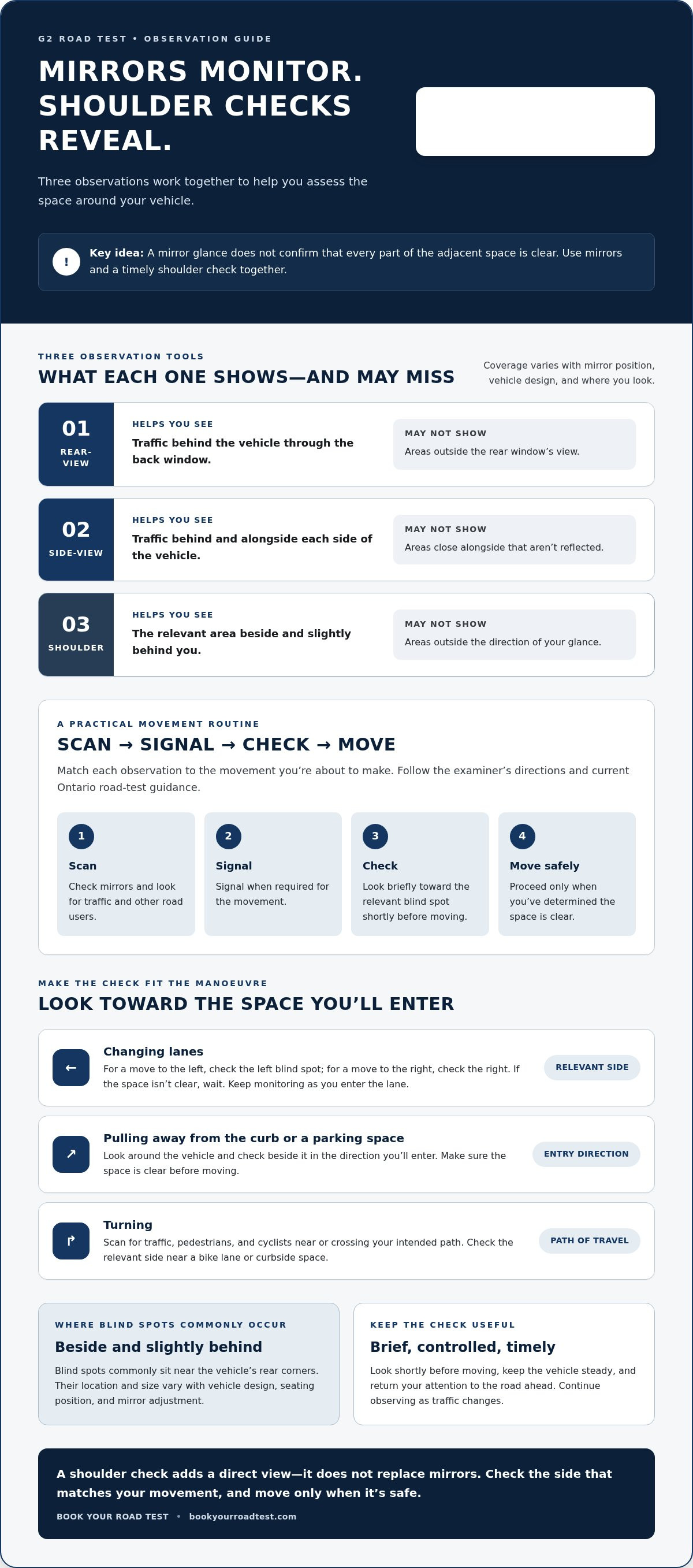
Each observation has a different purpose. Your rear-view mirror helps you monitor traffic behind the vehicle through the back window. Side-view mirrors show areas behind and alongside each side, but their coverage depends on their position and the vehicle's design. A shoulder check adds a direct view of the relevant area beside and slightly behind you. Use these observations together, not as alternatives.
| Observation | What it helps you see | What it may miss |
|---|---|---|
| Rear-view mirror | Traffic behind the vehicle | Areas outside the rear window's view |
| Side-view mirror | Traffic behind and beside the vehicle | Areas close alongside that aren't reflected |
| Shoulder check | The relevant area beside and slightly behind you | Areas outside the direction of your glance |
What can mirrors show, and what can they miss?
Adjust your mirrors before driving so they provide a useful view around the vehicle. Even well-adjusted mirrors can't show everything, and the visible area varies between vehicles. A car may be visible in a side mirror as it approaches, then move into an area the mirror doesn't cover as it draws alongside. A mirror glance is useful, but it doesn't confirm that every part of the adjacent space is clear.
How do you make a shoulder check safely?
Before moving toward another lane or away from the curb, glance briefly over your shoulder toward the space your vehicle will enter. Keep the vehicle steady, avoid holding your gaze away from the direction of travel, and promptly bring your attention back. Don't focus on a prescribed head angle or a fixed number of seconds. Look at the relevant area without losing control or awareness of what's ahead.
That's the practical distinction in how to properly check blind spots g2 test situations: mirrors help you monitor traffic, while a timely shoulder check looks into an area the mirrors may not reveal. When you're ready to arrange your test, Book Your Road Test provides independent third-party booking assistance and is unaffiliated with the Ministry of Transportation.
How to Check Blind Spots During G2 Test Manoeuvres
Make your observation fit the movement you’re about to make. A lane change to the left calls for a check on the left. Pulling away from the curb calls for attention to the space beside the vehicle and the direction you’ll enter. A practical sequence is to scan, signal when required, check the relevant blind spot, and move only when you’ve determined it’s safe. Keep observing as the situation changes.
Use this as a routine, not as a claim that every manoeuvre has an identical test procedure. Follow the examiner’s directions and current Ontario road-test guidance, and stay aware of other road users throughout the movement.
When changing lanes or turning
For a lane change, check the mirrors to assess traffic behind and alongside you. Signal when appropriate, then check the blind spot on the side you plan to move toward shortly before changing lanes. If the space isn’t clear, wait. Continue monitoring traffic as you enter the lane, since a single glance can’t account for a vehicle that moves into the space afterward.
Turns also call for observations that match the vehicle’s path. Before turning, scan for traffic, pedestrians, and cyclists near or crossing your intended path. If you may cross or travel alongside a bike lane or curbside space, check the relevant side before turning. A check in one direction doesn’t cover hazards on the other side.
When pulling away, parking, or reversing
Before pulling away from a curb or parking space, look around the vehicle and check the blind spot on the side you’ll enter. Signal when required, then move only when the path is clear. During parking and other low-speed manoeuvres, keep scanning for nearby people and vehicles as your car’s position changes.
Reversing calls for ongoing observation, not just one shoulder check before the car moves. Look in the direction of travel and use mirrors and direct checks to monitor the space around the vehicle. Move slowly, maintain control, and stop if you can’t confirm the path is clear. Check again before resuming.
To practise how to properly check blind spots g2 test manoeuvres, quietly say the sequence as you rehearse: scan, signal if needed, check the relevant space, move only when safe. Then adapt it to the direction and risks of each movement. The aim is deliberate observation that supports safe control, not a hurried or mechanical head turn.
Blind-Spot Check Mistakes That Can Undermine Safe Observation
A blind-spot check should help you make a safe decision, not become an automatic gesture. A mirror glance alone may not show the full adjacent area. A check made too early may miss traffic that has moved since you looked. Timing matters: observe the relevant space shortly before you move, then proceed only if it’s clear.
Is a mirror check enough for a G2 road test?
No. Mirrors provide useful information about traffic behind and beside you, but their view has limits. Before moving into an adjacent lane or pulling away from the curb, a shoulder check helps you see a vehicle, cyclist, or pedestrian the mirrors may not reveal. Keep scanning for other road users as you complete the movement. A shoulder check shows the area at that moment, not what may happen next.
A visible head turn by itself isn’t proof of effective observation. Direct the check toward the space your vehicle will enter and time it close enough to the movement to be useful. Rather than trying to predict how an examiner will score an individual action, focus on safe observation.
How can you avoid looking away for too long?
Make a brief, purposeful glance toward the relevant blind spot, then bring your attention back to the direction of travel. Don’t hold your gaze over your shoulder while the vehicle is moving, or turn so sharply that you lose control or awareness of what’s ahead. An oversized or repeated head movement can become distracting rather than more informative.
Practise in a safe, low-pressure setting with a qualified instructor or, where appropriate, an eligible supervising driver. Ask them to notice whether your check is aimed at the correct side and happens close to the movement. The goal of how to properly check blind spots g2 test preparation is consistent, situation-appropriate awareness, not a theatrical gesture meant to impress the examiner.
- Mirror-only check: Add a direct check when moving into an area the mirrors may not show.
- Check made too early: Recheck near the moment you’re ready to move.
- Prolonged or exaggerated turn: Keep the glance brief and maintain vehicle control.
- Automatic movement: Match the direction of your observation to the manoeuvre.
When you’re ready to arrange your G2 road test, book your G2 road test through Book Your Road Test, an independent third-party booking service unaffiliated with the Ministry of Transportation and DriveTest.
Practise a Consistent Blind-Spot Routine Before Your G2 Test
A calm routine makes observation part of each manoeuvre instead of something you have to remember at the last second. Practise in a safe, low-pressure setting with a qualified instructor or an eligible supervising driver, and follow their safety advice. Keep your attention on the road and the vehicle under your control.
A simple practice routine for observation
Before each practice manoeuvre, identify what you plan to do and which areas you need to observe. Then follow a consistent sequence: scan the surroundings, signal when appropriate, check the relevant blind spot shortly before moving, and proceed only when it’s safe.
- Lane change: Identify the direction, check the mirrors, signal as appropriate, then check the blind spot on that side before moving.
- Turn: Scan the path of the turn for traffic, pedestrians, and cyclists. Check the relevant side if another road user could be beside or crossing your route.
- Moving away from a stop: Check around the vehicle and toward the space you’ll enter before pulling out.
Repeat the routine in different situations, but don’t let it become a mechanical sequence detached from what’s happening around you. Ask your instructor or supervising driver whether your check is timely, aimed at the right area, and brief enough to maintain vehicle control. If you’re unsure, pause practice and follow their guidance before continuing.
What to remember on test day
Settle in, listen to the directions, and respond to the road situation in front of you. Make observations deliberate and relevant, not exaggerated for visibility or repeated automatically when the manoeuvre doesn’t call for them. Keep scanning as conditions change, and follow current official Ontario test instructions along with applicable safety guidance from your instructor.
Apply the same practical idea behind how to properly check blind spots g2 test preparation: look where your vehicle is about to go, check the relevant space at the right time, and move only when safe. Consistency comes from attentive practice, not from rushing through a memorized gesture.
Ready to arrange your G2 road test? Book your G2 road test through Book Your Road Test, an independent third-party service unaffiliated with the Ministry of Transportation or DriveTest. Its administration fee is separate from standard government test fees.
Build a Calm Routine, Then Get Ready for Test Day
Remember the essentials: mirrors and shoulder checks have different roles, your check should match the direction you plan to move, and a brief, timely observation is more useful than an exaggerated head turn. Practise until the routine feels consistent while keeping your attention on the road and maintaining control.
That’s the foundation of how to properly check blind spots g2 test situations. Respond to what’s happening around you, check the relevant space before moving, and proceed only when it’s safe.
When you’re ready, arrange your G2 road test booking through Book Your Road Test. The independent third-party service is unaffiliated with the Ministry of Transportation or DriveTest. Booking assistance covers more than 60 DriveTest centres, and the cancellation finder monitors for newly available road-test appointments. Any administration fee is separate from standard government test fees.
Stay calm, observe deliberately, and trust the routine you’ve practised. You’re ready to take the next step.
Frequently Asked Questions
How do you properly check blind spots during a G2 test?
Check the blind spot on the side your vehicle is about to move toward, shortly before moving. Scan the road and mirrors, signal when appropriate, then make a brief shoulder check while keeping the vehicle controlled. Move only when the space is clear, and continue watching for other road users. The key to how to properly check blind spots g2 test situations is matching the observation to the manoeuvre instead of turning your head automatically.
Do I need to shoulder check every time I turn on a G2 test?
No. A shoulder check isn’t automatically needed for every turn. Check the relevant side whenever the manoeuvre could take you into an area your mirrors don’t fully show, or when a cyclist, vehicle, or pedestrian could be beside or crossing your path. Keep scanning in all directions that matter to the turn. Respond to the road situation rather than repeating the same head movement regardless of context.
Are mirrors enough to check blind spots on a road test?
No. Rear-view and side-view mirrors provide useful views of traffic behind and alongside your vehicle, but their coverage is limited by mirror adjustment and vehicle design. Before moving into an adjacent lane or pulling away from a curb, a brief shoulder check can help you see an area the mirrors may not reveal. Use mirrors and direct observation together, then proceed only when you’ve determined the intended space is clear.
When should I check my blind spot when changing lanes?
Check the blind spot on the side you plan to move toward shortly before changing lanes. Scan your mirrors first to assess traffic, signal when appropriate, then make a brief shoulder check and move only if the lane is clear. Don’t rely on an observation made well before you’re ready to move, since traffic can change position. Keep monitoring the road as you enter the lane, because one glance can’t show what happens afterward.
Should I check blind spots when reversing or parking?
Yes. Check around the vehicle before reversing or beginning a parking manoeuvre, and keep observing as the vehicle moves. Use mirrors and direct checks to monitor the area around the car, including for pedestrians or other vehicles. Don’t rely on a single glance before reversing; the view and nearby hazards can change as your position changes. Move slowly, stay in control, and stop if you can’t confirm your path is clear.
Can I fail my G2 test for not checking a blind spot?
Missing a blind-spot check can leave an important area unobserved and make a manoeuvre unsafe, but don’t assume that one missed check automatically determines your test result. Test outcomes depend on the examiner’s assessment of your driving as a whole. Focus on making timely, relevant checks before moving, while following the examiner’s directions and maintaining safe vehicle control.
How can I practise blind-spot checks before my G2 road test?
Practise in a safe, low-pressure setting with a qualified instructor or an eligible supervising driver. Before each lane change, turn, or move away from a stop, identify the intended movement, scan the surroundings, signal when appropriate, and check the relevant blind spot. Ask for feedback on your timing and vehicle control. Repeat the routine until it’s consistent, but stay responsive to each situation instead of making checks mechanically.


