

What if the key to how to handle intersections on G2 test day isn’t memorizing a route, but using the same calm routine each time? As you approach, it’s easy to worry about missing a sign, overlooking a pedestrian or choosing the wrong moment to turn. A clear process helps you stay focused and make safe decisions.
If intersections make you nervous, you’re not alone. Right-of-way, complete stops and turning decisions can feel like a lot to manage while an examiner is watching. Practise these skills in a consistent sequence instead of trying to guess what the examiner expects.
This guide explains how to scan, decide and proceed at common Ontario intersections. You’ll learn what to look for at stop signs, traffic lights and uncontrolled intersections, how to handle turns and pedestrians, and how to practise before your G2 road test.
Key Takeaways
- Use a repeatable scan, decide and proceed routine instead of memorizing a route.
- Adjust your speed as you approach, then read the signs, signals, pedestrians and traffic before choosing your next move.
- Practise a clear observation-and-action process at stop signs, traffic lights and while turning.
- Build confidence by using the same checklist at a variety of intersections with supervision.
- On test day, listen, observe and act safely. Don’t make an unsafe or illegal move to try to match what you think the examiner expects.
G2 Test Intersections: Skills Examiners Look For
Feeling nervous at an unfamiliar intersection is normal. A repeatable routine makes it easier to respond when signs, traffic or the layout change. The core of how to handle intersections on g2 test day is straightforward: observe what’s around you, choose a legal action and move only when it’s safe.
A safe approach means noticing controls and other road users early, following the rules that apply, and keeping your vehicle under control. Intersections can have different layouts and controls, including turn lanes, stop signs and traffic signals. This overview of different types of intersections provides background, while the Ontario Driver’s Handbook is the reference for Ontario road rules.
What the examiner can observe at an intersection
An examiner can observe whether you adjust your speed, check signs and signals, position your vehicle for the intended movement, and proceed with control. They can also see whether you look for pedestrians, cyclists and approaching vehicles before acting. These are visible signs of attention and decision-making, not a secret sequence of head movements.
Look deliberately, but keep your movements natural. Each check should help you see a relevant area. A rushed glance can miss something, while exaggerated movements can distract you from controlling the vehicle. Start observing early enough to make a considered choice instead of reacting at the last moment. The priority is safe, legal driving throughout the test, not following a memorized set of head movements.
A simple scan, decide and proceed routine
Use the same three steps as you approach an intersection. They provide a practical framework without relying on a memorized test route.
- Scan: Look for signs, signals and lane markings. Check the intersection and nearby areas for pedestrians, cyclists and approaching traffic.
- Decide: Identify what the controls and road conditions require. Choose whether to stop, yield, turn or continue, and position your vehicle for that action.
- Proceed: Move only when the manoeuvre is legal and your path is clear. Keep control as you enter and travel through the intersection, while continuing to watch for other road users.
If something changes while you’re assessing the situation, pause and reassess rather than forcing a move. This routine won’t predict every intersection, but it gives you a consistent way to read each one and respond safely.
Approach, Stop and Read the Intersection Before You Move
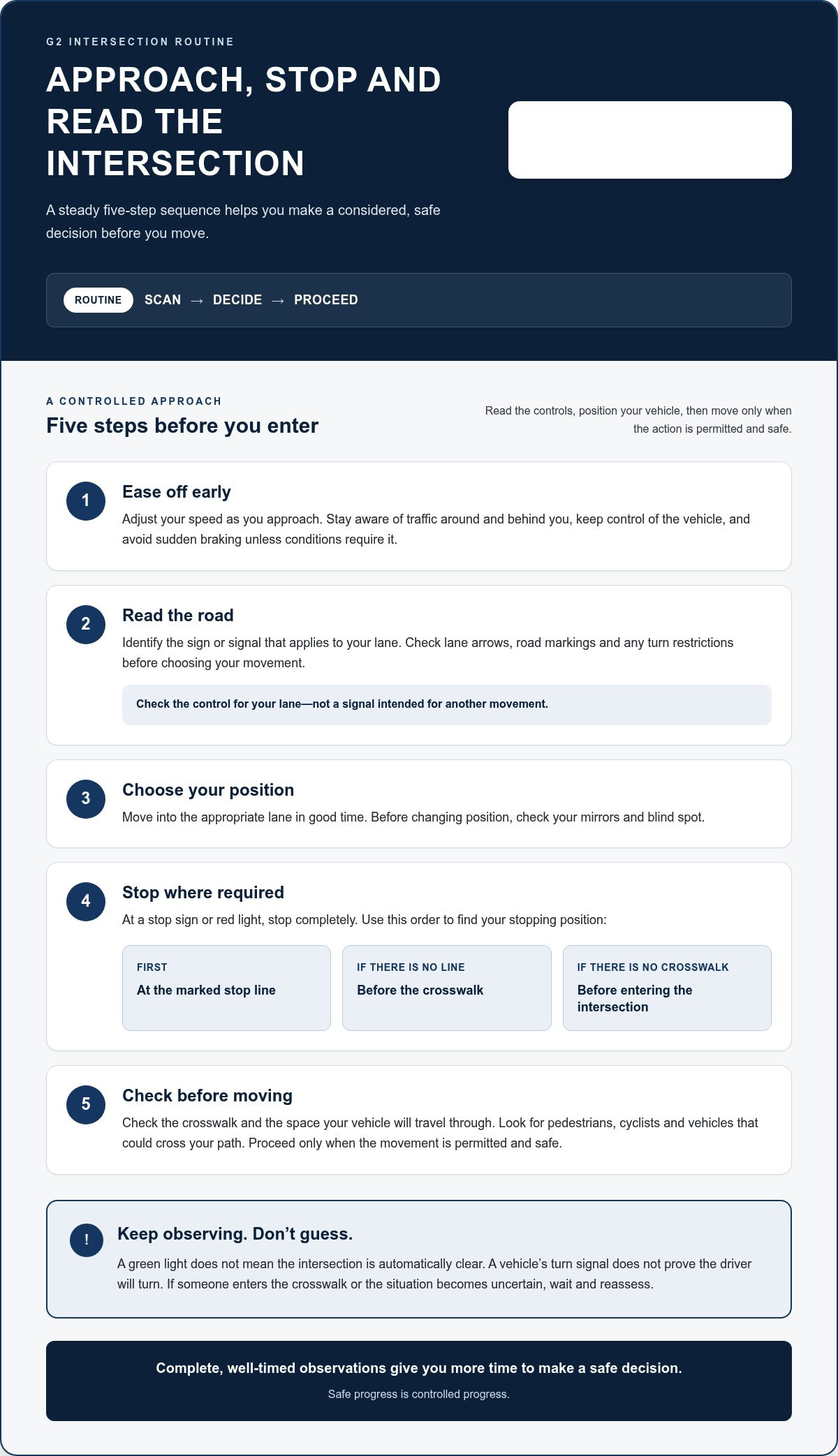
A controlled approach gives you time to understand what the intersection requires before you reach it. Practise this sequence until it feels steady, even when the layout changes. It’s a practical part of learning how to handle intersections on g2 test day.
- Ease off early. Adjust your speed as you approach while staying aware of traffic around and behind you. Keep control of the vehicle and avoid sudden braking unless conditions require it.
- Read the road. Identify the sign or signal that applies to your lane, along with lane arrows, road markings and turn restrictions.
- Choose your position. Move into the appropriate lane in good time. Check your mirrors and blind spot before changing position.
- Stop where required. At a stop sign or red light, stop completely at the marked stop line. If there isn’t one, stop before the crosswalk. If there’s no crosswalk, stop before entering the intersection.
- Check before moving. Look for people and vehicles that could cross your path. Proceed only when the movement is permitted and safe.
Complete, well-timed observations give you more time to make a safe decision. Hurried checks can leave important parts of the intersection unseen.
Read the controls and markings that apply to you
Make sure you’re reading the signal for your lane, not one intended for another movement. Check lane arrows and signs before committing to a turn. A posted restriction may prohibit a turn even when the signal allows other traffic to move. A green light doesn’t mean the intersection is automatically clear. Use the Ontario Driver’s Handbook to review current provincial rules and guidance on signs, signals and stopping positions.
Check the path, not just the signal
Before proceeding, check the crosswalk and the space your vehicle will travel through. Look for pedestrians, cyclists and vehicles approaching from directions that could intersect with your path. A vehicle’s turn signal can provide useful information, but it doesn’t prove the driver will turn. Keep observing rather than relying on one glance.
Before turning or changing position, make the appropriate mirror and blind-spot checks. If someone enters the crosswalk or traffic makes the situation uncertain, wait and reassess. Safe progress is controlled progress.
Once you’ve practised these approach habits, you can arrange your G2 road test booking through Book Your Road Test. The independent third-party service manages bookings and charges an administration fee. It isn’t affiliated with the Ontario Ministry of Transportation.
Handle Turns, Stop Signs and Traffic Lights Without Guesswork
Intersection decisions depend on the controls, the people and vehicles around you, and the direction you intend to travel. Review the Ontario Driver’s Handbook, then practise applying the rules to real situations. The aim isn’t to move instantly or wait indefinitely. It’s to make a calm, legal choice and proceed when it’s safe.
| Situation | Observe | Decision | Safe next action |
|---|---|---|---|
| Left turn | Oncoming traffic, pedestrians, cyclists, turn signals and lane markings. | Yield to oncoming traffic and pedestrians with the right-of-way. Check that the turn is permitted. | Turn from the appropriate lane when the path is clear, keeping the vehicle controlled throughout the turn. |
| Right turn | Crosswalk, cyclists beside the vehicle, traffic and signs restricting the turn. | Check that turning is allowed and yield to people or traffic with the right-of-way. | Turn only when the path is clear, watching for road users who may be less visible. |
| Stop sign | Stop line, crosswalk, pedestrians and traffic approaching from other directions. | Stop completely, then determine who has the right-of-way. | Proceed when permitted and safe. Don’t roll forward without checking again. |
| Traffic light | The signal for your lane, any turn arrow, the crosswalk and the intersection ahead. | Follow the signal and any signs. A green light doesn’t mean the path is automatically clear. | Enter only when the movement is allowed and there’s room to proceed safely. |
Make turns with a clear view of your path
Signal in good time and move into the correct lane when it’s safe. Before turning, check your mirrors and the relevant blind spot, then scan the direction you’ll travel. For a left turn on a solid green light, yield to oncoming traffic and pedestrians with the right-of-way. A green arrow permits movement in the arrow’s direction, but you still need to check that the way is clear. In Ontario, you may turn right on a red light after coming to a complete stop, unless a sign prohibits it. Yield before turning.
Respond to stops and changing lights calmly
At a stop sign, come to a complete stop before assessing the intersection. At an all-way stop, proceed according to who arrived first. If vehicles arrive at the same time, follow the applicable right-of-way rules. Don’t assume another driver will follow through just because they signalled. A signal doesn’t guarantee their next move.
If a light turns yellow as you approach, stop if you can do so safely. Don’t accelerate to beat the red, and don’t brake abruptly if stopping would be unsafe. Route expectations aren’t rules: use the signs, signals and actual traffic conditions to guide your decision. This is the practical core of how to handle intersections on g2 test day: stay observant, follow Ontario rules and avoid rushed moves as well as unnecessary hesitation.
Practise G2 Test Intersections With a Repeatable Checklist
Practise at varied intersections rather than learning one route by heart. A familiar route can build comfort, but the goal is to recognize controls, assess traffic and choose a safe action even when the layout changes. Use this checklist after each intersection, ideally once the vehicle is safely stopped and you can discuss the drive without distraction.
A checklist for every intersection
- Controls: Did you identify the sign or signal for your lane, along with lane arrows, turn restrictions and stop lines?
- People and traffic: Did you check crosswalks, cyclists, approaching vehicles and anyone who could cross your intended path?
- Speed and position: Did you adjust your speed early, choose the appropriate lane and stop in the right place when required?
- Before the manoeuvre: Did you signal as needed and check your mirrors and relevant blind spot before turning or changing position?
- Decision: Did you proceed only after confirming the movement was permitted and the path was clear?
Ask your supervising driver for specific feedback, such as “you checked the crosswalk before turning” or “you spotted the lane arrow early.” Specific observations are more useful than a general “good job” because they show what to repeat or improve. To keep your attention on driving, agree that feedback will come after the intersection or once you’ve stopped safely, unless an immediate safety concern needs to be addressed.
Reset calmly after a missed turn or small mistake
A missed turn doesn’t require a sudden correction. Keep your lane and speed appropriate, continue along the safe route, and follow the next direction when you can do so legally. Don’t cut across a lane, stop unexpectedly or turn from the wrong position just to get back on course.
If you feel tense, take a steady breath and bring your attention back to the road. Notice the next sign or signal, check what other road users are doing, then decide on your next action. A safe, legal choice matters more than recovering a particular route or correcting an imperfect decision immediately. This is a useful reset when practising how to handle intersections on g2 test day scenarios: pause mentally, not in a place where stopping would be unsafe.
When you’re ready to schedule your G2 road test, arrange your G2 road test booking through Book Your Road Test, an independent third-party service that charges an administration fee and isn’t affiliated with DriveTest or the Ontario Ministry of Transportation.
On G2 Test Day, Stay Safe: Then Arrange Your Road Test
Test-day nerves can make an ordinary intersection feel like a high-pressure decision. Return to the routine you’ve practised: listen, observe, decide and act safely. You don’t need to predict an examiner’s preferred route or make a move just to avoid seeming hesitant. Safe, legal driving comes first.
A final intersection routine for test day
- Listen: Pay attention to the examiner’s direction. If you’re unsure what they asked, ask for clarification when it’s safe to do so.
- Observe: Approach at a controlled speed and identify the signs, signals, crossings and lane markings that apply to your lane.
- Decide: Choose a movement allowed by the controls and road rules. Check for pedestrians, cyclists and vehicles that could affect your path.
- Act safely: Proceed when the movement is permitted and the way is clear. If you’re uncertain, don’t make a sudden turn, stop or lane change. Reassess and follow the applicable rules and examiner’s directions safely.
That’s the practical answer to how to handle intersections on g2 test day: stay attentive, make a considered choice and keep your vehicle under control. One imperfect moment doesn’t mean you should stop paying attention to what comes next.
This guide is educational, not an official DriveTest scoring rubric, and it can’t guarantee a passing result. Use the Ontario Driver’s Handbook for current road rules, and build readiness through safe, supervised practice in varied situations.
Arrange your test when you’re ready
Booking is separate from learning to drive, so focus on practice and readiness first. When you’re ready to schedule, book your G2 road test through Book Your Road Test. The independent third-party booking service charges an administration fee and isn’t affiliated with the Ontario Ministry of Transportation or DriveTest.
Take Your Intersection Routine Into Test Day
Confidence comes from having a process you can repeat, not from knowing the test route. As you practise how to handle intersections on g2 test day, scan the signs, signals, lane markings and other road users. Choose a legal action and proceed only when it’s safe. Controlled speed, complete stops where required and calm decisions help you stay focused when an intersection feels unfamiliar.
If you miss a direction or make a safe but imperfect choice, don’t react abruptly. Keep driving safely and focus on the next decision. Your priority is following the rules and responding to the road, not guessing what the examiner expects.
Book Your Road Test is an independent third-party service that assists with bookings at more than 60 DriveTest centres and offers a cancellation finder that monitors for earlier openings. An administration fee applies, separate from standard government test fees. The service isn’t affiliated with the Ontario Ministry of Transportation or DriveTest.
Keep practising with care. Approach test day one intersection, one safe decision at a time.
Frequently Asked Questions
How should I approach an intersection on my G2 test?
Approach at a controlled speed and check the signs, signals, lane markings and activity around the intersection. Look for pedestrians, cyclists and vehicles that could cross your path. Decide whether you need to stop, yield, turn or continue, then act only when the movement is legal and safe. Keep scanning as you proceed, since conditions can change while you’re waiting or moving through the intersection.
What do examiners look for at intersections on a G2 test?
Examiners can observe whether you control your speed, position the vehicle appropriately, notice signs and signals, and check for people and traffic before moving. They assess how safely and consistently you respond to the situation, not whether you follow a memorized route or make exaggerated head movements. Show clear, purposeful observation, follow right-of-way rules and keep the vehicle under control through the manoeuvre.
Do I have to come to a complete stop at a stop sign?
Yes. Stop completely at the stop line, if there is one. If there isn’t, stop before the crosswalk. If neither is marked, stop before entering the intersection. After stopping, check for pedestrians and traffic, then proceed when you have the right-of-way and it’s safe. A slow roll isn’t a complete stop, even if the intersection appears clear.
Can I turn right on a red light during my G2 test?
In Ontario, you may turn right on a red light after coming to a complete stop, unless a sign prohibits the turn. Before moving, check for pedestrians and cyclists in the crosswalk and yield to traffic with the right-of-way. Make sure the way is clear and the turn is permitted. Don’t treat the red light as a simple pause before turning.
What should I do if the light turns yellow as I approach?
Stop if you can do so safely. If stopping would require abrupt or unsafe braking, proceed with caution and clear the intersection safely. Don’t speed up to beat the red, and don’t make a sudden stop without considering traffic behind you. Base your choice on the light, your distance from the intersection and road conditions, rather than trying to predict what the examiner expects.
How can I practise intersections before my G2 road test?
Practise with a qualified supervisor at a variety of intersections, including those controlled by stop signs and traffic lights. Use the same scan-and-decide routine each time, then review whether you noticed the controls, chose a suitable speed and position, checked for road users, and moved only when safe. Focus on making good decisions in different settings instead of memorizing one possible test route.
Will one mistake at an intersection automatically fail my G2 test?
Not every mistake automatically means you’ve failed, but a dangerous action or a serious failure to follow road rules can have significant consequences. The outcome depends on the nature of the mistake and the overall assessment of your driving. If you make a safe but imperfect choice, don’t react abruptly or dwell on it. Continue to observe, follow the rules and drive safely through the rest of the test.


