

You don't need a flawless drive to pass your Ontario road test. Most drivers assume examiners demand mechanical perfection, but scoring is actually designed to evaluate your overall behavioural safety patterns. If you're stressed about how are points deducted on g2 test evaluations and fear that one missed blind-spot check will sink your attempt, you're not alone. It's equally common to confuse score sheet marks with statutory demerit points, leading to unnecessary pre-test anxiety.
This guide clarifies the DriveTest scoring rubric so you understand exactly how examiners mark minor and major errors against the 30-point deduction limit. You'll learn which small technique slips can quietly accumulate into a failing grade, which specific actions trigger an automatic disqualification, and how to maintain the required 70 percent passing threshold. Here is a clear, practical breakdown of how your driving is measured before you sit behind the wheel.
Key Takeaways
- Road test marks are strictly internal DriveTest performance checks, not legal demerit points that follow your driving licence record.
- Understanding how are points deducted on g2 test scoring sheets reveals that repeating minor errors can cause a failure just as quickly as a major control slip.
- Statutory infractions, dangerous actions, and curb strikes trigger automatic disqualifications regardless of your cumulative point tally.
- Structured observation cycles, exaggerated mirror checks, and smooth speed regulation effectively safeguard your passing score margin.
- Mastering the evaluation criteria allows you to diagnose weak habits and prepare confidently before securing your upcoming road test appointment.
Demerit Points vs. Road Test Deductions: The Core Scoring Distinction
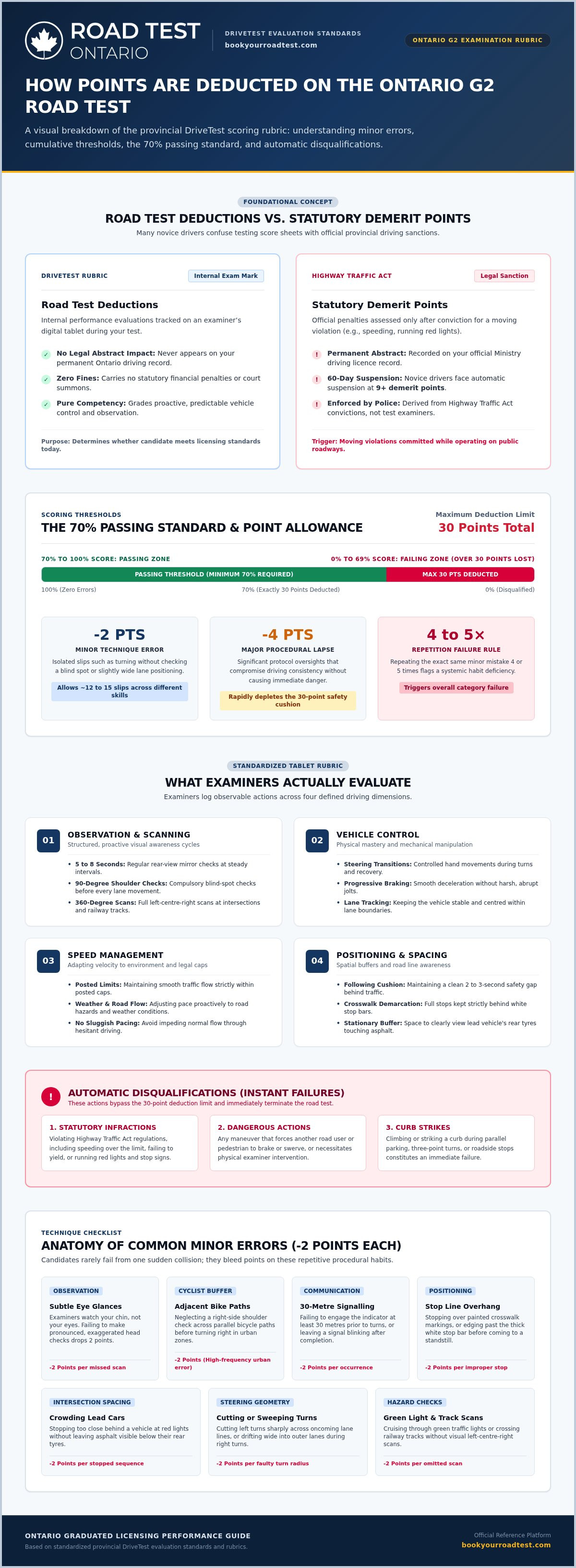
Novice drivers often confuse official driving record penalties with exam scoring. Demerit points are statutory sanctions assessed under the Highway Traffic Act only after a conviction for a moving violation, such as speeding or running a red light. For novice drivers operating under the graduated driver licensing framework in Ontario, accumulating nine or more demerit points results in an automatic 60-day licence suspension. Road test deductions, on the other hand, exist solely on your evaluation sheet. They measure procedural habits, carry zero legal fines, and never appear on your permanent driving abstract.
Understanding how are points deducted on g2 test evaluations requires seeing the process through an examiner's eyes. You aren't being evaluated to avoid police tickets; you're being graded on whether you demonstrate proactive, predictable vehicle control across everyday traffic situations.
What Examiners Actually Mark on the Official Evaluation Sheet
Licence examiners record your performance using a standardized digital rubric on a tablet. Rather than assigning arbitrary negative scores, the system tracks specific observable actions across four core evaluation categories:
- Observation: Regular mirror checks every five to eight seconds, blind-spot checks before lane movements, and full 360-degree scans at intersections.
- Vehicle Control: Smooth steering hand transitions, progressive braking, and appropriate lane tracking.
- Speed Management: Maintaining flow within posted limits according to road and weather conditions.
- Positioning: Proper following distances (a clean two-to-three-second cushion) and correct stopping positions behind crosswalk lines.
Each time you omit a required habit, such as turning without checking your blind spot, the examiner logs a deduction against that specific competency.
The Passing Grade: How Many Errors Are Permitted?
You don't need a spotless evaluation to earn your licence. The provincial testing standard requires a minimum overall score of 70 percent to pass. This framework permits up to 30 points in cumulative deductions. Minor technique errors typically cost two points each, while major procedural lapses deduct four points. This means an applicant can accumulate roughly 12 to 15 minor deductions across different skills and still succeed.
However, repeating the exact same minor mistake four or five times signals a systemic lack of control. If an examiner flags repeated failures to check blind spots before every right turn, those recurring deductions can trigger an overall category failure. The key to how are points deducted on g2 test rubrics is balance: isolated slips won't fail you, but repetitive procedural oversights will quickly deplete your passing margin.
Common Minor Errors: Where Drivers Routinely Lose Points
Most failed attempts don't happen because of sudden collisions. Instead, candidates slowly bleed points through basic operational oversights. When reviewing provincial DriveTest evaluation standards and pass rates, examiners consistently identify routine lapses in situational scanning, sluggish speed management, and poor vehicle positioning as the main drivers of test failures. Understanding how are points deducted on g2 test sheets helps you spot and correct these subtle bad habits during practice.
Observation Habits and Scanning Deficits
Examiners sit with their clipboards or tablets angled toward you, watching your chin rather than your eyes. Glancing subtly at a mirror isn't enough; you must demonstrate distinct, exaggerated head turns. Failing to scan railway tracks, omitting left-centre-right head movements when approaching green traffic lights, or neglecting a 90-degree shoulder check before altering lane positions costs two points per missed action. In urban environments, omitting a blind-spot check across adjacent bicycle paths before making a right turn represents an immediate, recurring observation penalty.
Intersection Stops, Turns, and Lane Placement
Approaching intersections requires strict adherence to spatial boundaries. Stopping over painted crosswalk lines or past the thick white stop bar leads to direct deductions. Once stationary behind another vehicle, you must leave enough space to see their rear tires touching the asphalt; crowding lead cars costs marks. During turns, sweeping wide into an outer lane or cutting left turns sharply across oncoming lane markings chips away at your score. Additionally, forgetting to signal 30 metres before a turn or leaving a blinker flashing after a lane change adds unnecessary deductions.
Parking and Low-Speed Manoeuvre Slip-Ups
Low-speed exercises present frequent opportunities for minor scoring errors. During parallel parking, three-point turns, and roadside stops, examiners grade control, observation, and mechanical technique:
- Kerb Contact: Lightly brushing rubber against the kerb is a minor handling penalty, though mounting the kerb will end the exam.
- Dry Steering: Turning the steering wheel while the vehicle is completely stationary causes unnecessary tyre wear and incurs marks.
- Hill Parking Alignments: Turning wheels toward the wrong side or failing to set the emergency parking brake costs two points.
Knowing how are points deducted on g2 test evaluations gives you the control to eliminate these small technical leaks. Once you feel confident running clean observation cycles and executing tight manoeuvres, you can use a G2 road test booking service to lock in an appointment slot that fits your schedule.
Immediate Failures vs. Cumulative Deductions: What Ends the Test
Every driver needs to understand the sharp boundary between a minor point penalty and an immediate disqualification. While understanding how are points deducted on g2 test rubrics helps you preserve your 30-point buffer, certain severe actions bypass numerical scoring entirely. If you commit an automatic failure, the examiner instructs you to return directly to the test centre. The evaluation halts on the spot, regardless of whether you previously kept a spotless score.
The provincial system categorizes driving errors into two distinct operational streams:
- Cumulative Technical Deductions: Minor observation omissions, late signals, or wide turns that subtract two or four points. These allow you to continue driving as long as your total deductions remain under the statutory threshold.
- Direct Disqualifications: Four statutory conditions that pose immediate safety hazards, break traffic statutes, or require emergency staff intervention.
Traffic Law Violations That Terminate the Test
Any direct breach of the Highway Traffic Act terminates the road test instantly. The most frequent infraction is rolling through a stop sign or making a right turn on red without achieving zero vehicle motion. You must bring the car to a full, settled halt behind the limit line before creeping forward for visibility. Exceeding the posted limit, particularly in 40 km/h residential zones, school areas, or community safety sectors, results in an instant disqualification. In accordance with standard road safety principles outlined in the CAA guide to graduated licensing requirements, examiners maintain zero tolerance for dangerous right-of-way errors, such as turning left across oncoming traffic or failing to yield to crossing pedestrians.
Dangerous Actions and Examiner Intervention
An automatic termination occurs whenever an examiner must intervene to prevent an incident. This applies if the evaluator physically grasps the steering wheel, taps a dual brake pedal, or shouts a verbal warning to avoid a collision. Forcing another motorist or cyclist to brake or swerve to avoid your car also counts as an immediate dangerous action.
Kerb contact is another area where many novices misjudge how are points deducted on g2 test score sheets. Gently brushing a tyre sidewall against concrete while parallel parking merely yields a minor manoeuvre deduction. However, mounting the kerb, jumping the concrete with a wheel, or striking a roadside barrier constitutes a loss of vehicle control, terminating your attempt immediately.
Tactical Preparation: How to Prevent Unnecessary Mark Deductions
Preventing mark deductions comes down to building conscious habits that withstand test-day nerves. When anxiety peaks, muscle memory takes over. If you haven't drilled the exact observational cadences examiners look for, your natural eye movements won't register on their tablets. Understanding how are points deducted on g2 test criteria enables you to implement proactive driving habits that protect your score from unforced slips.
One highly effective drill is commentary driving during your final practice hours. Speak your observations out loud: "Checking rear-view mirror before braking," "Scanning crosswalk left, centre, right," or "Shoulder checking right bicycle lane." This verbalisation forces active awareness, eliminates blind-spot lapses, and calms racing thoughts under pressure.
Developing Consistent Visual Routines
Examiners expect an unbroken visual cycle while the vehicle is in motion. Align your seat and rear-view mirror so you must intentionally lift your chin to check behind you, making every glance obvious to the evaluator. Follow these three visual rules to retain points:
- Mirror Cadence: Scan your rear-view and side mirrors every five to eight seconds on open roads.
- Pre-Braking Checks: Check your centre mirror immediately before your foot touches the brake pedal.
- Intersection Scans: Turn your head decisively left, straight, and right before entering an intersection, even on fresh green lights.
Executing Controlled Low-Speed Manoeuvres
Parallel parking and three-point turns cause high stress, but recovering from an imperfect setup is entirely within your control. If your parallel parking angle feels too wide, pause. Signal, complete a 360-degree observation scan, shift into drive, and pull forward to reset your entry. Correcting your alignment costs a single two-point manoeuvre mark, whereas panicking and rushing increases your risk of mounting the concrete kerb.
For roadside stops and hill parking, keep physical control methodical. Signal your approach, check mirrors and your blind spot, pull parallel within 30 centimetres of the kerb, shift into park, and firmly engage the handbrake. When facing uphill with a kerb, rotate the front wheels fully to the left; for all other hill scenarios, turn them to the right.
Before leaving for the test centre, verify that all brake lights, turn signals, and horn mechanisms function correctly. An equipment defect cancels the test immediately as an out-of-order vehicle, forfeiting half your prepaid examination fee. Once your vehicle is road-ready and your visual routines are ingrained, you can secure an earlier test date across regional hubs using a road test cancellation finder.
Next Steps: Handling Test Results and Booking Your Date
Once your road test finishes and the car is parked at the centre, the examiner delivers your verbal debrief. Whether you pass or fail, you will receive a digital performance evaluation sheet via the DriveTest portal. Understanding how are points deducted on g2 test score sheets transforms this post-test feedback into a concrete action plan. Reviewing your exact tally marks helps you isolate weak spots, correct flawed mechanics, and prepare for subsequent milestones in the graduated licensing process.
If your test was unsuccessful, Ontario regulations require a mandatory 10-calendar-day waiting period before you can retest. The provincial scheduling system blocks any booking attempts during this window. Use those 10 days intentionally to run targeted drills based on your marked deductions.
How to Read Your Examination Feedback Sheet
The electronic report breaks down your drive into specific procedural categories. Instead of dwelling on the final outcome, analyze the clustering of your checkmarks:
- Traffic Observation Deficits: Clustered marks under intersection scanning, lane changes, or blind spots indicate you need to exaggerate head checks and widen your field of view.
- Vehicle Handling Faults: Marks logged for erratic braking, poor steering control, or irregular speed modulation suggest you need more practice with vehicle balance and pedal control.
- Manoeuvre Execution: Deductions concentrated under parallel parking, three-point turns, or roadside stops show that you must refine spatial positioning and reference points.
Treating these marked categories as a structured practice checklist ensures you fix the precise operational errors that depleted your score margin.
Securing Your Road Test Appointment Efficiently
High testing demand often creates multi-month appointment backlogs across regional facilities. Waiting weeks for an opening delays your progression and increases pre-test anxiety. While standard government portals require manual checking, an automated road test cancellation finder Ontario scans available slots across over 60 test centres, helping you locate newly opened examination dates immediately after your mandatory waiting period expires.
Drivers pursuing two-wheeled licensing pathways can also review M2 road test booking guidelines to plan their test schedules effectively. Once you master how are points deducted on g2 test rubrics and eliminate repetitive mistakes, secure your preferred appointment through Book Your Road Test to lock in your next test date without unnecessary delays.
Master the Rubric and Drive with Confidence
Earning your G2 licence doesn't require robotic flawlessness. Success comes from showing examiners that you're a predictable, observant driver who prioritizes road safety. When you know exactly how are points deducted on g2 test score sheets, you can protect your 30-point buffer, eliminate recurring observation blind spots, and steer clear of automatic disqualification traps.
Once you've built steady scanning cadences and polished your low-speed manoeuvres, you're ready to get behind the wheel. Don't let long provincial administrative queues stall your licensing progress. You can simplify scheduling across over 60 test centres and find earlier test dates through automated cancellation monitoring. Find an earlier appointment with BookYourRoadTest.com today, stay calm under evaluation, and take the next confident step toward your full driving independence.
Frequently Asked Questions
Do road test deductions add demerit points to my driver licence?
No, road test deductions do not transfer to your official driving abstract. Demerit points are statutory penalties assessed exclusively after convictions for moving violations under the Highway Traffic Act. Score sheet marks are internal DriveTest rubrics used solely to evaluate whether you pass or fail your practical exam on test day. If you don't pass, those deductions disappear once you leave the vehicle, leaving your official driving record completely clean.
How many mistakes can you make on a G2 test before failing?
You can lose up to 30 points before failing, as the passing threshold requires an overall score of 70 percent or higher. In practice, understanding how are points deducted on g2 test evaluations means you can typically commit around 12 to 15 minor technical errors. However, making four or five repetitive mistakes within the same competency, such as consistently skipping blind-spot checks, can trigger an automatic category failure regardless of your point buffer.
Does hitting the kerb while parallel parking result in an automatic failure?
It depends entirely on the severity of the contact. Lightly touching or brushing your tyre rubber against the concrete is scored as a minor two-point manoeuvre error. You can pause, adjust your angle, and complete the park safely. However, mounting the kerb, jarring the vehicle over the sidewalk, or striking the concrete hard constitutes an immediate loss of control, resulting in an instant test termination and a failing grade.
What happens if the examiner has to speak up or intervene during the test?
Any physical or urgent verbal intervention by the examiner triggers an immediate automatic failure. If the evaluator grabs the steering wheel, taps their emergency dual brake, or shouts a verbal instruction to prevent a potential collision or traffic violation, your test terminates on the spot. Examiners only step in when public safety is compromised or when another motorist must swerve or brake hard to avoid an incident.
Can I fail my G2 test for driving slightly below the speed limit?
Yes, driving excessively below posted speed limits without adverse weather or heavy traffic can cause you to fail. Examiners deduct points for impeding traffic flow and displaying a lack of driving confidence. While travelling two to three kilometres per hour under the limit is acceptable, driving 10 km/h below the flow on dry roads accumulates speed management deductions that quickly drain your passing margin.
How soon can I rebook my G2 road test if I do not pass?
You must wait a mandatory 10 calendar days before retaking the G2 exam in Ontario. The official booking system enforces this waiting period to give candidates time for remedial practice. While you cannot sit for an examination during those 10 days, you can schedule your upcoming appointment immediately. Exploring cancellation monitoring options can help you secure an opening right after your eligibility window reopens.
What are the most common reasons candidates lose points on the G2 test?
The leading cause of point loss is observation lapses, especially when drivers learn how are points deducted on g2 test rubrics the hard way. Candidates routinely omit visible blind-spot shoulder checks before turns and lane changes. Other frequent penalties include rolling stops at red lights, stopping over painted crosswalks, delayed turn signals, and erratic vehicle positioning during low-speed manoeuvres like three-point turns or parallel parking.


