

Arguing with your examiner in the parking lot will never turn a failed score sheet into a driver's licence. If you believe you were judged unfairly, you are likely wondering: can you argue a road test fail and get the result overturned on the spot? The short answer is no; an examiner's professional judgment is considered final, and confronting staff at the test centre will not reverse the decision.
It is deeply frustrating to walk away empty-handed due to perceived bias or overly harsh scoring, especially after weeks of dedicated preparation. While you cannot debate your way to an immediate pass, you do have formal recourse. In this guide, you will discover your official rights, the legal procedures for lodging a complaint against improper conduct, and practical strategies to bypass long backlog queues. We examine how administrative disputes work and highlight the fastest routes to secure an earlier retest date.
Key Takeaways
- While many drivers wonder if you can argue a road test fail to overturn a result, an examiner's evaluation is legally binding and cannot be changed on-site.
- Legitimate complaints focus strictly on procedural violations, unprofessional conduct, or discrimination rather than subjective driving assessments.
- Filing an official dispute requires immediate documentation of your route and interactions before escalating the issue to an on-duty centre supervisor.
- Reviewing your evaluation sheet helps you distinguish between accumulated minor errors and automatic disqualifications so you can adjust your driving habits.
- Expedited rebooking through active cancellation monitoring provides the fastest, most practical solution to overcoming long test backlogs.
Can You Overturn a Road Test Fail? The Regulatory Reality
Many disappointed candidates leave the parking lot feeling blindsided by an unexpected mark and ask: can you argue a road test fail? In real-world licensing systems, the short answer is no. Challenging an examiner's score sheet immediately after returning to the centre will never transform an unsatisfactory result into a pass. Transportation agencies establish structured driving test procedures designed to protect public safety above all else. Because staff operate with delegated field discretion, their real-time safety scores carry legal finality.
The Legal Authority of Driver Examiners
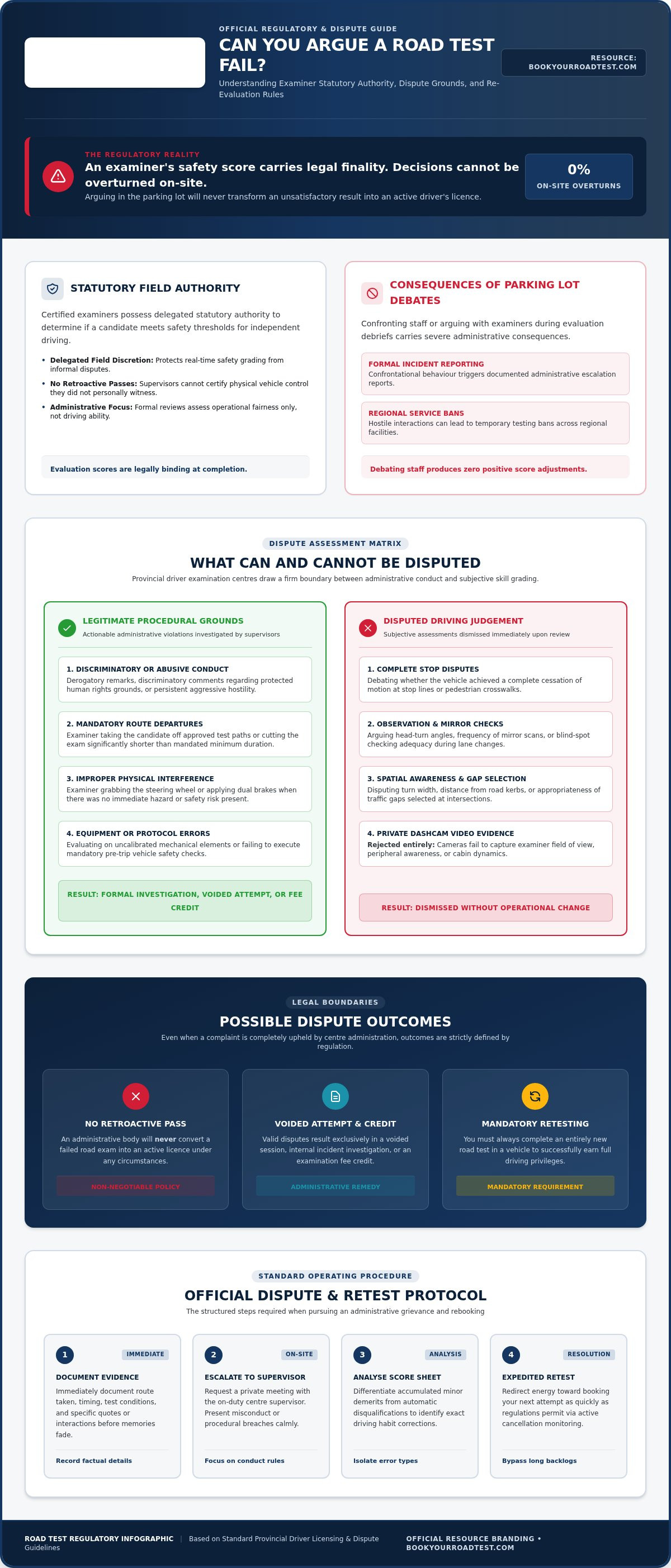
Certified examiners possess statutory authority to determine whether an applicant meets the safety threshold required for independent operation. This authority shields their subjective grading decisions, including spatial awareness, lane positioning, and mirror checks, from informal dispute. Arguing with personnel during your evaluation debrief accomplishes nothing. In fact, confrontational behaviour regularly triggers formal incident reports, which can result in temporary service bans across regional test facilities.
Why a Failed Score Never Becomes a Pass
A provincial licensing body cannot issue a driver's licence without a verified, uncompromised practical exam on record. A road test decision cannot be overturned post-examination because supervisors cannot retroactively certify physical vehicle control that they did not witness firsthand. Even when candidates present valid procedural grievances, administrative reviews only assess operational fairness, not driving ability.
- No retroactive passes: An administrative body will never convert a failed road exam into an active licence under any circumstances.
- Voided attempts: Legitimate disputes result exclusively in a voided session, an incident investigation, or an examination fee credit.
- Mandatory retesting: You must always complete an entirely new road test to earn your full driving privileges.
Understanding these boundaries saves valuable energy. Instead of wondering if you can argue a road test fail to salvage your morning appointment, redirect your efforts toward booking your next attempt as quickly as regulations permit.
Legitimate Grounds for Complaint vs Disputed Driving Judgement
Before deciding whether to escalate an issue, you must separate professional conduct from professional judgment. When asking whether you can argue a road test fail, the core issue comes down to what actually occurred during the evaluation. Provincial driver examination centres draw a firm boundary between how an examiner treats you administratively and how they score your driving skill behind the wheel.
Actionable Procedural Violations and Misconduct
Supervisors take formal complaints seriously when an examiner violates testing regulations or professional standards. You hold actionable grounds for escalation if you experienced direct misconduct during your examination. Legitimate procedural grievances include:
- Discriminatory or abusive conduct: Derogatory remarks, discriminatory comments regarding protected human rights grounds, or persistent aggressive hostility.
- Mandatory route departures: An examiner taking you off approved evaluation paths or cutting the appointment significantly shorter than the mandated minimum duration.
- Improper physical interference: An examiner grabbing the steering wheel or applying dual-brake mechanisms when there was no immediate hazard or safety risk.
- Equipment or protocol errors: Evaluating you on uncalibrated mechanical elements or failing to conduct mandatory pre-trip safety checks.
Subjective Grading Disputes That Will Not Stand
Challenging an examiner's score sheet based on driving perception is entirely unproductive. If your dispute centres on whether your vehicle came to a complete stop, how wide your turn was, or whether you turned your head enough during a blind-spot check, supervisors will dismiss your claim immediately. An examiner is legally certified to assess these nuances in real time.
Private dashcam recordings will not reverse a grading dispute either. Examination bodies consistently reject dashcam video during reviews because recorded angles do not capture the examiner's full field of view, peripheral awareness, or cabin dynamics. If your failure stemmed from demerits, mirror checks, or gap selection, the answer to whether you can argue a road test fail remains a definitive no.
When your test result cannot be disputed, the most effective step is scheduling a quick retake. Using an independent road test cancellation finder allows you to monitor open slots continuously across regional facilities and secure an earlier date without unnecessary delays.
How to File an Official Road Test Dispute: Step-by-Step
If you encounter procedural irregularities rather than simple scoring differences, formal administrative channels provide an orderly path forward. While asking whether you can argue a road test fail at the front desk will yield no immediate change, following established dispute protocols ensures your concerns receive proper operational review from regional management.
Immediate Actions at the Testing Centre
Your first steps inside the facility set the tone for any future appeal. Walk directly to the reception counter and calmly request to speak with the on-duty centre supervisor or branch manager. Avoid venting frustration about your failed result. Instead, focus entirely on clarifying procedural points.
- Collect documentation: Request a full, legible copy of your evaluation sheet and note the examiner's identification or badge number.
- Record operational details: Write down your exact departure time, return time, weather conditions, and the specific vehicle used.
- Log the route: Jot down streets, intersections, and specific driving manoeuvres while your memory is completely fresh.
- Request a manager debrief: Politely ask the supervisor to review the recorded infractions against the standardized testing rubric to confirm procedural alignment.
Filing a Formal Administrative Appeal
When an on-site discussion fails to resolve clear procedural violations, you must escalate through the provincial transportation authority's formal complaint portal. Submit your grievance within forty-eight hours of your appointment to maintain credibility and accurate records.
Draft your written statement using strictly neutral, factual phrasing. Clearly identify chronological events rather than emotional impressions. Detail any specific departure from approved testing routes, improper interference with vehicle controls, or documented unprofessional statements. Attach your evaluation sheet and any supporting witness statements from individuals present during your pre-test or post-test interactions.
Managing your expectations during this review is vital. Understanding the regulatory framework answers why you can argue a road test fail only on procedural terms: licensing authorities will never convert an evaluation into a passing grade. If the provincial oversight committee upholds your grievance, the typical remedy consists of a waived examination fee and an expedited re-examination conducted alongside a senior testing supervisor. For most candidates, pursuing an administrative appeal runs concurrently with preparing for a scheduled retake.
Analysing Your Evaluation Sheet to Guarantee a Future Pass
Carefully examining your practical exam report provides the clearest route forward after an unsuccessful attempt. Rather than dwelling on whether you can argue a road test fail, treat your official scoring sheet as a diagnostic blueprint. Every checkmark and deducted demerit highlights the precise operational adjustments needed to secure full licensing privileges on your next appointment.
Demerit Accumulation vs Disqualifying Actions
Provincial evaluation sheets divide performance issues into two distinct categories: accumulated minor faults and automatic disqualifications. Recognizing which category triggered your result reveals exactly how your test was assessed.
- Minor demerit accumulation: Minor infractions involve small operational inconsistencies like improper hand positioning, late signal cancellation, or slight hesitation at uncontrolled intersections. Earning isolated points will not fail you. Crossing the established cumulative demerit threshold, however, results in an automatic fail.
- Direct disqualifying actions: Critical errors terminate the exam immediately regardless of an otherwise clean drive. These include disobeying regulatory traffic signs, failing to yield to approaching pedestrians, climbing a curb during parking manoeuvres, or creating an imminent collision risk that requires defensive intervention.
- Systemic error patterns: Pay close attention to repeated deductions across similar manoeuvres. Missing mirror checks during three separate lane changes indicates an ingrained habit rather than a momentary lapse.
Targeted Remediation for Common Problem Areas
Correcting identified weaknesses requires deliberate practice behind the wheel. If observation checks contributed to your score, adjust how you demonstrate awareness inside the cabin. Many drivers scan properly using only their eyes, which evaluators sitting in the passenger seat cannot easily detect. Practise deliberate head movements toward your side mirrors, rearview mirror, and blind spots so your visual checks are unmistakably clear.
Stopping technique represents another frequent stumbling block. Eliminate rolling stops by ensuring the vehicle settles into a complete halt behind painted stop lines or crosswalks before inching forward to check cross-traffic. Similarly, spend time refining your speed control and following distance during busy peak-hour transitions to eliminate lingering defensive hesitation.
Once you understand your evaluation sheet and adjust your driving habits, you can take control of your timeline. You can schedule a G2 road test booking service to bypass lengthy booking queues and lock in an earlier testing slot across official testing centres.
Rescheduling Your Retake: Faster Booking Strategies
Redirecting your focus toward rapid rebooking yields far better outcomes than questioning whether you can argue a road test fail. Administrative inquiries often drag on for weeks without altering your licensing status. Securing an upcoming test date allows you to apply recent examiner feedback immediately while behind-the-wheel habits remain fresh in your mind.
Mandatory Waiting Periods and Timing Considerations
Provincial licensing frameworks enforce statutory waiting intervals before candidates become eligible for another attempt. Depending on regional regulations, you must typically wait between seven and fourteen days before retaking an exam. Use this mandatory window intentionally. Target test times during mid-morning or early afternoon to avoid heavy commuter traffic and school zone congestion, and maintain active driving practice to reinforce your observation routines.
Securing Earlier Dates with Cancellation Finders
High demand creates massive appointment backlogs across testing centres, often showing standard calendar openings months down the road. Waiting that long disrupts work commitments and school routines. However, hundreds of scheduled appointments open up every single week due to last-minute applicant cancellations, illness, and schedule adjustments.
Snatching these sudden openings manually requires sitting at a screen and refreshing official portals continuously throughout the day. It is an exhausting process that rarely fits into a busy schedule. You can bypass this manual friction and save weeks of frustration using the road test cancellation finder to find open dates across multiple testing centres automatically.
Rather than wondering whether you can argue a road test fail through prolonged bureaucratic channels, let an autonomous administrative concierge track calendar shifts on your behalf. Secure your next appointment seamlessly through Book Your Road Test, an independent third-party service provider committed to simplifying your scheduling workflow so you can concentrate entirely on passing your upcoming driving exam.
Move Past a Disputed Exam and Reclaim Your Schedule
Walking away from an unfair evaluation feels discouraging. While you might still wonder can you argue a road test fail to protect your record, the reality is that examiner decisions remain legally binding. Formal appeals only address procedural misconduct rather than driving marks, meaning your fastest route to driving independence is taking decisive action on a retake.
Instead of letting multi-month backlogs delay your career or personal plans, take control of your calendar. As an autonomous booking administration concierge trusted by thousands of Canadian drivers, Book Your Road Test simplifies your scheduling workflow. Our system provides continuous monitoring across official testing centres to catch last-minute cancellations the instant they appear, eliminating the frustration of navigating confusing government portals. Find an earlier road test date today, address the feedback on your score sheet, and earn your licence with confidence.
Frequently Asked Questions
Can an examiner change my road test result from fail to pass?
No, an examiner cannot alter a recorded failed result once the test debrief is finished. Provincial transportation regulations make practical driving score assessments legally binding immediately upon entry into the official registry. Even if an examiner re-evaluates their notes or listens to your perspective, they lack the legal authority to reverse the outcome post-test. Earning your licence always requires taking and passing an entirely new practical exam.
Can you argue a road test fail using dashcam footage?
No, you cannot argue a road test fail using dashcam footage because provincial licensing bodies do not accept external video recordings during disputes. Dashcams only capture a forward or rearward viewpoint, failing to record your full eye movements, cabin interactions, or the complete peripheral road environment observed by the evaluator. Consequently, administrative supervisors rely exclusively on certified examiner observations and standard scoring rubrics when reviewing testing sessions.
What happens if you complain about a driving examiner?
Filing an official complaint initiates an internal administrative investigation into the examiner's procedural conduct rather than your driving marks. Regional supervisors review the examiner's notes, test route logs, and past performance history. If investigators discover legitimate procedural violations, discrimination, or improper conduct, the licensing office typically provides a complimentary re-evaluation appointment with a senior evaluator. However, disciplinary actions against staff remain confidential and will never automatically overturn your score.
How long do you have to wait before retaking a failed road test?
Most Canadian provincial jurisdictions impose a mandatory waiting period between seven and fourteen days before you can attempt another practical exam. This statutory interval prevents immediate retesting without adequate remediation, ensuring candidates have sufficient time to practise identified problem areas. While you can often access the booking schedule immediately to reserve a future slot, the testing system will prevent you from scheduling any date inside that minimum blackout window.
Will filing an official complaint delay booking my next road test?
No, lodging a formal complaint does not freeze your profile or restrict your ability to schedule another practical exam. The administrative dispute process operates completely independently of the examination booking schedule. You are fully entitled to reserve your next test slot as soon as your statutory waiting period allows, even while an operational review of your previous session remains open with regional management.
Can you request a different examiner for your road test retake?
Yes, you can usually request a different examiner when checking in for your next test appointment at the facility. While automated scheduling systems assign evaluators randomly based on daily rotation queues, informing the on-duty supervisor about past friction will prompt staff to reassign you to another available examiner. Booking your retest at a different regional testing centre is another seamless option to guarantee an entirely fresh evaluation.
What is the fastest way to get an earlier road test date after failing?
The fastest way to bypass backlogs is leveraging automated cancellation monitoring rather than relying on standard calendar openings. When determining next steps after asking if you can argue a road test fail, an administrative booking concierge or independent cancellation finder tracks sudden slot releases across testing centres around the clock. This approach captures newly dropped appointments from candidate cancellations instantly, frequently moving your retest forward by weeks or even months.


