

Did you know that nearly half of all drivers fail their G1 exit exam on the first try? Most of the time, the frustration doesn't come from the driving itself, but from the confusion of looking at a digital report filled with technical jargon you don't recognize. Understanding the g2 road test score sheet is the most effective way to turn a "fail" into a "pass" because it reveals exactly what the examiner was looking for while you were behind the wheel.
We know how stressful it feels to see checkmarks next to terms like "scanning" or "lane selection" without knowing what you actually did wrong. This guide breaks down the professional logic behind your exam results so you can stop guessing and start improving. You'll learn the difference between minor deductions and immediate disqualifications, giving you the clarity needed to book your next attempt with total confidence. We'll walk through every category on the modern tablet-based evaluation, from parking manoeuvres to intersection safety, ensuring you're fully prepared for your next test centre visit.
Key Takeaways
- Learn how the universal shift to digital tablet scoring at DriveTest centres provides a more transparent and accessible record of your driving evaluation.
- Identify the specific threshold of minor errors allowed and which critical safety violations lead to an immediate disqualification from the exam.
- Master the observation and space management habits that examiners prioritize when understanding the g2 road test score sheet.
- Discover how to decode specific examiner remarks to create a targeted practice plan that ensures you are ready for your next road test booking.
Decoding the G2 Road Test Score Sheet: An Overview
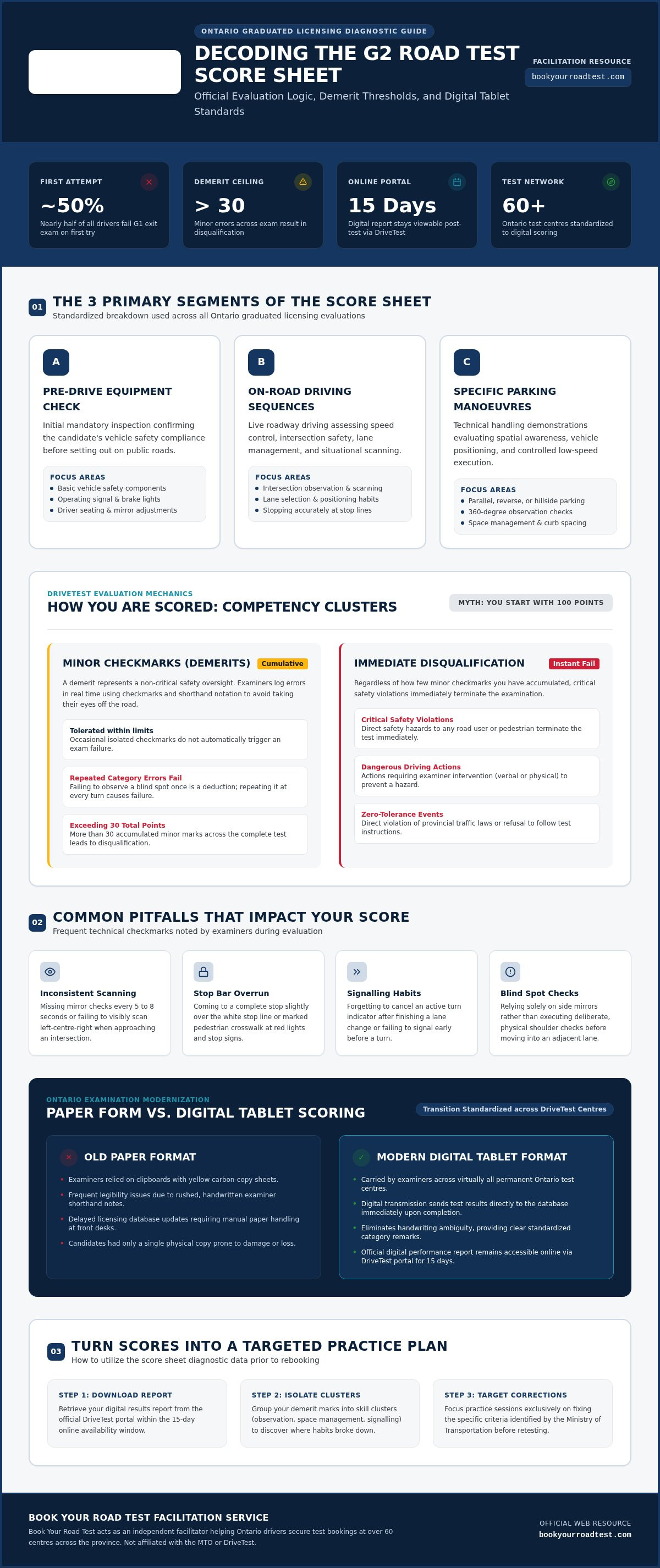
The G2 road test score sheet is the official record of your performance during your G1 exit exam. It serves as a standardized bridge within the Ontario graduated licensing system, ensuring every driver meets the same safety criteria before earning their novice privileges. Understanding the g2 road test score sheet is vital because it transforms a high-pressure experience into a clear set of technical requirements. The document is logically organized into three primary segments: the pre-drive equipment check, on-road driving sequences, and specific parking manoeuvres.
Examiners rely on a system of checkmarks and shorthand codes to track your progress in real time. They need to stay focused on the road and your vehicle control, so they don't have time to write long explanations while you're moving. A checkmark usually signifies a minor error or a missed observation. While one or two marks won't result in a failure, they show the examiner where your habits are inconsistent. By reviewing these marks later, you can see exactly which areas of your driving need more attention before your next booking.
The Purpose of the Evaluation Form
This form exists to standardize driving safety across all candidates. It provides a transparent, professional record that removes guesswork from the evaluation process. Instead of a subjective opinion about your driving, the examiner uses the sheet to identify specific habits that require further practice. If you find yourself needing a retest, this document acts as a diagnostic tool. It helps you focus your training on the exact categories where you lost points, making your practice sessions much more efficient. It's the best way to ensure you're actually fixing the problems that the Ministry of Transportation cares about.
Paper vs. Digital: What to Expect
By 2026, DriveTest centres across Ontario have transitioned to tablet-based scoring across virtually all permanent locations. You should expect your examiner to carry a digital device instead of a clipboard with yellow carbon-copy paper. This shift is beneficial because digital tablets transmit your results to the licensing database immediately after the test ends. You can access your official performance report online through the DriveTest portal for up to 15 days post-test. These digital reports eliminate the legibility issues common with old handwritten notes, giving you a clear summary of the examiner's feedback.
We act as an independent facilitator to help you secure your booking at one of over 60 centres. Our service includes an administrative fee to provide a simplified booking process and access to our cancellation finder tool. We are not affiliated with the MTO or DriveTest, but we aim to reduce your administrative stress so you can focus on mastering the technical skills recorded on your score sheet.
Demerits vs. Immediate Disqualifications: How You Are Scored
One of the most common misconceptions among Ontario drivers is the idea that they start with 100 points and lose them for every mistake. In reality, the examiner tracks your performance through a system of competency clusters. Understanding the g2 road test score sheet requires shifting your focus from a single numeric score to the cumulative weight of your errors. While you are allowed a certain number of minor mistakes, the evaluation is designed to identify patterns of unsafe behaviour. If you demonstrate a consistent lack of mirror checks or poor lane positioning, those small checkmarks will eventually lead to a failure.
The scoring logic is anchored in DriveTest examination standards and pass rates, which emphasize safety over technical perfection. Most examiners consider a total of more than 30 minor errors across the entire test as a reason for disqualification. However, you can also fail if you repeat the same minor error in a specific category too many times. For instance, failing to check your blind spot once is a deduction; failing to do it at every turn is a demonstrated safety risk that ends the attempt.
The Point Deduction System
The evaluation form uses checkmarks to record minor errors that don't pose an immediate hazard to other road users. A demerit on a road test is defined as a non-critical safety oversight that demonstrates a need for further habit development. Common deductions include improper signalling, such as forgetting to cancel a signal after a turn, or stopping slightly over the white stop bar. While these mistakes are frustrating, they are manageable as long as you remain calm and don't let one error lead to another. If you do find yourself needing a second attempt after reviewing your results, our G2 road test booking service can help you find an earlier date at a nearby centre.
Critical Errors and Immediate Failures
Regardless of how many minor points you have accumulated, four specific "Dangerous Actions" will result in an immediate disqualification. These are non-negotiable safety breaches that force the examiner to terminate the test for public safety. These grounds include:
- Examiner Intervention: Any time the examiner has to grab the steering wheel or use the dual-brake to prevent a hazard.
- Dangerous Action: Mounting a curb, nearly causing a collision, or creating an imminent hazard for other drivers or pedestrians.
- Traffic Law Violations: Direct breaches of the Highway Traffic Act, such as speeding or running a red light.
- Vehicle Equipment Failure: If your vehicle's brake lights or signals stop working during the test.
We are an independent facilitator that helps you manage the administrative process of scheduling these exams. Please be aware that our service includes an administrative fee that is separate from the official DriveTest fees. We are not affiliated with the MTO, but we provide the support you need to focus on your technical driving skills rather than the stress of the booking system.
Breaking Down the Key Scoring Categories
Understanding the g2 road test score sheet requires looking at your drive as a series of competency clusters rather than a single event. The examiner evaluates your performance across four main pillars: observation, space management, vehicle control, and adherence to the rules of the road. Each cluster contains specific criteria that, if missed, result in the checkmarks that can lead to a cumulative failure. Mastering these categories is the most effective way to ensure your performance report remains clear of deductions.
Observation and Blind Spots
Observation is the most scrutinized category on the entire form. Examiners cannot track subtle eye movements, so you must use exaggerated head movements to show you're scanning. This means your chin should move toward your shoulder during every check. You must demonstrate the "Mirror-Signal-Blind Spot" sequence every time you change lanes, merge, or turn. Failing to do so is one of the most common ways to accumulate minor errors quickly.
- Mirror Checks: Sweep your mirrors every 5 to 8 seconds to demonstrate constant situational awareness.
- Blind Spots: Physically turn your head to check your blind spot before every lane change and at least twice during every turn.
- Intersection Scans: Look left, centre, and right before entering any intersection, even if you have the right-of-way or a green light.
Speed and Space Management
Maintaining a "cushion of space" is essential for a passing grade. This means keeping at least a two-to-three-second following distance behind the vehicle in front of you. Your lane positioning should be centred, avoiding the habit of "hugging" the curb or the centre line. Examiners also watch for smooth vehicle control, noting any jerky steering or sudden, aggressive braking that suggests a lack of comfort with the vehicle's mechanics.
Speed regulation is equally vital. While speeding is a direct violation of the Highway Traffic Act and grounds for immediate failure, being overly cautious can also lead to deductions. Driving 10 kilometres per hour under the limit in clear, dry conditions is often marked as impeding traffic. You should aim to stay exactly at the posted limit, adjusting only for weather or traffic flow. Demonstrating that you can keep pace with traffic while remaining in control shows the examiner you're ready for the responsibilities of a G2 licence.
We act as an independent facilitator to help you manage the administrative process of securing your road test. Our service includes an administrative fee to provide a simplified booking experience and access to our proprietary cancellation finder. We are not affiliated with the MTO or DriveTest, but we help manage the logistics so you can focus on mastering the technical skills recorded on your score sheet. This support is designed to get you behind the wheel at one of over 60 centres without the typical scheduling delays.
Common Pitfalls That Impact Your G2 Score
Many candidates fail not because they lack skill, but because they have developed "real-world" habits that don't align with DriveTest standards. Understanding the g2 road test score sheet helps you identify these invisible errors before they become a problem on exam day. One frequent deduction involves steering technique. Using only one hand to turn or "palming" the steering wheel suggests a lack of total vehicle control. You must use two hands at all times, preferably in the nine-and-three or ten-and-two positions, to satisfy the examiner's requirements for stability and safety.
Yielding to pedestrians is another area where examiners have zero tolerance. If a pedestrian is waiting at a crosswalk or has already entered the roadway, you must yield the right-of-way completely. Failing to do so is often categorized as a dangerous action, which results in an immediate disqualification regardless of how well you drove for the rest of the test. These mistakes are often the result of nerves, but knowing they are high-priority items on the score sheet can help you stay focused.
The "Rolling Stop" Trap
The rolling stop is perhaps the most common reason for a failed G1 exit exam in Ontario. To avoid a deduction, you must bring the vehicle to a complete, motionless stop behind the white stop bar or pedestrian crosswalk. A helpful tip is to "feel the back-set," which is that slight physical sensation of the car settling back on its suspension once all momentum has stopped. If you stop past the white line or merely slow down without stopping, the examiner will mark it as a major technical error. In many cases, repeated rolling stops are treated as a direct violation of traffic laws, ending the test early.
Lane Discipline and Turning
Maintaining strict lane discipline is a core component of understanding the g2 road test score sheet. You must stay in the centre of your lane without drifting toward the curb or the centre line. When turning, you must enter and exit in the corresponding lane. For example, if you're turning left into a multi-lane road, you must land in the leftmost lane before signalling to move over to the right. Cutting corners or swinging too wide into the wrong lane are technical errors that suggest you aren't yet ready for a G2 licence.
Signalling timing also plays a significant role in your final score. You should activate your signal approximately 30 metres before a turn to give other road users enough warning. If you've recently reviewed a failed score sheet and identified these pitfalls in your own driving, you can book your road test today to secure a new appointment. We are an independent facilitator and charge an administrative fee to help you find dates at over 60 centres, helping you get back on the road without the typical scheduling stress.
Reviewing Your Results and Preparing for a Retest
Receiving your results can feel overwhelming, but the evaluation report is actually your most valuable training asset. Understanding the g2 road test score sheet allows you to move past the emotional reaction of a failure and focus on the technical feedback provided by the examiner. By treating the document as a diagnostic report, you can identify exactly where your habits diverged from the ministry standards. This clarity is essential for transforming your driving performance before your next booking.
The document serves as a personalized roadmap for your practice sessions. Instead of practicing general driving, you can focus on the specific clusters where you lost points. If you see multiple checkmarks in the "Turns" or "Observation" categories, you know precisely what to drill. This targeted approach saves time and builds the specific competencies the examiner is looking for.
Analyzing the Examiner’s Feedback
The "Examiner Remarks" section at the bottom of the sheet often contains the most specific insights into your driving performance. It's important to distinguish between errors caused by simple nerves and those indicating a genuine lack of skill. If you have checkmarks scattered across different categories, it might just be the pressure of the day. However, if the marks are concentrated in one area, such as "Observation," you need to prioritize that skill. Many drivers find that seeking professional instruction for their specific weak areas is the fastest way to ensure a pass on their second attempt.
Securing Your Next Test Date
In Ontario, you must wait a mandatory period of 10 calendar days before you're eligible to retake the G1 exit exam. This time should be used to turn your score sheet into a personalized practice checklist. Once you feel confident that you've corrected the errors, your next challenge is finding an available appointment. High demand often leads to long wait times at local DriveTest centres, which can be frustrating when you're ready to get back on the road. Understanding the g2 road test score sheet is only the first step; getting back behind the wheel quickly is the second.
Using a road test cancellation finder ontario is an effective strategy to avoid these delays by monitoring for earlier openings. We act as an independent facilitator to help you book a road test quickly at any of the 60+ centres across the province. Our service is designed for convenience and efficiency, providing a simplified administrative process that manages the logistics for you. Please note that we're an autonomous entity not affiliated with the MTO or DriveTest, and we charge an administrative fee for our booking and monitoring services. This allows you to focus entirely on your driving skills while we handle the scheduling technicalities.
Master Your Retest with Confidence
Mastering the technical requirements of the Ontario graduated licensing system is the most effective way to eliminate exam anxiety. By understanding the g2 road test score sheet, you've gained the clarity needed to transform examiner feedback into a precise practice plan. Focus your efforts on consistent observation and smooth vehicle control to clear those clusters of minor errors. Remember that avoiding immediate disqualifications, like rolling stops or dangerous actions, is just as critical as technical precision.
We are here to manage the administrative logistics so you can focus on your driving skills. As an independent facilitator, we provide a simplified booking process and access to our proprietary cancellation finder to identify earlier dates at over 60 centres across the province. Our service operates autonomously from the MTO and DriveTest; we charge a transparent administrative fee for our monitoring and scheduling support. Book your next G2 road test appointment today and take the next step toward your full licence with total certainty. You have the tools and the knowledge; now it's time to get back on the road.
Frequently Asked Questions
How many points can you lose on a G2 test in 2026?
In 2026, examiners use a competency-based evaluation rather than a simple countdown from 100 points. Generally, accumulating more than 30 minor error checkmarks results in a failure. However, repeating the same minor error in a single category, such as failing to check mirrors every 5 to 8 seconds, can lead to a disqualification even if your total count is low. Understanding the g2 road test score sheet means recognizing that consistency is more important than a specific number.
What is considered an immediate fail on the G2 road test?
An immediate failure occurs when you commit a "Dangerous Action" or a direct violation of the Highway Traffic Act. This includes running a red light, speeding, or failing to yield the right-of-way to pedestrians. Physical or verbal intervention by the examiner to prevent a collision also ends the test instantly. Finally, if your vehicle has a safety defect like a non-functional brake light, the test will be terminated before it even begins.
Can I see my G2 road test score sheet online?
Yes, you can download your official performance report online at the DriveTest portal for up to 15 days after your exam. Since virtually all centres in 2026 use digital tablets, your results are synced to the Ministry of Transportation database immediately. After this 15-day window, you must visit a centre in person to request a copy. Reviewing this digital report is the most effective way to identify the specific habits you need to correct.
Do examiners use a specific quota for failing students?
No, DriveTest examiners do not follow a failure quota. Every candidate is evaluated against standardized safety criteria set by the ministry to ensure fairness across the province. While pass rates vary between different locations, these differences are usually due to local traffic density or road complexity rather than examiner bias. The focus remains entirely on whether you demonstrate the skills necessary to drive safely and independently on Ontario roads.
What happens if I fail my G2 road test?
If you don't pass, the examiner will provide a brief summary of your results, and you'll be able to download your detailed report online. You'll need to pay a retest fee of $53.75 CAD to book a new appointment. This is an excellent time to use a third-party facilitator to manage the scheduling logistics. We help you find earlier dates at over 60 centres for an administrative fee, allowing you to focus on your driving skills.
How long do I have to wait to retake the G2 test if I fail?
You must wait a mandatory minimum of 10 calendar days before you're eligible to retake the G1 exit road test. This period is intended to give you enough time to practice the skills identified in your evaluation remarks. Once these 10 days have passed, you're eligible to book your next attempt. Many drivers use our cancellation finder service during this time to secure a spot as soon as their eligibility window opens.
Does a minor mistake like hitting a curb during parallel parking count as a fail?
Hitting the curb during parallel parking is evaluated based on the severity of the contact. A light touch while adjusting your position is usually marked as a minor error or a deduction for poor spatial awareness. However, mounting or jumping the curb is considered a dangerous action and results in an immediate failure. Understanding the g2 road test score sheet helps you realize that controlled, slow movements are always safer than rushing a manoeuvre.
Why did I fail my G2 test if I didn’t have many checkmarks?
You can fail with very few checkmarks if you commit a single major safety violation or a "Dangerous Action." These critical errors override your performance in other categories because they pose an immediate risk to traffic. Additionally, examiners look for competency clusters; if you consistently miss blind-spot checks during every turn, the examiner may fail you for a demonstrated lack of observation, even if the rest of your drive was technically perfect.


