

What if practising a familiar route isn’t the best way to prepare for your full G test? If you’re unsure what to focus on, especially when merging, changing lanes or driving on the highway, you’re not alone. A reliable answer to “what to practice for full g test” is less about memorizing turns and more about making safe, repeatable decisions in different situations.
Online checklists can conflict or become outdated, making it harder to know what the test may assess. This practical checklist helps you identify skills to practise, track your progress and prepare for test day. It also points out details to verify with DriveTest, including current test procedures and what to bring, so you don’t have to rely on assumptions.
We’ll cover observation, speed control, lane changes, highway driving and other key habits, with simple ways to assess whether each feels consistent. You’ll also find guidance on arranging an appointment when you’re ready. Focus on decisions you can repeat, not a route you hope to recognize.
Key Takeaways
- Practise repeatable driving decisions instead of relying on a memorized route or expecting a guaranteed result.
- Use the checklist to identify what to practice for full g test, from vehicle control and observation to safe highway manoeuvres.
- Build confidence on the highway with a clear sequence: observe, signal, adjust to traffic speed and enter when there’s room.
- Track recurring errors and skills that feel consistent so each practice session has a clear focus.
- Before test day, confirm current appointment, identification and vehicle requirements with DriveTest.
What Does the Full G Test Assess? Start With the Skills, Not a Route
It’s normal to feel uncertain about what the examiner may ask you to do. Prepare by practising safe decisions in different situations instead of trying to memorize a route. No checklist can guarantee a result, but knowing what to practice for full g test gives your sessions a clearer focus.
The full G road test assesses whether you can drive safely and independently in varied traffic conditions. That means showing awareness of what’s around you, control of your vehicle, clear communication with other road users and sound judgement as conditions change. The G licence is the final stage of the graduated driver licensing (GDL) system, which progresses from a learner licence toward a full licence.
Which driving skills should you expect to demonstrate?
Think of these as practice areas, not guaranteed test manoeuvres. The examiner’s instructions and route may vary. Practise showing that you can:
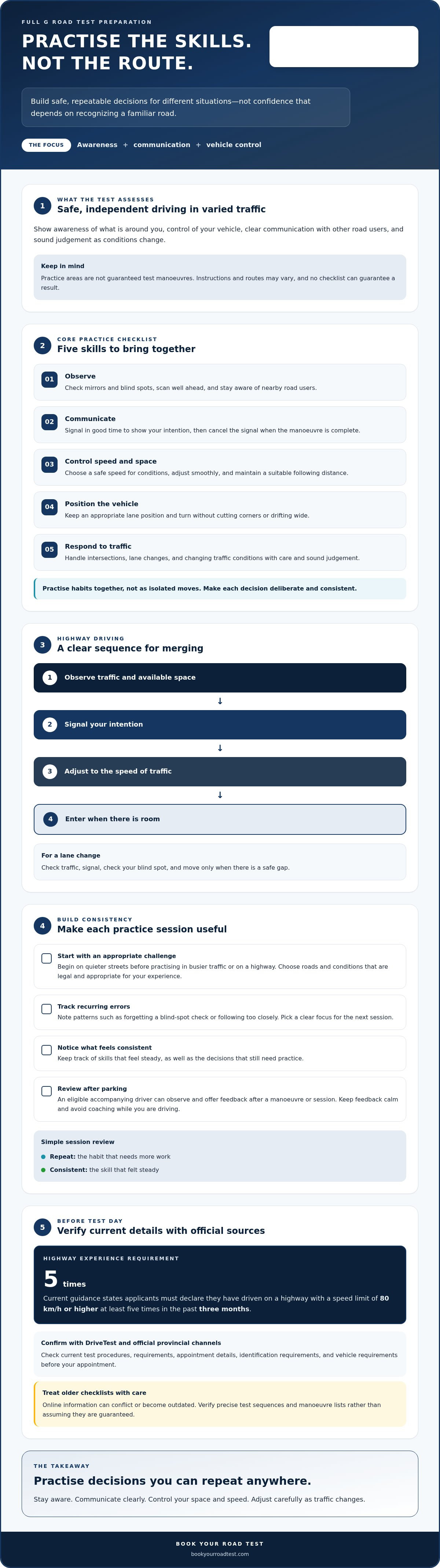
- Observe: Check mirrors and blind spots, scan ahead and stay aware of nearby road users.
- Communicate: Signal in good time and cancel the signal when your manoeuvre is complete.
- Control speed and space: Choose a safe speed for the conditions and maintain a suitable following distance.
- Position the vehicle: Keep an appropriate lane position and turn without cutting corners or drifting wide.
- Respond to traffic: Handle intersections, lane changes and changing traffic conditions with care and sound judgement.
Practise these habits together, not as isolated moves. A lane change, for example, involves checking traffic, signalling, checking your blind spot and moving only when there’s a safe gap. Aim to make each decision deliberate and consistent.
How to check current full G test requirements
Use current information from the Ministry of Transportation to confirm requirements, procedures and test details before your appointment. Older online checklists may describe a temporary or outdated test format. Treat any precise sequence of test elements or manoeuvre list as something to verify, not a promise of what you’ll encounter.
Check the current highway experience requirement with official sources, too. Current guidance states that applicants must declare they’ve driven on a highway with a speed limit of 80 km/h or higher at least five times in the past three months. Confirm that requirement and any other details directly with official provincial channels and Book Your Road Test before test day.
Full G Test Practice Checklist: What to Practice for Full G Test
A familiar route can help you feel more comfortable, but it won’t prepare you for every traffic situation. Practise decisions you can repeat anywhere: noticing what’s around you, communicating clearly and controlling the vehicle smoothly. Good driving brings observation, communication and vehicle control together, one decision at a time.
Use this checklist as a guide to practice areas, not a promise that every manoeuvre will appear on your test. Choose roads and conditions that are legal and appropriate for your experience, then increase the challenge gradually. For example, build confidence on quieter streets before practising in busier traffic or on a highway. An accompanying driver who meets current requirements can observe and offer feedback after a manoeuvre or session. Ask them to stay calm and avoid coaching you while you’re driving.
Practise observation, signalling and space management
- Check before you move: Practise checking mirrors and blind spots before pulling away, turning, changing lanes or moving toward the roadside.
- Signal clearly: Signal early enough to communicate your intention, then cancel the signal once the manoeuvre is complete.
- Leave room: Maintain a suitable following distance and scan well ahead. Watch for changing traffic, brake lights, intersections and road users who may affect your next decision.
- Stay predictable: Keep a steady, appropriate position and adjust your speed smoothly when traffic or conditions change.
Ask your observer to note specific patterns, such as forgetting a blind-spot check or following too closely. Review those observations after you’ve parked, rather than trying to process a running commentary in traffic. For additional general safety reminders, see these highway driving tips, and always follow the applicable road rules.
Practise turns, intersections and parking-lot manoeuvres
Approach turns and intersections at a controlled speed, choose an appropriate position and wait for a safe gap. Make deliberate observations before proceeding, and steer smoothly rather than making sharp corrections. Where a stop is required, come to a complete stop in the appropriate place, check carefully and proceed only when safe.
Use a quiet, legal area to build low-speed control, including reversing or parking practice where appropriate. These are useful driving skills, but don’t assume a particular parking or low-speed manoeuvre will be tested. Formats and procedures can change, so check current Ministry of Transportation and DriveTest information before relying on an online manoeuvre list.
When your practice shows you’re ready to arrange a test, you can review an independent G Road Test Booking Service. It schedules tests but doesn’t provide driving instruction or a test vehicle. Its booking service has an additional administration fee, separate from the official test fee.
Highway Driving for the Full G Test: Practise Merging and Lane Changes
Highway driving can feel intimidating, especially when traffic is moving quickly and you’re looking for a safe opening. You don’t need to start in the most demanding conditions. Build confidence gradually with planned practice, a route that suits your ability and an accompanying driver who meets current requirements.
If you’re deciding what to practice for full g test, focus on the choices behind each manoeuvre. Look for traffic early, communicate your intention, judge the available space and proceed only when it’s safe. If conditions feel overwhelming, stop somewhere safe and choose a less demanding practice route next time.
How to practise merging onto a highway
Begin on a legal practice route with a qualified accompanying driver, and choose conditions that let you concentrate without feeling pressured. Before entering, scan traffic and the lane ahead. Then build speed appropriately on the acceleration lane while assessing the available gap.
- Observe: Check mirrors and look for traffic in the lane you plan to enter.
- Signal: Make your intention clear, but don’t treat a signal as permission to move into an occupied space.
- Match traffic: Adjust your speed appropriately while continuing to assess the gap.
- Enter safely: Move over only when there’s room. Don’t force entry or make another driver brake or swerve to accommodate you.
If there isn’t a safe opening, stay in control and follow the road layout and traffic conditions. Your accompanying driver can share observations once you’re safely off the highway, rather than distracting you with instructions during the merge.
How to practise highway lane changes and exits
On a suitable stretch of highway, practise one deliberate lane change at a time: check mirrors, signal, check your blind spot, confirm there’s enough space and move smoothly when safe. Once in the new lane, settle into a steady position and a speed appropriate to traffic and conditions. Keep scanning ahead and leave room around other vehicles so you have time to respond if traffic slows.
Plan for exits early by watching signs and noting which lane you’ll need. Signal and change lanes only when there’s a safe gap. If you miss an exit, continue safely and follow the road to another route rather than making a sudden move across traffic.
Highway practice is useful preparation, but don’t assume a particular road, sequence or manoeuvre is guaranteed to be part of your test. Confirm current highway experience requirements and test procedures with the Ministry of Transportation and DriveTest before test day.
How to Plan Practice Sessions and Know When You Are Ready
Practice works best when each drive has a purpose. Instead of trying to cover every skill in one session, choose one priority, such as smoother mirror checks or more confident highway merging. A simple plan helps you notice progress and decide what needs attention next, without treating one good drive as a guarantee of passing.
A simple practice-session structure
Use this flexible format and adjust it to your experience, conditions and available time:
- Set one goal: Choose a specific skill, such as checking mirrors before slowing or planning a lane change early.
- Start in manageable conditions: Practise where traffic and road demands let you concentrate on that skill. Add complexity only when you’re comfortable and it’s safe and legal to do so.
- Repeat and review: Practise the goal in different situations, then discuss how it went once the vehicle is parked.
- Choose a next step: Note one strength, one area to improve and one priority for your next session.
Keep a brief log after each drive. Record repeated errors, skills that felt consistent and the conditions you practised in. For example, if you made a safe lane change in quieter traffic but hesitated in busier conditions, make that contrast your next practice goal. A log turns “I need more practice” into a useful plan.
How to assess readiness without guessing
Readiness isn’t about having a flawless drive or knowing a particular route. Look for consistent, independent safe driving across different conditions: you observe without reminders, control the vehicle smoothly, communicate your intentions and make decisions that leave time and space to respond.
Ask your qualified accompanying driver to look for patterns over several sessions, rather than focusing on one isolated mistake. Do you regularly miss a check, rush a decision or need prompting in a certain situation? If an important skill remains inconsistent, keep practising in suitable conditions. You can also consider seeking instruction from a qualified driving instructor. A booking service can arrange a test appointment, but it doesn’t assess readiness or provide driving instruction.
Once your practice record and feedback give you confidence, check current appointment procedures and requirements before booking. Book Your Road Test is an independent third-party service, unaffiliated with the Ministry of Transportation and DriveTest. Its G Road Test Booking Service schedules tests and charges an additional administration fee separate from the official test fee. It doesn’t provide instruction or a test vehicle.
Full G Test Day: Final Checks and Booking Next Steps
By test day, your preparation should be about staying organized and giving yourself enough time to focus. You’ve practised the skills that matter. Now check the practical details instead of relying on an old checklist or assumptions.
What to confirm before your appointment
- Rest and plan ahead: Get a good night’s rest, check your appointment details and plan how you’ll travel to the DriveTest centre.
- Confirm documents: Follow the current appointment instructions to check which identification and documents you need. Don’t rely on a list from an older article.
- Arrange a suitable vehicle: You’ll need to arrange your road-test vehicle independently. Check DriveTest’s current vehicle requirements and make sure the vehicle is in suitable working order before travelling.
- Check the latest instructions: Verify arrival guidance, appointment conditions and other test-day requirements directly with DriveTest.
These checks can prevent avoidable last-minute uncertainty. If anything is unclear, use official DriveTest information to confirm it before test day.
How to arrange a full G road test
You can arrange a G road test through official DriveTest booking channels, including its website or phone service. An independent booking service is another option for scheduling assistance. Whichever route you choose, confirm current procedures and appointment details before making plans.
Book Your Road Test is an independent third-party service, not an official authority and not affiliated with the Ministry of Transportation or DriveTest. It helps schedule G road tests at DriveTest centres and offers a cancellation finder that monitors for earlier openings. The service does not provide driving instruction or a test vehicle.
If you’re deciding what to practice for full g test, use your final review to revisit the skills you’ve been tracking, then shift your attention to rest, documents and vehicle readiness. There’s no need to cram on test day. Focus on driving safely and responding to the conditions in front of you.
Ready to schedule or look for an earlier opening? Explore G road test booking options. Book Your Road Test charges an additional administration fee for its booking service, separate from any official government or test fees. Review the service details before proceeding.
Take Your Preparation Into Test Day
Preparing for the full G test isn’t about memorizing a route. It’s about building safe habits you can rely on, keeping track of what’s improving and checking current DriveTest instructions before your appointment. Use your practice notes to guide a final review, then give yourself room to stay focused and respond calmly on the road.
If you’re ready to arrange a test, Book Your Road Test offers booking assistance at more than 60 DriveTest centres. Its cancellation finder monitors for newly available appointment slots. The service is not affiliated with DriveTest or the Ministry of Transportation, and its booking assistance has an additional administration fee separate from official fees.
Explore G road test booking assistance when you’re ready to take the next step. Keep practising safely, verify the details and trust the skills you’ve worked to build.
Frequently Asked Questions
What should I practise most for the full G test?
Prioritize habits that help you drive safely in different situations: observation, signalling, speed control, following distance, lane positioning and sound decisions. Highway driving deserves focused practice, including merging and changing lanes when safe. To decide what to practice for full g test, review your practice log for recurring errors, then choose one skill to work on during your next drive. Check current DriveTest information for test details.
Is highway driving part of the full G test?
Yes, highway driving is an important part of the full G road test. Practise entering the highway, travelling with traffic, changing lanes and responding to exits without rushing. The route and specific test elements can vary, and test formats or procedures may change. Confirm current requirements and any highway experience declaration directly with the Ministry of Transportation or DriveTest before your appointment.
How do I practise merging for the full G test?
Practise with an accompanying driver who meets current requirements, on a route and in conditions suited to your experience. Scan traffic and the lane ahead, signal, build speed appropriately and assess whether there’s a safe opening. Enter only when there’s room. A signal doesn’t give you priority, so don’t force your way in or depend on another driver to make space.
Can I practise for the full G test without a driving instructor?
Yes, you can practise with a qualified accompanying driver, provided you meet current licensing rules and the driver meets the applicable requirements. Agree on a practice goal before setting out, and ask the observer to save feedback until you’re safely parked. If a skill remains difficult or unsafe, consider getting help from a qualified driving instructor. Booking services arrange appointments, not instruction.
What happens if I make a mistake during the G test?
A mistake doesn’t necessarily mean you should stop driving or assume the result. Stay composed, follow the examiner’s directions and continue making safe decisions. The outcome depends on your overall performance and the nature of the error; a serious safety issue may have more consequence than a minor slip. For current information about evaluation and results, check official DriveTest guidance rather than relying on an old online scoring checklist.
How do I know when I am ready for the full G test?
You’re better prepared when you can drive safely and independently across different conditions, with consistent observation, smooth vehicle control and sensible decisions. Ask your accompanying driver to look for repeated patterns, not judge you by one perfect or difficult drive. Keep practising if you still need reminders for important checks or manoeuvres. Confidence helps, but no practice checklist can guarantee a passing result.
Can I book an earlier full G test appointment?
You can check official DriveTest booking channels for appointments, or use an independent service that monitors for newly available slots. Book Your Road Test offers a cancellation finder for this purpose, but it isn’t affiliated with DriveTest or the Ministry of Transportation. Its service has an additional administration fee, separate from official fees. Review the service terms and confirm current appointment procedures before proceeding.


