
What if the reason most drivers fail isn't a lack of skill, but a simple misunderstanding of the examiner's scorecard? It's natural to feel anxious when you're caught between conflicting advice from friends and the pressure of a long wait for your appointment at a DriveTest centre. You want to know exactly what do they test you on g2 road test so you don't waste time or money on a retake due to a minor technicality. We understand the frustration of dealing with the Ontario graduated licensing system, especially when the stakes feel high and the rules seem unclear.
This success checklist provides the transparency you need to master the specific manoeuvres and observational habits required for the 2026 exam. We'll outline every requirement from the initial vehicle safety check to the final park, ensuring you're prepared for three-point turns and parallel parking. You'll gain the confidence to pass on your first attempt and learn how to find a test date faster than the standard booking queue allows. This guide simplifies the process, allowing you to focus on driving safely while we help you manage the logistics of your road test booking.
Key Takeaways
- Identify the specific criteria examiners use to evaluate your independence and safety on residential streets.
- Master the precise execution of mandatory manoeuvres so you know exactly what do they test you on g2 road test.
- Learn the observational habits that matter most, including the required frequency for mirror and blind spot checks.
- Verify your vehicle's condition against official requirements to avoid an automatic cancellation on your test day.
- Find out how to navigate long wait times and organize your booking more efficiently through specialized search tools.
What is the G2 Road Test? Defining the G1 Exit Exam Standards
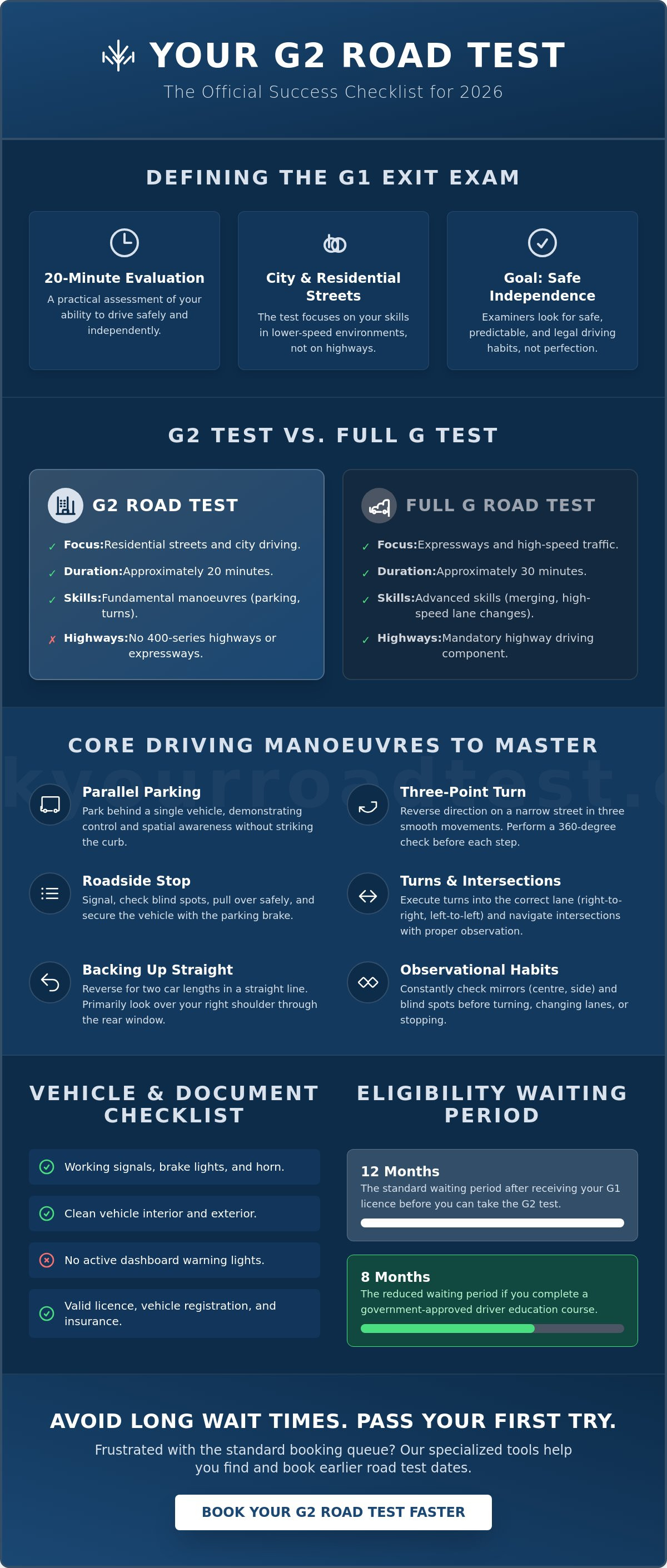
The G2 road test, commonly referred to as the G1 exit exam, is your first practical assessment in the driver licensing process. It marks the transition from being a supervised learner to a driver capable of navigating roads independently. This 20-minute evaluation takes place on city streets and residential areas to ensure you can manage basic traffic flow without assistance. It is a core component of the Graduated Driver Licensing system, which is designed to reduce risks for new drivers by introducing privileges in stages.
Passing this test grants you a G2 licence. This level of licensing significantly reduces the restrictions found at the G1 stage, though you must still maintain a zero blood alcohol level and ensure every passenger has a working seatbelt. Understanding exactly what do they test you on g2 road test is the first step toward securing your independence on the road. The examiner isn't looking for professional-level precision; they are looking for safe, predictable, and legal driving habits that show you won't be a danger to others.
Eligibility and Waiting Periods
You must meet specific provincial requirements before you can book your appointment. The standard waiting period is 12 months after you receive your G1 licence. You can shorten this wait to 8 months by completing a government-approved driver education course. We recommend checking your eligibility dates early to avoid disappointment when trying to secure a spot through a G2 Road Test Booking Service. Keeping your driving record clean during this phase is mandatory. Any suspensions will reset your progress and delay your ability to move to the next level of the licensing programme.
The Difference Between G2 and G Road Tests
Many applicants feel intimidated because they confuse the requirements of the G2 test with the final G test. When people ask what do they test you on g2 road test, the answer usually focuses on city-specific challenges rather than high-speed highway merging. The G2 road test focuses entirely on fundamental vehicle control within lower-speed environments. You will stay on local roads and will not be required to drive on 400-series highways or high-speed expressways. In contrast, the full G test evaluates advanced skills like highway merging and lane changes at high speeds. For your G2 attempt, the priority remains on how you interact with pedestrians, stop signs, and intersections in a city setting.
- G2 Road Test: Focuses on residential streets, takes 20 minutes, and requires basic manoeuvres.
- G Road Test: Focuses on expressways, takes 30 minutes, and requires advanced traffic interaction.
Core Driving Manoeuvres: Mastering Parallel Parking and Three-Point Turns
Technical proficiency in specific manoeuvres is the foundation of a successful attempt. When you ask what do they test you on g2 road test, the answer begins with your ability to manipulate the vehicle in tight spaces. Parallel parking is a mandatory component where you must park behind a single vehicle. The examiner evaluates your steering control, spatial awareness, and whether you maintain a safe distance from the curb. You don't need to be perfectly centred on the first try, but you must demonstrate that you can adjust safely without striking the curb or surrounding objects.
The three-point turn is another critical skill designed to show you can reverse direction on a narrow street. This must be executed smoothly in three distinct movements without blocking traffic for an extended period. You must perform a full 360-degree check before each movement to ensure the way is clear. Similarly, roadside stops require you to signal, check your blind spots, and pull over safely to the right. Once stopped, you must secure the vehicle by engaging the parking brake. If you are struggling to find a nearby location to practice these skills, using a G2 Road Test Booking Service can help you secure an appointment at a centre with familiar road layouts.
Backing up in a straight line is often overlooked but remains a standard requirement. You will be asked to reverse for a specific distance, usually about two car lengths, while maintaining a straight path. The key here is your observational habit; you must look over your right shoulder through the rear window rather than relying solely on your mirrors or a backup camera.
Precision in Turns and Intersections
Examiners watch your lane discipline closely during every turn. You must execute right turns into the rightmost lane and left turns into the leftmost lane, even if you plan to change lanes later. Managing the right-of-way at four-way stops and uncontrolled intersections is vital. You should arrive at a complete stop, establish eye contact with other drivers if necessary, and proceed only when it is your turn. Maintaining a consistent speed and proper lane positioning throughout the turn shows the examiner you are in full control of the vehicle's trajectory.
Parking and Hill Starts
Hill parking requires specific wheel positioning to prevent the car from rolling into traffic. For uphill parking with a curb, turn your wheels to the left. For all other scenarios, including downhill parking or parking on a shoulder without a curb, turn your wheels to the right. You should also be prepared for an "emergency stop" procedure. This involves pulling over quickly but safely, activating your hazard lights, and securing the car as if it had broken down. Proactive preparation regarding Vehicle Safety and Documentation ensures that your car is actually eligible to perform these manoeuvres on the day of your evaluation.
Observational Habits: The Critical Skills Examiners Watch For
Examiners rely on a standardized marking sheet to quantify your awareness on the road. When considering what do they test you on g2 road test, many applicants focus purely on the car's position, but your eye and head movements are equally weighted. You must demonstrate a consistent scanning pattern throughout the entire drive. This includes checking your rearview mirror every 5 to 8 seconds during normal driving to maintain a 360-degree view of your surroundings. If you fail to show this rhythm, the examiner may mark it as a lack of situational awareness, even if your vehicle control is perfect.
Intersections require even more rigorous observation. You must scan from left to right before entering any intersection, even if you have a green light. This habit proves you are looking for potential red-light runners or pedestrians who might step into the roadway. Understanding what do they test you on g2 road test helps you focus on these defensive habits that distinguish a safe driver from one who is merely following the rules. Blind spot checks, or shoulder checks, are also mandatory before every single lane change or turn to ensure no cyclists or vehicles are hidden from your mirrors.
The "Exaggerated Head Movement" Technique
Moving your eyes is often insufficient for an examiner to record a successful check. They sit in the passenger seat and cannot always see where your pupils are directed. You must physically move your head so the motion is visible. If you wear a baseball cap, the brim should clearly shift left and right. Some drivers find it helpful to quietly verbalize their actions, saying "checking mirror" or "scanning left" to ensure the examiner notes the habit. This creates a clear rhythm for checking side mirrors and the rearview mirror in a way that is impossible to miss.
Space Management and Following Distance
Space management is the physical evidence of your observational skills. You must maintain a safe three-second following distance behind the vehicle in front. This provides necessary reaction time for unexpected stops. When coming to a full stop behind another car, ensure you can see their rear tires touching the pavement. This gap allows you to steer around them if they stall or if you need to move quickly to avoid a rear-end collision. You should also adjust your lane positioning to avoid "door zones" near parked cars, demonstrating that you are constantly processing the information you observe.
Pre-Test Checklist: Vehicle Safety and Documentation
Preparation involves more than just mastering the steering wheel. Many applicants spend weeks practicing their manoeuvres only to have their appointment cancelled before the engine even turns on. When considering what do they test you on g2 road test, you must realize that the evaluation begins with a mandatory vehicle safety inspection. If your car fails to meet provincial standards, the examiner will refuse to conduct the test. This results in a lost attempt and the frustration of having to rebook your session.
The examiner will conduct a walk-around to verify that all essential safety components are functional. You must ensure that both brake lights, all signal lights, and the horn are in perfect working order. The windshield must be free of major cracks, particularly those that obstruct the driver's field of vision. Tires are another common point of failure. They must have adequate tread depth and cannot be "space-saver" spares designed only for temporary emergency use. If your vehicle is deemed unsafe for any reason, the test ends immediately.
Required Documentation to Bring
You must present your physical G1 driver’s licence card upon arrival. Photocopies or digital versions are not accepted and will lead to an immediate refusal. Additionally, you need to provide current vehicle insurance and ownership papers. If you are attempting the test after only 8 months because you completed a government-approved driver education course, ensure your records are updated in the system. Organizing these documents in a clear folder shows the examiner that you are a responsible applicant. If you need to find a new appointment date due to a previous cancellation, you can use our G2 Road Test Booking Service to secure a slot quickly.
Vehicle Interior and Cleanliness
The interior of your car must be safe and accessible for the examiner. The passenger-side door must open easily from both the inside and the outside. If the handle is broken or the door is jammed, the examiner cannot enter the vehicle, and the test will be cancelled. Seatbelts for both the driver and the examiner must be in perfect mechanical condition. Finally, remove any clutter from the dashboard and seats. A clean environment allows the examiner to observe your habits without distraction and demonstrates that you take the responsibilities of driving seriously.
Booking Your Appointment and Managing Your Road Test Schedule
Booking your G2 road test through the official DriveTest portal is the standard approach, but it often requires navigating wait times that stretch several months into the future. This administrative backlog is a significant source of anxiety for many new drivers who are eager to gain their independence. While you focus on studying what do they test you on g2 road test, we can help streamline the scheduling process as an autonomous service provider. Fees are collected at the time of booking, and it is vital to remember that these are non-refundable if you cancel without sufficient notice. To ensure a smooth start on your test day, plan to arrive at the centre at least 30 minutes before your scheduled slot to complete the check-in process.
Managing the logistics of your appointment requires the same level of attention as your actual driving practice. Using a G2 Road Test Booking Service can help you organize these administrative details, allowing you to focus entirely on your skills behind the wheel. We understand the urgency of securing a date, especially when personal or work commitments depend on your ability to drive. By using a professional facilitator, you can avoid the frustration of the official system's limitations and move toward your G2 licence with greater efficiency and less stress.
How to Secure an Earlier Date
Finding a sooner date requires a proactive strategy. One common method is checking the official system during off-peak hours, such as late at night or very early in the morning, when new slots might appear. However, this manual process is time-consuming and often frustrating. A more efficient alternative is using a road test cancellation finder Ontario to automate the search for you. This tool monitors the system for openings that occur when other applicants reschedule. Additionally, being flexible with your testing location can significantly reduce your wait. Choosing a DriveTest centre slightly outside your immediate area often reveals sooner availability than high-demand urban centres, allowing you to move through the graduated licensing system faster.
Final Preparation Tips for Test Day
Once your date is secured, spend time practicing in the specific neighbourhood surrounding your chosen DriveTest centre. This helps you familiarize yourself with local speed limits, school zones, and unique intersection layouts. Knowing the area reduces the cognitive load during the actual evaluation. Managing test anxiety is equally important; use deep breathing or visualization techniques to stay calm. Realize that the examiner is a professional safety auditor, not an adversary. Their goal is to verify that you have mastered what do they test you on g2 road test so you can drive safely on your own. If you stay organized and follow this success checklist, you'll be well-positioned for a first-time pass.
Secure Your G2 Licence with Confidence
Passing your G2 road test requires a strategic blend of technical skill and proactive preparation. By mastering essential manoeuvres like parallel parking and maintaining strict observational habits through visible head movements, you demonstrate to the examiner that you are a safe, independent driver. It is equally important to ensure your vehicle is in perfect working order to avoid an immediate disqualification before the test even begins. Now that you understand what do they test you on g2 road test, the only remaining hurdle is the administrative challenge of securing a convenient appointment date.
We provide stress-free administrative support to help you manage your booking at over 60 centres across the province. Our proprietary search tool allows you to secure earlier dates by identifying cancellations without the frustration of manual searching. Skip the wait and book your G2 road test today to move one step closer to your full driving privileges. You have done the hard work of learning the rules of the road; let us handle the logistics of getting you behind the wheel for your evaluation. Stay focused on your defensive driving habits and you will be ready for success on test day.
Frequently Asked Questions
How long does the G2 road test take?
The G2 road test typically takes about 20 minutes to complete from start to finish. This duration includes the initial vehicle safety inspection performed by the examiner and the actual driving portion on local residential and city streets. You should plan to be at the DriveTest centre for at least an hour to account for check-in procedures and the processing of your results after the drive is finished.
What happens if I fail my G2 road test?
If you don't pass your attempt, you must wait a minimum of 10 days before you can take the test again. You'll also need to pay the additional road test fee for each subsequent attempt after the first one included in your G1 package. This waiting period provides an opportunity to review the examiner’s feedback and practice the specific manoeuvres that caused the deduction of points.
Do I have to drive on the highway for a G2 test?
No, you aren't required to drive on 400-series highways or high-speed expressways during this specific evaluation. The G2 road test is designed to assess your ability to navigate safely through residential areas and city intersections. High-speed highway driving and merging are skills reserved for the final Class G road test, which you can take after holding your G2 licence for 12 months.
Can I use a backup camera during my parallel park?
You can use a backup camera as a secondary aid, but you must not rely on it as your primary observational tool. Examiners specifically watch for physical head movements and over-the-shoulder checks during reversing manoeuvres. Relying solely on the dashboard screen is a common error when people ask what do they test you on g2 road test; you must demonstrate that you can observe your surroundings manually.
What are the most common reasons for failing the G2 test?
The most frequent reasons for failure include committing a traffic violation, such as failing to stop completely at a stop sign, or performing an action that requires the examiner to intervene. Other common issues involve a lack of observation, such as failing to check blind spots or mirrors consistently. Cumulative minor errors on the marking sheet can also lead to an unsuccessful result if they show a pattern of unsafe habits.
Can I use my own car for the G2 road test?
You can use your own car, a rental, or a vehicle borrowed from a friend, provided it is in good working order. The vehicle must be fully insured, properly plated, and meet all provincial safety standards, including functional signal lights and a clear windshield. If the examiner identifies a safety defect during the pre-test check, they'll cancel the appointment and you'll have to rebook for a later date.
How many mistakes are allowed on the G2 road test?
There isn't a specific number of allowed mistakes because the marking system weighs different errors with varying point values. While you can lose a few points for minor technical errors, a single "major" mistake or a dangerous action results in an immediate failure. The examiner evaluates your overall ability to drive safely and predictably; as long as your total score stays above the passing threshold, you'll receive your licence.
What should I do if my G1 licence is about to expire?
If your G1 licence is approaching its five-year expiry date, you must pass your G2 road test before that date to avoid starting the process over. Passing the test typically allows you to pay a fee to extend your licensing period while you work toward your full G. If you're struggling to find a date before your expiry, using a specialized booking service can help you find a cancellation slot quickly.


