
What if the most stressful three minutes of your driving career didn't have to be a gamble against the curb? If you're preparing for an upcoming appointment, you likely feel the pressure of an examiner watching your every head movement while you attempt to slot into a tight space. While Ontario officially streamlined the full G test in January 2022 to prioritize highway merging and high-speed lane changes, many drivers still look for g road test parallel parking tips to ensure their foundational skills are sharp. It's natural to worry about hitting the concrete or losing track of your allowed adjustments when the stakes are this high.
We realize that you need a clear plan to replace that test-day anxiety with professional precision. This guide provides the essential reference points and 360-degree observation techniques you need to master the manoeuvre on any street. You will find a clear mental checklist to follow during your test and a transparent look at the automatic fail criteria that examiners look for. We'll help you understand exactly what is expected so you can approach your G road test booking with the confidence of a seasoned driver.
Key Takeaways
- Understand the context of technical manoeuvres within the current Ontario evaluation framework and why foundational skills remain vital for road safety.
- Implement essential g road test parallel parking tips by mastering the 4-step reference point method to anchor your rear bumper with precision.
- Learn the specific observation standards and the "Curb Rule" required to avoid automatic fails during low-speed technical manoeuvres.
- Discover how to use DIY practice drills with pylons or household items to build the muscle memory needed for real-world parking scenarios.
- Complete a final vehicle readiness checklist to ensure your car meets safety standards before arriving for your G road test booking.
The Role of Parallel Parking in Your G Road Test
Ontario's driving landscape changed significantly in January 2022. While the Ministry of Transportation modified the full G road test to focus on highway safety and lane management, the ability to control your vehicle in tight spaces remains a hallmark of a fully licensed driver. If you're looking for g road test parallel parking tips, you're likely aiming for that level of professional fluidity that separates a novice from a veteran. Transitioning from high-speed highway merging to the quiet, technical environment of a residential street requires a mental shift. Examiners aren't just looking to see if you can fit between two cars; they're evaluating your 360-degree awareness and your ability to remain calm when the pace of the test slows down.
A "G" class driver is expected to be more decisive than a "G2" beginner. On your G2 test, you might have been forgiven for a hesitant approach or multiple minor corrections. On the full G test, the expectation is maturity. You must demonstrate that you can reintegrate into traffic flow without causing other drivers to brake or swerve. Precision matters, but your confidence during the execution is what truly signals to the examiner that you're ready for a permanent licence.
Is Parallel Parking Mandatory on Every G Test?
As of June 2026, the modified G road test in Ontario officially excludes parallel parking, three-point turns, and roadside stops to help manage high volumes at DriveTest centres. However, you should never arrive at your appointment unprepared. Requirements can shift based on Ministry updates, and foundational skills are often evaluated indirectly through your general steering and positioning. Parallel parking remains a core competency of the Ontario Driver’s Handbook. Treating every test as if the manoeuvre is a certainty ensures you aren't caught off guard if the examiner asks you to demonstrate your low-speed control in a residential zone.
G2 vs. G Expectations: The Maturity of the Manoeuvre
The jump from a G2 to a full G licence represents a shift from "learning to drive" to "driving with experience." When you perform technical manoeuvres, the examiner looks for seasoned habits. This includes smoother steering movements and more frequent, natural mirror checks. Beginner drivers often "stare" at their reference points; experienced drivers use them as brief guides while keeping their eyes moving. If you're using a G Road Test Booking Service to secure your spot, ensure your practice sessions focus on this decisive movement. A G-level driver doesn't just park; they manage the entire street's safety while doing so. Your ability to signal early, check your blind spots, and park within the allowed three minutes shows you've moved beyond basic mechanics into true road mastery. Use these g road test parallel parking tips to refine your technique so that your performance feels like a natural habit rather than a rehearsed drill.
The 4-Step Reference Point Method for Perfect Parking
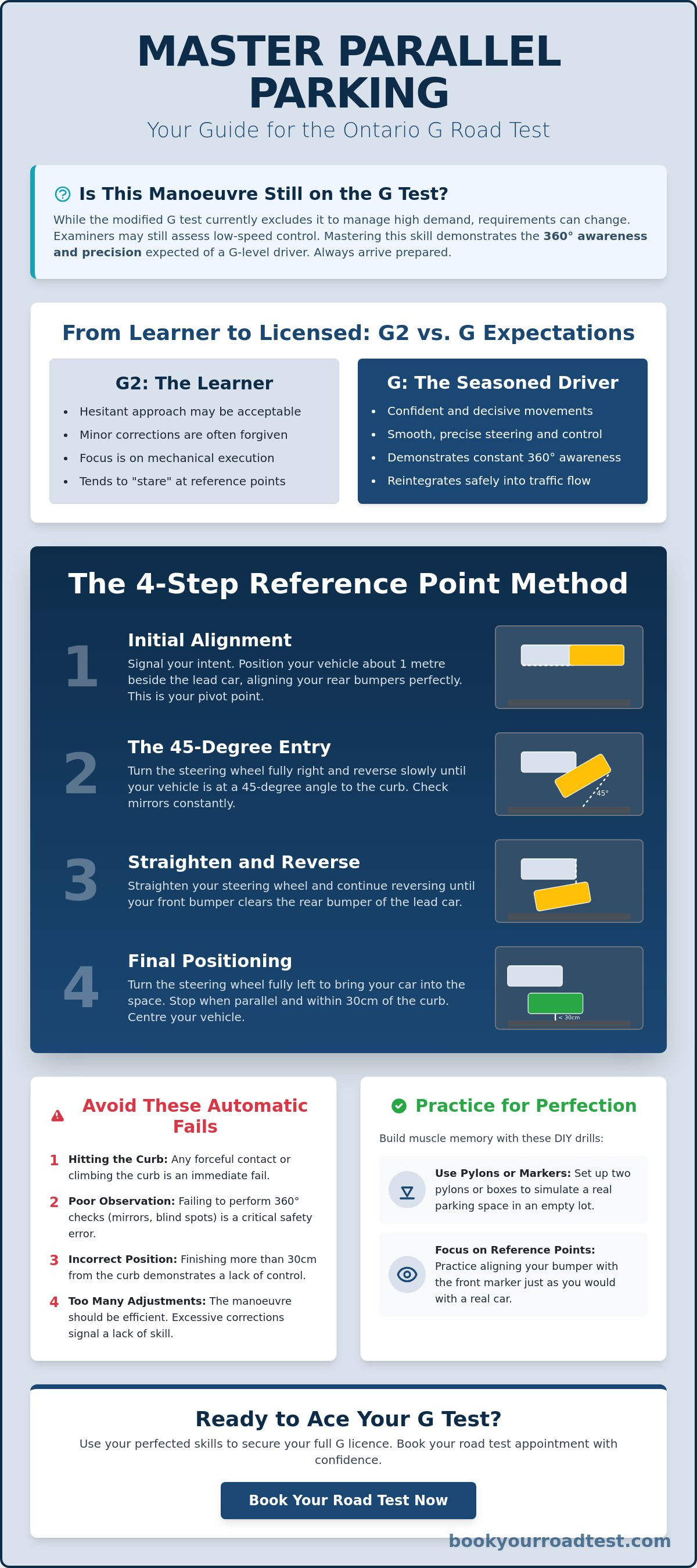
Mastering the mechanical steps of parallel parking transforms a high-stress manoeuvre into a predictable routine. By following these g road test parallel parking tips, you can eliminate the guesswork that often leads to test-day nerves. The process relies on four distinct phases that guide your vehicle safely into the space without risking contact with the curb or other cars.
First, you must signal your intention early to inform the examiner and other road users of your plan. Second, you align your rear bumper with the lead vehicle to create a stable pivot point. Third, you establish a precise 45-degree angle to enter the space effectively. Finally, you straighten the wheels and tuck the front end in to finish parallel to the curb. Following expert parallel parking advice from safety professionals ensures you maintain a safe buffer between vehicles at all times. Once you've refined these steps, using a G Road Test Booking Service can help you find a convenient time to demonstrate your skills.
Mastering the Initial Alignment
Success begins before you even shift into reverse. You should pull up beside the lead vehicle, maintaining a lateral distance of approximately one metre. This specific gap provides enough room for your front end to swing out as you reverse without hitting the car beside you. A standard sedan parallel start position requires your rear bumper to align exactly with the rear bumper of the lead vehicle while maintaining a lateral gap of one metre. To judge this from the driver's seat, look for the lead vehicle's rear bumper to appear in the middle of your rear passenger-side window. If you're driving an SUV, this reference point might shift slightly toward the back of the glass, so practising in your specific vehicle is essential for consistency.
The Turning Point: When to Cut the Wheel
Once aligned, shift into reverse and perform a full 360-degree check. When the area is clear, turn your steering wheel fully to the right (lock-to-lock) and begin backing up slowly. You're looking for the "sweet spot" where your car sits at a 45-degree angle to the curb. A common mistake is turning the wheel too slowly or too late, which often results in "curb-checking" or being forced to make multiple adjustments that can count against your score. Watch your driver-side mirror; you should see the entire front of the car behind you once you've reached the correct angle. At this point, straighten your wheels and continue backing until your front bumper clears the lead vehicle's rear corner. You'll know you've hit the "curb-meet" point when your passenger-side mirror shows the front door handle overlapping the curb line. Finish by turning the wheel fully to the left to bring the front end in line. Precision at this stage proves to the examiner that you have total control over your vehicle's dimensions and have internalized these g road test parallel parking tips.
Avoiding Automatic Fails and G Test Standards
Understanding the difference between a minor error and an automatic fail is the key to passing your evaluation. For a G licence, examiners expect a higher level of maturity than they did during your G2 test. While the technical steps are the same, the focus shifts toward how your actions impact the safety of the surrounding environment. One of the most common g road test parallel parking tips involves mastering the "Curb Rule." Touching the curb gently with your tire is often recorded as a minor deduction. However, if your vehicle climbs the curb or strikes it with significant force, the examiner will likely terminate the test immediately. This distinction exists because climbing a curb suggests a loss of vehicle control that could be dangerous in a real-world setting.
Observation remains the most critical component of the manoeuvre. You must perform a full 360-degree check before shifting into reverse and keep your signal active throughout the entire process. If another vehicle approaches while you are mid-park, the safest action is to stop and wait. Forcing another driver to swerve or brake suddenly to avoid your front-end swing is a major error. Demonstrating that you prioritize traffic flow over finishing the park quickly proves you have the temperament of a fully licensed driver. It shows you aren't just following a checklist but are actively managing the road.
Observation Habits That Impress Examiners
Examiners need to see that you're looking, so use exaggerated head movements to ensure they record your blind spot checks. Don't just rely on your mirrors; physically turn your head to check behind you and to the sides every three to five seconds. You also need to monitor your front-end swing as you cut the wheel. Many drivers focus so much on the curb that they forget the front of their car is swinging out into the live lane of traffic. A G-level driver manages both ends of the vehicle simultaneously to prevent clipping passing cars or cyclists.
Major vs. Minor Deductions
Precision is measured by your final distance from the curb. Your goal is to be within 30cm (12 inches) of the concrete. Being slightly too far away is a minor deduction, but parking so far out that you obstruct traffic is a major problem. You are typically allowed three adjustments to get into the space. If you find yourself needing more, it suggests a lack of familiarity with your vehicle's dimensions. Additionally, ensure you don't park too close to the lead vehicle. You need enough space to pull out safely without reversing again, which usually means being able to see the rear tires of the car in front of you from the driver's seat. Following these g road test parallel parking tips will help you stay within the scoring margins required for success.
Real-World Practice: Drills for Perfection
Muscle memory is your greatest ally when the examiner is sitting next to you with a clipboard. You can't rely on theory alone; you need to feel the vehicle's pivot point in your hands. To build this intuition, find a quiet parking lot or an empty residential street to set up your own practice centre. Use pylons, weighted garbage bins, or even laundry baskets to simulate the corners of other vehicles. These g road test parallel parking tips are most effective when you repeat the motion until you no longer have to think about which way to turn the wheel. Aim to complete the entire manoeuvre in under two minutes. While the official time limit is more generous, being fast and fluid demonstrates to the examiner that you're a confident, seasoned driver.
Don't just practice on sunny days. Ontario's weather is unpredictable, and you should be comfortable parking in rain or light snow. Precipitation can distort your mirror depth and make the curb harder to see. Practising in varied conditions ensures that a sudden downpour during your appointment won't rattle your focus. If you're ready to put these drills into action, using a G Road Test Booking Service can help you secure a time slot at a location where you've already scouted the local streets.
The Single-Vehicle Scenario
In many residential evaluation zones, you won't find a perfect gap between two cars. Instead, the examiner might ask you to park behind a single vehicle with nothing but open road behind it. This is often more difficult for beginners because they lose the rear car as a reference point. To master this, use the "imaginary box" method. Visualize where a second car would be and ensure you stay within that 6-metre space. G examiners often prefer this scenario because it forces you to demonstrate true spatial awareness rather than just matching your bumper to another car. You must still signal, check your blind spots, and finish parallel to the curb as if you were in a tight downtown spot.
Correcting a Bad Start
Even experienced drivers sometimes misjudge their initial angle. If you realize you're too wide or too narrow as you start to reverse, don't try to force a bad angle into a good result. You're generally allowed to pull forward once to reset your position without it counting as a failed attempt. The key is communication. Tell the examiner, "I'm going to pull forward to correct my alignment." This shows you're aware of your vehicle's position and are taking proactive steps to fix it. A calm, controlled reset is always better than hitting the curb or finishing 50cm away from the concrete. These g road test parallel parking tips are about management and recovery, not just a single perfect "one-shot" entry.
Securing Your Test Date and Final Preparation
Your vehicle's condition is the first thing an examiner notices before you even leave the parking lot. Ensure all brake lights, turn signals, and headlights function perfectly; a single burnt-out bulb will result in an immediate cancellation of your appointment. Clear your mirrors and windows of any streaks to maintain maximum visibility during your technical manoeuvres. A clean, organized interior provides a psychological edge. It suggests to the examiner that you're a disciplined driver who takes road safety seriously. Applying these g road test parallel parking tips won't help if your vehicle fails the initial safety inspection, so perform a full walk-around check the night before.
On the morning of your test, arrive at least 30 minutes early to check in at the kiosk. This buffer time allows you to settle your nerves and observe the local traffic patterns around the centre. Bring your current G2 licence and ensure you have your highway driving declaration ready, as you must confirm your recent experience on high-speed roads. Having a final checklist that includes your spectacles, if required, and a bottle of water can help you stay focused during the 20 to 30-minute evaluation. Being organized is the best way to combat the pressure of the examiner watching your every move.
Booking Your G Test Efficiently
Navigating the significant backlog at DriveTest centres across Ontario requires a strategic approach. High demand for appointments often means waiting months for a local opening, which can stall your progress toward a full licence. If you're in a hurry, using a road test cancellation finder is an effective way to secure an earlier date. This tool monitors the system for slots that open up due to other candidates rescheduling. While official government booking is available, many drivers prefer autonomous services for their speed and ease of use. It's important to realize that third-party booking services charge administrative fees to manage the search and scheduling process on your behalf. This cost covers the convenience of finding a time-sensitive appointment without the frustration of manual searching.
Final Preparation Tips
If you're a multi-class driver, you might also be reviewing requirements for the M2 road test or other licence types. Each test has its own specific technical demands, but the core principles of observation and control remain the same. To manage pre-test anxiety, use visualization techniques to walk through your g road test parallel parking tips while sitting in your parked car. See yourself checking your blind spots, hitting your reference points, and finishing perfectly parallel to the curb. This mental rehearsal builds the confidence needed to perform under pressure. Once you feel prepared, take the final step to secure your future on the road. Book your G road test today and get on the road sooner!
Take the Wheel with Confidence
Mastering technical control is about more than just passing a specific evaluation; it's about proving you have the maturity to manage any street safely. By internalizing these g road test parallel parking tips, you've replaced test-day anxiety with a systematic, professional approach. You now realize that reference points are your guides, but consistent 360-degree observation is what truly impresses an examiner. Whether you're parking behind a single vehicle or navigating a tight residential gap, your ability to remain calm and decisive is the hallmark of a fully licensed driver.
Now that you've refined your technique, the only thing left is to secure your appointment. We act as an autonomous facilitator to help you navigate the province's busy scheduling system. With access to over 60 DriveTest centres and a convenient cancellation finder service, we simplify the process of getting you on the road. We maintain corporate legitimacy through transparent administrative service fees, ensuring you know exactly what to expect. Skip the wait and book your G road test now to put your preparation into practice. Your permanent licence is within reach, and we're here to help you cross the finish line with ease.
Frequently Asked Questions
Do I have to parallel park on the G road test in Ontario?
No, the Ministry of Transportation officially removed parallel parking from the full G road test in January 2022 to streamline the evaluation process. The current test focuses primarily on highway driving, including merging and lane changes at high speeds. While the manoeuvre is not part of the standard G evaluation right now, practicing g road test parallel parking tips is still recommended to maintain the foundational skills required for safe daily driving in urban areas.
What happens if I hit the curb during parallel parking on my test?
Touching the curb lightly with your tire is usually recorded as a minor deduction, but climbing the curb or striking it with force is an automatic fail. This distinction is critical because mounting the curb suggests a significant loss of vehicle control. If you feel your tire nudge the concrete, you should stop immediately and adjust your position rather than continuing to reverse, which could lead to a more serious penalty.
How many attempts do I get to parallel park during the road test?
You are typically allowed three adjustments to successfully position your vehicle within the space. If you require more than three moves or exceed the three-minute time limit, the examiner will record a deduction for lack of skill. Efficiency is key; examiners look for a driver who can complete the manoeuvre quickly and confidently without obstructing the flow of traffic for an extended period.
Can I use a backup camera for parallel parking on the G test?
You may use a backup camera as a secondary aid, but it cannot be your primary source of information. You are required to demonstrate physical 360-degree checks and consistent mirror usage throughout the entire process. If an examiner notices you staring at the screen instead of turning your head to check blind spots and the front-end swing, you will lose points for poor observation habits.
How far from the curb should I be when parallel parked?
Your vehicle must be positioned within 30 centimetres, or approximately 12 inches, of the curb to be considered successful. Parking too far away from the concrete can create a hazard for passing traffic and cyclists, leading to a major deduction. Aiming for this specific distance proves you have a precise understanding of your vehicle's dimensions and can manage tight residential spaces effectively.
Is it an automatic fail if I can’t parallel park on the first try?
No, failing to slot the car in perfectly on your first attempt is not an automatic fail as long as you maintain safety. You are permitted to pull forward and reset your alignment once to correct a bad angle. As long as you don't strike the lead vehicle, climb the curb, or fail to check your surroundings, you can still pass the technical portion of the evaluation.
What is the most common reason people fail parallel parking on the G test?
Inadequate observation and failing to check blind spots are the most frequent causes of failure. Many drivers focus so much on their g road test parallel parking tips and mechanical reference points that they stop monitoring the street for approaching pedestrians or vehicles. Forgetting to signal your intention or failing to perform a full 360-degree check before shifting into reverse are considered major errors in judgement.
Do I need to park between two cars or just behind one?
You will almost always be asked to park behind a single vehicle rather than between two cars. This scenario is designed to test your spatial awareness, as you must visualize an imaginary box and stay within a 6-metre limit without a rear car to guide you. It requires a more sophisticated understanding of your vehicle's pivot points and final positioning relative to the curb.


