
What if your path to motorcycle freedom is blocked by a calendar rather than your riding skills? Many riders find themselves trapped in the high-pressure window between the mandatory 60-day waiting period and the final 90-day expiry of their M1 permit. It's a stressful situation, especially when you're struggling to find available dates at local centres. This guide helps you navigate the m2 road test requirements ontario with confidence, ensuring you don't lose your progress due to a scheduling oversight or a minor technicality.
You'll learn exactly how to prepare your bike for the pre-test inspection and which maneuvers you must master to satisfy the examiner. We provide a clear checklist of gear standards, including the mandatory DOT, Snell, or ECE helmet requirements; we also explain the recent 2026 residency declaration rules. As an independent facilitator, we understand the urgency of securing a spot before your time runs out. By the end of this article, you'll have a professional roadmap to transition from a learner to a licensed M2 rider without the typical administrative headaches.
Key Takeaways
- Understand the mandatory 60-day waiting period and the 90-day expiry limit to ensure you don't lose your M1 status before your test date.
- Review the essential m2 road test requirements ontario regarding motorcycle mechanical standards and approved helmet certifications to avoid an immediate disqualification.
- Master the specific low-speed maneuvers and exaggerated head checks required to demonstrate situational awareness to your examiner during the parking lot evaluation.
- Identify the major infractions that trigger an automatic failure so you can prioritize your practice sessions on high-stakes safety protocols.
- Learn how a specialized cancellation finder can help you secure an appointment at one of over 60 centres if you're struggling with peak-season availability.
Understanding the M2 Road Test Requirements in Ontario
Ontario manages motorcycle licensing through a graduated driver licensing (GDL) system. This phased approach helps new riders build technical skills before they face high-speed traffic. Moving from an M1 to an M2 licence requires passing a practical skills evaluation. Meeting the m2 road test requirements ontario involves more than just riding well; it requires precise timing and correct documentation.
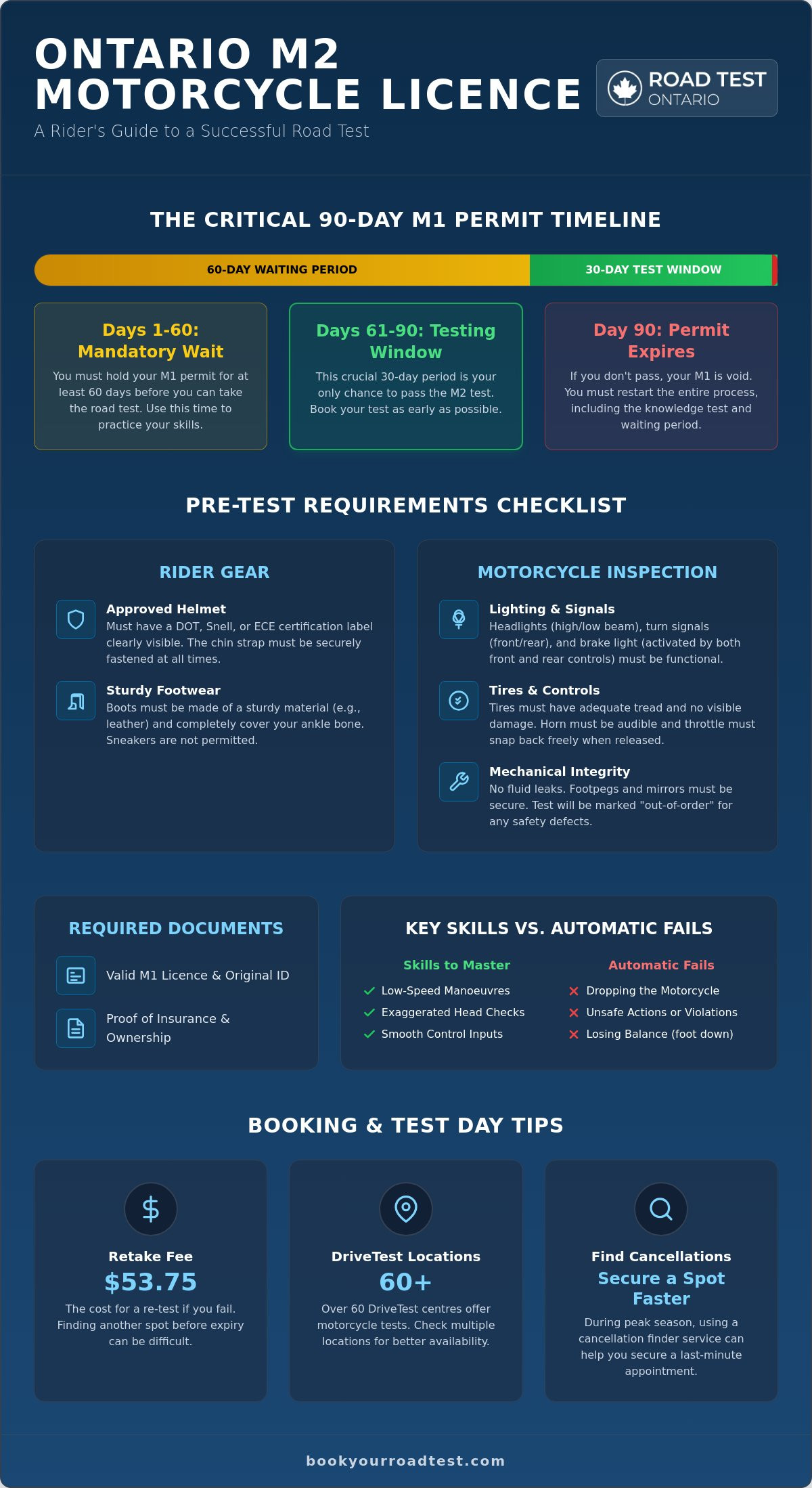
The most difficult part of the process is the tight timeline. You must hold your M1 permit for at least 60 days before you're eligible for the test. Your permit expires exactly 90 days after you get it. This leaves a tiny 30-day window to pass your road test. If you fail to pass within this timeframe, you lose your M1 status. You'll have to pay for a new knowledge test and start the 60-day wait all over again. While this guide focuses on Ontario, digital tools like Teorify illustrate how online preparation is becoming the standard for theoretical exams in other regions. Riders can choose between a private safety course or a direct test at a DriveTest centre. Choosing the DriveTest route means you're responsible for your own bike and scheduling.
Eligibility and Documentation
You can't test without the right paperwork. Bring your valid M1 licence and original identification to the appointment. You also need current proof of insurance and the ownership permit for your motorcycle. The examiner will check these items immediately. If your documents are expired or missing, your test will be cancelled, and you'll likely lose your booking fee. Ensure your bike is plated and the sticker is valid before arriving at the centre.
The M1 to M2 Transition Timeline
Find your M1 issue date and count forward 60 days to find your first available test slot. Don't wait until the final week of your permit to book. If you fail, the retake fee is $53.75. Finding a new date before your 90-day expiry can be nearly impossible during the busy summer months. Smart riders book their test early in that 30-day window. This gives you time to reschedule if a mechanical issue or a weather delay occurs. If you're nearing your expiry date and haven't secured a spot, checking for cancellations at various centres is your best strategy to avoid starting over.
Essential Equipment and Motorcycle Requirements
Passing the practical evaluation requires more than just riding skill. Your motorcycle must be in peak mechanical condition to satisfy the m2 road test requirements ontario. If the examiner identifies a safety defect during the initial inspection, they'll mark the test as "out-of-order." This result is frustrating because it counts as a missed opportunity during your narrow 90-day M1 window. You don't want to lose your booking fee because of a burnt-out bulb or a loose mirror.
The motorcycle you bring must be appropriate for the Class M2. It must be plated, insured, and fully functional according to the Highway Traffic Act. If you're using a borrowed bike, double-check the ownership and insurance documents before you arrive. Ensuring your vehicle is ready is the first step; the next is finding an M2 road test booking at a centre that works for you.
Pre-Test Motorcycle Inspection Checklist
Examiners follow a standardized protocol to ensure every test vehicle is safe for the road. Use this checklist to verify your bike's integrity before your appointment:
- Lighting: Test your high and low-beam headlights. Ensure both front and rear turn signals work. Your brake light must activate when using either the front lever or the rear pedal.
- Tires and Wheels: Check for adequate tread depth. There should be no visible cracks, bulges, or embedded objects in the rubber.
- Controls: Your horn must be functional and audible. The throttle should snap back freely when released.
- Mechanical Integrity: Ensure there are no active fluid leaks. Footpegs must be secure, and mirrors must provide a clear view without vibrating excessively.
Approved Riding Gear Standards
Your personal equipment is just as important as the bike. You must wear a helmet that meets one of the three approved standards: DOT, Snell, or ECE. The chin strap must be securely fastened during the entire test. While the official Ontario government guide provides the baseline for legal riding, examiners have specific expectations for road tests.
Footwear is a frequent cause of test day rejection. You must wear sturdy boots that completely cover the ankle bone. Sneakers, even leather ones, are generally not permitted. Sturdy gloves and a dedicated riding jacket are highly recommended. These items don't just protect you; they signal to the examiner that you're a disciplined rider who respects the risks of the road. If you show up in a t-shirt or shorts, the examiner may refuse to conduct the test for safety reasons.
Mastering the Maneuvers: What Happens During the M2 Road Test
Most riders expect a high-speed evaluation in heavy traffic, but the M2 road test is primarily a demonstration of low-speed technical precision. The evaluation usually takes place in a controlled parking lot environment where an examiner observes your ability to handle the motorcycle's weight and balance. Meeting the m2 road test requirements ontario requires you to be hyper-aware of your surroundings. This awareness is demonstrated through exaggerated head movements. Because examiners cannot see where your eyes are looking behind a helmet visor, you must physically turn your head for every shoulder check and mirror look to prove you are scanning the area.
The examiner will provide specific instructions before each segment of the test. They generally use hand signals or verbal cues to tell you when to begin a maneuver. The scoring system is transparent but strict. Minor errors, such as stalling the engine or touching a foot to the ground during a turn, result in point deductions. However, major infractions like dropping the motorcycle, committing a dangerous action, or violating a traffic law will end the test immediately. For more administrative specifics, you can check the DriveTest M2 road test details before your scheduled date.
The Core Technical Maneuvers
Precision is the focus of the off-road portion. You will be asked to complete several specific tasks designed to test your steering and braking capabilities:
- Serpentine/Slalom: You must weave through a series of cones at a steady, controlled speed. This tests your ability to lean the bike and manage your line without hitting markers.
- Figure-Eight: This maneuver requires you to stay within a designated box while performing tight turns. It demonstrates your control over the steering lock and your balance at low speeds.
- Controlled Stop: You will accelerate to a specific speed and then bring the motorcycle to a smooth, complete stop on a designated mark. The examiner looks for proper use of both front and rear brakes without skidding.
Balance and Throttle Control
Technical skill also involves managing the motorcycle's power delivery. The following tasks evaluate your finesse with the clutch and throttle:
- The "Slow Ride": You must ride in a straight line at a walking pace for approximately 10 to 15 seconds. Putting a foot down or failing to maintain a straight path will result in a deduction.
- Shifting Gears: If space allows, you may be asked to demonstrate smooth upshifts and downshifts. The examiner looks for seamless transitions that do not upset the balance of the bike.
- Starting on a Grade: You must demonstrate the ability to start from a stopped position on an incline. This requires coordinated use of the rear brake and the clutch to prevent rolling backward.
Avoiding Automatic Failures and Common Mistakes
Riders often struggle with nerves when they realize their M1 is about to expire. This pressure can lead to unforced errors during the parking lot evaluation. If you find yourself in a situation where you need to retake your exam quickly, you can use a road test cancellation finder to secure a new date before your permit reaches its 90-day limit.
Instant Fail Scenarios
Certain actions result in an immediate "unsatisfactory" grade, regardless of how well you performed other tasks. These are classified as major infractions because they represent a significant safety risk. The following scenarios will end your test on the spot:
- Dropping the Motorcycle: If your bike touches the ground at any point after the test begins, the evaluation stops. This applies even if you are stationary.
- Dangerous Actions: Any move that requires the examiner or another person to intervene to avoid a collision is an automatic fail. This includes nearly hitting a cone or another vehicle.
- Traffic Law Violations: Even in a parking lot, you must respect basic traffic principles. Rolling through a stop sign or ignoring a directional arrow will result in a failure.
- Putting a Foot Down: While a single "dab" might only be a deduction in some segments, putting your foot down during a specific maneuver like the figure-eight can trigger a fail depending on the centre's specific criteria.
Common Points Deductions
Minor mistakes accumulate. While one or two won't result in a failure, a pattern of poor habits will. Examiners track these using a standardized score sheet. Frequent deductions include:
- Inadequate Observation: This is the most common error. If the examiner doesn't see your head move for a blind-spot check or a mirror glance, they assume you didn't do it.
- Wobbling or Poor Balance: Excessive steering corrections during the "slow ride" or serpentine indicate a lack of throttle and clutch coordination.
- Signal Management: Forgetting to cancel your turn signal after completing a maneuver is a common oversight that signals a lack of focus.
- Improper Lane Positioning: You must demonstrate that you know how to "block" your lane and maintain the safest path through a turn.
Booking Your M2 Road Test: Navigating Timelines and Cancellations
Securing a spot for your motorcycle evaluation is often the most frustrating part of meeting the m2 road test requirements ontario. During the peak riding months from May to September, DriveTest centres across the province face a massive surge in demand. Many riders find the official government booking portal difficult to use, especially when dates are scarce. If you're nearing your 90-day expiry, the pressure to find a slot becomes intense. We act as an independent concierge to simplify this process, providing a streamlined interface to manage your appointment across more than 60 regional locations.
Strategic Booking for M1 Holders
Riders should realize that waiting until the 60-day mark to look for a date is a mistake. To ensure you get a slot that fits your schedule, aim to start your M2 road test booking at least 45 days in advance. This lead time is crucial for popular locations like Toronto, Brampton, or London. When you use our service, you'll encounter a convenience fee in addition to the standard government testing fees. This fee covers our administrative support and the use of our proprietary search tools. We maintain full transparency about our status as an autonomous service provider, offering a stress-relief alternative to the standard government system for those who value efficiency.
The Advantage of a Cancellation Finder
If the local centres appear fully booked, don't panic. Slots frequently open up when other riders reschedule or cancel their appointments. Our road test cancellation finder Ontario monitors over 60 centres simultaneously to identify these sudden openings. This automated system is particularly helpful for riders who need a test immediately to avoid their M1 permit expiring. Instead of manually refreshing a webpage for hours, you can let our technology do the heavy lifting. This ensures you can secure a date at a convenient centre even during the busiest weeks of the year.
Before you head to the centre, verify this final checklist for your appointment:
- Original M1 licence and a secondary piece of identification.
- Valid motorcycle ownership and current proof of insurance.
- Approved helmet (DOT, Snell, or ECE) and ankle-covering boots.
- A motorcycle that has passed your personal mechanical inspection.
Book Your M2 Road Test Now and let us handle the scheduling stress while you focus on mastering your slow-speed maneuvers. We provide the support you need to move from an M1 to an M2 with total confidence.
Secure Your Motorcycle Licence with Confidence
Success on your road test depends on three distinct factors: mechanical preparation, technical skill, and logistical timing. You've learned how to verify your bike's safety, master the low-speed maneuvers, and avoid the major infractions that trigger automatic failures. Understanding the m2 road test requirements ontario is the foundation you need to transition from a learner to a licensed rider. However, the administrative burden of finding a date before your M1 expires shouldn't be the hurdle that stops your progress.
Our service acts as a professional facilitator for riders who want to bypass the frustration of official booking systems. We provide access to over 60 DriveTest locations across the province and utilize a proven cancellation finder to help you secure earlier dates. With dedicated administrative support, we ensure your licensing journey is as efficient as possible. Skip the wait and book your M2 road test today!
Take the final step toward your riding freedom. With the right preparation and a secured test date, you'll be on the road in no time.
Frequently Asked Questions
How long do I have to wait to take my M2 road test in Ontario?
You must wait a minimum of 60 days after obtaining your M1 licence before you can attempt the M2 road test. This mandatory waiting period is designed to ensure new riders have time to practice basic handling skills. Since the M1 permit is only valid for 90 days, you have a narrow 30-day window to complete your evaluation before your permit expires and you're forced to start the process over.
Can I take the M2 road test on a moped or limited-speed motorcycle?
Yes, you can take the test on a moped or limited-speed motorcycle, but your licence will be restricted. Passing with a limited-speed vehicle results in an M2-L or M2-M licence, which prohibits you from operating full-speed motorcycles or riding on 400-series highways. To obtain a full licence that meets all m2 road test requirements ontario without restrictions, you must use a motorcycle capable of maintaining highway speeds.
What happens if my M1 licence expires before my scheduled M2 test?
If your M1 licence expires before you pass your test, you'll have to restart the entire graduated licensing process. This means you must pay for and pass the M1 knowledge test again and wait another 60 days before you're eligible for another road test. To prevent this, many riders use a cancellation finder to secure an appointment before their 90-day permit window closes.
Do I need my own motorcycle for the M2 road test at DriveTest?
You must provide your own motorcycle for the road test because DriveTest centres don't supply vehicles for any licence class. The bike you bring must be plated, insured, and in full compliance with the Highway Traffic Act. If the examiner finds any mechanical defects during the pre-test inspection, such as a non-functional signal or a worn tire, they'll cancel your test immediately.
What are the most common reasons for failing the M2 road test?
The most frequent reasons for failure are inadequate observation and poor low-speed balance. Examiners look for exaggerated head movements to verify you're scanning your surroundings; simply moving your eyes isn't enough. Other common mistakes include putting a foot down during the figure-eight maneuver, stalling the engine, or failing to cancel turn signals. Any dangerous action or dropping the motorcycle results in an automatic failure.
Is the M2 road test conducted on public roads or in a parking lot?
The M2 road test is almost entirely conducted in a controlled parking lot environment. Unlike the full M test, which focuses on highway and street riding, the M2 evaluation is a technical skills test. You'll be required to navigate through cones and markers to demonstrate your balance, steering, and braking precision. This allows the examiner to observe your bike control in a safe, off-road setting.
Can I use a Bluetooth headset during my M2 road test?
You generally won't use a Bluetooth headset during a standard M2 technical skills test. Since the evaluation takes place in a parking lot, the examiner provides instructions verbally while you're stopped or uses standardized hand signals. If you're taking a version of the test that includes a road portion, the centre will usually provide a one-way radio or headset to ensure you can hear the examiner's directions.
How much does it cost to book an M2 road test in 2026?
The cost of your first M2 road test is included in the initial $159.75 M1 licence package fee paid at the start of your journey. This fee covers the knowledge test, your first road test attempt, and your five-year licence. If you fail your first attempt and need to book a retake, the 2026 fee for each subsequent M2 road test attempt is $53.75, payable to the DriveTest centre.


