
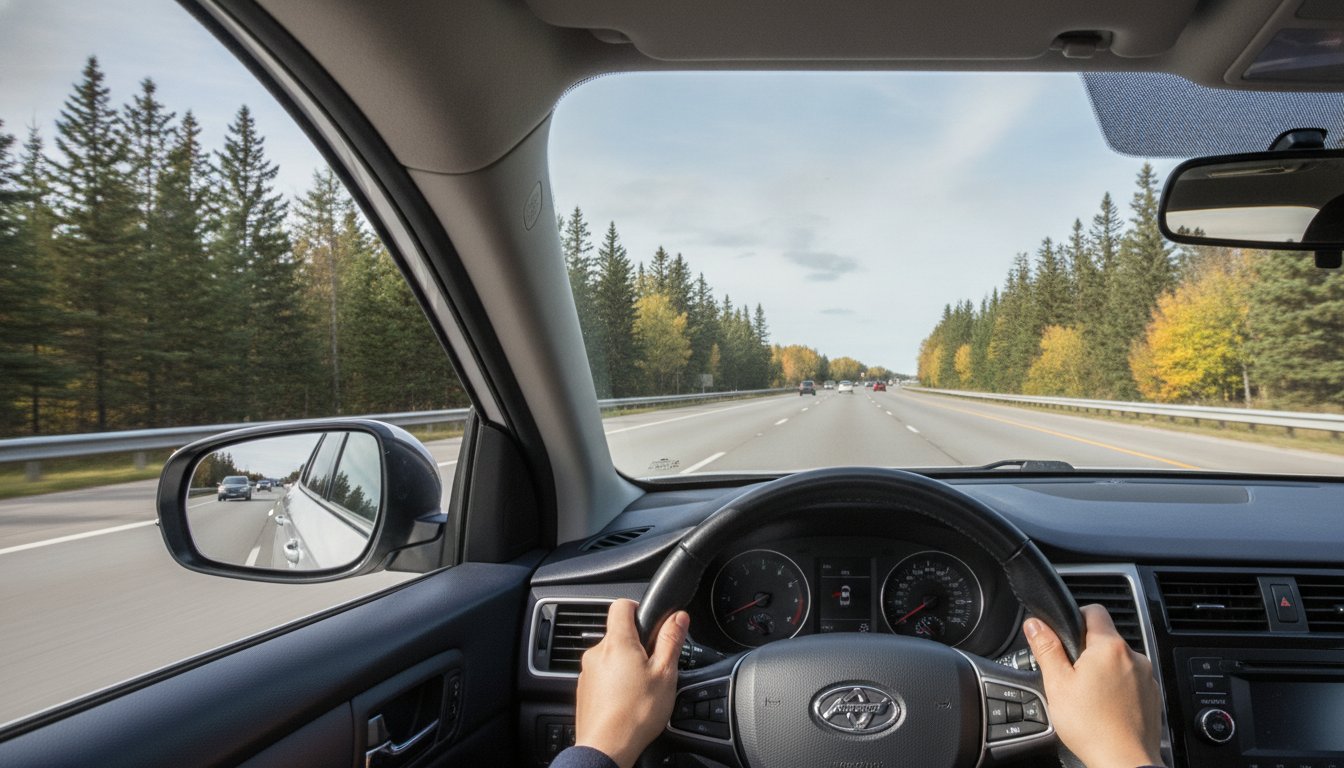
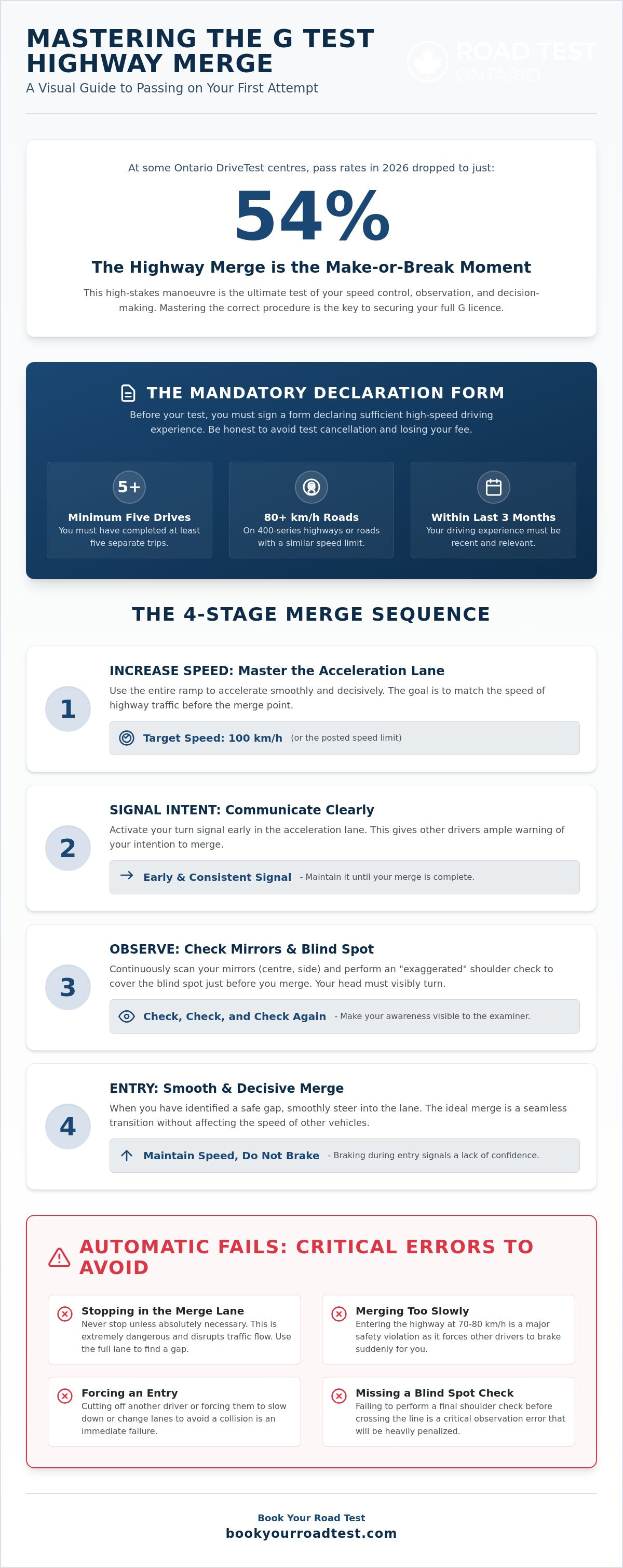
Did you know that pass rates at some Ontario DriveTest centres, such as Toronto Port Union, dropped to just 54% in 2026? A primary reason for these figures is the high-stakes nature of the highway portion of the exam. It is completely normal to feel a surge of anxiety when you see the acceleration lane approaching. You might worry about matching the speed of 400-series traffic or missing a critical blind spot check while the examiner marks their clipboard. Understanding exactly what examiners look for during g test highway merge is the most effective way to turn that nervousness into professional confidence.
We realize that merging is a choreographed safety demonstration where your observation skills are just as vital as your speedometer reading. This guide will help you master the exact sequence of signals and safety checks required to secure your full G licence. You will gain a clear understanding of speed requirements on the ramp and the specific timing examiners expect for a seamless entry into traffic. We provide a detailed look at the common pitfalls to avoid so you can approach your appointment with certainty. By following this 2026 guide, you can prepare to merge at highway speeds and pass your G test on the first attempt.
Key Takeaways
- Learn the precise 4-stage sequence required to demonstrate high-speed decision-making and vehicle control on the acceleration ramp.
- Identify exactly what examiners look for during g test highway merge to ensure your observation skills and speed matching meet provincial standards.
- Understand how to avoid fatal errors, such as stopping at the end of the merge lane, which result in an automatic failure.
- Master the "Move Over" rule and proper following distances to maintain safety while travelling at highway speeds.
- Discover how to secure a G road test appointment efficiently using a professional booking service to bypass long wait times.
The Highway Merge: Why It Is the Make-or-Break Moment of Your G Test
The G test represents the final hurdle in Ontario's graduated licensing system, moving beyond basic residential handling to high-speed environments. The highway merge is the smooth integration into traffic flow without disrupting other vehicles. Examiners prioritize this specific task because it serves as a critical test of high-speed decision-making and precise vehicle control. Because the merge involves high velocities and complex lane changes, it is considered the highest-risk manoeuvre on the entire exam. While a G2 test focuses on your ability to follow basic rules, the full G test requires you to demonstrate advanced awareness and a proactive driving style.
Success depends on your grasp of traffic merging principles to ensure you don't force other drivers to adjust their speed or lane position. A single hesitation at 100 km/h can create a dangerous ripple effect for kilometres. This is why understanding what examiners look for during g test highway merge is essential for any candidate aiming for a first-time pass. The examiner needs to see that you can handle the vehicle with confidence while maintaining the safety of everyone sharing the road.
The Declaration of Highway Driving Experience
Before your test officially begins, you must sign a mandatory Declaration of Highway Driving Experience form at the DriveTest centre. This document is a formal requirement to ensure you have logged enough time in high-speed environments to be safe on the road. Specifically, you must declare that you have driven on a 400-series highway or a road with a speed limit of 80 km/h or higher at least five times in the preceding three months. It is vital to be honest on this form; if your experience is insufficient, the examiner is required to cancel the test, which often results in the loss of your pre-paid fee.
The Examiner’s Scorecard: An Overview
From the passenger seat, the examiner uses a specific scorecard to track your performance against provincial standards. They aren't just looking at your hands on the wheel; they are watching your eyes and head movements. You must use "exaggerated" head turns when checking your mirrors and blind spots to make your awareness visible to the person marking you. The scorecard distinguishes between minor errors, such as a slightly late signal, and "automatic fail" mistakes like merging too slowly or failing to check a blind spot. Knowing what examiners look for during g test highway merge allows you to prioritize these high-value safety checks during the most stressful parts of the drive.
The 4-Stage Merge Sequence: What the Examiner Is Marking
The highway merge isn't just one movement; it is a series of four distinct stages that must be executed with precision. Examiners break down your performance into the increase, the signal, the observation, and the entry. Each stage has its own set of criteria. If you fail to demonstrate mastery in even one area, it can jeopardize your entire result. Understanding what examiners look for during g test highway merge means recognizing that these stages often overlap and requires you to maintain total awareness of your vehicle's position relative to others.
Stage 1 involves the increase in speed, where you must use the length of the acceleration lane to match the flow of traffic. Stage 2 is the signal, which provides other drivers with notice of your intentions. Stage 3 is the observation phase, requiring a rigorous check of your surroundings. Finally, Stage 4 is the entry, where you smoothly transition into the live lane without touching the brakes. This final step is vital; any unnecessary braking during the entry phase signals to the examiner that you lack the confidence or judgment required for a full G licence.
Mastering the Acceleration Lane
The ramp is designed for one purpose: getting your vehicle up to highway speed. Examiners expect you to reach 100 km/h, or the posted limit, before you reach the end of the ramp. Merging at 70 or 80 km/h is a common error that forces highway traffic to slow down, which is a major safety violation. If you find yourself on a short ramp or in heavy traffic, you must still prioritize reaching a compatible speed. Don't merge too early. Use the full length of the lane to find a gap. If you are struggling to find a testing date to practice these skills, you can book your G road test through a streamlined service to secure a spot at a centre known for fairer merge lanes.
Observation and Blind Spot Checks
Observation is the backbone of a successful merge. The examiner follows the "Mirror-Signal-Blind Spot" (MSB) sequence closely. You should check your centre mirror first to gauge the speed of vehicles behind you, then your side mirror, and finally perform an obvious shoulder check. Knowing what examiners look for during g test highway merge helps you realize that this shoulder check must be visible; a quick glance with your eyes isn't enough. The Official MTO Handbook on Freeway Driving emphasizes that you must check your blind spot just before you move into the lane. This ensures no vehicles have moved into your path since your last mirror check. Examiners watch for this specific timing to confirm you are making decisions based on real-time data, not just habit.
Fatal Errors: Common Merge Mistakes That Lead to an Automatic Fail
While minor points can be deducted for small technical errors, certain actions result in an immediate "unsatisfactory" result. Understanding what examiners look for during g test highway merge is vital because the margin for error at 100 km/h is non-existent. The most frequent cause for an automatic fail is stopping at the end of the acceleration lane. This creates a dangerous obstacle for following drivers and makes it nearly impossible to enter the live lane safely. Unless traffic is completely stationary, you must keep moving. Stopping on a ramp signals a fundamental lack of highway driving competency.
Interfering with the flow of traffic is another critical error that will end your test. If you force a vehicle already on the highway to brake or change lanes to avoid a collision, the examiner must intervene or fail you. This usually happens when a candidate merges at a speed significantly lower than the surrounding traffic. According to the Official MTO Driver's Handbook, you must adjust your speed to match the vehicles already on the freeway. Additionally, failing to check your blind spot before moving into the highway lane is a fatal error. The examiner assumes you are moving into a space you haven't verified as clear, which is a high-risk gamble.
The Danger of Hesitation
Hesitation is often interpreted by examiners as a lack of confidence or poor judgment. Waiting for a "perfect" gap that is hundreds of metres long isn't realistic on busy Ontario highways. You must identify a safe gap and commit to it decisively. This is especially challenging when a transport truck is in the right-hand lane. Many students panic and slow down; however, the safest course is usually to accelerate to a speed that allows you to merge ahead of the truck or time your entry to slip in behind it with ample space. Committing to your decision is a key part of what examiners look for during g test highway merge.
Speed Management Pitfalls
Speed control requires a delicate balance. While you must reach highway speeds, exceeding the limit significantly while still on the ramp can lead to a failure for speeding. Another common mistake is braking immediately after the merge is complete. This indicates to the examiner that you are uncomfortable with the highway environment and creates a hazard for the driver behind you. You must maintain your speed and establish a safe following distance. Finally, always adjust for conditions. If it's raining or visibility is low, examiners expect you to find a larger gap and maintain stability on potentially slick ramps.
Speed vs. Safety: Mastering Traffic Flow and Lane Discipline
Once you have successfully entered the live lane, your task shifts to maintaining a stable position within the flow of traffic. The examiner looks for "predictability" rather than just technical speed. This means avoiding erratic movements or sudden speed changes that could confuse other motorists. You must maintain a consistent 2-3 second following distance behind the vehicle in front of you. At highway speeds of 100 km/h, this gap provides the necessary reaction time for sudden stops and demonstrates that you aren't tailgating, which is a frequent point deduction on the scorecard.
Lane discipline is a major component of what examiners look for during g test highway merge and the minutes that follow. During the test, the examiner will typically ask you to perform a lane change to the left and then back to the right. This is a test of your ability to manage space while travelling at high velocities. You should also be aware of highway etiquette regarding merging traffic. If you are in the right-hand lane and see vehicles attempting to enter from an on-ramp, you should move to the left lane if it is safe to do so. This proactive move shows the examiner you are aware of the entire road environment, not just the space directly in front of your bumper.
Executing Lane Changes at Highway Speeds
When moving between lanes, it is vital to maintain your speed throughout the entire manoeuvre. Many candidates instinctively lift off the accelerator during the move, which can cause following traffic to close in quickly. Cancel your signal promptly after the change is complete to avoid misleading other drivers. If you encounter "blind spot campers" who linger in your danger zone, adjust your speed slightly to clear the area before attempting to move. If you feel prepared to demonstrate these advanced skills, you can book your G road test to secure your evaluation date through our simplified booking platform.
Exiting the Highway Safely
Exiting the freeway is the final part of the highway evaluation and requires precise speed management. A common error is decelerating while still in the live highway lane, which can impede the flow of traffic behind you. You should maintain your highway speed until your vehicle has fully entered the deceleration lane. Once there, observe the yellow ramp speed signs, which indicate the safe maximum speed for the upcoming curve. Always check your speedometer during this transition; after driving at 100 km/h for several minutes, doing 60 km/h can feel much slower than it actually is, leading to "velocitization" where you enter the ramp too fast.
Booking Your G Road Test: How to Secure a Date Without the Wait
The final hurdle to your full driving freedom isn't just the merge itself; it's finding a slot to prove your skills. In 2026, high demand for G road test appointments has created significant booking challenges across Ontario. Many candidates find themselves waiting months for an opening at their preferred DriveTest centre. This delay is frustrating, especially when you have spent weeks mastering what examiners look for during g test highway merge. Using a professional booking service simplifies this administrative process by handling the search for you. It acts as an efficient facilitator, allowing you to focus on your driving rather than refreshing a government webpage.
Why Use a Road Test Cancellation Finder?
A major advantage for modern candidates is the ability to leverage technology to find earlier dates. Using a road test cancellation finder Ontario can help you find a spot weeks in advance by identifying openings from other candidates’ cancellations. This system monitors the database for you, removing the stress of manual searching. It is a reliable way to bypass the standard wait times and secure a test date that fits your specific schedule. By utilizing this proprietary search tool, you gain a sense of relief and momentum during a high-anxiety period.
Ready to Level Up Your Licence?
Securing a full G licence offers significant benefits beyond just highway access. It often leads to lower insurance premiums and removes the time restrictions and passenger limits associated with the G2 level. You can book road test Ontario appointments through an efficient interface designed for speed and clarity. We provide a professional concierge service that understands your urgency. You have the skills and you know what examiners look for during g test highway merge. Now is the time to secure your date and finalize your journey to becoming a fully licensed Ontario driver.
Finalize Your Path to a Full G Licence
Mastering the highway merge is about demonstrating professional confidence and advanced situational awareness. You now understand the 4-stage sequence and the specific safety checks required to satisfy provincial standards. By mastering what examiners look for during g test highway merge, you can avoid common pitfalls like ramp hesitation or inadequate observation. This knowledge is your most powerful tool for passing on your first attempt and becoming a safer driver on Ontario's fastest roads.
We provide a simplified booking process with full transparency regarding our status as an autonomous service provider. Our platform allows you to access openings at over 60 DriveTest centres across the province. You can secure earlier dates through our proprietary cancellation finder; this tool identifies spots that others have vacated, saving you weeks of manual searching. Book your G road test appointment today to move past G2 restrictions and secure your full driving privileges. You have the technical skills; now secure the date to prove them. Safe driving.
Frequently Asked Questions
Can I fail my G test if I merge at 90 km/h instead of 100 km/h?
Yes, merging at 90 km/h when the traffic flow is 100 km/h can result in a failure. Examiners look for your ability to match the live traffic speed exactly to ensure a smooth transition. Entering the highway significantly slower than other vehicles forces them to brake or change lanes, which is a major safety violation during the evaluation.
What happens if the highway is too congested to reach full speed on the ramp?
You must match the actual speed of the traffic, even if it is well below the posted limit. If the highway is congested and moving at 50 km/h, your ramp speed should reflect that reality. The goal is to integrate into the flow without causing other motorists to adjust their behaviour; this demonstrates proper judgment in real-world conditions.
Do I have to go on a 400-series highway for every G road test?
Most G road tests require travel on a 400-series highway, but some centres use highways with limits of 80 km/h or higher if a 400-series road is unavailable. You must declare your experience on these high-speed roads before the test begins. This declaration confirms you have driven on such highways at least five times in the last three months.
Is it an automatic fail if I do not check my blind spot during a merge?
Yes, failing to perform a shoulder check is considered a critical safety error and typically leads to an automatic fail. This is a primary part of what examiners look for during g test highway merge because mirrors have limitations. You must show an obvious head movement to verify the lane is clear before moving the vehicle.
How many times do I need to check my mirrors during the highway portion?
You should check your mirrors every 5 to 10 seconds while driving on the highway to maintain awareness. Additionally, you must check them before every signal, lane change, or merge. Constant observation demonstrates to the examiner that you are maintaining a 360-degree view of the traffic environment at all times.
Can I use my backup camera or blind spot sensors during the G test?
You are not permitted to rely on electronic aids like backup cameras or blind spot sensors during your evaluation. While your vehicle can have these features, the examiner expects you to use traditional observation techniques. You must demonstrate that you can drive safely using mirrors and physical shoulder checks without technological assistance.
What should I do if a vehicle on the highway speeds up to block my merge?
If a driver blocks your path, you must adjust your speed to find the next available gap safely. Do not force your way into the lane or stop at the end of the ramp. This situation tests your ability to react to unpredictable drivers while maintaining calm and precise vehicle control under pressure.
How do I handle a merge if the acceleration lane is very short?
On short ramps, you must accelerate more decisively to reach highway speeds in a limited distance. Understanding what examiners look for during g test highway merge helps you realize that timing is everything on a short lane. Start your mirror checks earlier in the ramp so you can identify a gap before you run out of pavement.


