
Passing your G2 road test requires more than just technical driving ability; it requires a specific, safety-first performance that satisfies the examiner’s criteria. Learning how to pass g2 test first try often feels like a high-stakes guessing game, especially when you're facing long wait times at DriveTest centres and the fear of an automatic fail for a single oversight. Anxiety is a common response to this high-pressure environment, but it shouldn't stand between you and your independence on the road.
This 2026 success guide simplifies the entire process, providing a clear and professional roadmap to secure your licence without needing a second attempt. It details how to master the defensive driving techniques examiners prioritize, such as frequent mirror checks and thorough intersection scanning. It also covers the technical requirements for your vehicle and the mental strategies needed to stay calm under pressure. This article provides the momentum and clarity you need to navigate your test day with precision and ease.
Key Takeaways
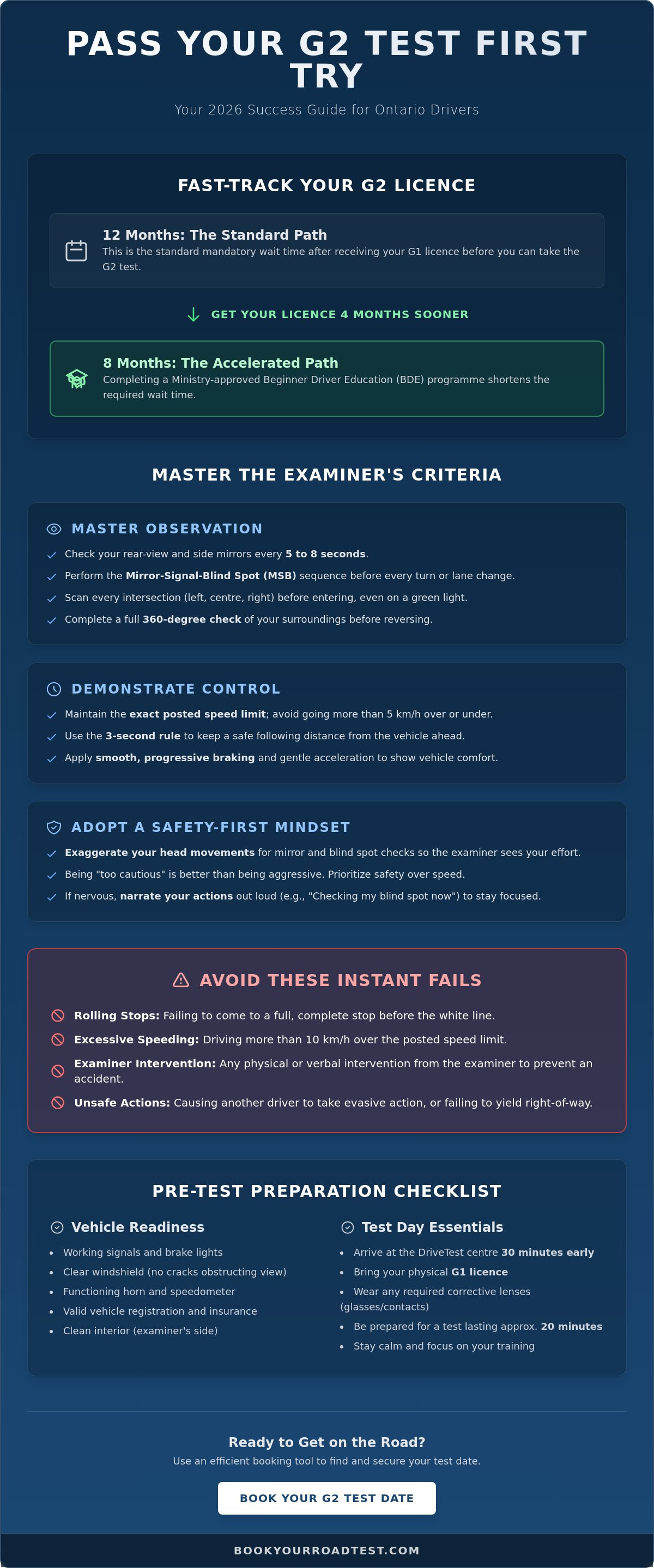
- Learn how completing a Ministry-approved education programme can reduce your mandatory wait time between the G1 and G2 tests from 12 months down to 8 months.
- Discover the specific technical skills and observation habits required to understand how to pass g2 test first try without common errors.
- Avoid immediate disqualification by identifying "instant fail" scenarios like rolling stops or any physical or verbal intervention from the examiner.
- Ensure your vehicle is road-test ready with a checklist covering essential safety components like signals, brake lights, and a clear windshield.
- Reduce administrative anxiety by utilizing efficient booking tools to secure a test date, helping you stay focused on your performance behind the wheel.
Understanding the G2 Road Test: The First Step to Success
The G2 road test, officially known as the G1 Exit Test, is the bridge between supervised learning and independent driving. It represents a significant milestone within Ontario's Graduated Licensing System. Understanding the structure of this exam is the first step in learning how to pass g2 test first try. Unlike the final G test, this evaluation focuses exclusively on your ability to handle basic residential and city traffic. You won't be required to drive on 400-series highways or high-speed expressways. Instead, the examiner evaluates your performance in school zones, at controlled intersections, and during low-speed manoeuvres like parallel parking.
Preparation begins long before you arrive at the DriveTest centre. While the standard waiting period after receiving your G1 is 12 months, completing a Ministry of Transportation (MTO)-approved Beginner Driver Education (BDE) course reduces this to 8 months. This four-month advantage is a primary reason many new drivers invest in professional instruction. Examiners aren't looking for professional-level precision; they're looking for consistent, safe habits. A slightly crooked park is rarely a fail, but failing to check your blind spot is a major concern.
Eligibility and Requirements for 2026
Your test day will be much smoother if you have your administrative details organized. You must bring your physical G1 licence and wear any corrective lenses required by your vision condition. The vehicle you provide must be in good working order and carry valid insurance and registration documents. Although the test itself typically lasts about 20 minutes, you're required to check in at least 30 minutes before your scheduled appointment. During check-in, you may be asked to sign a declaration of highway driving experience. While this is a formal requirement for the G test, being familiar with the process helps build confidence for your current attempt.
The "Safety-First" Mindset
Success on this test is largely psychological. Many applicants fail because they appear overly confident or aggressive, whereas being "too cautious" is rarely a reason for disqualification unless it creates a traffic hazard. You can communicate your safety awareness through deliberate body language. Exaggerate your head movements during mirror and blind-spot checks so the examiner clearly sees your effort. If your nerves feel unmanageable, try narrating your actions out loud. Telling the examiner, "I'm checking my blind spot before turning," confirms your awareness and helps you stay focused on how to pass g2 test first try.
Mastering the Essential Skills for a First-Time Pass
To understand how to pass g2 test first try, you must move beyond basic operation and demonstrate advanced situational awareness. The examiner isn't just watching your feet and hands; they're watching your eyes. Observation is the most heavily weighted category on the score sheet. You should check your mirrors every 5 to 8 seconds to maintain a constant awareness of the traffic around you. This habit shows you're a proactive driver rather than a reactive one, which is exactly what an examiner wants to see during the 20 to 30 minutes you're behind the wheel.
Speed control and space management are equally vital for a successful outcome. You must maintain the posted speed limit exactly, or slightly below if road conditions are poor. Speeding more than 10 km/h over the limit results in an immediate fail. Simultaneously, you must manage the space around your vehicle by following the three-second rule. This following distance provides a necessary safety buffer and demonstrates that you aren't rushing the process. If you're feeling prepared to demonstrate these habits, you can find an available G2 road test date through a specialized booking service to get started.
Vehicle control should be smooth and deliberate. Jerky braking or sudden acceleration suggests a lack of comfort with the vehicle. Practice progressive braking, where you apply light pressure initially and increase it as you slow down. This level of control proves you're ready for the responsibility of a G2 licence. By mastering these foundational skills, you significantly increase your chances of passing on your first attempt.
Observation Techniques and Blind Spots
You must perform a full 360-degree check of your surroundings before your vehicle moves an inch in reverse. For every turn or lane change, follow the Mirror-Signal-Blind Spot (MSB) sequence to ensure no other road users are in your path. Even when you have a green light, you must scan intersections from left to right to confirm the way is clear before proceeding. This shows the examiner you realize that a green light doesn't always guarantee safety.
Manoeuvres: Parking and Turns
The three-point turn requires three distinct, controlled steps: signal left and pull to the far side, signal right and reverse while turning the wheel, then signal left and proceed forward. When parallel parking, remember that the manoeuvre doesn't have to be perfect; it just needs to be safe, legal, and completed within a reasonable number of movements. For hill parking, remember the curb rule. Turn your wheels to the left for uphill with a curb, but turn them to the right for downhill with a curb or any hill without a curb.
Avoiding the "Instant Fail": Common Pitfalls to Realize
The G2 road test is a performance of safety, and certain errors are so critical they end the exam immediately. Understanding these "instant fail" criteria is essential for anyone researching how to pass g2 test first try. The most frequent cause of failure is the rolling stop. You must bring the vehicle to a complete, motionless state behind the stop line or sidewalk. If the vehicle is still creeping forward even slightly, the examiner will mark it as a failed attempt. Many drivers develop lazy habits during practice; however, on test day, you need to feel the "back-settle" of the car to ensure you've fully stopped.
Examiner intervention is another non-negotiable failure. If the examiner has to touch the steering wheel or use the passenger-side brake to prevent a dangerous situation, the test is over. This also applies to verbal intervention. If they have to tell you to stop or steer away from an obstacle, it qualifies as a fail. Right-of-way violations at four-way stops are common pitfalls. You must know exactly whose turn it is to proceed. If you hesitate too long or go out of turn, it demonstrates a lack of confidence or a misunderstanding of traffic laws. Regarding speed, research indicates that exceeding the limit by more than 10 km/h is an automatic disqualification. Even a 5 km/h overage can lead to a fail if the examiner deems it unsafe for the specific road conditions.
Traffic Signs and Signals
You must respect every signal with absolute precision. When a light turns amber, you should stop if it is safe to do so. If you're already at the "point of no return" where stopping would require hard braking in the middle of an intersection, you should proceed cautiously. Turning right on a red light is permitted in Ontario unless a sign says otherwise, but it requires a full stop first. Failing to stop completely before turning right is a common reason for an unsuccessful result. Always check for school zones and construction areas, as these often have lower speed limits that examiners monitor closely.
Pedestrian Safety and Right-of-Way
Pedestrians are the most vulnerable road users, and examiners have zero tolerance for safety risks involving them. Even if a person is crossing illegally, you must yield to them. At a pedestrian crossover, you must wait until the person has moved from curb to curb before you proceed. This "curb-to-curb" rule is a specific requirement that ensures the pedestrian's path is entirely clear. Additionally, if an emergency vehicle approaches with sirens or lights flashing, you must pull over to the right and stop immediately. Failing to react correctly to an emergency vehicle is a certain way to end your test early. Learning how to pass g2 test first try means being prepared for these unpredictable moments with a calm, safety-first response.
Vehicle Readiness and Logistics: Don’t Fail Before You Start
Many applicants spend months practicing manoeuvres only to have their test cancelled within the first five minutes because of a mechanical defect. Knowing how to pass g2 test first try includes ensuring your vehicle meets the Ministry of Transportation's strict safety standards. Before the examiner enters the vehicle, they will conduct an external inspection to verify that your brake lights, turn signals, and horn are fully operational. If any of these components fail to work, your test is immediately cancelled. This often results in the forfeiture of your test fee, which is a frustrating and expensive mistake to make.
Professionalism extends to the state of your vehicle's interior. A tidy, clean car suggests to the examiner that you're an organized and serious driver who respects the rules. Remove any loose items from the dashboard or floor mats that could slide around during turns. You should also ensure you have at least half a tank of fuel. Running low on gas adds unnecessary stress to an already high-pressure situation and could potentially lead to a stall. Once you're certain your vehicle is ready, you can book your G2 road test appointment to secure your spot and move one step closer to your licence.
The Pre-Test Vehicle Inspection
The examiner will ask you to demonstrate several functions before the driving portion begins. You must show that your left and right turn signals work at both the front and rear of the vehicle. They will also check your brake lights and hazard lights while you stay in the driver's seat. Ensure your windshield wipers are functional and your tires are properly inflated with no visible damage. If a warning light like the "Check Engine" or "ABS" light is glowing on your dashboard, the examiner may refuse to start the test. It's your responsibility to provide a roadworthy vehicle.
Arrival and Documentation
Arriving at the DriveTest centre 30 minutes early is essential for the check-in process. This buffer allows you to find parking and use the self-service kiosk or speak with a staff member without rushing. If you're late, you risk losing your appointment and your fee. When you arrive, park in a designated road test space. If the centre allows it, reverse into the spot so you can start the test by driving forward, which is much easier when nerves are high. Remember to bring your physical G1 licence and a method of payment for any outstanding administrative fees you might owe.
Securing Your Test Date and Reducing Administrative Stress
Securing a test date is often the most frustrating part of the licensing process. In 2026, wait times at many DriveTest centres remain significant, which can create a gap between your practice sessions and the actual exam. This delay often leads to skill decay, where the defensive driving habits you've worked so hard to build begin to fade. If you want to understand how to pass g2 test first try, you must realize that administrative efficiency is just as critical as your parallel parking skills. Reducing the stress of the booking process allows you to keep your focus entirely on the road.
Using a third-party booking service provides a streamlined alternative to navigating the standard portal yourself. These services act as a professional concierge, managing the scheduling hurdles so you don't have to monitor the site for openings constantly. While these autonomous providers charge an administration fee, the relief of having a confirmed date that fits your schedule is often worth the investment. It eliminates the anxiety of the unknown and ensures you can plan your final practice sessions with a clear deadline in mind. This momentum is the final piece of the puzzle for a successful first-time attempt.
Why Timing Matters for Your Road Test
Timing is everything when it comes to peak performance. You should aim for the "Goldilocks Zone," which is the period when your skills are fresh and your confidence is high immediately following consistent practice. Waiting too long can result in "4-month rust," making you second-guess your observation habits or mirror checks. To stay in peak form, utilizing a road test cancellation finder ontario can help you snag an earlier date. This ensures you take your test while your technical abilities and safety-first mindset are at their absolute sharpest.
Professional Booking Assistance
Navigating the DriveTest system can be time-consuming and confusing for many new drivers. A professional booking service handles the administrative details, allowing you to dedicate your energy to mastering the road. It's a transparent process designed to provide speed and convenience, especially for those with urgent licensing needs. By removing the logistical burden, you can approach your test day with a calm and organized demeanor. Ready to get on the road? Book your G2 road test booking today and focus on your driving, not the paperwork. This organized approach ensures you arrive at the centre ready to perform at your best.
Take the Next Step Toward Your G2 Licence
Achieving independence on Ontario's roads requires a combination of technical skill and logistical preparation. You've learned that success depends on mastering the Mirror-Signal-Blind Spot sequence and ensuring your vehicle is in peak mechanical condition before you arrive at the DriveTest centre. By avoiding common pitfalls like rolling stops and maintaining a safety-first mindset, you have a clear roadmap for how to pass g2 test first try. The final step is ensuring you don't lose momentum while waiting for an available appointment.
Our third-party administrative experts manage your booking to remove the stress of navigating complex scheduling systems. We provide access to cancellation finder services that help you secure earlier dates, a strategy trusted by thousands of Ontario drivers to simplify their licensing journey. Don't let administrative hurdles stand between you and your driving goals. Secure your G2 road test date now with Book Your Road Test and focus on your performance behind the wheel. You've put in the practice; now it's time to claim your licence with confidence.
Frequently Asked Questions
What happens if I fail my G2 test on the first try?
If you fail your G2 test on your first attempt, you're required to wait at least 10 days before you can try again. This mandatory period allows you to practice the skills identified in your performance report. You'll need to pay a re-test fee of $53.75 for each subsequent attempt. Understanding the feedback from your examiner is the best way to realize how to pass g2 test first try during your next scheduled appointment.
How many minor mistakes are allowed on the G2 road test?
There isn't a fixed number of minor mistakes allowed on the G2 road test; instead, the examiner assesses your overall safety and competence. While a few minor errors like a slightly wide turn might be overlooked, a single serious safety violation results in an immediate failure. The focus remains on consistent, safe habits rather than absolute technical perfection behind the wheel.
Can I use my own car for the G2 road test?
You can use your own personal vehicle for the G2 road test as long as it meets all Ministry safety standards. The examiner will perform a pre-test check to ensure your brake lights, signals, and horn are functional. If your vehicle fails this inspection, your test will be cancelled and you may forfeit your fee. Ensure your insurance and registration documents are current and present in the car.
Do I have to go on the highway for my G2 test?
The G2 road test does not include driving on 400-series highways or high-speed expressways. This exam focuses on residential streets and city traffic to evaluate your basic driving manoeuvres. You'll be tested on your ability to handle intersections, school zones, and parallel parking. Highway driving is reserved for the final G road test, which occurs at least 12 months after you receive your G2 licence.
How much does it cost to book a G2 road test in Ontario?
The fee for a G2 road test attempt is $53.75 in Ontario as of 2026. If you're taking the test for the first time, this cost is typically included in your initial $159.75 G1 licence package fee. Any additional attempts following a failure will require the $53.75 payment. Managing these costs and scheduling through a professional booking service helps streamline the administrative process for new drivers.
What is the most common reason for failing the G2 test?
Rolling stops at stop signs are the most common reason for failing the G2 road test. Many drivers fail to bring the vehicle to a complete, motionless state, which examiners consider a serious safety violation. Other frequent causes include failing to check blind spots and poor observation at intersections. Focusing on these specific areas is a key strategy for those learning how to pass g2 test first try.
Can I use a backup camera or parking sensors during the test?
You can use a vehicle equipped with a backup camera or parking sensors, but you cannot rely on them as your primary observation tool. The examiner expects you to perform physical 360-degree checks and use your mirrors throughout every manoeuvre. Relying solely on the screen is a common error that can lead to a deduction or failure. These technologies are considered secondary aids to your manual observation skills.
How soon can I re-take the test if I do not pass?
You can rebook your test immediately after an unsuccessful attempt, but you must wait at least 10 days before the actual re-examination can occur. This waiting period is designed to give you sufficient time to address the errors noted by the examiner. Using a cancellation finder service during this time can help you secure the earliest possible date once your mandatory 10-day period has concluded.


