

What if I told you that being a "good driver" isn't actually enough to pass your road test on the first try? You've likely spent months practicing your turns and parallel parking, yet the thought of a silent examiner marking a clipboard next to you is still enough to cause serious anxiety. It's a common frustration to feel prepared but remain confused about the specific difference between a minor point deduction and an automatic fail. This guide clarifies exactly what examiners look for in g2 test evaluations so you can demonstrate the precise safety habits Ontario requires.
We understand that the pressure to succeed is high, especially when a retake fee of $53.75 and long wait times for a new appointment are on the line. You deserve a clear path to your licence that removes the guesswork from the passenger seat. In this success guide, we provide a definitive checklist of required skills and master observation techniques that signal confidence to your examiner. We also share how to navigate the booking process efficiently to avoid unnecessary delays, ensuring you head to the DriveTest centre with total peace of mind.
Key Takeaways
- Prioritize safety and predictability to align with the examiner's mindset and demonstrate you are not a hazard to other road users.
- Identify the specific scoring criteria and observation habits that reveal exactly what examiners look for in g2 test evaluations.
- Avoid automatic disqualifications by mastering the difference between minor point deductions and major safety violations like the "California stop."
- Follow a technical checklist for turns and parallel parking to ensure you maintain steering control and proper lane positioning every time.
- Complete a final vehicle and documentation pre-check to prevent your test from being cancelled before it even begins at the DriveTest centre.
The Examiner’s Mindset: Safety Over Perfection
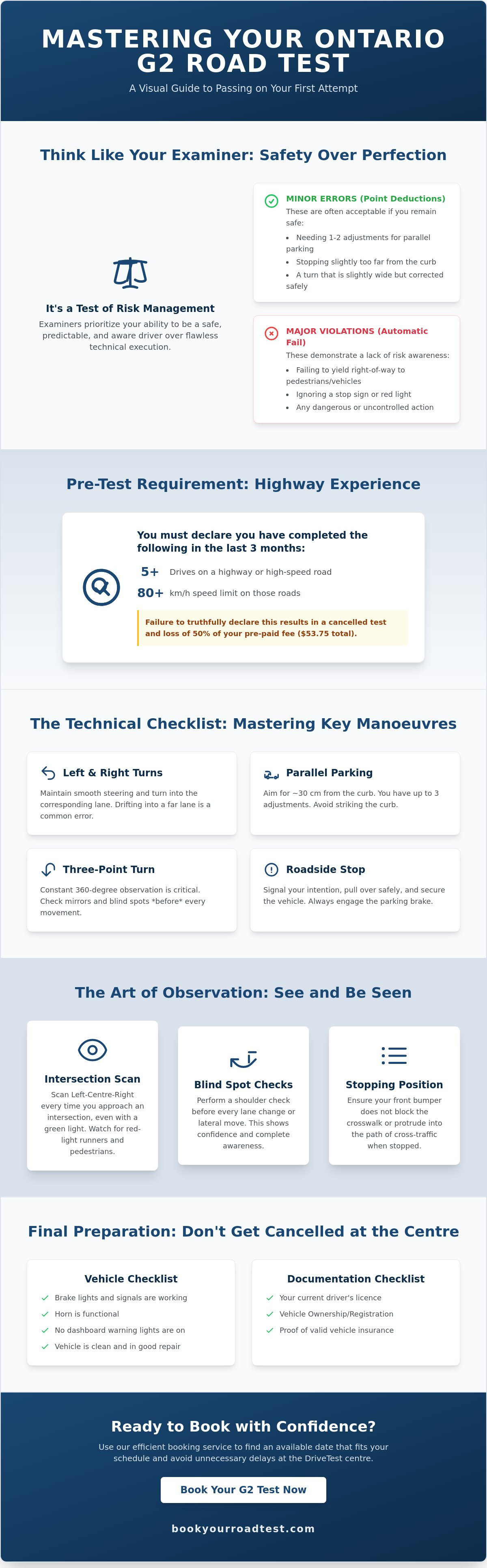
Many students walk into their road test believing they must drive with absolute technical perfection to pass. This is a common misconception. While basic skill is necessary, the core of what examiners look for in g2 test evaluations is your ability to prioritize safety over flawless mechanics. They aren't looking for a driver who never touches a line or completes a parallel park in a single motion; they are looking for a driver who is safe, aware, and completely predictable to other road users. They want to see that you follow the rules of the road while maintaining a high level of situational awareness.
Minor technical errors, such as being slightly too far from the curb during a roadside stop or requiring a second attempt at a parallel park, rarely lead to an immediate failure. Instead, examiners focus on your decision-making. A major safety violation, like failing to yield to a pedestrian or ignoring a stop sign, will end the test instantly because it demonstrates a lack of risk awareness. Essentially, the G2 examiner acts as an evaluator of risk management rather than just mechanical operation.
The Declaration of Highway Driving Experience
Before you even put the car in drive, you must complete a highway declaration form. This is a mandatory component of Ontario's Graduated Licensing System. You are required to state that you have driven on high-speed roads with a speed limit of at least 80 km/h at least five times within the three months preceding your test date. If you cannot truthfully declare this experience, the examiner will cancel your appointment. You will also lose 50% of your pre-paid test fee. This requirement ensures you've practised the high-speed merges and lane changes that define safe driving on Ontario's major thoroughfares.
Predictability and Confidence
Examiners value decisiveness. When you hesitate at a four-way stop or wait too long to make a safe left turn, you confuse other drivers. This lack of predictability signals to the examiner that you don't feel in control of the vehicle or the situation. Decisive movements during lane changes, where you check your blind spot and move smoothly into the gap, show that you are aware of your surroundings. To pass, you should maintain a consistent space cushion around your car, keeping enough distance from others to allow for safe reactions. Smooth braking and clear, early signalling are the best ways to prove you are a low-risk driver. Understanding what examiners look for in g2 test scenarios allows you to drive with the quiet confidence that leads to success.
Essential G2 Manoeuvres: The Technical Checklist
Mastering the technical side of the road test requires more than just basic vehicle control. It involves executing specific movements with a level of precision that satisfies the Ministry’s grading sheet. When performing left and right turns, your examiner is primarily watching your lane choice. You must always turn into the "corresponding" lane; drifting into the far lane during a turn is a frequent error that results in lost points. Smooth steering control is equally vital, as jerky movements suggest you aren't yet comfortable with the vehicle's mechanics.
Understanding what examiners look for in g2 test scoring helps you realize that small adjustments are often allowed. For example, during parallel parking, you typically have three opportunities to adjust your position. The goal isn't a single, perfect movement, but rather getting the vehicle within a reasonable distance of the curb (usually about 30 cm) without striking it or other cars. Similarly, during a three-point turn, you must maintain constant 360-degree observation. If you move the car without checking your surroundings first, the examiner will mark it as a lack of observation.
Roadside stops are another area where simple mistakes lead to failure. You must signal your intention, pull over to a safe spot, and secure the vehicle completely. This includes engaging the parking brake every single time. Failing to use the emergency brake during a roadside stop or when parking is a common reason for a deduction. If you feel ready to prove these skills, you can use a G2 road test booking service to find an available date that fits your schedule.
Intersection Mastery
Intersections are the most high-risk areas during your test. You must perform a "Left-Centre-Right" scan every time you approach one, even if the light is green. This habit proves you are actively looking for red-light runners or pedestrians. Your stopping position is also critical; ensure your front bumper does not block the crosswalk or protrude into the path of cross-traffic. If your view is obstructed by trees or buildings, you should stop fully at the line first, then "creep" forward slowly to gain visibility.
Parking and Low-Speed Control
Low-speed control is often tested through hill parking. When parking uphill with a curb, turn your wheels to the left. For all other hill scenarios, turn them to the right. This ensures the car would roll into the curb rather than into traffic if the brakes failed. Some test centres may also require back-in parking at the end of the exam. Use your mirrors and physical shoulder checks throughout the entire motion to show the examiner you have full control of your blind spots.
The Art of Observation: Mirror Checks and Blind Spots
Observation is the most frequent category for point deductions in Ontario. You might be a safe driver, but if the examiner doesn't see you looking, they can't give you credit for it. This is a core part of what examiners look for in g2 test performances. They need to see active, intentional scanning of the environment at all times. Simply moving your eyes behind sunglasses isn't enough; you must use exaggerated head movements so the examiner can clearly record your check on their score sheet. If your head doesn't move, the check didn't happen in their eyes.
The "5-Second Rule" is a fundamental habit you should adopt. You need to check your rearview mirror every 5 to 8 seconds to maintain full situational awareness. This shows you aren't just looking at the car in front of you, but are aware of the entire traffic flow. Blind spot checks, or shoulder checks, are also non-negotiable. These must be obvious every time you turn, change lanes, or pull over to the side of the road. If you fail to check your blind spot even once during a lane change, it's a significant mark against your final score.
The Systematic Observation Loop
To stay organized, use a consistent loop. Step 1: Check your rearview mirror before you ever touch the brake pedal. This ensures you know how close the vehicle behind you is before you slow down. Step 2: Scan every intersection from left to right before you enter. This habit protects you from drivers who might run a red light or fail to stop. Step 3: Perform a deep shoulder check in the direction of any lateral movement. This includes lane changes, merging, or even shifting slightly within your lane to avoid an obstacle. Following this sequence shows you're a proactive driver who manages space effectively.
Pedestrian and Cyclist Awareness
Examiners closely watch how you interact with vulnerable road users. You should scan for pedestrians at every crosswalk and corner, even when none are immediately visible. It's particularly important to "check your right" for cyclists before making any right-hand turn. If you're turning right, a quick glance over your right shoulder can prevent a collision with a cyclist who might be coming up beside you. Demonstrating clear yielding protocols shows the examiner you've identified and prioritized everyone's safety. Always give pedestrians the right-of-way, even if they're just stepping off the curb, to prove you're a responsible driver.
Common Automatic Disqualifications and Major Errors
Understanding the difference between a minor point deduction and an automatic disqualification is the key to passing your road test. While previous sections focused on observation and technical skill, this section covers the "non-negotiables" that end a test instantly. Disobedience of traffic signs is the most common pitfall. A rolling stop, often called a "California stop," is a 100% automatic fail. Speeding is another critical area; exceeding the limit by even 5 km/h in a school zone or residential area will result in an immediate failure. These rules are strictly enforced to ensure that new drivers can manage high-risk environments safely.
Dangerous actions include any move that forces another driver to take evasive action. If a car has to slam on its brakes because you pulled out too early, the test is over. This also applies to mounting the curb. While a gentle "tap" during a parallel park might only cost you a few points, "climbing" the curb with a tire is considered a major error and leads to disqualification. Knowing exactly what examiners look for in g2 test safety standards helps you avoid these high-stakes blunders. If you are worried about these strict requirements, you can book your G2 road test at a centre known for having slightly more manageable traffic conditions.
The "Rolling Stop" Trap
To avoid the rolling stop trap, your vehicle must have zero momentum for a full three seconds. You must stop completely behind the white line, not on it or over it. If your visibility is blocked by trees or parked cars, you must perform a full stop at the line first. Only then can you "creep" forward to check for cross-traffic. This two-stage process proves to the examiner that you respect the right-of-way while proactively managing your visibility. Many applicants fail because they merge these two steps into one slow, continuous roll.
Examiner Intervention
Any form of examiner intervention results in a failed attempt. Verbal intervention occurs if the examiner has to tell you to brake, steer, or speed up to avoid a hazard. Physical intervention is more direct, involving the examiner touching the steering wheel or using the passenger-side brake in a dual-brake vehicle. If you make a minor mistake, like hitting a turn signal late, stay calm. Panicking often leads to the kind of erratic movement that triggers a major intervention fail. Maintaining your composure allows you to finish the test and potentially pass despite small errors.
Final Preparation: Vehicle Safety and Stress-Free Booking
Your preparation shouldn't end with your driving skills. Before the examiner even sits in the passenger seat, they perform a mandatory vehicle inspection. This initial check is a critical part of what examiners look for in g2 test protocol. If your brake lights are out or your horn doesn't work, the test is cancelled immediately. You'll lose your fee and have to rebook, which can be a significant setback given current wait times at many centres. Ensuring your vehicle is in top mechanical condition is the first step toward a successful day.
Documentation is another area where simple errors cause unnecessary delays. You must have your physical G1 licence ready and be prepared to sign the highway declaration form mentioned in earlier sections. Arrive at the DriveTest centre at least 30 minutes before your scheduled time. This allows you to check in at the kiosk, find your parking spot, and settle your nerves before the evaluation begins. Being early helps you avoid the rush and ensures you don't miss your slot due to administrative hurdles.
Vehicle Requirements Checklist
- Visibility: Ensure your windshield wipers are functional and your washer fluid is topped up, especially during Ontario's unpredictable rainy or winter seasons.
- Accessibility: Both the driver and passenger doors must open easily from both the inside and outside. If the examiner cannot exit the vehicle quickly in an emergency, they won't start the test.
- Cleanliness: Keep the interior clean and free of clutter. A tidy car shows you're organized and respect the safety of your evaluator.
- Mechanicals: Double-check that all turn signals, high beams, and brake lights are working perfectly the morning of your test.
Booking Your Success
Many students fail not because of poor skills, but due to test-day nerves amplified by months of waiting. When you wait too long between your lessons and the actual exam, your confidence can slip. Using a road test cancellation finder Ontario helps you secure a date while your training is still fresh in your mind. This tool allows you to bypass the standard backlog and find slots that other applicants have dropped, giving you more control over your timeline.
Managing the administrative side of licensing is often the most stressful part of the process. By using a professional service to handle the scheduling, you can focus entirely on mastering what examiners look for in g2 test manoeuvres. This systematic approach reduces anxiety and ensures you arrive at the centre ready to succeed on your first attempt. Once you've secured your date and verified your vehicle, you can approach the road test with the quiet confidence of a prepared driver.
Secure Your Ontario G2 Licence with Confidence
Success on your road test is the result of thorough preparation and a commitment to safe, predictable driving. By internalizing exactly what examiners look for in g2 test evaluations, you can shift your focus from technical perfection to active risk management. Remember that visible observation through exaggerated head movements and avoiding the "rolling stop" trap are the most effective ways to protect your score. Ensuring your vehicle meets all safety requirements before you arrive at the centre prevents unnecessary cancellations and keeps your momentum high.
Navigating the administrative side of the DriveTest system doesn't have to be a source of frustration. Our independent administrative experts support over 60 DriveTest centres across Ontario, providing a stress-free cancellation finder service to help you secure an appointment when your skills are sharpest. Book your G2 road test with ease and find earlier dates today to avoid long wait times and focus on your driving. You've done the work to understand the requirements; now it's time to get behind the wheel and earn your independence.
Frequently Asked Questions
Is parallel parking mandatory on the G2 test?
Parallel parking is mandatory in almost all cases during the G2 road test. Depending on the specific centre where you take your exam, you might be asked to park between two real vehicles or a single pylon representing a car. This manoeuvre is a key part of what examiners look for in g2 test skills to ensure you can safely position your vehicle in urban environments without striking other cars or obstructing traffic.
Can I fail the G2 test for going too slow?
Yes, driving significantly below the speed limit when road conditions are clear can lead to a failure. Driving too slowly is often classified as a "traffic hazard" because it forces other drivers to brake or pass you unexpectedly. Examiners expect you to maintain a consistent speed that matches the flow of traffic while staying within the legal limit to demonstrate you are a predictable and safe driver who doesn't impede others.
How many minor mistakes are allowed on the G2 test?
There is no fixed number of minor mistakes that results in a fail, but you can typically accumulate several points for small technical errors. These might include poor hand position on the steering wheel or failing to signal far enough in advance. As long as you don't commit a major safety violation or a dangerous action that requires examiner intervention, these minor points won't necessarily prevent you from passing your exam.
What happens if I hit the curb during the G2 test?
Tapping the curb lightly while you are parking is usually recorded as a minor error rather than an automatic fail. However, if your tire "mounts" or climbs over the curb, the examiner will likely fail you for a lack of vehicle control. This is a critical distinction in what examiners look for in g2 test performances, as mounting the curb suggests a potential hazard to pedestrians or a significant loss of steering accuracy.
Do I have to go on the 400-series highway for my G2?
No, you are not required to drive on 400-series freeways during your G2 road test. This specific exam focuses on local residential streets and highways with speed limits up to 80 km/h. High-speed, multi-lane freeways like the 401 or the QEW are reserved for the full G road test. You must still declare your previous high-speed experience on roads of at least 80 km/h before the test begins to qualify.
What should I do if I make a mistake during the test?
If you make a mistake, you should stay calm and continue driving safely. Many students fail because they become preoccupied with a small error and subsequently commit a major violation. The examiner might only view the initial slip-up as a minor point deduction. By maintaining your focus on the road ahead, you prove that you can remain composed under pressure, which is a trait all evaluators respect in new drivers.


