
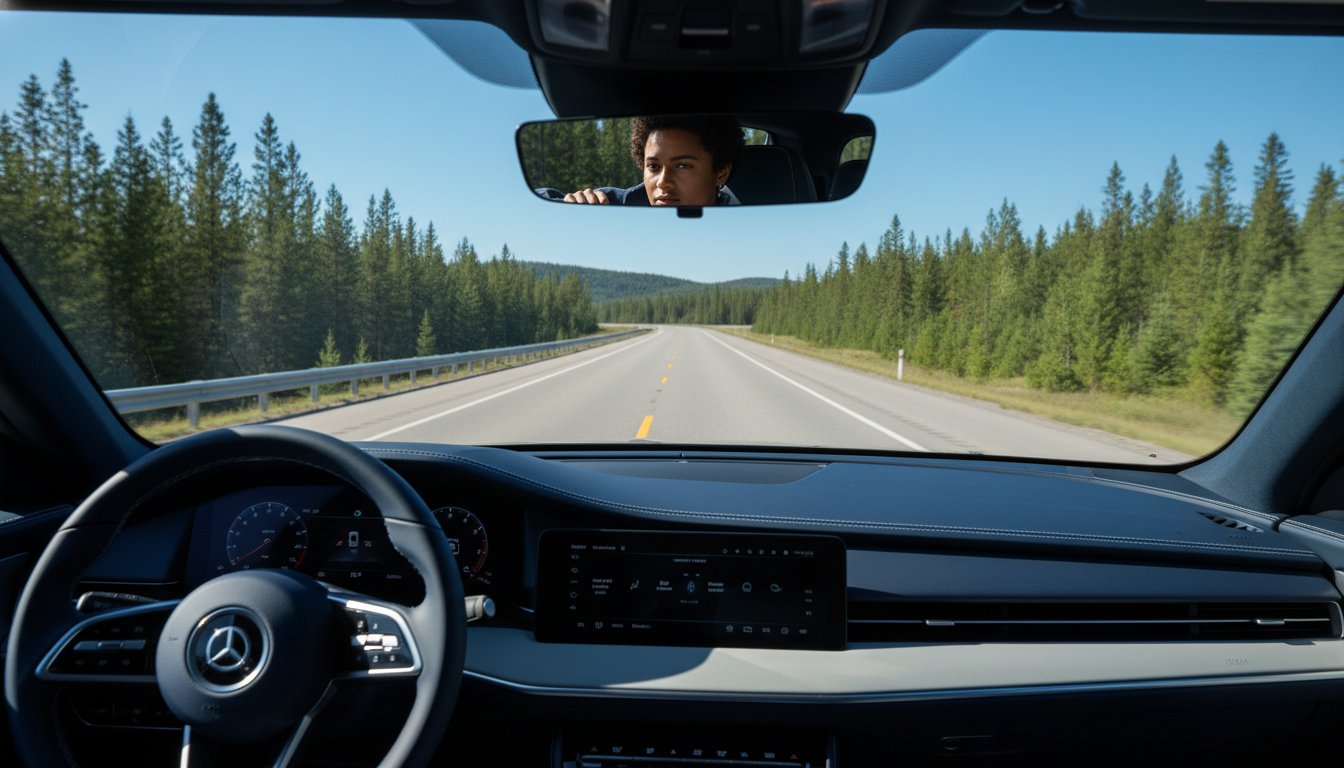
Did you know that nearly 50 percent of drivers fail their road test on the first attempt? It's a frustrating reality, especially when you consider that wait times for re-tests can stretch for several months. If you feel anxious about your upcoming appointment, you aren't alone. Many applicants find themselves confused by how modern car technology, like backup cameras and lane assist, affects their score. Understanding the most common g2 test mistakes 2026 examiners are flagging is the first step toward walking away with your licence.
Passing in 2026 requires more than just following the rules; it requires performative safety. You must visibly demonstrate your caution so the examiner has no doubt about your awareness. We've compiled this ultimate checklist to help you master examiner expectations and avoid the frequent errors that lead to failure. This article covers everything from proper observation techniques to handling real-world scenarios, ensuring you feel calm and prepared to secure your G2 licence on your very first try.
Key Takeaways
- Verify your vehicle's signals and horn functionality to prevent an immediate disqualification during the pre-test inspection.
- Adopt the exaggerated head movement technique to avoid the most common g2 test mistakes 2026 examiners cite regarding mirror and blind-spot checks.
- Clarify the official protocol for using backup cameras and lane-assist technology so you don't lose marks for over-reliance on digital aids.
- Discover how to maintain a continuous 360-degree scan during technical manoeuvres like parallel parking and three-point turns.
- Learn how to interpret the examiner's feedback sheet and navigate the mandatory 10-day waiting period if you need to rebook your road test.
The Pre-Test Inspection: Avoiding the "Automatic Fail" Before You Start
Your road test begins before you even turn the key. Many drivers arrive at the road test centre focused on parallel parking, only to find their appointment cancelled within minutes. If your vehicle doesn't meet strict provincial safety standards, you won't even leave the parking lot. This is one of the most avoidable common g2 test mistakes 2026 candidates face; it results in a forfeited fee and the frustration of waiting weeks for a new slot. Under the graduated driver licensing (GDL) system, the burden of providing a roadworthy vehicle rests entirely on the applicant.
The examiner will conduct a functional check of your vehicle's essential components. They'll ask you to activate your turn signals, tap the brake pedal, and honk the horn. If a single bulb is burnt out or your horn remains silent, the test is over. This isn't just about safety; it's about provincial regulations that staff cannot overlook. Beyond the mechanical requirements, don't underestimate the "clean car" psychology. A tidy, odour-free interior suggests to the examiner that you're a disciplined driver who takes the responsibility of licensing seriously. Many applicants opt for professional car detailing Brampton to ensure their vehicle looks its best before the big day. It sets a professional tone that can influence their perception of your performance throughout the drive.
Vehicle Safety Standards for 2026
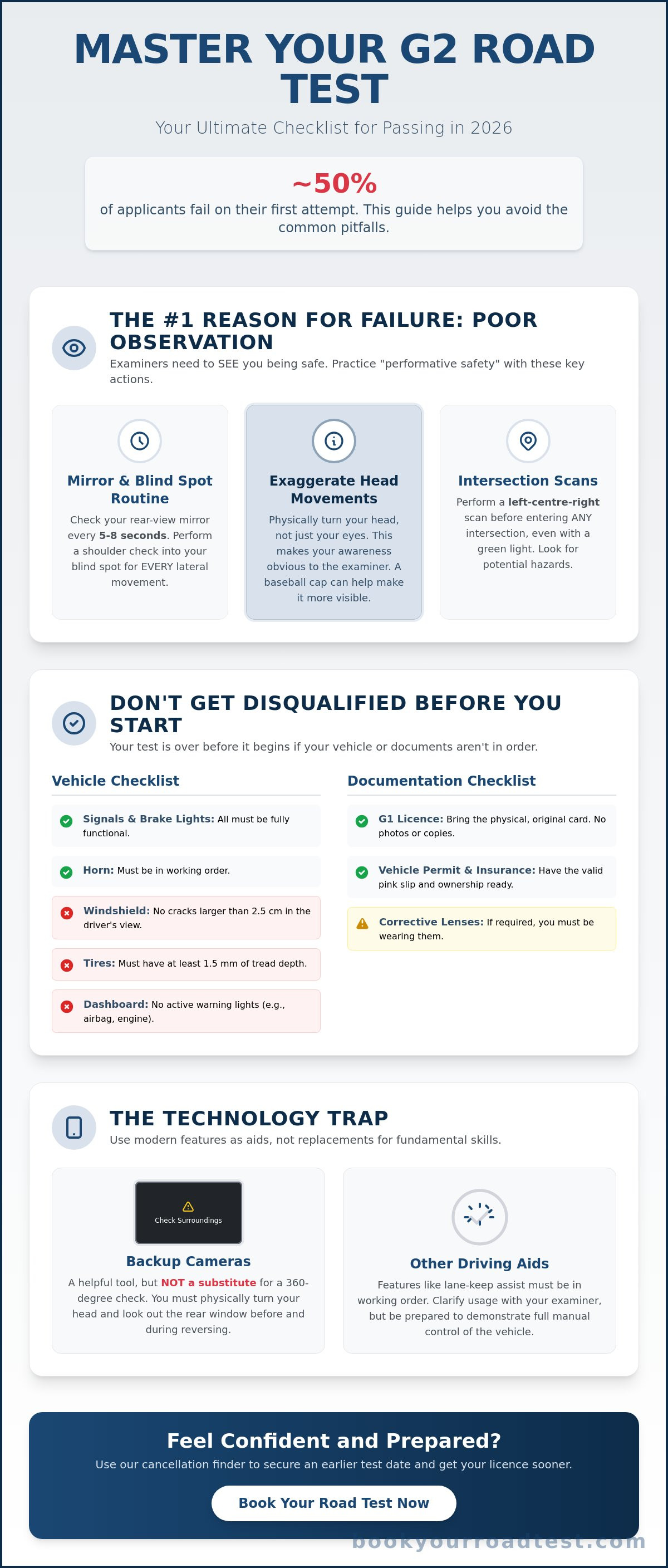
Ensure your windshield is free of major cracks. Any damage that exceeds 2.5 cm or sits directly in the driver's field of vision will result in a rejection. Check your tires for adequate tread; they must have at least 1.5 mm of depth to be considered safe. In 2026, examiners are paying closer attention to dashboard warning lights. If your vehicle displays an active airbag light or a "malfunction" alert for electronic stability control, you'll likely be sent home. Modern safety tech, such as lane-keep assist, must be in good working order even if you don't intend to use it during the manoeuvres.
The Documentation Checklist
Arrive at the testing location at least 30 minutes before your scheduled time. You must present your physical, original G1 licence. Digital copies or photos on your phone aren't valid for identification during the test. Have your vehicle permit and a valid insurance pink slip ready for inspection. If your licence includes a condition code for corrective lenses, ensure you're wearing your glasses or contacts when the examiner greets you. Forgetting these documents is a common g2 test mistakes 2026 pitfall that creates unnecessary stress and delays your progress toward a full licence.
Observation Errors: The #1 Reason for G2 Failure
If you ask any examiner at a provincial licensing location why students fail, the answer is almost always poor observation. It isn't enough to simply be safe; you have to prove you're being safe through visible actions. This concept of performative safety is vital because examiners cannot see where your eyes are looking if you only move your pupils. Failing to demonstrate active awareness is one of the most common g2 test mistakes 2026 applicants make during their evaluation. You must show that you're constantly processing the environment around your vehicle to prove you can handle real-world hazards.
Observation isn't just about looking forward. It involves a continuous 360-degree awareness that informs every decision you make on the road. Whether you're pulling away from a curb or sitting at a red light, your head should be in motion. Examiners are trained to watch for specific scanning patterns that indicate a driver is prepared for unexpected obstacles. If you're worried about finding a time that works for your schedule to show off these skills, a Road Test Cancellation Finder can help you secure an earlier date to get your licence faster.
The Mirror and Blind-Spot Routine
Maintain a consistent rhythm by checking your rear-view mirror every 5 to 8 seconds. This keeps you aware of following distances and potential emergency vehicles approaching from behind. Use exaggerated movements to make your intentions clear. Physically turn your head toward your mirrors and blind spots rather than just glancing with your eyes. Some students wear a baseball cap during the test because the brim makes head movements more obvious to the examiner sitting beside you. You must perform a blind-spot check every single time the vehicle moves sideways, including lane changes, merges, and even when pulling over to the curb.
Intersection Observation Mistakes
Intersections are high-risk zones where many common g2 test mistakes 2026 occur. Before you enter any intersection, you must perform a "left-centre-right" scan. This applies even if you have the right of way or a green light. You're looking for red-light runners or pedestrians who might step off the curb unexpectedly. Many drivers fail because they perform a "rolling stop" at stop signs. You must feel the vehicle's weight shift back as it comes to a complete halt. Hold that position for a full three seconds before you even think about moving forward into the intersection.
Pedestrian awareness requires a "curb-to-curb" mentality. If a pedestrian is using a crosswalk, you must remain stopped until they have completely reached the opposite sidewalk. Starting to drive while they are still in the other half of the roadway is a frequent reason for an automatic fail. Always double-check for cyclists in your right-hand blind spot before making a turn. They often travel straight through intersections while cars are trying to turn across their path, and failing to see them is a critical safety error.
The Technology Trap: Using Modern Car Features Correctly
Modern vehicles in 2026 are essentially rolling computers, equipped with everything from 360-degree cameras to haptic steering feedback. While these features make daily commuting safer, they often become a liability during a road evaluation. Relying on your vehicle's sensors instead of your own physical observations is one of the most common g2 test mistakes 2026 examiners report. The provincial licensing guidelines require you to demonstrate full manual control and awareness, regardless of how advanced your car's hardware might be. If you aren't yet comfortable managing these features under pressure, using a G2 Road Test Booking Service can help you find an appointment time that allows for extra practice in your specific vehicle.
Blind-spot monitoring systems are a particular point of confusion for many new drivers. These systems use lights or audible alerts to warn you of nearby traffic, but they aren't a substitute for the shoulder checks discussed in previous sections. Examiners look for a physical head turn every time you move the vehicle laterally. If you rely on the mirror's warning light and skip the manual check, you'll face a point deduction for improper observation. This is because sensors can sometimes fail to detect smaller objects, such as e-scooters or narrow-profile bicycles, which are increasingly common on city streets today.
Backup Cameras and Sensors
Backup cameras are legally permitted as a secondary aid, but they should never be your primary viewing source. One of the common g2 test mistakes 2026 applicants make is staring at the infotainment screen while the car is in reverse. You must maintain a physical "look back" through the rear window and perform a 360-degree scan of your surroundings. Use the camera only for a final check of the distance between your bumper and an object or curb. Parking sensors that beep as you get closer to obstacles are also just aids; if you stop only because the car told you to, the examiner may mark you down for lack of spatial judgment.
Automated Driving Aids
Many 2026 car models feature "Active Assist" technology, such as lane-keep assist and adaptive cruise control. These features can be intrusive during a road test. Lane-keep assist might tug at the steering wheel if you're positioning yourself to avoid a hazard, which can look like a lack of control to the person in the passenger seat. It's often best to deactivate these systems before the test begins. You must also remember that self-parking features are strictly prohibited. Engaging an automated parking system will result in an immediate failure because you aren't the one performing the manoeuvre. You must manage the accelerator, brake, and steering entirely on your own to prove you're ready for your G2 licence.
Technical Maneuvers: Parallel Parking and Three-Point Turns
Technical skills often cause the most anxiety for applicants. These manoeuvres happen at low speeds in controlled environments, making them easier to practice than unpredictable city traffic. Despite this, errors during these tasks remain high on the list of common g2 test mistakes 2026 examiners witness. If you struggle with these specific skills, you should use a G2 Road Test Booking Service to secure an appointment at a location known for having more spacious testing routes. Mastering the mechanics of the car is only half the battle; the other half is proving you can execute them while maintaining total awareness of your surroundings.
Speed management is equally vital during these technical sections. Many drivers believe that driving very slowly shows caution. In reality, driving significantly below the speed limit without a valid reason, such as poor weather or road construction, can be dangerous. It impedes the flow of traffic and can lead to a point deduction. You should maintain a steady, predictable speed that matches the current road conditions. This shows the examiner you are a confident driver who understands how to integrate with other road users safely.
Parallel Parking Precision
Precision is the primary goal during the parallel park. You must signal your intention early as you approach the target vehicle. Position your car parallel to the other vehicle before you begin to reverse. Aim to finish with your car within 30 to 45 centimetres of the curb. If you end up too far away, you'll lose points for poor positioning. However, hitting the curb is a more serious issue. A light touch is usually a minor mark, but mounting the curb or hitting it with force is a "Dangerous Action." This results in an immediate failure because it indicates a lack of vehicle control.
Three-Point Turn and Roadside Stops
The three-point turn is a test of both coordination and observation. You must complete the turn in a smooth, continuous motion without hitting any curbs or obstructing traffic. Before every move, perform a 360-degree scan to ensure no cars or pedestrians have entered your space. This builds on the observation techniques discussed earlier in this guide. During roadside stops, many students forget the final steps. You must activate your four-way flashers and pull the emergency brake every time the examiner asks you to park. Failing to set the parking brake is a frequent error that suggests you aren't fully prepared for real-world parking scenarios.
The Strategic Recovery: What to Do if You Fail Your G2
Failing a road test is a significant source of stress, but it is a hurdle many Ontario drivers face. Statistics show the average pass rate for the G2 test sits between 50 and 60 percent. This means nearly half of all applicants will need at least one more attempt to secure their licence. Instead of letting frustration take over, use the experience as a diagnostic tool. Your performance on the road has provided a clear map of exactly which common g2 test mistakes 2026 examiners are looking for in your specific driving style. The path to success on your second try begins with a clinical look at your results.
Provincial regulations require a mandatory 10-day waiting period before you can attempt the G2 road test again. This window is designed to give you enough time to practice the skills that were lacking. Use this time effectively. If you struggled with observation or technical manoeuvres, focus your practice sessions exclusively on those areas. For those who find that complex vehicle mechanics are distracting from their observation skills, you can explore Automatic Driving Lessons with Wimbledon Driving School to see how professional instruction can streamline your preparation. Returning to the DriveTest centre without making tangible changes to your habits often leads to the same result. Efficiency is key; you want your next attempt to be your last.
Analyzing the Examiner Scoresheet
Your examiner's feedback sheet is the most valuable document you possess for your recovery. Look specifically for any marks in the "Dangerous Action" or "Violation of Traffic Laws" columns. These are critical errors that result in an immediate failure, regardless of how well you performed elsewhere. If your sheet is filled with smaller "X" marks, tally them to find patterns. You might realize you consistently forget to check your mirrors every 5 to 8 seconds or that your turns are consistently too wide. If a specific comment is unclear, ask the examiner for a brief verbal clarification before you leave the centre. Understanding their perspective helps you avoid repeating common g2 test mistakes 2026 candidates often overlook.
Securing Your Second Chance
The biggest challenge after a failure is often the long wait for a new appointment. While official calendars might show dates several months away, the system is dynamic. Openings appear every hour as other applicants reschedule or cancel their slots. You don't have to wait for months to try again. Many of the strategies used for m2 road test booking, such as checking multiple regional centres, apply perfectly to G2 searches as well. Expanding your search to nearby towns can often reveal much earlier availability.
To bypass the frustration of manual searching, use a professional Road Test Cancellation Finder. This tool monitors the system constantly and can help you secure a new date in days rather than months. This allows you to retake the test while your recent practice and the examiner's feedback are still fresh in your mind. Combined with a targeted practice plan, this proactive approach ensures you move past the G2 stage and toward your full driving privileges with minimal delay.
Secure Your G2 Licence with Confidence
Success on your road test depends on your ability to demonstrate "performative safety" through every turn and lane change. By prioritizing vehicle maintenance and avoiding common g2 test mistakes 2026 like over-relying on digital driving aids, you significantly improve your chances of passing. Remember that your examiner needs to see your head move and your mirrors checked to verify your awareness. This visible caution is what separates successful applicants from those who struggle.
If you're facing a long wait after a failed attempt, our autonomous platform can help you get back on the road sooner. We monitor over 60 DriveTest centres 24/7 to help you skip standard 4-month wait times. Our service provides specialized support for all Ontario licence types to simplify your booking experience. Book Your G2 Road Test Re-take Faster with Our Cancellation Finder to secure a new date that fits your schedule. With the right preparation and a proactive approach to scheduling, your G2 licence is well within reach.
Frequently Asked Questions
Can I use my backup camera during the G2 test in 2026?
Yes, you can use a backup camera during your road test, but it must not be your primary viewing source. You are required to perform a full 360-degree scan and look out the back window while reversing. Relying solely on the screen is one of the common g2 test mistakes 2026 examiners often penalize because it suggests a lack of spatial awareness.
What is considered an "automatic fail" on the G2 road test?
An automatic fail occurs if you commit a "Dangerous Action" or a "Violation of Traffic Laws." This includes mounting a curb, failing to stop for a school bus, or causing the examiner to intervene to avoid a collision. Any action that puts you or other road users in immediate danger results in an unsuccessful attempt regardless of your performance elsewhere.
How many minor mistakes are allowed before I fail the G2 test?
You can accumulate a specific number of minor points before failing, usually between 15 and 30 points depending on the evaluation sheet used. Each small error, like failing to check a mirror or making a wide turn, adds points to your score. Repeating the same minor mistake multiple times can lead to a failure if it demonstrates a persistent lack of competency.
Do I need to bring my own car for the G2 road test?
You must provide your own vehicle for the road test as DriveTest centres do not provide cars for applicants. Ensure the vehicle you bring is in excellent mechanical condition and meets all provincial safety standards, including working signals and brake lights. If your vehicle fails the pre-test inspection, your appointment will be cancelled and you'll lose your test fee.
What happens if I hit the curb while parallel parking?
If you lightly touch the curb while parallel parking, you'll likely receive a minor mark for poor positioning. However, mounting the curb with a tire or hitting it with enough force to jar the vehicle is considered a "Dangerous Action." This is a common g2 test mistakes 2026 pitfall that leads to an immediate failure because it indicates a lack of vehicle control.
Can I take my G2 test in a different city than where I live?
You can take your G2 road test at any official DriveTest centre in Ontario regardless of your home address. Many applicants choose to book in different cities to find earlier dates or to test in areas with less traffic volume. If your local centre has long wait times, searching for availability in a nearby town is a very practical strategy.
What should I do if I fail my G2 test today?
If you are unsuccessful today, you must wait a mandatory 10 days before you can attempt the road test again. Use this time to review your examiner's feedback sheet and practice the specific skills that were marked as errors. You can book your next attempt immediately, provided the new date is at least 10 days after your previous failure.
Is lane-keep assist allowed to be on during the driving exam?
Lane-keep assist and other active safety features are generally allowed to remain on, but they should not interfere with your manual control. If the system jerks the steering wheel or corrects your path, the examiner may interpret it as a lack of steering control. It's often safer to deactivate these features to ensure you're the one making all driving decisions.


