
Did you know that a single three-second lapse in judgment during your highway merge can end your road test before you even reach the next exit? You have likely spent weeks refining your lane changes, yet the anxiety of a hidden rule causing an immediate disqualification often remains. It is natural to feel stressed about misunderstood examiner cues or the required frequency of mirror checks, especially when a single critical error results in an immediate failure. Understanding exactly what causes an automatic fail on g test is the most efficient way to replace that nervous energy with professional confidence.
We understand that the licensing process can feel opaque and demanding. This guide provides a definitive 2026 checklist of the safety violations and technical errors that lead to an instant fail, from rolling stops to dangerous actions that require examiner intervention. You will gain a clear "cheat sheet" of actions to avoid, ensuring you are fully prepared for the technical demands of the Ontario highway. Once you feel ready to prove your skills, we are here to help you secure a G road test booking or use our road test cancellation finder to find a time that fits your schedule.
Key Takeaways
- Identify the specific MTO standards that classify certain errors as "Dangerous Actions" rather than simple point deductions.
- Discover what causes an automatic fail on g test by reviewing the checklist of immediate disqualifiers like signal disobedience and curb contact.
- Learn to distinguish between critical errors that allow for a second chance and safety-critical failures that end the test on the spot.
- Implement pro-active habits like verbalizing your safety checks to clearly demonstrate your awareness to the examiner.
- Prepare your vehicle to meet strict safety requirements and use our road test cancellation finder to secure a convenient test date once you are ready.
How the Ontario G Road Test is Scored: MTO Standards
The Ontario G road test is the final hurdle in the province's graduated licensing system. To pass, you must demonstrate a high level of competency on city streets and high-speed highways. The scoring system is demerit-based, meaning the examiner marks down points for technical errors. However, there is a clear line between losing a few points and suffering an immediate disqualification. Understanding what causes an automatic fail on g test is essential for any driver aiming to upgrade their licence without a second attempt.
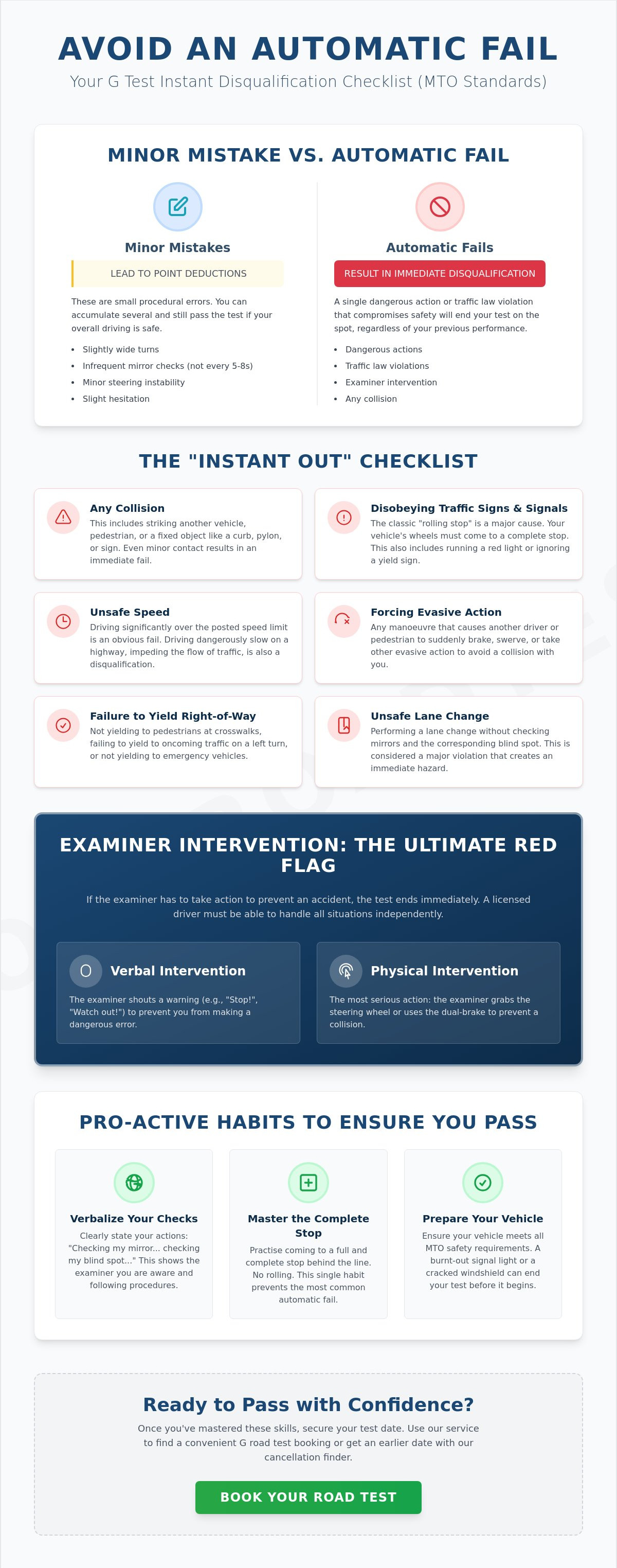
Official Ministry standards categorize failures into two main groups: "Dangerous Actions" and "Traffic Law Violations." While you can accumulate several minor demerits and still receive your full licence, a single entry in either of these major categories terminates the test immediately. This happens regardless of how perfectly you drove during the first twenty minutes. It is a binary result; the moment safety is compromised, the evaluation ends to ensure the safety of everyone on the road.
Minor Mistakes vs. Major Safety Violations
Examiners distinguish between procedural errors and safety breaches. For example, failing to check your mirrors every five to eight seconds is a point deduction. In contrast, performing a lane change without checking your blind spot is often classified as a major violation because it creates an immediate hazard. The primary factor in what causes an automatic fail on g test is the potential for a collision. Minor technical errors, such as turning slightly wide into a multi-lane road, usually result in small point losses. You can pass with these mistakes if your overall driving is sound. However, the threshold for an automatic fail is much lower. One dangerous manoeuvre, like a rolling stop at a red light, is enough to result in an unsuccessful result.
The Examiner Intervention Rule
This is a critical area where many applicants feel confused. Intervention occurs when the examiner has to take control of the situation to prevent an accident. Verbal intervention happens if the examiner must shout a warning or give an instruction to avoid a specific danger, such as "Stop!" or "Watch out for that cyclist!" Physical intervention is more direct. It involves the examiner grabbing the steering wheel or using the dual-brake in their vehicle. If the examiner has to step in to maintain safety, it is an automatic fail. This rule exists because a fully licensed driver must be able to recognize and react to hazards independently. If you find yourself needing a retake due to an intervention, using a road test cancellation finder can help you secure a new appointment quickly.
The "Instant Out" Checklist: Dangerous Actions and Violations
The DriveTest examiner is looking for one thing above all else: safety. While accumulating demerits for minor errors is frustrating, certain actions compromise safety so severely that the evaluation ends on the spot. These "Dangerous Actions" and "Traffic Law Violations" are strictly defined by MTO standards. Knowing the specific triggers for an immediate disqualification is the best way to avoid a wasted trip to the centre. Understanding exactly what causes an automatic fail on g test ensures you don't fall into common traps that catch even experienced G2 drivers off guard.
Here is a summarized checklist of the most common reasons for an instant fail:
- Any Collision: Striking another vehicle, a pedestrian, or even a stationary object like a curb or a pylon.
- Disobeying Signals: Running a red light or failing to stop completely at a stop sign.
- Evasive Manoeuvres: Any action that forces another driver to swerve or brake hard to avoid you.
- Speeding: Driving significantly over the posted limit or dangerously under the limit on a highway.
- Failure to Yield: Not giving the right-of-way to emergency vehicles or pedestrians at crosswalks.
Disobeying Traffic Signs and Signals
The "Rolling Stop" is perhaps the most frequent trap for applicants. In Ontario, your vehicle must reach a state of zero movement. If your wheels are still creeping forward, even at a snail's pace, it's a violation. This applies to right turns on red lights too. You must stop completely, check for pedestrians, and ensure no signage prohibits the turn before proceeding. Another high-stakes violation involves school buses. If you fail to stop for a bus with its red lights flashing, the test ends immediately due to the extreme safety risk to children.
Highway Merging and Lane Change Failures
Highway performance is a massive part of what causes an automatic fail on g test. Merging is a common pain point. If the flow of traffic is 100 km/h and you attempt to merge at 70 km/h, you create a dangerous speed differential. This forces other drivers to take evasive action, which is an automatic fail. Similarly, failing to perform a clear shoulder check before a lane change is considered a major safety breach. The examiner needs to see your head move to verify you have checked your blind spots. If you've been practicing these moves and feel confident, you can use a G Road Test Booking Service to find an available slot at your preferred location.
Critical Errors vs. Automatic Failures: Knowing the Threshold
The evaluation sheet used by examiners is divided into technical skills and safety requirements. While we have already looked at the "Dangerous Actions" that end a session instantly, it is equally important to understand how smaller mistakes can snowball. The Highway Traffic Act (HTA) serves as the legal foundation for these rules. If your driving deviates from these regulations, you will see marks on your score sheet. Understanding the nuances of what causes an automatic fail on g test helps you realize that some errors are cumulative while others are absolute. A single dangerous move ends the test, but a series of minor lapses can lead to the same unsuccessful result.
Point Accumulation: How Many Mistakes Are Too Many?
Every applicant starts with a clean slate. As you drive, the examiner records demerits for minor technical lapses. On a typical evaluation, you are permitted a specific number of minor errors, usually between 15 and 30 depending on the specific test criteria. However, "Driving Skills" points differ from "Safety" violations. For example, if you use one hand on the steering wheel while turning, you will lose points for poor technique. If you repeat this behaviour throughout the entire test, the examiner may determine that you lack the necessary control to be a fully licensed driver. This leads to a failure based on an accumulated pattern rather than a single event. Before Booking your G Test, you should review the score sheet to see which habits carry the heaviest weight.
Habitual Errors That Become Critical
Observation is the most common area where drivers lose points. You must check your mirrors every five to eight seconds. This is not just a helpful suggestion; it is a requirement to demonstrate constant situational awareness. If you miss one check, it is a minor demerit. If you consistently fail to scan intersections or check your mirrors, it becomes a critical error. Similarly, following distance is a major factor. The three-second rule is the standard for maintaining a safe gap between vehicles. If you tail-gate the car in front of you, you are committing a safety violation. While one instance of being slightly too close might just be a warning, a persistent lack of space becomes a critical safety error. Proper lane positioning also matters. Staying centred in your lane prevents you from drifting toward other vehicles, which is a key part of maintaining a safe environment. If you find your test was unsuccessful due to these habits, our G Road Test Booking Service can help you find a new date to try again with improved focus.
Practical Habits to Prevent Instant Failure (Pro-active Checklist)
Building reliable driving habits is the most effective way to manage test-day anxiety. While you now understand what causes an automatic fail on g test, you must translate that knowledge into muscle memory before you arrive at the DriveTest centre. Examiners look for consistency. If you perform a perfect merge once but hesitate the second time, you risk a safety violation. Adopting a pro-active approach ensures that your safety checks become automatic, leaving you more mental energy to follow the examiner's directions.
One of the most effective techniques is to exaggerate your head movements. Even if you can see your mirrors with a quick glance, the examiner needs to witness the physical movement of your head to verify the check. Many successful applicants also choose to verbalize their actions. Quietly saying "Checking left, checking right" or "Blind spot clear" demonstrates your awareness and confirms you aren't missing critical steps. Additionally, practice the "Full Stop" habit by silently counting to three once your vehicle has reached zero movement at every stop line. This simple count prevents the rolling stop trap that ends many tests prematurely.
Perfecting the 360-Degree Observation
Observation is about more than just looking; it is about following a specific sequence. When approaching any intersection, you must scan in a Left, Centre, Right, and Left again pattern. This ensures you catch any late-arriving traffic or pedestrians. For every turn or lane change, you must adhere to the Mirror-Signal-Blind Spot (MSB) sequence. Signalling before you check your mirrors or blind spot is a common technical error. Furthermore, observation during reverse manoeuvres is a frequent fail point. You must physically look out the back window while reversing. Relying solely on your mirrors or a backup camera is considered a lack of observation and can result in significant demerits.
Mastering the Highway Environment
The highway portion is often where drivers feel the most pressure. To succeed, you must master the acceleration lane. Your goal is to reach the flow of traffic, typically 100km/h, before you reach the merge point. Merging at a lower speed is a primary example of what causes an automatic fail on g test because it forces highway drivers to brake. Once you find a suitable gap, maintain your speed. You should never brake while merging into a highway lane unless it is absolutely necessary to avoid a collision. When exiting, wait until you are fully within the deceleration lane before you begin to slow down significantly. This prevents you from impeding the flow of high-speed traffic behind you. If you feel confident in these habits, you can use our G Road Test Booking Service to schedule your appointment and demonstrate your skills.
Preparing for Your Test Day: Logistics and Booking
Your preparation for the G road test begins long before you merge onto the highway. Many applicants focus exclusively on their driving skills, yet they overlook the administrative and mechanical requirements that lead to a disqualification before the engine even starts. Understanding what causes an automatic fail on g test includes knowing the "Out-of-Order" criteria. If your vehicle or documentation fails to meet Ministry standards, the examiner will terminate the appointment immediately. This is not just a delay; it's an official failure that requires a new booking and a repeat of the waiting period.
Efficiency on test day starts with arriving at least 30 minutes early. This buffer allows you to complete the check-in process at the kiosk and ensures you aren't marked as a "no-show," which is another form of an automatic fail. You should also verify that your G2 licence is valid and that you have no outstanding fines with the province. If you are also looking for information on m2 road test booking, the process shares similar safety requirements and check-in protocols.
Vehicle Requirements: Can Your Car Fail You?
The examiner will perform a pre-test inspection of your vehicle's essential safety features. If your brake lights, turn signals, or horn are not functioning, the test is cancelled instantly. This is often called an "Out-of-Order" failure. Your windshield must be free of large cracks that obstruct the driver’s or examiner’s view, and your tires must have adequate tread depth. Certain dashboard warning lights are also red flags. An active "Airbag" or "ABS" light suggests a safety system failure, which typically leads to an immediate disqualification of the vehicle for testing purposes.
Booking Your Appointment Without the Wait
Securing a slot at a popular DriveTest centre can be difficult due to high demand across Ontario. Many drivers find that the next available date is months away, which adds unnecessary stress to the process. Our G Road Test Booking Service and Road Test Cancellation Finder help you realize an earlier test date by monitoring the system for openings. Once you have a date, perform a final walk-around of your vehicle the night before. Arriving with a safe car, a valid licence, and a calm mindset is the final step to ensuring you don't fall victim to what causes an automatic fail on g test.
Secure Your Full G Licence with Confidence
Mastering the highway merge and avoiding the "rolling stop" trap are essential steps for every Ontario driver. By focusing on exaggerated observation and maintaining strict vehicle safety standards, you eliminate the technical errors that often lead to an unsuccessful attempt. Knowing exactly what causes an automatic fail on g test allows you to replace uncertainty with a clinical focus on safety. You have put in the practice; now you simply need to demonstrate that professional mindset to your examiner on the day of your appointment.
We act as an efficient facilitator to help you navigate the scheduling process without the usual frustration. Our service provides simplified booking at over 60 DriveTest centres across the province, and our cancellation finder is designed to help you secure earlier dates. We manage the administrative details so you can enjoy a stress-free experience. Skip the wait and book your G road test today. You are closer than ever to earning your full driving privileges, and we look forward to supporting your success.
Frequently Asked Questions
Is hitting the curb an automatic fail on the G test in Ontario?
Yes, striking the curb with enough force to mount it or cause a significant jar to the vehicle is considered a collision. While a light touch during a parking manoeuvre might only result in point demerits, any impact that endangers the vehicle's alignment or safety is an immediate disqualification. Examiners view this as a lack of basic vehicle control.
Can I fail the G test for driving too slowly on the highway?
Yes, driving significantly below the speed limit is a major safety hazard that can end your test. If you travel at 70 km/h in a 100 km/h zone without a valid reason like heavy traffic or poor weather, you impede the flow of traffic. This is a primary example of what causes an automatic fail on g test because it forces other drivers to perform dangerous passing manoeuvres.
What happens if the examiner has to touch the steering wheel?
Any physical intervention by the examiner results in an instant failure. If the examiner grabs the wheel or uses the dual-brake to prevent a potential hazard, the evaluation ends immediately. This action confirms that the driver is not yet capable of maintaining independent safety on the road without professional assistance.
Is a rolling stop at a red light considered an automatic fail?
Yes, failing to bring your vehicle to a complete stop at a red light or stop sign is a serious traffic law violation. Your wheels must reach a state of zero movement before you proceed. Even if the intersection is clear, a "California stop" or rolling through a right turn on red will terminate your test on the spot.
How many minor mistakes are allowed on the G road test?
Ontario does not set a single fixed number, but you generally fail if you accumulate more than 15 to 30 demerits. The exact threshold depends on the specific scoring sheet used for your test type. While minor errors like wide turns won't end the test instantly, they can lead to a failure if they show a persistent pattern of poor driving habits.
Will I fail if I don’t reach 100km/h on the highway merge?
You may fail if your speed is low enough to create a hazard for existing highway traffic. The goal is to match the flow of traffic, which is usually 100 km/h on 400-series highways. If you merge at 80 km/h and force a transport truck to brake, the examiner will record an automatic failure. Understanding what causes an automatic fail on g test helps you realize that speed management is just as critical as technical steering.
Does a "near miss" count as an automatic failure if no one was hurt?
Yes, any action that requires another road user to swerve or brake hard is classified as a dangerous action. You don't need to make physical contact to fail. The examiner evaluates your ability to drive without creating risks, so forcing an evasive manoeuvre from someone else is an "instant out" on your evaluation sheet.
Can I retake my G test immediately if I fail due to an automatic violation?
No, you must wait a minimum of 10 days before you can attempt the road test again in Ontario. This mandatory waiting period applies regardless of the reason for your failure. During this time, you can use our road test cancellation finder to secure a new appointment at a convenient location once your eligibility window reopens.


