
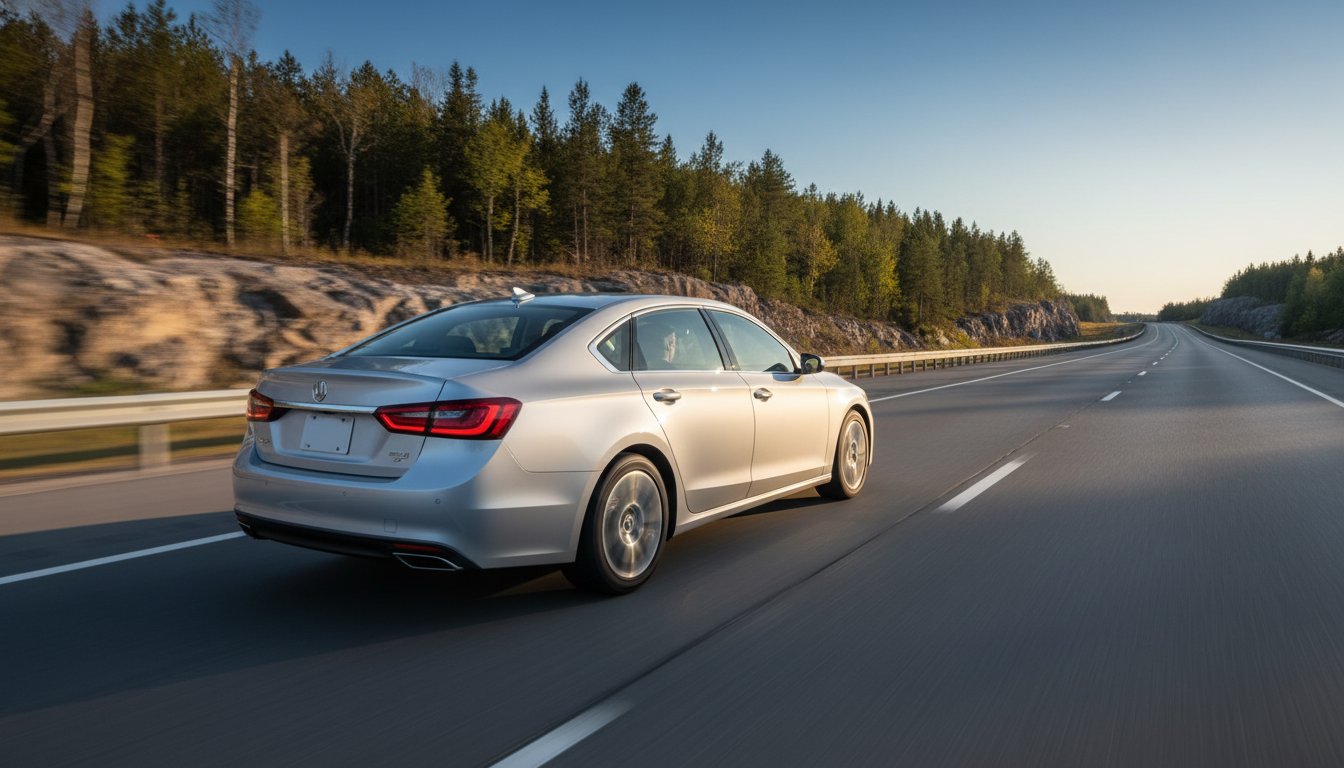
What if the most intimidating part of your Ontario G road test was actually the simplest way to prove you're ready for a full licence? Most drivers feel a knot in their stomach when the examiner points toward the 400-series on-ramp. It's completely normal to worry about merging into 100 km/h traffic or knowing exactly how many times to check your mirrors to satisfy a strict evaluation. By mastering specific highway driving tips for g test ontario, you can turn that anxiety into a controlled, professional performance that mirrors exactly what G test officials want to see.
This guide provides the expert techniques you need to handle high-speed observation and lane changes with total composure. We will break down the specific criteria used for the highway evaluation, including how to manage sections where speed limits have increased to 110 km/h. You'll learn how to execute every move with the clinical precision required to pass on your first attempt. Whether you're worried about a single speed error or the highway driving declaration, we're here to ensure you feel prepared and calm before you even turn the key.
Key Takeaways
- Learn how to match traffic speed perfectly on the acceleration lane to avoid dangerous merges and ensure a smooth entry into 400-series traffic.
- Master the 5-8 second mirror check rule and other essential highway driving tips for g test ontario to satisfy strict examiner observation requirements.
- Identify the common errors, such as driving too slowly or forcing other drivers to brake, that lead to an automatic failure during the highway portion.
- Understand the exact duration and structure of the 400-series highway component so you know what to expect during your 35-minute evaluation.
- Discover how to navigate current booking backlogs to secure your G road test date before your novice licence expires.
The Highway Component: What to Expect During Your G Road Test
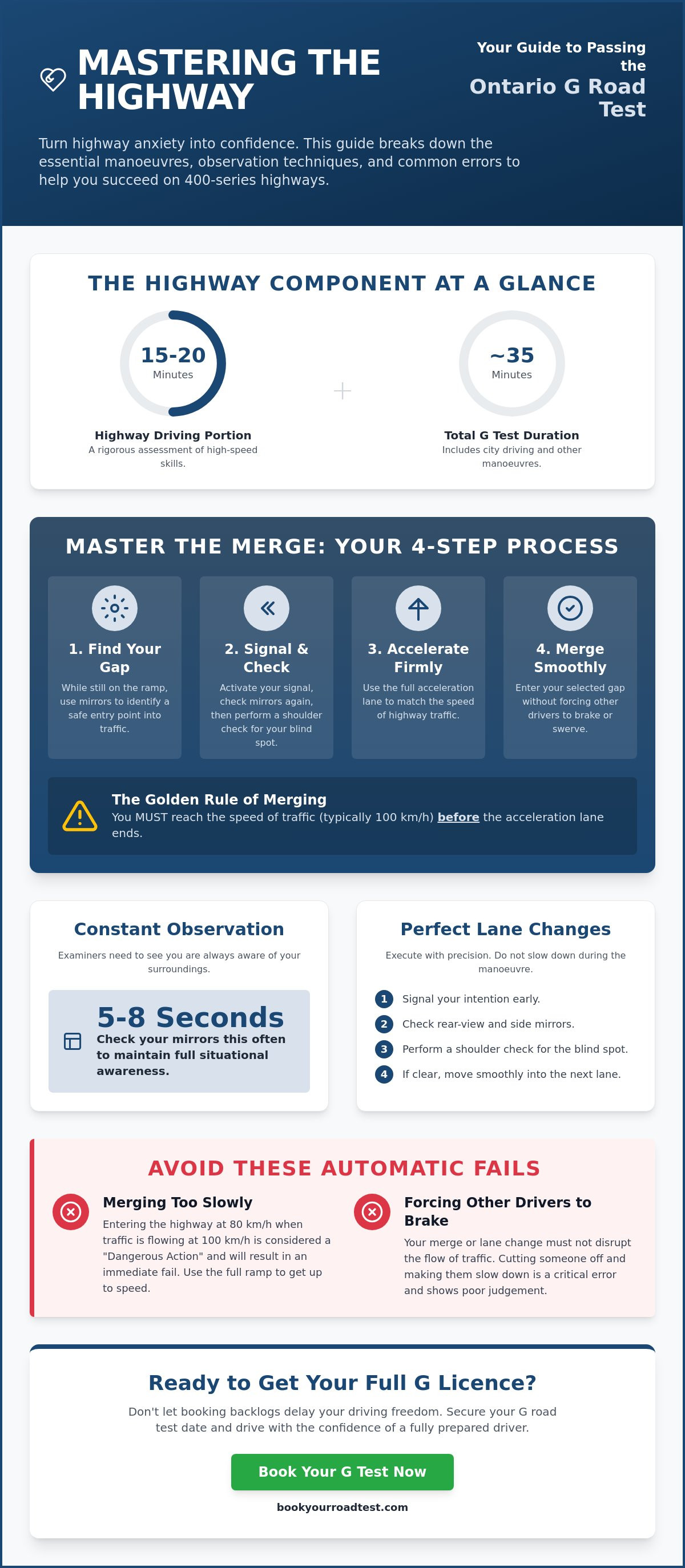
The G road test, officially known as the G2 exit test, serves as the final milestone in Ontario's graduated licensing system. While your G2 exam focused heavily on residential safety and basic vehicle control, the full G test demands a higher level of technical proficiency and environmental awareness. During the approximately 35-minute evaluation, you should expect to spend roughly 15 to 20 minutes on high-speed thoroughfares. This portion is not just a formality; it is a rigorous assessment of your ability to handle complex traffic patterns safely and efficiently.
Depending on your DriveTest centre location, your examiner will direct you toward major routes like the 401, 403, 404, 407, or the QEW. In some regions, regional expressways with speed limits of 80 km/h or higher are used instead. Understanding how 400-series highways are designed helps you anticipate the layout of interchanges and merge lanes, which is critical for success. The examiner isn't looking for the hesitant caution of a learner; they want to see the assertive competence of a fully licensed driver who can integrate seamlessly into traffic without causing disruptions.
G2 vs. G: Why the Highway Changes Everything
Moving from a G2 to a full G licence marks a significant shift in responsibility. Your G2 test stayed within the lower speeds of residential areas, but the G test puts you in a high-speed environment where decisions must be made in seconds. The stakes are also much higher. If your G2 licence is nearing its five-year expiry date and you fail the test, you may face the frustration of starting the entire graduated process over from a G1. Success requires precise mirror work and the ability to process visual information much faster than you did on local streets. You must prove you can stay calm while vehicles pass you at high speeds.
Required Highway Maneuvers for a Pass
To earn your full licence, you must demonstrate mastery over several core tasks. Examiners look for a perfect merge where you match the flow of traffic before leaving the acceleration lane. You'll likely be asked to perform multiple lane changes in quick succession to show you can manage blind spots and gaps at 100 km/h. Using specific highway driving tips for g test ontario, such as maintaining a consistent speed even while checking your surroundings, will help you avoid the common mistake of slowing down during a lane change. The examiner will observe your speed maintenance across different traffic flows to ensure you aren't impeding others or creating hazards for those behind you.
Master the Merge: Entering and Exiting 400-Series Highways
Merging into 100 km/h traffic is often where applicants feel the most pressure. However, the "Golden Rule" of the G test is simple: you must match the speed of highway traffic before you reach the end of the acceleration lane. This requires a mechanical blend of speed matching and gap finding. Effective highway driving tips for g test ontario emphasize looking for your spot as early as possible. While you are still on the curved part of the on-ramp, use your side mirrors and a quick glance to identify a suitable gap. This early "Gap Selection" prevents the panic of reaching the straightaway without a plan.
The sequence must be fluid and deliberate. Signal your intent as soon as the ramp begins to straighten. Check your rearview mirror, then your side mirror, and perform a decisive blind spot check. Once you've identified your gap, accelerate smoothly but firmly to reach the flow of traffic. If you've already secured a G road test booking, practice this specific rhythm until it feels like second nature. The examiner is looking for confidence, not hesitation. Your goal is to integrate so smoothly that the existing traffic doesn't have to adjust their speed for you.
The 100km/h Target: Acceleration Ramp Etiquette
Merging at 80 km/h when the flow of traffic is 100 km/h is frequently marked as a "Dangerous Action" by examiners. This often results in an automatic failure because it forces other drivers to brake or swerve. You must use the full length of the acceleration lane to reach the posted limit. If a slow-moving vehicle is ahead of you on the ramp, increase your following distance early. This gives you enough "runway" to accelerate to 100 km/h once the vehicle in front finally merges. Don't let another driver's lack of confidence compromise your test results.
Exiting the Highway: Deceleration and Signal Timing
Exiting requires just as much precision as entering. You should activate your turn signal approximately 150 metres before the deceleration lane begins. A common mistake is braking while still in the live highway lane. This disrupts the flow of traffic behind you and will result in lost marks. Instead, maintain your highway speed until your entire vehicle has moved into the off-ramp lane. Only then should you apply the brakes to meet the lower speed limit of the exit ramp. This ensures you aren't an obstacle for the high-speed traffic continuing straight.
Lane Discipline and High-Speed Observation Techniques
Safe highway driving is built on a foundation of constant, rhythmic observation. While you are cruising at 100 km/h, the environment changes much faster than it does on city streets. Examiners are specifically looking for the "5-8 Second Rule," which means your eyes should hit a mirror at least once every five to eight seconds. This isn't just about safety; it's about proving you have total situational awareness. Integrating these highway driving tips for g test ontario into your practice sessions will help you develop the muscle memory needed to pass without second-guessing your every move.
One of the most common reasons students lose marks is not because they didn't look, but because the examiner didn't see them look. You must slightly exaggerate your head movements. If you only move your eyes, the examiner, who is often looking at a clipboard or out the side window, won't notice your effort. A clear, deliberate turn of the chin toward each mirror and into your blind spot makes your observation undeniable. This transparency builds trust with the evaluator and demonstrates that you are proactively managing the space around your vehicle.
Maintaining a safe buffer is equally vital. At highway speeds, you should keep at least a three-second following distance between you and the vehicle ahead. To check this, pick a stationary object like a sign or a bridge. Once the car in front passes it, count "one-one-thousand, two-one-thousand, three-one-thousand." If you reach the object before you finish counting, you're too close. This gap gives you the necessary time to react to sudden braking or debris without having to jerk the steering wheel or slam on your brakes.
Proactive Observation: The 360-Degree Scan
Effective observation starts far beyond your front bumper. You should scan the horizon 12 to 15 seconds ahead to anticipate traffic slowdowns, construction, or vehicles entering from on-ramps. A professional habit to adopt is checking your rear-view mirror every single time you see a brake light activate in the distance. This allows you to know exactly who is behind you before you even need to slow down. The Observation Cycle is a continuous loop of mirrors and road scanning. It never stops until the car is parked and the engine is off.
Lane Change Precision Under Pressure
Changing lanes at high speeds requires the MSB sequence: Mirror, Signal, Blind Spot. Once you've confirmed the path is clear, use a smooth, gradual steer to move into the next lane. Avoid sharp or jerky movements, as these suggest a lack of control at high speeds. If you encounter "blind spot lingerers"-drivers who sit right beside your rear quarter panel-don't panic. Adjust your speed slightly to create a clear gap before initiating your sequence. Always ensure you cancel your signal immediately after your fourth wheel has entered the new lane to avoid confusing other drivers.
Common Highway Mistakes That Lead to Automatic Failure
A single error on the 400-series can end your test instantly. While minor mistakes might only result in lost marks, certain "Dangerous Actions" trigger an immediate disqualification. Impeding the flow of traffic is a primary culprit. If you merge at 70 km/h while other vehicles are travelling at 100 km/h, you force others to brake or swerve. This is not just a point deduction; it is a safety hazard that examiners cannot overlook. To avoid this, apply the highway driving tips for g test ontario we covered regarding aggressive acceleration on the ramp.
Speeding remains the most straightforward path to failure. DriveTest examiners follow a zero-tolerance policy for exceeding the posted limit. Even if every other car is moving at 120 km/h, you must remain at or slightly below the limit. Similarly, incomplete blind spot checks are the number one reason for G test failure in Ontario. If you fail to turn your head decisively before every single lane change, the examiner will assume you didn't look. This lack of verification suggests you aren't ready for the responsibility of a full licence.
If you are feeling confident and ready to avoid these pitfalls, use our G road test booking service to find an appointment that fits your schedule. Securing a date is the first step toward proving your competence on the road.
The "Speeding vs. Flow" Dilemma
You may find yourself in a situation where the flow of traffic is significantly faster than the 100 km/h or 110 km/h limit. In these cases, stay in the right-most lane. This position allows faster drivers to pass you on the left and reduces the pressure to keep up with illegal speeds. Use your speedometer as a primary tool. Check it frequently to ensure you haven't drifted upward while following a faster vehicle. Maintaining your own pace demonstrates the discipline required for a full G licence.
Handling Nerves and Examiner Instructions
High-speed environments are loud, and it is easy to mishear an instruction. If you aren't sure what the examiner said, ask for clarification immediately. Missing an exit is not an automatic failure as long as you continue driving safely and follow the next set of directions. The real danger lies in panicking and making a sudden, unsafe lane change to "save" the exit. Stay calm, keep your eyes on the road, and remember that the examiner is there to observe your safety, not to trick you into a mistake.
Booking Your G Test: How to Secure a Date Without the Wait
The current administrative backlog for G road tests in Ontario remains a significant hurdle for novice drivers. In many regions, wait times for an appointment can stretch between four to six months. This delay creates immense psychological pressure. Knowing that a failure could result in another half-year wait or even licence expiry makes the evaluation feel much higher stakes. If your G2 licence is nearing its five-year limit, the backlog isn't just an inconvenience; it's a threat to your driving status. Failing a test with only weeks left on your licence could force you to restart the entire graduated licensing process from the G1 level. Having a solid grasp of highway driving tips for g test ontario is only half the battle. You also need a strategic approach to finding an appointment that works for your timeline.
Why Timing Your Test Matters
Timing your test is a subtle but effective way to improve your chances of success. Aim to book your evaluation during off-peak hours, typically between 10:00 AM and 2:00 PM. During these windows, highway traffic is generally lighter and more predictable than the chaotic morning or evening rush. This environment allows you to demonstrate your merging and lane-change skills with less interference from aggressive commuters. By organizing your personal schedule around these optimal times, you can realize your goal of becoming a fully licensed driver much sooner. It's about creating the best possible conditions for you to perform the skills you've practiced.
The Book Your Road Test Advantage
Navigating the official booking system often feels like a full-time job. We act as an independent service provider to help you bypass the frustration of refreshing the DriveTest portal all day. Our platform is not a government agency; instead, we are a professional concierge designed to find you an appointment with speed and transparency. We monitor the system constantly for new openings. This ensures you have the best possible chance of finding a slot at your preferred centre, whether that's in the GTA or a quieter regional office.
By using the Road Test Cancellation Finder Ontario, you can gain access to earlier dates that appear when other applicants reschedule. This tool acts as the ultimate stress-relief mechanism for those on a tight deadline. Don't let a crowded system hold back your freedom or risk your licence expiring while you wait for a slot to open up manually. Book your G road test today and let us handle the administrative search while you focus on mastering the road.
Drive Toward Your Full Licence Today
Mastering the 400-series portion of your exam comes down to three pillars: assertive speed matching, rhythmic observation, and precise lane discipline. By applying these highway driving tips for g test ontario, you've already reduced the uncertainty that leads to test-day anxiety. You now understand the examiner's focus on "fully licensed" competence rather than hesitant learner habits. The final hurdle is often the administrative backlog that keeps you from putting these skills into practice before your current licence expires.
Waiting for an appointment shouldn't be the most difficult part of your journey. We provide a functional, stress-free solution to help you navigate this hurdle efficiently. Our automated cancellation monitoring covers over 60 DriveTest centres across the province, ensuring you don't have to spend your day refreshing a government website. You can secure an earlier G road test date with our Ontario Cancellation Finder right now. We handle the complex booking administration so you can remain focused on your road performance. You're ready to leave your novice licence behind and embrace the freedom of the road with total confidence.
Frequently Asked Questions
How fast should I merge onto the highway during my G test?
You must match the flow of traffic, which is typically 100 km/h or 110 km/h depending on the posted limit of the specific 400-series highway. You are expected to reach this speed while still in the acceleration lane before merging. Merging significantly slower than surrounding vehicles is classified as a "Dangerous Action" and often results in an automatic failure because it forces other drivers to brake.
Do I have to go on a 400-series highway for the G test?
Yes, the G evaluation requires you to drive on a high-speed highway with a speed limit of at least 80 km/h. Most DriveTest centres utilize 400-series highways like the 401, 403, or QEW to assess your skills. If your local centre isn't near a 400-series road, the examiner will use a regional expressway that meets the provincial speed and design criteria for the exit test.
How many lane changes are required on the G test highway portion?
You will typically perform at least two lane changes while on the highway: one to move into the left lane and one to return to the right. Some examiners may request four or more changes if traffic conditions allow them to better observe your gap selection. Every lane change must follow the Mirror, Signal, Blind Spot sequence with a clear, exaggerated head movement to earn full marks.
What happens if the highway is extremely congested during my test?
If the highway is congested, you must adjust your speed to match the current flow while maintaining a safe three-second following distance. You aren't required to reach 100 km/h if the traffic is moving at 40 km/h. In these scenarios, the examiner focuses on your ability to select safe gaps and your frequency of mirror checks while navigating the slower traffic flow.
Can I fail my G test for going 101 km/h in a 100 km/h zone?
Technically, exceeding the posted limit by any amount is a speeding error, but examiners look for consistent control. While a brief drift to 101 km/h might only result in a minor mark, staying consistently above the limit is a major fault. Applying highway driving tips for g test ontario like frequent speedometer scans helps you stay exactly at the limit and avoids giving the examiner a reason to fail you.
Do I need to do a blind spot check when exiting the highway?
Yes, you must perform a decisive blind spot check before moving from the highway lane into the deceleration lane. Even though you are exiting, another vehicle could be travelling in an adjacent lane or on the shoulder. This check confirms the path is entirely clear before you begin the exiting manoeuvre, ensuring you don't cut off another driver who may be approaching the ramp.
What should I do if I miss my exit during the G road test?
If you miss your exit, remain calm and continue driving to the next available exit while following all safety protocols. Do not attempt a sudden lane change or brake aggressively to "save" the exit. Inform the examiner that you missed the turn; they will provide new directions to get you back on track. As long as you maintain safe driving habits, missing an exit is not an automatic failure.
Is parallel parking still required on the Ontario G test in 2026?
Parallel parking remains a mandatory component of the G road test in 2026. Although the highway portion is the primary focus of the upgrade from a G2, you are still evaluated on your ability to perform residential manoeuvres. This includes three-point turns, roadside stops, and parking. You must prove you are a well-rounded driver capable of handling both high-speed expressways and tight urban spaces.


