

Passing your M2 road test isn't just about knowing how to ride; it's about performing "safety theatre" for an examiner who needs to see every shoulder check as a deliberate act of survival. It's completely normal to feel anxious about stalling at a busy intersection or failing on a technicality like a missed blind spot check. You've likely spent the last 60 days practicing on your M1, yet the pressure of a 20 minute evaluation can make anyone second-guess their lane positioning. Understanding exactly what to expect on m2 road test ontario sessions is the most effective way to neutralize those nerves and ensure a successful licence upgrade.
This 2026 guide provides the technical clarity you need to master every required manoeuvre with professional precision. You will gain the confidence to handle complex traffic scenarios while demonstrating the specific habits examiners prioritize. We will examine the exact drills required during the evaluation, provide a comprehensive checklist of road situations, and outline the mandatory gear requirements you must meet before you even start your engine. By the end of this article, you'll have a clear roadmap to transition from a learner to a seasoned M2 rider.
Key Takeaways
- Confirm your eligibility by ensuring you have held your M1 for at least 60 days and have prepared your motorcycle for a strict mechanical pre-trip inspection.
- Master the art of "safety theatre" to show the examiner you are constantly aware of your surroundings, which is a critical part of what to expect on m2 road test ontario assessments.
- Develop flawless technical habits for slow-speed balance and smooth clutch control to prevent stalling or losing stability during the 20 minute evaluation.
- Identify the specific technicalities and automatic fail conditions, such as improper lane positioning or failing to perform mandatory shoulder checks, that often catch riders off guard.
- Manage the high seasonal demand for test slots by understanding the logistical requirements and how to secure a booking before your M1 licence expires.
Understanding the Ontario M2 Road Test Basics
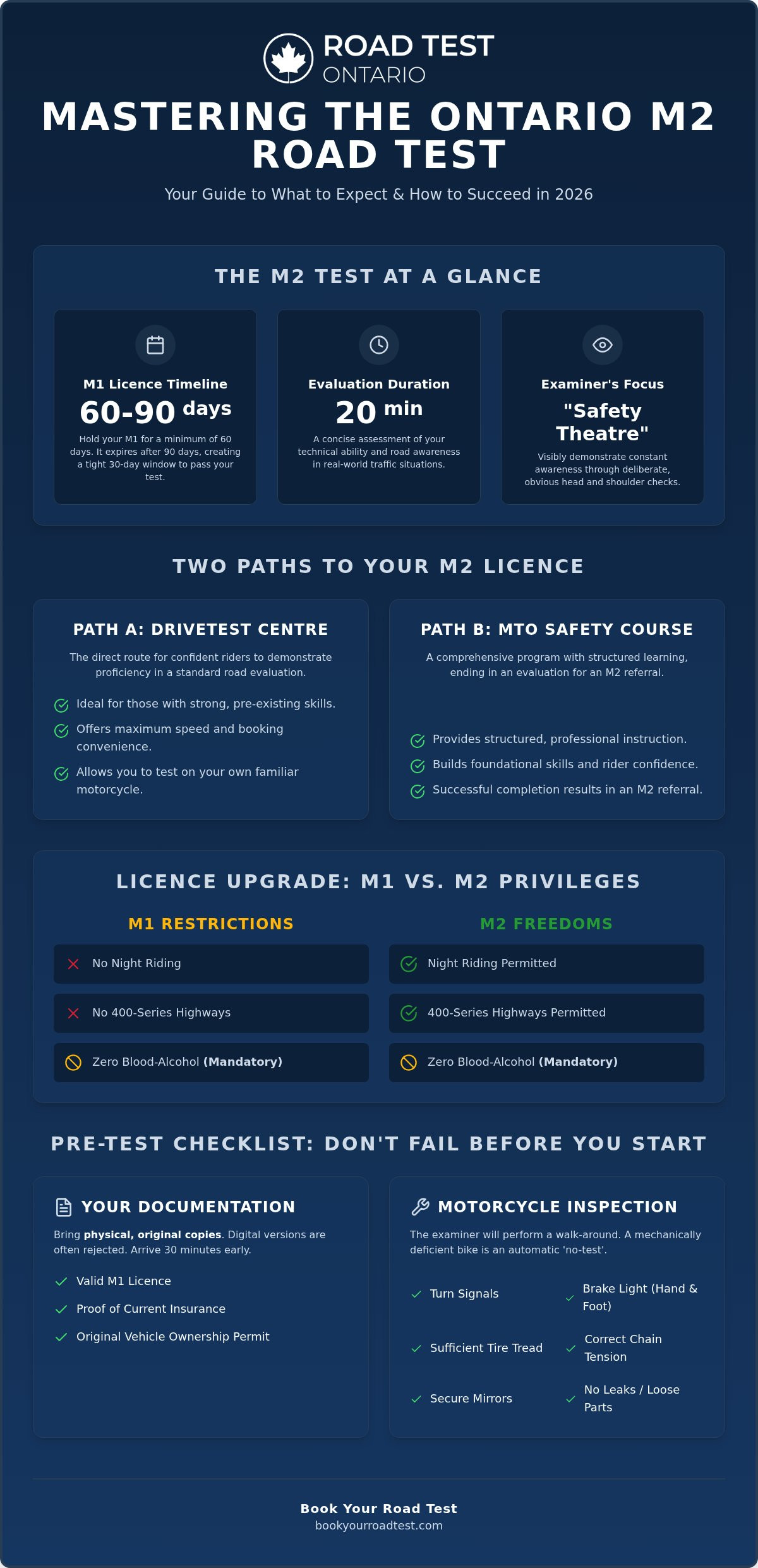
The M2 road test represents the first major practical milestone in Ontario's Graduated Licensing System for motorcyclists. It's the bridge between holding a temporary learner's permit and gaining the freedom to ride without most daytime restrictions. Before you can attempt this evaluation, you must hold your M1 licence for a minimum of 60 days. This mandatory waiting period is designed to ensure you've spent enough time practicing basic handling and low speed control in a controlled environment. Since your M1 expires after 90 days, you have a narrow 30 day window to complete this step unless you choose to restart the process.
Knowing what to expect on m2 road test ontario sessions will help you stay calm when the examiner begins their evaluation. The test itself is a concise, 20 minute assessment of your technical ability and road awareness. During this time, the examiner isn't just checking if you can keep the bike upright; they're looking for a proactive safety mindset. You'll be evaluated on your ability to maintain balance, control your speed, and execute precise manoeuvres while navigating real traffic situations. Success depends on showing that you're a predictable and observant presence on the road.
M1 vs. M2: What Changes After You Pass?
Upgrading to an M2 licence significantly expands your utility as a rider. Passing this test removes the restrictive "no night riding" rule and the prohibition against using high speed 400-series highways. This upgrade transforms your motorcycle from a daytime practice tool into a legitimate mode of transportation. However, some rules remain strict. You must still maintain a zero blood-alcohol level regardless of your age or experience. The M2 licence acts as a long term probationary period, requiring you to gain 22 months of riding experience before you're eligible to take your final M road test.
The Two Paths to Your M2 Licence
Riders in Ontario generally choose between two distinct routes to secure their upgrade. Option A involves booking an official evaluation at a DriveTest centre. This is often the preferred choice for those who feel confident in their existing skills and want to secure their licence quickly without committing to a full weekend of classroom instruction. Option B is completing an MTO-approved motorcycle safety course, where a successful final evaluation results in a referral for your M2.
While safety courses provide a structured learning environment, many riders opt for the DriveTest route for its speed and convenience. It allows you to demonstrate your proficiency on your own familiar equipment in a standard road environment. Regardless of the path you choose, the criteria for passing remain rigorous. You must show that you can operate your vehicle safely without endangering yourself or other motorists.
Your road test begins before you ever click into first gear. Arriving at the centre with a mechanically deficient motorcycle or incomplete paperwork is the fastest way to receive an immediate "no-test" result. This counts as a failed attempt and requires you to rebook, which can be frustrating when available dates are scarce. Understanding what to expect on m2 road test ontario procedures begins with the bike itself, so treat the pre-trip inspection with the same seriousness as the riding portion of the evaluation. Before the examiner approaches, verify that you have your physical documentation organized. You must present a valid M1 licence, proof of current insurance, and the vehicle's original ownership permit. Digital copies are frequently rejected at the counter, so bring the physical papers to ensure a smooth check-in process. Plan to arrive at the centre at least 30 minutes early to complete these administrative steps. These requirements are detailed in the Official MTO Motorcycle Handbook, which serves as the standard for all provincial licensing centres.Mechanical Checklist for the M2 Test
The examiner will perform a systematic walk-around to verify that your motorcycle is street-legal and safe for public roads. They will ask you to demonstrate the functionality of your front and rear turn signals, along with the brake light using both the hand lever and foot pedal. Ensure your tire tread depth is sufficient and that your chain tension is adjusted to the manufacturer's specifications. Mirrors must be securely attached and provide clear visibility without excessive vibration. An examiner expects a "ready-to-ride" motorcycle to satisfy all Highway Traffic Act requirements while presenting no visible leaks, loose components, or structural hazards.
Approved Riding Gear Requirements
Your gear choice communicates your safety awareness to the examiner before you even pull away. While a DOT-approved helmet is the legal minimum, ensure it fits correctly and the visor is clear. Footwear is a frequent point of failure during inspections; you must wear sturdy boots that fully cover the ankle bone to provide adequate protection. While not always strictly mandated for the test itself, wearing motorcycle-specific gloves and a long-sleeved jacket demonstrates a professional attitude toward rider safety. If you are struggling to find an available slot before your current permit expires, using a road test cancellation finder can help you secure an earlier date.
Preparing for what to expect on m2 road test ontario inspections ensures you don't fail on a simple technicality. The examiner's objective is to confirm that your equipment is reliable for the duration of the 20 minute evaluation. Arriving prepared sets a professional tone for the remainder of your assessment.
Core Technical Maneuvers You Must Demonstrate
Once you clear the pre-trip inspection, the practical evaluation begins. Starting and stopping your motorcycle with precision is the foundation of the 20 minute assessment. Examiners watch for smooth clutch control and steady balance as you pull away from the curb. Stalling isn't an automatic failure, but it signals a lack of vehicle familiarity that can lead to point deductions. You must also demonstrate competent gear shifting; the examiner needs to see that you can navigate the gearbox efficiently without looking down at your controls or losing focus on the road ahead. Consult Ontario's Official M2 Road Test Information for a full breakdown of the skills assessed during this phase.
Intersection safety remains the most scrutinized element of the ride. When you approach a junction, your head should be in constant motion. Examiners expect you to check left, centre, and right before entering any intersection, even if you have the right of way. This proactive observation is a major part of what to expect on m2 road test ontario evaluations. You must also maintain a consistent speed through curves, choosing a line that maximizes visibility and stability. Braking or shifting mid-turn suggests poor planning and can negatively impact your score.
The Art of the Clean Stop
Stopping your bike requires more than just pulling the lever. You must use both the front and rear brakes in tandem to achieve a controlled, balanced stop. As you decelerate, downshift through the gears so you're in first gear by the time you reach a complete halt. This ensures you're ready to move immediately if a hazard develops behind you. When you stop, the standard practice is to put your left foot down while keeping your right foot firmly on the rear brake. This keeps the bike stable and prevents it from rolling on uneven surfaces.
Lane Positioning and Blocking
Understanding the "thirds" of a lane is critical for rider safety and exam success. You should generally ride in the left third of the lane to stay visible to oncoming traffic, but you must move to the right third when preparing for a right turn or to avoid hazards. This strategy is known as "blocking," as it prevents other vehicles from trying to share your lane space. Every time you change your position within the lane or move between lanes, you must use clear signals and perform a physical head check to verify your blind spots. Relying solely on mirrors is a common mistake that leads to failed attempts during the road test.
Mastering these technical manoeuvres shows the examiner that you have moved beyond basic operation and are ready for the responsibilities of an M2 licence. Consistency is your goal. If you can perform these tasks smoothly under pressure, you'll significantly increase your chances of a successful result. Knowing what to expect on m2 road test ontario sessions allows you to focus on your performance rather than the mystery of the evaluation process.
Common Mistakes and How to Avoid an Automatic Fail
Success on your road test depends as much on avoiding critical errors as it does on demonstrating technical skill. While minor mistakes like stalling once or forgetting to cancel a signal might result in a point deduction, they won't necessarily end your attempt. However, automatic disqualifications are non-negotiable. If you drop your motorcycle at any point, run a red light, or exceed the speed limit, the examiner will terminate the evaluation immediately. Staying calm is essential; if you stall, simply restart the bike safely and continue. Panicking often leads to a second mistake that could push you over the point limit.
Understanding what to expect on m2 road test ontario sessions requires you to distinguish between being a good rider and being a good test candidate. Examiners need to see that you're actively managing risks. If you realize you've made a minor error, don't let it rattle you. Take a deep breath and focus on the next manoeuvre. Most riders who fail do so because they accumulate too many small penalties or commit a single, avoidable major violation like a rolling stop at a stop sign.
The Importance of the "Life Saver" Glance
The biggest gap in most riders' preparation is the lack of "safety theatre." Because examiners follow you in a vehicle, they cannot see your eye movements through your helmet visor. You must physically turn your head to demonstrate that you're checking your mirrors and blind spots. This "Life Saver" glance is required before every turn, lane change, and intersection entry. If your helmet doesn't move, the examiner assumes you didn't look. Time these checks so they're obvious and deliberate, ensuring the person behind you can clearly record your observation habits.
Speed Management and Traffic Laws
Maintaining the correct speed is a delicate balance. You must stay exactly at the posted limit. Riding too fast is an obvious fail, but riding significantly below the limit suggests a lack of confidence and can also lead to deductions. Come to a full and complete stop at every stop sign; the bike should settle completely before you proceed. Additionally, maintain a safe following distance. In Ontario, this typically means keeping at least a two second gap between you and the vehicle ahead to show you're prepared for sudden stops.
If you're feeling the pressure of a looming deadline, don't let a lack of available dates add to your stress. You can secure a spot quickly by using a specialized M2 road test booking service to find an appointment before your learner's permit expires.
Booking Your M2 Road Test and Day-of Logistics
The 90 day expiry of the M1 licence creates significant time pressure for new riders. Since you must wait 60 days before you can even attempt the evaluation, you only have a small window to secure an appointment before your permit becomes invalid. Understanding what to expect on m2 road test ontario logistics is crucial for managing this timeline effectively and avoiding the need to restart the written knowledge test. Planning ahead is the only way to ensure you don't lose your progress during the busy summer months.
Securing a Test Date in a Crowded System
Motorcycle testing is seasonal in Ontario, typically available from mid-May through mid-October. This limited window results in high demand, making m2 road test booking a difficult task during peak months. If the official portal shows no availability, using a road test cancellation finder ontario can be a strategic way to find slots that others have vacated. An independent administrative service can handle the constant monitoring of over 60 DriveTest centres for you, providing a streamlined alternative to the standard booking process. While we are an autonomous concierge service and not affiliated with the MTO, our tools are designed to reduce the stress of navigating the provincial system.
Final Preparation Tips
Preparation extends beyond your riding ability. If possible, ride through the streets surrounding your chosen centre to familiarize yourself with local speed limits and intersection layouts. Spend the night before visualizing the specific manoeuvres and the exaggerated head movements required for the examiner. You must also consider your transport logistics. Since your M1 restricts you from high speed roads and night riding, ensure your route to the centre complies with these laws, or arrange for a licensed rider to help transport your bike if the test centre is outside your legal riding area.
On the day of your test, arrive at least 30 minutes early to check in and complete your residency declaration. Once you successfully finish the 20 minute ride, the examiner will provide immediate feedback. If you pass, you'll receive a temporary paper M2 licence at the counter. This document allows you to ride immediately without M1 restrictions while you wait for your permanent card to arrive by mail. You must then hold this M2 for 22 months before you're eligible for your full M licence, though this period is reduced to 18 months if you complete a recognized safety course. Knowing what to expect on m2 road test ontario logistics ensures you can focus entirely on your performance when the examiner signals the start of your test.
Secure Your Freedom on Two Wheels
Mastering the technical requirements of the M2 evaluation is the final hurdle before you unlock the full utility of your motorcycle. By prioritizing a "ready-to-ride" mechanical state and committing to the "safety theatre" of visible head checks, you eliminate the technicalities that often lead to failed attempts. You now understand exactly what to expect on m2 road test ontario sessions, from the initial document check to the final feedback from your examiner. Success on the road is built on this foundation of preparation and calm execution.
The high demand for seasonal testing slots shouldn't prevent you from upgrading your licence before your M1 expires. Our independent administrative support helps busy riders bypass the frustration of the official portal by monitoring over 60 Ontario centres for available openings. Book your M2 road test date today or find an earlier cancellation with our expert service. We focus on the logistics so you can focus on your riding. You've put in the practice hours, so trust your training and enjoy the ride toward your new M2 licence.
Frequently Asked Questions
How long is the M2 road test in Ontario?
The M2 road test typically lasts approximately 20 minutes. This concise evaluation focuses on your ability to handle a motorcycle in real traffic conditions rather than just basic parking lot manoeuvres. During this time, the examiner assesses your lane positioning, observation habits, and technical control. Knowing what to expect on m2 road test ontario sessions helps you stay focused during this brief but critical window of evaluation.
What happens if I fail my M2 road test?
If you fail the evaluation, you must wait at least three days before attempting the test again. You'll need to pay a new test fee and secure a revised booking date. The primary risk of failing is the 90 day expiry limit on your M1 licence. If your M1 expires before you pass, you must retake the written knowledge test and restart the 60 day mandatory waiting period.
Do I need my own motorcycle for the M2 road test?
Yes, you are responsible for providing a mechanically sound, street-legal motorcycle for your evaluation. DriveTest centres don't provide vehicles for testing purposes. Your motorcycle must have a valid licence plate, current insurance, and functioning safety equipment like signals and brake lights. If you don't own a bike, you must borrow or rent one and ensure it is legally transported to the centre for your attempt.
Can I take the M2 road test if it is raining?
Motorcycle road tests are seasonal and weather dependent, typically running from mid-May to mid-October. Evaluations usually proceed in light rain, but examiners may cancel or postpone tests during heavy downpours, high winds, or thunderstorms for safety reasons. If weather conditions are questionable on your test day, contact the centre or check your booking status. Safety remains the priority, and you won't be penalized for a weather-related postponement.
How many days do I have to wait after getting my M1 to take the M2 test?
You must hold your M1 learner's permit for a minimum of 60 days before you are eligible to take the M2 road test. This period allows you to practice essential riding skills in lower-risk environments. Since the M1 licence is only valid for 90 days, you have a 30 day window to successfully complete your road test. Planning your booking early is vital to ensure you secure a date before your permit expires.
What is the most common reason for failing the M2 test?
The most frequent reason for failure is a lack of visible observation, specifically failing to perform head checks for blind spots and mirrors. Examiners need to see your helmet move to verify you are checking your surroundings. Other common errors include improper lane positioning, failing to cancel turn signals, and rolling through stop signs. Understanding what to expect on m2 road test ontario evaluations means prioritizing "safety theatre" to prove your awareness.
Can I ride on the 400-series highways once I pass my M2?
Passing your M2 road test removes the high-speed road restrictions associated with the M1 permit. You are legally allowed to ride on all Ontario roads, including 400-series highways and the QEW. Additionally, the restriction against night riding is lifted. However, you must still maintain a zero blood-alcohol level and follow all other graduated licensing rules while you gain the 22 months of experience required to attempt your full M licence.
Do I need to bring an instructor or a "chase car" to my M2 test?
You don't need to provide a chase car or an instructor for the M2 road test. The examiner will follow you in their own vehicle and provide instructions through a one-way radio headset provided at the centre. Your only responsibility is to arrive with your motorcycle, required gear, and documentation. Ensure your helmet can accommodate the examiner's earphone comfortably so you can hear instructions clearly while navigating the test route.


