

A centre with a higher pass rate may not give you better odds of passing. If you’re comparing DriveTest locations, that number can look like a shortcut to a less stressful test. But understanding drivetest centre pass rates starts with seeing them as a record of past results, not a forecast for one driver.
Pass rates can differ, but figures may cover different licence classes, reporting periods or groups of candidates. They may also reflect local traffic and road conditions rather than differences in assessment standards. Ontario road tests follow common criteria across centres, even though the driving environment varies.
This guide explains what a pass rate measures, which details to compare and why a centre’s percentage can’t tell you your personal chance of passing. Use the information alongside practical factors such as test-day readiness and scheduling, rather than treating your choice of centre as a guarantee.
Key Takeaways
- Understanding drivetest centre pass rates means checking which tests, candidates and reporting period the figures cover.
- Compare equivalent test categories and time periods before interpreting differences between centres.
- Use pass-rate data as context, not as a prediction of your personal result.
- Let your preparation and practical test plans guide your decision, not a centre ranking alone.
- Review the data source and its limitations before using the figures to plan your road test.
What DriveTest Centre Pass Rates Measure, and What They Do Not
A DriveTest centre pass rate summarizes recorded outcomes for a defined group of completed road tests. To interpret the figure, find out which tests were counted, when they took place and how the rate was calculated. Without those details, a percentage can look precise while leaving out important context.
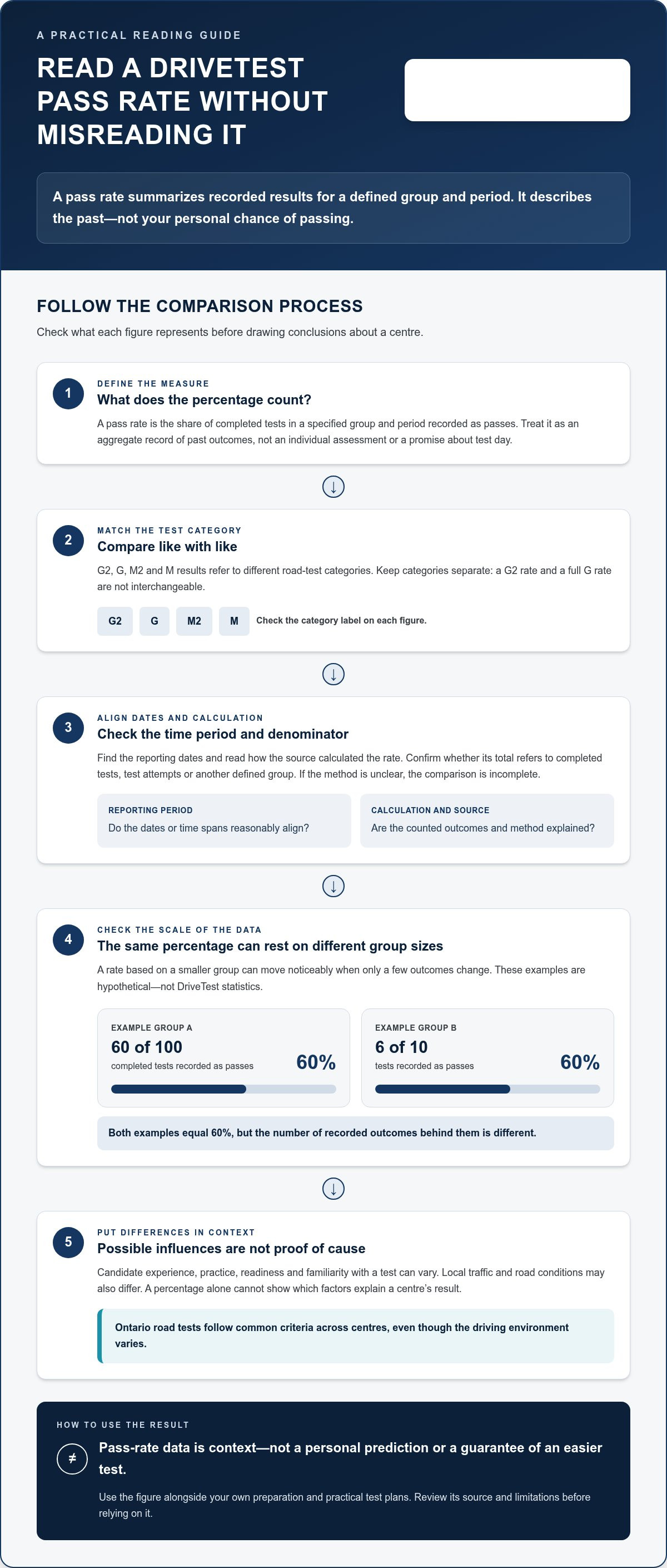
A pass rate is the share of completed tests in a specified group and period recorded as passes. It describes that group’s past results, not your personal chance of passing. That distinction is central to understanding drivetest centre pass rates. The figure is an aggregate, not an assessment of an individual driver or a promise about test day.
How to read a centre pass-rate figure
Before comparing percentages, identify the measure behind each one. A G2 road test result and a full G road test result represent different test categories, so their rates aren’t interchangeable. Check the reporting dates and whether the source explains what counts in the calculation. A figure from one period may not describe outcomes in another.
Pay attention to the denominator, too. A source may not make clear whether the total refers to completed tests, test attempts or another defined group. Read the source’s wording instead of assuming two figures use the same method. A rate without its denominator and context is incomplete.
- Test and licence class: Does the figure cover G2, G or another test category?
- Reporting period: What dates or time span does it represent?
- Calculation and source: Does the source explain which outcomes were counted and how the percentage was calculated?
These checks matter because driving tests and requirements can vary between jurisdictions. A general overview of global driving test variations provides context, but figures from different places shouldn’t be compared as if they describe the same test.
Why a pass rate is not a personal prediction
A centre-level figure combines results from candidates with different amounts of driving experience, practice and familiarity with the test. It doesn’t reveal each candidate’s circumstances or tell you in advance how a particular test will go. Even when two figures cover the same test category and period, they summarize groups, not individuals.
For example, imagine a hypothetical report says that 60 of 100 completed tests in a defined group were recorded as passes. The group’s recorded pass rate was 60%. That doesn’t mean the next candidate has a 60% personal chance of passing, or that the figure reliably forecasts the result for someone with a different level of preparation. It describes what was recorded for that group, not what must happen next.
Use the number as background information, not as a verdict on your readiness. Understanding the scope and limitations of a rate helps you read it more carefully, while your own preparation remains specific to your test.
Why DriveTest Centre Pass Rates Can Differ
Two centre-level percentages can look like a direct comparison, but several factors may sit behind the difference. The candidates included, the test category and the dates covered can all affect the overall result. These are possible influences, not proof of why a particular centre recorded a certain rate. Understanding drivetest centre pass rates means separating plausible explanations from conclusions the data can’t support.
Preparation and experience vary from candidate to candidate. One group may include more people who have practised extensively, while another may have a different mix of experience or readiness. Those differences can affect aggregate outcomes, but without information about the candidates, you can’t assume they explain a centre’s rate. A percentage alone doesn’t reveal who was tested or how prepared they were.
Candidate mix, licence class, and test type
Keep G2, G, M2 and M results separate. They refer to different road-test categories, so combining or comparing them casually can create a misleading impression. Candidate groups may also differ in experience and readiness. Unless a data source provides evidence about those groups, treat candidate mix as a possible factor, not an established explanation for a specific result.
Figures labelled only “road test” may not tell you which results are included. Look for a clear category label and an explanation of how the results were grouped. If a source attributes a change to test procedures or reporting rules, verify that explanation against a current, authoritative source before relying on it.
Time periods, sample sizes, and uncertainty
Rates can shift when the periods being compared differ. A figure from one set of dates may reflect different conditions or a different group of candidates than a figure from another period. Compare equivalent categories over reasonably similar reporting periods. Otherwise, the gap may reflect the comparison itself rather than a meaningful difference between centres.
Check the number of tests behind each percentage, if the source provides it. A rate based on a small group can move noticeably when only a few outcomes change. For illustration, six passes out of ten tests and 60 passes out of 100 both equal 60%, but the smaller group has far fewer recorded outcomes behind the same percentage. This example is hypothetical, not a DriveTest statistic.
- Check the category: Confirm that both figures refer to the same type of road test.
- Check the dates: Compare reporting periods that reasonably align.
- Check the evidence: Look for sample sizes and methodological notes. Don’t infer a cause when the source doesn’t explain one.
A difference in observed rates doesn’t, by itself, show that one test is easier. It may reflect candidate mix, time period, sample size or other factors that the published data doesn’t resolve. Once you’ve weighed those limits, practical considerations such as choosing a suitable test date can guide your planning. Book Your Road Test provides booking support for G2, G, M2 and M road tests through an independent third-party service, separate from DriveTest and government services. Explore Ontario road test booking support, with an additional administration fee for the convenience service.
How to Compare DriveTest Centre Pass Rates Without Misreading Them
A useful comparison starts with the details behind each figure, not the order of a ranking. Two percentages may appear to measure the same thing while covering different test categories, dates or groups. Before deciding that one centre’s result is better, check whether the figures are genuinely comparable and what information the source provides.
A percentage without a comparable denominator can make unlike groups look directly comparable. For example, a figure based on one test category and reporting period can’t be fairly ranked against a figure covering another category or a different span of time. Understanding drivetest centre pass rates means paying attention to the data’s scope, not just the number.
A fair-comparison checklist
Use this review before comparing results. Match the licence class and test category first, then check that the reporting periods align and the source uses comparable definitions. If sample sizes or calculation details are missing, record that as a limitation. Missing information is a reason to be cautious, not proof that the figures are biased.
| What to compare | Figure A | Figure B | Caveat to record |
|---|---|---|---|
| Data source | Source and publication date | Source and publication date | Are both sources identifiable and comparable? |
| Test category | Licence class and test type | Licence class and test type | Do both figures cover the same test? |
| Reporting period | Dates covered | Dates covered | Do the periods reasonably align? |
| Sample size | Number of tests, if provided | Number of tests, if provided | Is one result based on a much smaller group? |
| Methodology | Calculation and definitions | Calculation and definitions | What relevant context is missing? |
Fill in the table using the sources you’re comparing. If a detail isn’t published, mark it “not stated” rather than guessing. A ranking with no clear source, method or sample size may still show reported figures, but it offers less support for a confident comparison. Don’t turn missing context into a conclusion about why a rate differs.
What a ranking cannot establish
A higher observed rate doesn’t, by itself, prove that a test is easier or that examiners are unfair. It shows an association between a centre and the results recorded in a particular set of data. Without evidence that isolates the cause, you can’t tell whether the difference reflects candidate groups, reporting choices or another factor.
A top-ranked centre isn’t a reliable shortcut to passing, either. Treat rankings as one limited reference point, not a promise about your own outcome. If you’re using a comparison to plan a test, weigh the quality of the data alongside your readiness and scheduling needs. Book Your Road Test provides independent Ontario road test booking assistance, separate from DriveTest and government services. An additional administration fee applies.
How to Use Pass-Rate Information in Your Road-Test Plan
Pass-rate research can help you ask better questions about the data, but it shouldn’t make the decision for you. Use it as background context, then plan around the test you need to take, your readiness and practical scheduling needs. Understanding drivetest centre pass rates is most useful when it supports a thoughtful plan, not a search for a guaranteed shortcut.
Choose useful information over a tempting shortcut
A favourable statistic can catch your attention, but it can’t tell you how your own test will go. Keep the data and your booking decision separate: first assess whether the figures are relevant and comparable, then consider what date and centre make sense for your circumstances. Choosing a centre doesn’t promise a particular result.
Use this sequence to turn research into a practical plan:
- Verify the source. Find out who published the figure, what test it covers and when the results were recorded. If the method or context isn’t explained, treat the rate as limited information.
- Compare equivalent tests. Match the licence class and test category, and use figures from reasonably similar reporting periods. Don’t combine different categories just to create a simpler ranking.
- Weigh the limitations. Note whether the source gives a sample size or explains its calculation. Missing details are a reason to be cautious, not evidence that a centre is easier or harder.
- Plan around readiness. Consider your familiarity with the relevant test and the practicalities of the date and location. Don’t let a percentage outweigh whether you’re prepared to take the test.
Prepare around the test you will take
Once you’ve identified the right test category, confirm its current requirements using official Ontario preparation materials for that licence class. Requirements can change, so rely on current official guidance rather than an old checklist or assumptions based on another category. Build your checklist from the applicable materials, then focus on the requirements they describe.
- Confirm the category: Check whether you’re preparing for a G2, G, M2 or M road test.
- Review current guidance: Use official materials that apply to your test and note any requirements you need to remember.
- Check your readiness: Consider whether you’re comfortable with the skills and expectations covered by the relevant guidance before settling on a test date.
If you’re planning an M2 test, the M2 road test booking guide can help you think through the scheduling process. Choose a date that fits your plan, not simply one linked to a higher pass-rate figure.
When you’re ready to arrange a road test, explore road test booking support. Book Your Road Test is an independent third-party service, separate from DriveTest and the Ministry of Transportation. Its convenience services carry an additional administration fee.
Next Steps After You Understand DriveTest Centre Pass Rates
Turn your research into a decision you can act on. Verify the source and what its figures cover. Compare equivalent test categories and reporting periods, note any missing context, and focus on preparing for the test you’ll take. Then choose a practical date and centre. Understanding drivetest centre pass rates can inform your planning, but it can’t replace knowing whether you’re ready or whether the timing works for you.
Availability and readiness are separate considerations. A centre’s historical results don’t show which appointments are open, and a convenient date doesn’t by itself mean you’re prepared. Keep both questions in view: what timing works for you, and are you ready to take the applicable test?
When booking convenience may help
If managing the scheduling process is a challenge, third-party booking support can make that step more convenient. Book Your Road Test is an independent service, separate from DriveTest and government services, and it doesn’t administer road tests. Its cancellation finder monitors for openings created when other candidates cancel. An opening may appear, but using the service doesn’t guarantee an earlier appointment or affect your test result.
The road test cancellation finder guide explains the process. Treat the service as scheduling support, not a shortcut to passing. Your preparation and the test itself remain separate from how an appointment is arranged.
Make an informed booking decision
Before choosing a booking option, consider the convenience you want and the applicable cost. Third-party convenience services carry an additional administration fee, so include it in your decision. Review the service details and fee before proceeding, and distinguish scheduling assistance from official test administration: DriveTest handles the road test, while Book Your Road Test operates independently.
A calm plan is straightforward: verify the data, compare like with like, prepare for your licence class and test category, then choose a date that fits your readiness and schedule. Pass-rate research can add context, but it can’t predict your result or tell you when appointments will be available.
If booking support suits your needs, explore road test booking options. Book Your Road Test provides independent scheduling assistance for an additional administration fee.
Make Your Next Road-Test Step a Practical One
Understanding drivetest centre pass rates can help put your research in perspective, but your next move doesn’t need to depend on finding a perfect statistic. Focus on what you can act on now: choose a test date that works with your schedule and gives you room to feel prepared. A clear plan is more useful than trying to predict an individual result from a centre’s past outcomes.
If arranging the booking is your next task, consider whether support would make that step easier. Book Your Road Test provides independent booking administration for G2, G, M2 and M road tests. Its cancellation finder monitors for openings created by cancellations. The service is separate from DriveTest and government services, and an additional administration fee applies.
Explore road test booking support when you’re ready to move forward. Choose the support that suits your scheduling needs, then focus on preparing for your test.
Frequently Asked Questions
Are DriveTest centre pass rates published for every location?
Don’t assume that a current, comparable pass-rate figure is available for every DriveTest location. If you find a rate, check who published it, which test it covers and when the results were recorded. A table listing some centres may not represent every location or explain its methods. If key details are missing, treat the figure as incomplete rather than filling gaps with assumptions.
Can I choose a DriveTest centre based on its pass rate?
You can consider a pass rate, but it’s safer not to make it the deciding factor. First make sure the figure applies to your licence class and test, then weigh practical points such as travel, timing and your familiarity with the area. A centre’s past results can’t guarantee a better outcome for you. Choose a location that fits your circumstances and supports a sensible test-day plan.
Do G2 and G road test pass rates mean the same thing?
No. A G2 rate refers to results for the G2 road test, while a G rate refers to the full G road test. They represent different test categories and stages of Ontario’s graduated licensing process, so comparing them as though they measure the same exam can lead to a false impression. Look for the exact test label before interpreting a rate or using it in a comparison.
Can a high pass rate predict whether I will pass?
No. A high rate describes recorded outcomes for a group, not what will happen on your individual test. When understanding drivetest centre pass rates, keep the distinction between group results and your own readiness clear. A published figure can’t account for your practice, test-day decisions or the specific circumstances of your drive. Use the number as background, then focus on meeting the relevant test requirements.
Does a low pass rate prove that a DriveTest centre is unfair?
No. A lower reported rate alone doesn’t establish unfair treatment or show that the test is harder. It may reflect factors the figure doesn’t explain, including who took the tests or how the data was grouped. A claim about unfairness requires evidence beyond a ranking or percentage. Avoid judging examiners or a centre based on a number without substantiated context.
What should I do if I cannot find reliable pass-rate data?
Don’t let the absence of a dependable figure stall your planning. Use current official Ontario materials to confirm the requirements for your licence class, and make preparation your priority. You can also choose a practical test date and location based on your schedule and travel needs. If a rate turns up later, assess its source and scope before letting it influence your decision.


