

Ontario Motorcycle Licence: 2026 Step-by-Step Guide
Getting an Ontario motorcycle licence is a staged process, not a single test. Even a full G licence doesn’t let you skip the motorcycle stages. If the motorcycle license ontario process has you unsure where to start, first understand what each stage requires and when you can book the next test.
It’s understandable to have questions about M1, M2, and M, especially because waiting periods, restrictions, and road tests differ at each stage. This guide explains the sequence, including the 60-day minimum before the M2 road test and the M2 holding period before you can qualify for a full M licence. An approved safety course can shorten that second wait.
You’ll learn what to expect from the knowledge test and road tests, which restrictions apply while you practise, and how to plan your study, training, and booking. You’ll also find practical steps for checking eligibility and comparing booking options, so you can plan a realistic timeline.
Key Takeaways
- The motorcycle license ontario process moves through M1, M2, and M, with different requirements at each stage.
- Plan around M1 validity, the minimum wait before the M2 road test, and M1 riding restrictions.
- Understand how the M2 and full M road tests differ, and how an approved safety course may affect progression.
- Use a practical checklist to plan your practice, confirm test requirements, and prepare for your appointment.
- Confirm what happens after a test and who makes official licensing decisions. Independent booking assistance is optional and carries a separate administration fee.
How the Ontario motorcycle licence process works from M1 to M
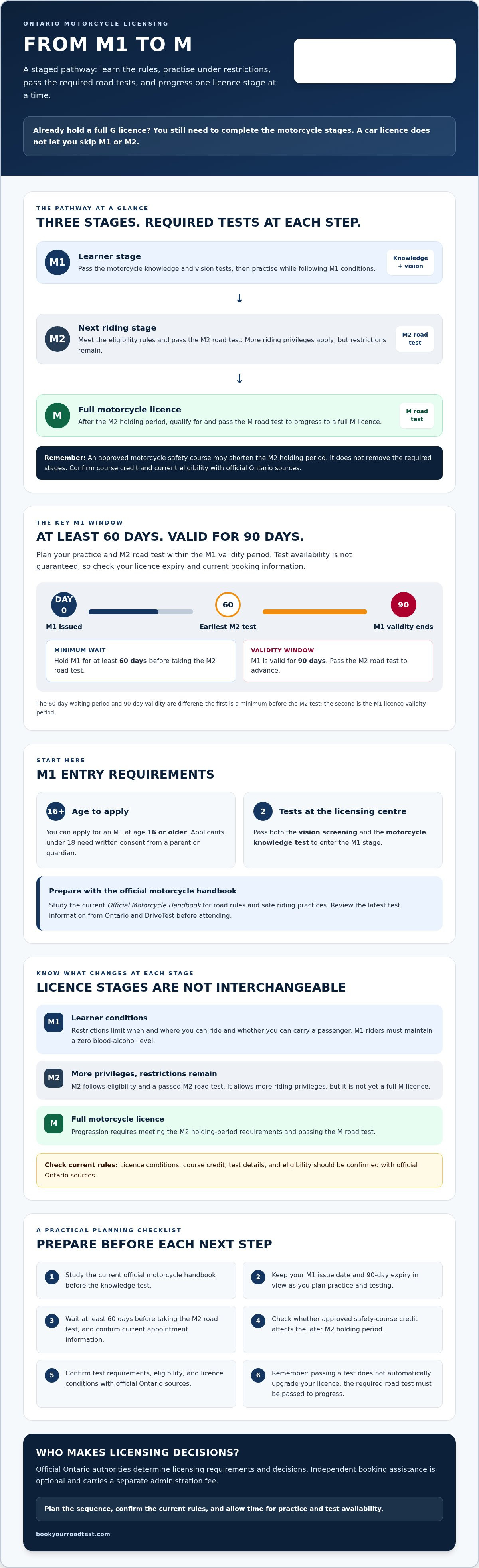
The stages build your experience in sequence: pass the knowledge and vision tests, practise under M1 conditions, then qualify for M2 and, later, M. You don’t skip the motorcycle stages because you already hold a car licence. Knowing the sequence makes the motorcycle license ontario process easier to plan. Your timeline depends on current rules, test availability, and whether you complete an approved motorcycle safety course.
Featured-snippet definition: Ontario’s motorcycle licensing process is a graduated pathway from M1 learner status to M2 and then a full M licence, with practice, waiting periods, and required tests along the way.
Stage-by-stage flow
Study the official motorcycle handbook → pass the M1 knowledge and vision tests → practise with an M1 → take the M2 road test → gain experience with an M2 → qualify for and pass the M road test → receive an M licence.
An approved safety course may affect how long you must hold M2 before progressing, but it doesn’t remove the required stages.
What do M1, M2, and M motorcycle licences mean?
M1 is the learner stage. It comes with conditions that limit when and where you can ride and whether you can carry a passenger. M2 is the next stage, reached after you meet the eligibility rules and pass the M2 road test. It allows more riding privileges, but restrictions still apply. M is the full motorcycle licence stage. These are steps in one pathway, not interchangeable licence options. Check Ontario’s current rules before relying on any particular privilege or restriction.
This progression is part of Canada’s broader graduated driver licensing (GDL) system. In Ontario, each stage gives you an opportunity to gain experience before moving on. For current descriptions and conditions, refer to the Ontario Ministry of Transportation’s official motorcycle information.
Who can start the Ontario motorcycle licence process?
You can apply for an M1 at age 16 or older. Applicants under 18 need written consent from a parent or guardian. At the licensing centre, expect a vision screening and a motorcycle knowledge test. You must pass both to enter the M1 stage. Prepare with the current Official Motorcycle Handbook and review the latest test information from Ontario and DriveTest before attending.
After receiving M1, you must hold it for at least 60 days before taking the M2 road test. M1 is valid for 90 days, so plan your practice and next step rather than leaving everything until the end of that period. The later M2-to-M progression has its own minimum holding period, which may be shorter with qualifying approved training. Confirm current eligibility, course credit, test details, and licence conditions with official Ontario sources before making plans.
M1 to M2: Requirements, Waiting Periods, and Restrictions
Passing the M1 knowledge test is the start of practice under specific rules, not permission to ride without limits. M1 comes with legal conditions, and you must meet the requirements for the next stage before moving to M2. Keep two dates in view: your M1 issue date and the earliest date you may take the M2 road test.
How long must you hold an M1 before moving to M2?
You must hold an M1 for at least 60 days before taking the M2 road test. Your M1 licence is valid for 90 days, so plan your practice and booking within that window. Passing the test doesn’t automatically upgrade your licence. You must take and pass the M2 road test to advance.
Study the current Ontario motorcycle handbook before the knowledge test. It covers the rules and safe riding practices you’ll need to understand before practising. An approved safety course may affect the later M2-to-M progression; don’t assume it shortens the M1 waiting period or replaces the M2 test. Confirm course credit and eligibility with official Ontario sources.
M1 timeline
Day 0: M1 issued → At least 60 days: M1 holding period → By day 90: M1 expires; pass the M2 road test to progress.
These are minimum and validity periods, not a guarantee that a test appointment will be available. Check your licence expiry and current DriveTest booking information as you plan.
What restrictions apply while riding with an M1?
Ontario’s M1 restrictions define where, when, and how you may ride. They’re legal requirements, not optional practice tips. Under current guidance, an M1 rider must:
- Maintain a zero blood-alcohol level.
- Ride only from half an hour before sunrise until half an hour after sunset.
- Ride without passengers.
- Avoid 400-series highways and other expressways with speed limits over 80 km/h.
If a route, time, or condition is unclear, check official Ontario guidance before riding. These restrictions can affect everyday plans, so map a permitted route and arrange travel that doesn’t depend on carrying a passenger or riding outside the allowed hours.
Once you’re eligible, you can book the M2 road test through official DriveTest channels. If you prefer booking assistance, Book Your Road Test is an independent third-party service for M2 appointments and charges a separate administration fee. It isn’t affiliated with DriveTest or the Ministry of Transportation. Review the M2 road test booking service details before choosing a booking option.
M2 and full M tests: compare the routes and prepare for each
The M2 and M road tests take place at different points in the graduated pathway and assess riding at different levels. The M2 test checks basic riding skills; the later M test includes more advanced skills, including highway driving. Review the current DriveTest motorcycle road test information, then practise for safe riding rather than relying on a test-day routine.
| Test | When it fits in the process | What to expect |
|---|---|---|
| M2 road test | After holding M1 for at least 60 days and meeting eligibility requirements | Assesses basic riding skills; approximately 15 to 20 minutes |
| M road test | After holding M2 for the required period and meeting eligibility requirements | Assesses more advanced skills, including highway driving; approximately 30 to 35 minutes |
Route in one sentence: In the motorcycle license ontario process, pass the M1 knowledge test, hold M1 for at least 60 days and pass the M2 road test, then hold M2 for 22 months, or 18 months after completing a government-approved motorcycle safety course, and pass the M road test to qualify for a full M licence.
What does the M2 road test assess?
The M2 test assesses basic riding skills. Time spent practising alone doesn’t establish that you’re ready. Work on smooth motorcycle control, deliberate observation, clear signalling, and appropriate road position, and use the official test materials to confirm what the current assessment covers. Practise in suitable conditions and build habits you can use in everyday riding. A course may support learning, but no course guarantees a pass.
When can you qualify for a full M licence?
On the standard route, you must hold M2 for 22 months before taking the M road test. Completing a government-approved motorcycle safety course can reduce the holding period to 18 months, subject to current Ontario rules and recognition of the course. Training doesn’t automatically upgrade your licence. You still need to meet the requirements and pass the M road test.
Before choosing a test date, confirm your eligibility and any course credit through official Ontario or DriveTest information. Motorcycle road tests are available seasonally, typically from mid-May to mid-October, weather permitting. You can book through official channels or use independent booking assistance through M2 and M road test booking support. Book Your Road Test is a third-party service, charges a separate administration fee, and isn’t affiliated with DriveTest or the Ministry of Transportation.
How to plan motorcycle practice and book an Ontario road test
A good test plan starts before you choose an appointment. Confirm that you’re eligible, practise using current test requirements, and check what you’ll need on the day. In the motorcycle license ontario process, the appointment is only one part of preparation. You’re also responsible for having a suitable motorcycle and meeting DriveTest’s requirements.
What should you do before choosing a test date?
- Confirm your licence stage and eligibility. Check your licence details and the earliest date you’re allowed to take the next test. If you completed an approved course, confirm whether you need documentation for any applicable credit.
- Practise with the official test information in mind. Review the current DriveTest motorcycle road test instructions and work on the skills assessed for your stage. Practise consistently, focusing on safe control, observation, signalling, and road position rather than memorizing a test-day routine.
- Choose a suitable test date. Motorcycle road tests are typically offered seasonally, from mid-May to mid-October, weather permitting. Check current appointment options and requirements before making plans.
- Prepare your documents and motorcycle. Confirm current identification, paperwork, and test-day requirements with DriveTest. Arrange an eligible motorcycle independently; Book Your Road Test does not provide test vehicles.
- Review the appointment details before you attend. Check the location, arrival instructions, cancellation rules, and any current fees through the official source.
How can you find and manage a road-test appointment?
You can book through official DriveTest channels, including online, by phone, or in person at a DriveTest Centre. Read the current booking terms before confirming, especially the rules for changing or cancelling an appointment. Keep your confirmation details accessible, and make sure your practice schedule and motorcycle arrangements fit the date you choose.
Riders can also choose independent booking assistance. Book Your Road Test helps schedule M2 and M road tests and charges a separate administration fee. Its optional paid cancellation finder monitors for earlier openings, but an earlier appointment isn’t guaranteed. The service is independent and isn’t affiliated with DriveTest or the Ministry of Transportation.
If you’d like help arranging an M2 or M road test appointment, review the motorcycle road-test booking service and its terms before proceeding.
Final readiness check
- You’ve confirmed your eligibility and test stage.
- You’ve practised using current official test information.
- You’ve checked identification, documents, fees, and cancellation rules.
- You’ve independently arranged an eligible motorcycle and reviewed your appointment instructions.
After your motorcycle test: next steps and booking support
A test result is a useful checkpoint, but make sure you understand what it means for your licence before riding again. The Ministry of Transportation of Ontario (MTO) sets licensing requirements, and DriveTest administers road tests. A third-party booking service can help arrange an appointment, but it doesn’t conduct tests or issue licences. Keep these roles clear as you plan the next step in the motorcycle license ontario process.
What happens after you pass or need another attempt?
If you pass: Confirm with DriveTest what happens next and check that your licence record or document reflects the correct stage. Before riding, review the conditions that apply to that licence class, including any restrictions and expiry information. Passing a test doesn’t mean every restriction disappears, so rely on current official guidance rather than assumptions.
If you don’t pass: Review the information you receive from the examiner and follow the official instructions for another attempt. Confirm when you’re eligible to rebook, whether a fee applies, and what you should practise before trying again. Don’t assume a particular appointment date will be available. Check DriveTest’s current instructions for the process and requirements.
For either result, keep your test paperwork and booking details until you’ve confirmed your next step. If anything about your licence status or permitted riding conditions is unclear, contact the appropriate official source before riding.
When might a third-party booking service help?
You can use official booking channels to arrange a road test. If you’d rather have administrative booking support, Book Your Road Test is an independent third-party service that helps schedule M2 and M road tests. Its booking assistance and cancellation finder carry a separate administration fee. The cancellation finder monitors for earlier openings, but it doesn’t guarantee that an earlier appointment will become available.
Book Your Road Test is not affiliated with the MTO or DriveTest. It doesn’t issue licences, provide instruction, or supply a motorcycle for your test. Compare its service details and fee with the official booking option, then choose what fits your needs. You’re not required to use a third party.
If you’re considering assistance with your next appointment, review the M2 and M road-test booking details before deciding. Otherwise, use official DriveTest channels and check their current instructions for booking, changes, cancellations, and test requirements.
Plan your next step with confidence
The motorcycle license ontario process follows a clear progression: meet the M1 requirements, practise within its restrictions, then qualify for M2 and the full M stage. Waiting periods, tests, and any approved-course credit affect when you can move forward. Confirm your eligibility and current requirements with official Ontario sources before choosing a test date.
DriveTest handles road tests, and the Ministry of Transportation of Ontario is responsible for official licensing. You can book through official channels or consider independent assistance for an M2 or M road test. Book Your Road Test is not affiliated with DriveTest or the Ministry, and its booking support and optional cancellation finder carry an additional administration fee. Compare the service details and fee with the official option before deciding.
Review motorcycle road-test booking options to decide whether official booking or optional assistance fits your plans. Check your requirements, organize your practice, and choose the booking option that works for you.
Frequently Asked Questions
How do I get a motorcycle licence in Ontario?
Start by passing the M1 knowledge test and vision screening, then follow the required M1, M2, and M stages. The motorcycle license ontario process involves practising under each stage’s conditions and passing the road tests required to advance. You must be at least 16 to apply for M1, and applicants under 18 need parent or guardian consent. Study the current Ontario motorcycle handbook and confirm requirements with official sources.
How long does it take to get an M2 licence in Ontario?
You must hold an M1 for at least 60 days before taking the M2 road test. You can move to M2 only after meeting the requirements and passing that test, so the total time also depends on your preparation and appointment timing. M1 is valid for 90 days. Motorcycle road tests are typically available seasonally, weather permitting, so check current DriveTest appointment information while planning.
Can I skip the M2 stage and get a full M licence?
No. Ontario’s motorcycle graduated licensing pathway requires riders to progress from M1 to M2 and then qualify for a full M licence. Holding a full G car licence doesn’t remove the motorcycle stages. After reaching M2, you must meet the applicable holding-period and eligibility requirements and pass the M road test. Confirm your individual route with official Ontario guidance, especially if you have previous riding experience or completed approved training.
What restrictions apply to an M1 motorcycle licence in Ontario?
An M1 rider must maintain a zero blood-alcohol level, ride without passengers, and operate the motorcycle only from half an hour before sunrise until half an hour after sunset. M1 riders can’t use 400-series highways or other expressways with speed limits over 80 km/h. These are legal restrictions, not optional practice advice. Check current Ontario guidance if you’re unsure whether a route or riding condition is permitted.
Do I need a motorcycle safety course to get an M2 licence in Ontario?
No, a motorcycle safety course isn’t required to qualify for M2. You still need to hold M1 for at least 60 days, meet the current eligibility requirements, and pass the M2 road test. A government-approved course may reduce the M2 holding period before the later M test from 22 months to 18 months. Verify course recognition and credit with official Ontario sources before relying on it to plan your timeline.
How do I book an M2 motorcycle road test in Ontario?
Book through official DriveTest channels, which include online, phone, and in-person options at a DriveTest Centre. Before confirming, check current test availability, booking and cancellation rules, fees, identification requirements, and what you need to bring. Motorcycle tests are typically offered seasonally, weather permitting. You’re responsible for arranging an eligible motorcycle for test day, so confirm the current vehicle requirements directly with DriveTest before your appointment.
Can a third-party service issue my Ontario motorcycle licence?
No. A third-party service can help schedule a road test, but it can’t conduct the official test or issue a licence. The Ministry of Transportation of Ontario handles official licensing, while DriveTest administers road tests. Book Your Road Test is an independent booking service for M2 and M tests, is not affiliated with either organization, and charges an additional administration fee for its booking assistance.
What happens if I cannot find an earlier motorcycle road-test date?
You can keep your existing appointment, check official booking channels again for openings, and continue practising safely while you wait. An optional cancellation-finder service can monitor for earlier dates, but it carries a separate administration fee and doesn’t guarantee an earlier appointment. Book Your Road Test offers this as an independent paid service. Confirm any new date through the service or official channel you used to book.


