

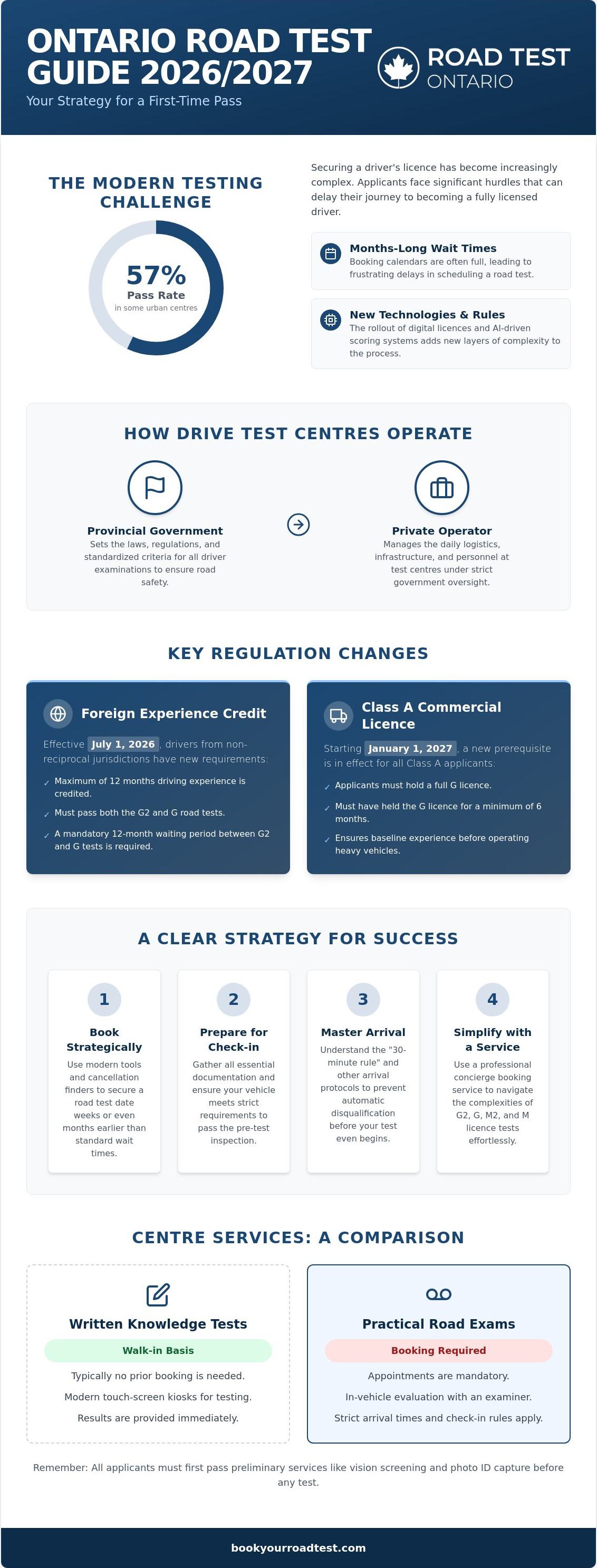
With pass rates at some urban locations dipping as low as 57% in 2026, the walk into a drive test centre can feel more like a high-stakes gamble than a simple milestone. You're likely feeling the pressure of months-long wait times and the confusing maze of new regulations, such as the digital licence rollout or AI-driven scoring systems. It's frustrating to feel prepared for the road but stalled by a booking calendar that seems permanently full.
We recognize that your time is valuable and the examination process is often overwhelming. This guide simplifies your journey by providing a clear strategy to secure an earlier appointment and master the specific requirements of the 2026 testing standards. We'll explore how to navigate the latest documentation rules, use modern tools to find cancellations, and organize your preparation to ensure you pass your test on the very first attempt.
Key Takeaways
- Understand the operational structure of each drive test centre and how provincial regulations influence your examination experience.
- Identify the essential documentation and vehicle requirements needed to satisfy strict check-in protocols on your exam day.
- Learn strategic booking techniques and how to leverage cancellation finders to secure a road test date weeks earlier than standard wait times.
- Master the "30-minute rule" and other arrival strategies that prevent automatic disqualification before your test even begins.
- Discover how to simplify the licensing process for G2, G, M2, and M categories using a professional concierge booking interface.
What is a Drive Test Centre and How Does It Work?
A drive test centre serves as the official gateway for any resident looking to gain or upgrade their driving privileges. These facilities are more than just examination rooms; they're high-volume service hubs where theory meets practice. Each facility manages the transition from a learner to a fully qualified operator by administering the standardized driving test. While the provincial government sets the laws and regulations, the daily operations of these centres are typically managed by private entities like Serco Canada Inc. under strict government oversight. This partnership ensures that testing remains consistent across the province while allowing for a more streamlined, business-like approach to customer service.
The relationship between private providers and provincial ministries is built on transparency and safety. The ministry defines the rules of the road and the criteria for success, while the private operator provides the infrastructure and personnel to execute those standards. This model allows the government to focus on policy and road safety legislation while the centres handle the logistical demands of thousands of daily applicants. Understanding this distinction helps candidates realize that while the staff are professional facilitators, they must adhere to rigid provincial protocols that leave little room for error.
The Role of the Drive Test Centre in Canada
These centres are the only authorized locations where you can complete official road exams. They act as the primary filter for road safety, ensuring every driver meets rigorous national standards before they're permitted to operate a vehicle independently. By centralizing the examination process, the system maintains a high level of integrity. Every examiner follows a standardized scoring rubric to eliminate bias. Whether you're visiting a rural location or a busy urban hub, the criteria for passing remain the same.
Types of Licences Handled at Local Centres
Most visitors head to their local drive test centre to progress through the graduated licensing system. This includes G1 knowledge tests, G2 road exams, and the final G road test. As of July 1, 2026, new regulations have changed how foreign experience is credited for those from non-reciprocal jurisdictions. These drivers now receive a maximum of 12 months of credit, requiring them to pass both the G2 and G tests with a mandatory 12-month waiting period between the two attempts.
Licensing for motorcycles follows a similar tiered structure with M1, M2, and M classifications. It's vital to remember that motorcycle testing is often seasonal and may not be available during winter months at all locations. Commercial licensing for Classes A through F also takes place at specialized centres. Starting January 1, 2027, a new requirement mandates that Class A applicants must hold a full G licence for at least six months before they can attempt their commercial road test. This ensures a baseline of experience before moving into heavy vehicle operation.
Essential Services Offered at Driver Examination Centres
Every drive test centre operates as a multi-functional facility designed to handle the entire lifecycle of a driver's licence. While the practical exam often takes the spotlight, these hubs provide critical preliminary services like vision screening and official photo ID capture. You'll need these first. Before you can even sit in the driver's seat for an evaluation, you'll need to pass through these administrative gates. These services ensure that every applicant meets the basic physical and legal requirements to operate a vehicle safely on Canadian roads. By 2026, the introduction of digital driver's licences allows you to store your credentials on a smartphone, but you'll still need to visit a physical location for the initial photo and identity verification.
Written Knowledge Tests vs. Road Exams
One of the most significant differences in service delivery is how exams are scheduled. Written knowledge tests are typically handled on a walk-in basis, allowing you to visit a drive test centre without a prior booking. Most modern centres use touch-screen kiosks. These digital environments have replaced traditional paper formats, which means you can realize your results immediately after the session. If you're following Ontario's Official Driver Licensing Guide, you'll know that passing this theory portion is your first step toward a G1 licence. It's a quick process, but you should still arrive early to account for potential queues at the reception desk.
Specialized Licensing and Exchanges
For those moving from another province or country, these centres manage the complex process of licence exchanges. You'll need to provide specific documentation, including proof of residency and your original out-of-province licence. If you're coming from a non-reciprocal jurisdiction, the centre staff will verify your driving history to determine which tests you must complete. For individuals also managing their own immigration status, CanadaPathway provides a digital platform to help you apply for permanent residence without hiring a consultant. Specialized hubs also cater to commercial upgrades and motorcycle licensing, which require unique equipment and specialized examiners. These appointments are often harder to find due to the limited number of qualified staff for heavy vehicles and bikes.
Senior drivers also interact with these facilities through mandatory renewal programs and re-evaluation sessions. These sessions are designed to support older drivers in maintaining their independence while ensuring they still meet safety standards. Whether you're a teenager or a seasoned veteran, the administrative burden can be heavy. To avoid the stress of navigating these requirements alone, you can use a professional booking service to help manage your road test schedule and ensure you're heading to the right location at the right time.
How to Secure a Road Test Appointment Faster
Wait times at any popular drive test centre can stretch into several months. This backlog is a reality of 2026, driven by a growing population and the rigorous time required for each individual examination. If you're looking to get on the road sooner, you need a strategy that goes beyond simply checking the official portal once a week. You need to be proactive and informed about how the system actually operates behind the scenes.
Strategic booking involves looking outside your immediate neighbourhood. Urban centres in the Greater Toronto Area are notoriously overbooked. By expanding your search to smaller, regional hubs, you might find an opening weeks or even months earlier than expected. For busy professionals or students, the time saved by travelling an extra hour often outweighs the frustration of waiting until next season. Utilizing a professional concierge service can help manage this search across multiple locations simultaneously, taking the administrative burden off your plate.
Step-by-Step: Booking Your Appointment
Before you begin, ensure you have your current licence and personal details ready. The process requires precision. Even a small typo can lead to issues at the check-in desk. You'll need to select your specific class, whether that's a standard vehicle or an m2 road test booking for motorcycle enthusiasts. It's important to understand the fee structure during this stage. You'll encounter the standard government exam fee, but if you're using a concierge service, there's also a transparent administration fee. This fee covers the convenience of a simplified interface and professional management of your file. Once you've secured a slot, always save your digital receipt to your smartphone.
The Secret to Finding Cancellations
Slots open up every day as other candidates reschedule or cancel their appointments. However, these openings are usually filled within seconds by someone else who happened to be refreshing the page at that exact moment. Manual searching is rarely effective for high-demand locations. This is where an automated road test cancellation finder ontario becomes an essential tool. These systems monitor the booking database constantly, identifying new openings the instant they appear. Using an automated tool can often secure a date within just a few days. This effectively allows you to bypass the standard queue and focus on your actual driving practice.
Test Day Checklist: What to Bring to the Drive Test Centre
Arriving at the drive test centre with the wrong paperwork is a common reason for automatic failure before you even start the engine. This is an avoidable setback that adds unnecessary stress to an already high-pressure day. The most critical rule for any candidate is the 30-minute arrival window. Examiners operate on a rigid, back-to-back schedule. If you aren't checked in and ready at least half an hour before your time slot, the system may automatically cancel your appointment to keep the queue moving. Use this extra time to find your designated parking spot and organize your documents so you aren't fumbling when the examiner approaches.
Emotional preparation is just as vital as your technical skills. It's natural to feel anxious when an official evaluator enters your vehicle with a clipboard or tablet. Take a few minutes before check-in to practice deep breathing and visualize your route. Remember that the examiner isn't there to trick you; they're simply verifying that you can operate a vehicle safely and follow the rules of the road. Staying calm helps you process instructions clearly and avoid the "silly" mistakes that often stem from nerves rather than a lack of ability.
Mandatory Documentation and Identification
You must present original, valid identification to the staff at the front desk. Photocopies or digital scans are generally not accepted for primary identity verification. Ensure you have your current licence, which must not be expired or suspended. If you're applying for a commercial licence in 2026, you must also provide documentation verifying your primary residence in Ontario and your legal eligibility to work in Canada. For new residents or those upgrading their class, acceptable forms of ID include:
- A valid Canadian Passport
- A Permanent Resident (PR) card
- An original Canadian Birth Certificate
- Proof of insurance and vehicle registration
Vehicle Safety Standards for Road Tests
Your vehicle must be in top mechanical condition to be used for an exam. A cracked windshield or a glowing check engine light on your dashboard will lead to an immediate disqualification. Examiners will perform a basic safety check before they even get into the car. They'll ask you to test your signal lights, brake lights, and horn. If any of these components fail, the test is over. For those completing an M2 or M motorcycle exam, you must also ensure your riding gear meets provincial safety standards, including a certified helmet and sturdy footwear that covers the ankle. Check your tire pressure and fluid levels the night before to ensure your vehicle is road-legal and ready for scrutiny.
Don't let a simple booking error or a missing document ruin your chances of success. To ensure your appointment is managed professionally from start to finish, book your road test through our simplified interface today.
Streamlining Your Experience with Book Your Road Test
Securing a slot at a drive test centre is often the most stressful part of the licensing journey. While the physical exam requires skill, the digital booking process requires a level of patience and persistence that many busy Canadians simply don't have. This is where Book Your Road Test provides a distinct advantage. As an independent concierge service, we bridge the gap between the applicant and the examination system, offering a streamlined path to a confirmed test date. We operate as an autonomous entity, separate from government agencies, to provide a specialized service focused entirely on efficiency and user support.
Thousands of drivers choose to pay a convenience fee because they value their time and peace of mind. The official booking portals, while functional, aren't designed to cater to the urgency of a professional or a student with a tight schedule. By choosing a facilitator, you're investing in a service that manages the administrative friction for you. This allows you to focus your energy on practicing your three-point turns and parallel parking rather than fighting with a booking calendar. Our commitment to transparency ensures you understand exactly what you're paying for: a professional shortcut to a high-demand service.
Why Choose a Third-Party Booking Service?
The primary benefit of a third-party service is the significant reduction in manual labor. Searching for an appointment at a drive test centre often involves hours of repetitive system refreshes and constant monitoring. Most people simply can't afford to sit at a computer all day waiting for a single slot to appear. We provide expert support for G2, G, M2, and M road test scheduling, ensuring that regardless of your licence class, your file is handled with precision. Our focus on speed means we're constantly looking for the quickest path to get you on the road. We realize that for many, a driver's licence isn't just a piece of plastic; it's a requirement for work, family, and independence.
The Book Your Road Test Advantage
Our proprietary tools are specifically designed to find openings at over 60 centres across the province. This broad reach gives you a much higher probability of finding an earlier date than if you were searching at a single local hub. The process is designed to be entirely stress-free. You provide your information once, and our system takes over the heavy lifting. We prioritize secure processing and clear, professional communication at every step of the way. You'll receive updates regarding your booking status without having to chase down information yourself. This organized approach ensures that when your test day arrives, you're heading to the centre with a confirmed appointment and the confidence that your paperwork is in order.
Take Control of Your Road Test Journey
Success on your examination day is the result of both driving skill and meticulous logistical preparation. By understanding the specific vehicle safety standards and documentation requirements for 2026, you've already cleared the biggest hurdles that cause automatic disqualification at the check-in desk. Remember that your choice of drive test centre and your booking strategy are just as vital as your ability to parallel park. Expanding your search to regional hubs and staying updated on the latest licensing regulations can save you months of unnecessary waiting while ensuring you meet all provincial criteria.
If you're ready to move past the frustration of endless system refreshes, our independent concierge service is here to help. We provide a simplified booking interface for G2, G, M2, and M licences at over 60 locations, utilizing a proprietary cancellation finder to secure the earliest possible dates for our clients. Skip the wait and book your road test appointment today! With the right tools and a clear plan, you can focus on the road ahead and earn your licence with total confidence.
Frequently Asked Questions
Can I walk into a drive test centre without an appointment?
You can walk into a drive test centre for written knowledge tests and basic administrative services, but all road exams require a pre-booked appointment. Written tests are handled on a first-come, first-served basis throughout the day. If you're looking to complete a G2, G, M2, or M road test, you must secure a specific time slot through the booking system before arriving at the facility.
How much does it cost to book a road test in 2026?
In 2026, the cost for a Class G1 licence package is $159.75, which includes your written test, one G2 road test attempt, and a five-year licence. If you require a retake, the fee for a G2 road test is $53.75, while a G road test costs $91.25 per attempt. These government fees are standardized, though third-party concierge services charge an additional administration fee for the convenience of securing earlier dates.
What happens if I need to cancel or reschedule my drive test centre appointment?
You must provide at least 48 hours of notice to cancel or reschedule your appointment without forfeiting your prepaid exam fee. If you fail to show up or cancel within this 48-hour window, you'll lose your payment and must pay again before booking a new date. Rescheduling can be managed through the online portal or via your professional booking concierge if you used one for your initial search.
How early should I arrive at the drive test centre for my exam?
You should arrive at the drive test centre exactly 30 minutes before your scheduled appointment time to complete the mandatory check-in process. This window allows the front-desk staff to verify your identity and documentation while ensuring your vehicle is parked in the correct designated area for examiners. Arriving late often results in an automatic cancellation of your test and the total loss of your booking fee.
Can I use my own vehicle for the road test, or is one provided?
You are responsible for providing your own vehicle for the road test, as examination centres do not have cars or motorcycles available for use. If you are looking for a dependable vehicle that meets these rigorous safety requirements, Stone Road Auto provides a wide selection of high-quality pre-owned cars that are thoroughly inspected and road-ready. Your vehicle must be in good working order and meet all provincial safety standards, including functioning signal lights, brake lights, and a valid licence plate. If the examiner identifies a safety issue, such as a cracked windshield, your test will be cancelled on the spot.
What documents do I need to exchange an out-of-province licence?
To exchange an out-of-province licence, you need to provide your original valid driver's licence, proof of residency, and primary identification like a Canadian Passport or PR card. If your licence is from a non-reciprocal jurisdiction, you may also need a certified translation or a formal driving record from your home country. Staff will evaluate these documents to determine if you're eligible for an immediate exchange or require testing.
Why are there no available dates at my local drive test centre?
Available dates are often scarce due to high demand in urban areas and a persistent backlog of applicants seeking specific time slots. Many popular hubs in the Greater Toronto Area are booked months in advance. To find a date sooner, consider looking at centres in smaller regional towns or using an automated cancellation finder that monitors the database for newly opened slots the moment they become available.
Does the drive test centre offer tests in languages other than English?
Written knowledge tests are available in several different languages to accommodate various applicants, but practical road exams are generally conducted only in English or French. You should check with your specific location to see which languages are supported for the touch-screen theory portion. While you can't have an interpreter in the car during a road test, some centres allow assistance during the initial administrative check-in.


