

Your riding skills might be flawless, but a single cracked indicator lens or an outdated helmet can end your Ontario motorcycle road test before you even leave the parking lot. It's a frustrating reality that many riders overlook the technical details that examiners scrutinize first. We understand the stress of securing a date only to face a "refused to test" result because of a minor equipment oversight. This motorcycle road test checklist ontario is designed to eliminate that uncertainty by providing a professional breakdown of exactly what the Ministry of Transportation expects from your bike and your gear in 2026.
You'll master every requirement for your M2 or M road test, from the latest residency declaration rules introduced in May to the specific communication protocols used during the highway "chase car" portion. We've compiled a comprehensive list of bike requirements, gear standards, and the specific manoeuvres you must demonstrate to secure your licence. This guide clarifies the differences between the M2 and M levels, ensuring you arrive at the DriveTest centre with the confidence of a prepared professional. By the time you finish reading, you'll be ready to verify your equipment and secure a test date that fits your schedule.
Key Takeaways
- Understand the mandatory waiting periods and the 2026 residency requirements to ensure you are eligible to attempt your next licence level.
- Use our comprehensive motorcycle road test checklist ontario to verify that your bike and safety gear meet every technical standard before the examiner begins the inspection.
- Identify the specific differences between M2 and M evaluations, including the transition from residential skill sets to advanced 400-series highway performance.
- Master the observation habits and lane positioning techniques that demonstrate professional situational awareness to your examiner.
- Learn how to navigate the check-in process at the DriveTest centre and manage test-day anxiety for a focused and successful performance.
Ontario's Motorcycle Graduated Licensing: M1 to M Requirements
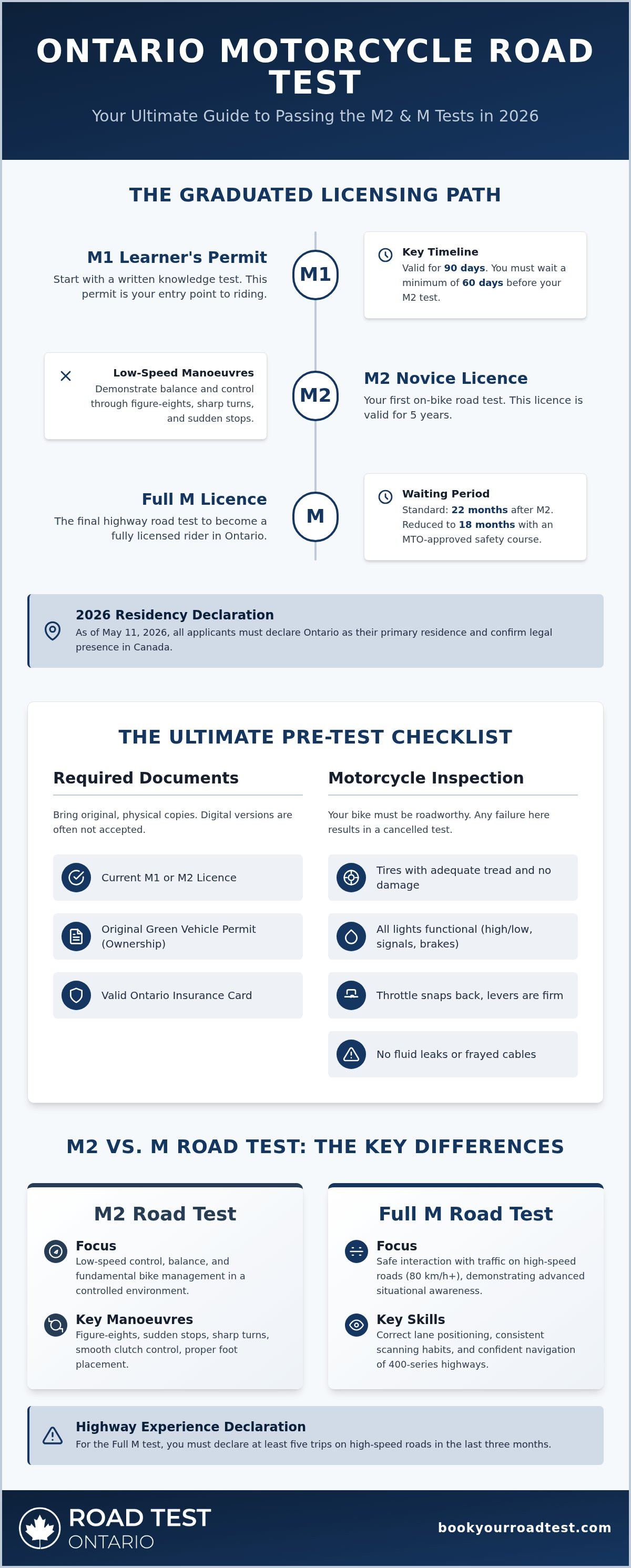
On May 11, 2026, Ontario implemented a strict residency declaration for all Class M applicants. You must now confirm that Ontario is your primary home and that you're legally present in Canada before you can proceed with testing. Ontario's Motorcycle Graduated Licensing System follows a logical progression from the M1 learner's permit to the full M licence. You start with a written knowledge test and a $78.75 package fee that covers your initial attempts. Because the M1 is only valid for 90 days, using a motorcycle road test checklist ontario helps you track the 60-day minimum wait period before you can upgrade to your next level.
Expiry dates are the most critical factor in your preparation. If you don't pass your M2 test within that 90-day M1 window, you lose your progress and must start over from the beginning. After earning an M2, you enter a five-year term. The standard wait for the final M test is 22 months. However, taking an MTO-approved safety course reduces this wait to 18 months. These courses usually cost between $400 and $700. They provide a significant advantage because the on-site testing often replaces the need for a separate M2 road test at a DriveTest centre, allowing you to focus entirely on gaining road experience.
The M2 Road Test: Your First Step to Freedom
This test evaluates your ability to manage a bike at low speeds where balance is most difficult. You'll perform specific manoeuvres like figure-eights, sudden stops, and sharp turns in a controlled environment. Examiners watch for smooth clutch control and proper foot placement during every start and stop. You must arrive with your M1 licence and the original green ownership and insurance documents for your motorcycle. If any paperwork is missing or if your bike doesn't meet the standards on your motorcycle road test checklist ontario, the staff will cancel your appointment and you'll lose your fee.
The Full M Road Test: Mastering the Highway
The full M test is a 30-minute evaluation of your ability to interact safely with heavy traffic. You'll spend significant time on highways with speed limits of 80 km/h or higher. You're required to sign a declaration confirming you have sufficient highway experience, which the MTO defines as at least five trips on high-speed roads in the previous three months. Examiners use a "chase car" and a one-way radio to provide directions while you ride. They'll watch your lane positioning and scanning habits closely to ensure you can handle the complexities of 400-series highway travel without hesitation.
The Ultimate Pre-Test Checklist: Bike and Gear Requirements
Arriving at the DriveTest centre is only half the battle. Before you ever pull out of the parking lot, an examiner will perform a rigorous technical inspection of your motorcycle and your safety equipment. If your bike fails to meet the standards outlined in the Ontario Government Motorcycle Licensing guidelines, the examiner will terminate the test immediately. You won't just lose your time slot; you'll also forfeit a portion of your prepaid fee. This motorcycle road test checklist ontario ensures your bike meets the technical standards required by the Ministry of Transportation before you even leave your driveway.
Beyond the mechanical state of your bike, you must present the correct documentation at the check-in counter. Ensure you have your current M1 or M2 licence, the original green vehicle permit (ownership), and a valid Ontario insurance card. Digital copies are often rejected, so keep the physical documents in your tank bag or jacket pocket. Once your paperwork is verified and your bike is ready, you can secure a road test appointment that fits your schedule using our simplified booking interface.
Motorcycle Mechanical Checklist
Examiners look for "roadworthiness" through a series of rapid checks. Your tires must have adequate tread depth with no visible dry rot or sidewall damage. Check every bulb on your bike. High and low beams, front and rear turn signals, and both the front and rear brake light switches must function perfectly. If your brake light doesn't illuminate when you use the foot pedal, it's an instant fail. Your throttle must snap back to the closed position instantly when released, and your clutch and brake levers should provide firm resistance without feeling "mushy" or sticking. Frayed cables or leaking fork seals are common issues that will result in a refused test.
Rider Gear and Protection
Ontario law is specific about what constitutes proper protection during an evaluation. Your helmet must be in good condition and carry a legitimate certification label from DOT, SNELL, or ECE. Examiners will physically check for these stickers. Eye protection is mandatory; if your helmet doesn't have a visor, you must wear shatterproof goggles or glasses. Your clothing must cover all exposed skin. This means a sturdy jacket with long sleeves, long pants (preferably denim or leather), and gloves that cover your entire hand. Your footwear is especially important. You must wear sturdy boots that cover the ankle bone. Running shoes or canvas high-tops are not acceptable and will lead to an immediate cancellation of your test.
M2 vs. M Road Tests: Comparing the Evaluation Criteria
The M2 road test is a 20-minute examination of your fundamental control. In contrast, the full M test lasts 30 minutes and demands high-speed proficiency. Understanding the Ontario Motorcycle Licensing Requirements is the first step in differentiating these two levels. The scoring system is based on a point-deduction model. Minor errors, like failing to cancel a signal or poor foot placement, cost points but don't cause an immediate failure. Major infractions, such as violating a right-of-way, speeding, or dropping the bike, result in an automatic "unsuccessful" result. Examiners look for a rider who is both technically skilled and mentally prepared for the complexities of Ontario traffic.
The environment changes significantly between the two tests. The M2 evaluation typically stays within low-speed residential areas and quiet side streets. The full M test requires you to navigate 400-series highways or high-speed expressways. Throughout both tests, "lane dominance" is a primary evaluation factor. You must choose the lane position that maximizes your visibility and prevents other vehicles from encroaching on your space. Usually, this is the left-third of the lane, but you'll need to adjust based on traffic flow and potential hazards. Staying stagnant in one position regardless of the environment suggests a lack of situational awareness.
M2 Focus: Handling and Intersections
This level tests your ability to navigate urban environments with precision. Examiners watch your ability to maintain balance during slow-speed turns and stops without wobbling or putting a foot down prematurely. A central part of your motorcycle road test checklist ontario should be practicing exaggerated head movements. Because examiners often follow you at a distance, they need to see your helmet move to verify you're scanning intersections and checking mirrors. You'll need to demonstrate perfect right-of-way knowledge at four-way stops and uncontrolled intersections. Failing to look both ways or hesitant decision-making will lead to point deductions.
M Focus: Highway and Traffic Flow
The full M test moves beyond the basics to assess your ability to merge and ride at highway speeds. You must reach the speed of traffic before merging from an on-ramp; merging too slowly is a common reason for failure. Once on the highway, maintaining a safe two-second following distance is non-negotiable. Examiners also evaluate your hazard perception in busy business districts. They're looking for proactive responses to potential dangers, like a car door opening or a pedestrian stepping off the curb. This test confirms you can handle the mental load of high-speed travel while maintaining the strict safety protocols required for a permanent Class M licence.
On-Road Performance: What the Examiner is Watching
Once your bike passes the initial inspection, the evaluation moves to the street. This is where the "chase car" dynamic begins. Unlike a car test where the examiner sits beside you, a motorcycle examiner follows you in a separate vehicle. They provide directions through a one-way radio headset that you'll tuck into your helmet. You cannot speak back to the examiner, so your riding must clearly demonstrate that you've heard and understood every command. Adding communication drills to your motorcycle road test checklist ontario is vital. If you miss a turn, don't make a dangerous last-minute manoeuvre. Continue safely and wait for the examiner to provide a new route.
Lane dominance is the primary concept examiners use to judge your safety. You must consciously choose the lane position that provides the greatest visibility and prevents other drivers from sharing your lane. In most cases, this is the left-third of the lane. This position puts you directly in the driver's side mirror of the vehicle ahead. However, you must be prepared to move to the centre or right-third to avoid oil patches, gravel, or encroaching traffic. If you're ready to put these skills to the test, you can book your M2 or M road test at any of the 60 DriveTest centres across the province.
Observation and Scanning Habits
A full-face helmet is excellent for safety, but it hides your eye movements from the examiner in the chase car. To pass, you must use "exaggerated head movements" to show you're scanning the environment. When you approach an intersection, physically turn your head left, right, and left again. You should check your mirrors every five to ten seconds and always before you begin braking. During lane changes, a shoulder check is mandatory. This isn't just a quick glance; it's a deliberate turn of the head to ensure the blind spot is clear. Examiners will deduct points every time they see a lane change performed without a visible head check.
Speed Management and Braking
Speed management requires absolute precision. In Ontario, riding even 2km/h over the posted limit can lead to a point deduction, while significantly exceeding the limit is an automatic failure. Conversely, riding too slowly can be seen as a lack of confidence or a traffic hazard. Aim to stay exactly at the limit whenever traffic allows. When it comes to stopping, use both your front and rear brakes simultaneously for every stop. This demonstrates proper vehicle control. When you come to a halt at a red light or stop sign, ensure you stop behind the white line. Your final stopping position should be in the left tire track of the lane to remain visible to the examiner and to protect your space from vehicles behind you.
Final Preparations: Booking and Passing Your Road Test
The final hurdle involves the logistics of the test day itself. Arriving at the centre with plenty of time reduces the physical tension that often leads to stiff riding. You should aim to be at the DriveTest centre at least 30 minutes before your scheduled slot. This window allows for document verification and provides a moment to settle your nerves. Once you park in the designated motorcycle testing area, perform a final systematic walk-around. Use your motorcycle road test checklist ontario to verify that no bulbs have burnt out during the ride to the centre.
Mental preparation is as important as mechanical readiness. Examiners appreciate a rider who is calm and attentive during the pre-test briefing. They'll explain the radio communication and the specific route expectations. If you pass, you'll receive a temporary paper licence immediately. If you're unsuccessful, the examiner will provide a feedback sheet detailing your errors. This document is an invaluable tool for your next attempt, as it highlights exactly where your observation or handling fell short of the MTO standard.
The Day of the Test
When you check in at the counter, the staff will confirm your residency declaration and verify your insurance. After this, wait by your bike in the designated area. Don't spend this time scrolling through your phone; instead, visualize the manoeuvres you've practiced. When the examiner arrives, they'll check your lights and signals one last time. Listen carefully to their instructions regarding the chase car distance and radio protocols. Most failures occur due to simple communication breakdowns or nerves, so stay focused on the examiner's voice in your headset and ride as you normally would during a practice session.
Securing Your Road Test Date
Finding an available slot can be challenging, especially during the peak riding season from May to September. Many riders find that m2 road test booking should be completed weeks or even months in advance to ensure a spot before an M1 expires. If your local centre is fully booked, don't panic. You can utilize a road test cancellation finder ontario to monitor for openings that appear when other riders reschedule. This tool is particularly effective for those nearing their licence expiry who cannot afford to wait for the next available standard opening. Book your motorcycle road test today to lock in your date and focus entirely on your final preparations.
Take the Next Step Toward Your Full Licence
Success on your road test depends on more than just handling your bike; it requires a professional commitment to safety standards and mechanical readiness. By following this motorcycle road test checklist ontario, you've already addressed the technical hurdles that cause many riders to fail before they even leave the DriveTest centre. You now understand the critical differences between the M2 and M evaluations, from low-speed balance to high-speed highway merging and the importance of lane dominance.
The final step is securing a date that fits your schedule before your current licence expires. Our platform offers a simplified booking interface for M2 and M categories that is trusted by thousands of Ontario riders. If your local centre is fully booked, our specialized cancellation finder provides access to earlier dates. This tool helps you get licensed faster without the months of waiting traditionally associated with the peak riding season.
Book Your Motorcycle Road Test in Ontario Now to put your preparation into action. You've done the work to master the requirements; now it's time to ride with confidence and secure your future on the road.
Frequently Asked Questions
Can I take my motorcycle road test if it is raining?
Yes, road tests typically proceed in the rain unless the examiner determines that conditions are hazardous. Heavy downpours, lightning, or extreme winds that compromise safety may lead to a cancellation. You should arrive prepared with waterproof riding gear. If the DriveTest centre cancels the appointment due to weather, they'll reschedule your session without charging an additional fee.
What happens if my motorcycle turn signal stops working during the test?
A signal failure during the evaluation usually results in an immediate disqualification because the vehicle is no longer considered roadworthy. If the defect is discovered during the pre-test inspection, the examiner will refuse to start the test. This risk is why reviewing a motorcycle road test checklist ontario is essential before you arrive. You'll need to repair the issue and book a new appointment to try again.
Do I need to bring my own headset for the motorcycle road test?
No, the DriveTest centre provides the necessary one-way radio equipment for the evaluation. The examiner will give you a small earpiece and a receiver that usually clips to your jacket or belt. You only need to ensure your helmet fits properly and can accommodate the earpiece. They often provide a disposable sanitary cover for the headset to maintain hygiene standards between different riders.
Can I use a moped or scooter for the M2 road test in Ontario?
You can use a scooter or moped, but it will result in a restricted licence. If you pass your test using a limited-speed motorcycle or a motor-assisted bicycle, your licence will carry an "L" restriction. This means you won't be legally allowed to ride full-speed motorcycles. To earn an unrestricted M2 or M licence, you must perform the test on a motorcycle that is capable of maintaining highway speeds.
How many times can I fail the motorcycle road test before I lose my licence?
There is no specific limit on the number of attempts you can make, but you're constrained by your licence expiry date. An M1 licence is only valid for 90 days, while an M2 lasts for five years. If you don't pass the next level before your current permit expires, you must start the graduated licensing process over from the beginning. This includes retaking the written knowledge test and paying the initial fees again.
Is the "Declaration of Highway Driving Experience" required for the M2 test?
No, the highway experience declaration is only mandatory for the full M road test. The M2 evaluation focuses on basic handling, low-speed balance, and navigating residential intersections. Since the M2 test doesn't involve 400-series highways, you don't need to prove high-speed experience yet. You'll only need to sign this document when you're ready to upgrade from your M2 to a permanent Class M licence.
What is the most common reason for failing the motorcycle road test in Ontario?
Inadequate observation habits are the most frequent cause of unsuccessful results. Many riders fail because they don't perform visible shoulder checks or neglect to scan intersections using exaggerated head movements. Even if you're checking your mirrors with your eyes, the examiner in the chase car needs to see your helmet move to confirm you're aware of your surroundings. Using a motorcycle road test checklist ontario helps remind you to practice these visual cues.
Can I borrow a friend’s motorcycle for the test, and what paperwork do I need?
Yes, you can use any motorcycle as long as it's roadworthy and properly documented. You must present the original green vehicle permit (ownership) and a valid Ontario insurance card for that specific bike at the check-in counter. Ensure the owner's insurance policy allows other licensed riders to operate the vehicle. Digital copies or photocopies are typically not accepted, so you must have the physical documents on hand.


