

Upgrading to your full M licence is a strategic timeline management task where a single scheduling error can cost you months of riding freedom. You've likely spent the last year counting down the days. It's frustrating to face conflicting information regarding 18-month versus 22-month waiting periods. It's natural to feel anxious about the highway exit test, especially as you navigate the new 2026 residency declarations and the shift to optional insurance benefits. The m2 to m license upgrade process ontario shouldn't feel like a bureaucratic hurdle that keeps you off the road.
We've designed this guide to act as your professional facilitator, providing the clarity you need to transition from your M2 with total confidence. You'll learn how to master the specific technical requirements of the M road test and understand the latest regulatory changes from Bill 60. We also provide proven strategies for finding available test dates at DriveTest centres. Secure your full licence before your current one expires. From timeline breakdowns to booking shortcuts, this is your comprehensive path to permanent riding status.
Key Takeaways
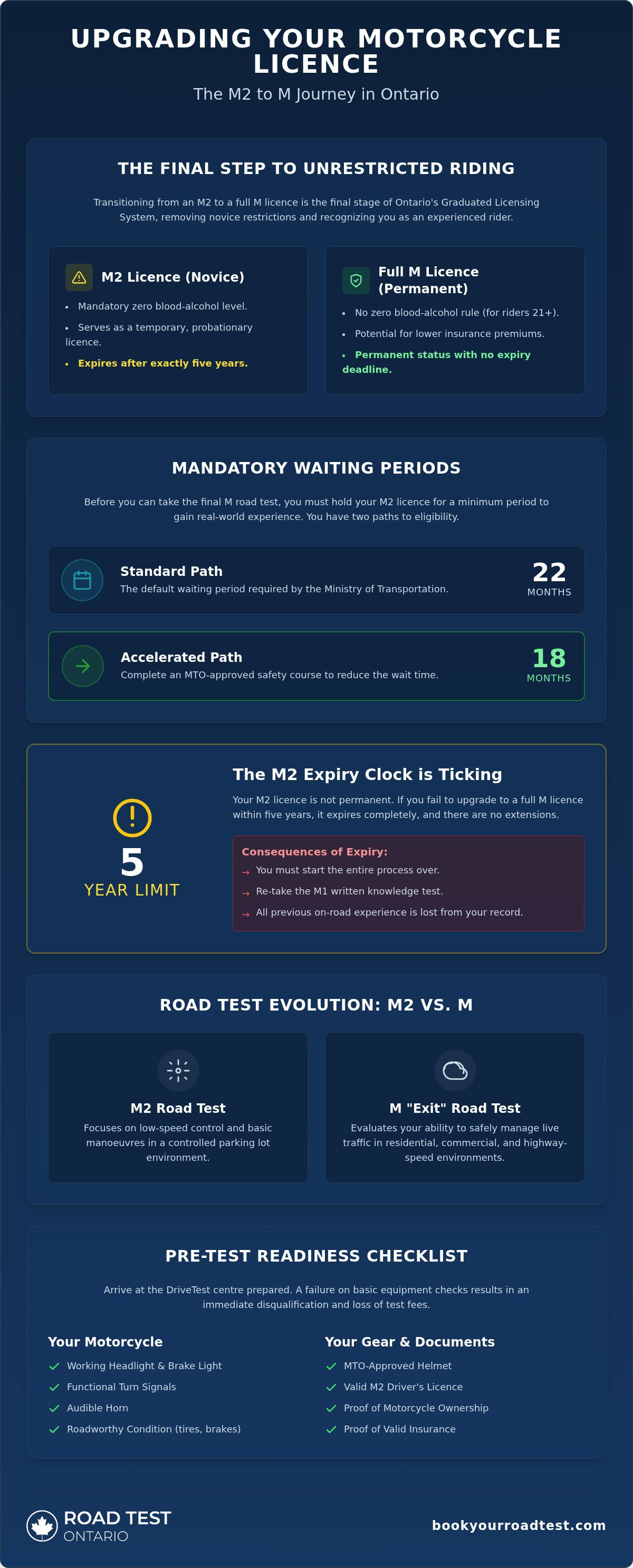
- Understand how the M2 to M transition serves as the final step in Ontario’s Graduated Licensing System, removing restrictions like the zero blood-alcohol requirement for riders over 21.
- Learn how the m2 to m license upgrade process ontario requires a standard 22-month waiting period, which can be reduced to 18 months by completing an MTO-approved safety course.
- Prepare for the shift from basic lot manoeuvres to the "exit" exam, which evaluates your performance in live residential and commercial traffic.
- Ensure your motorcycle is road-ready by performing a pre-test check on lights and the horn to avoid immediate disqualification by the DriveTest examiner.
- Discover strategies to bypass long official wait times and secure a test date before your M2 licence expires through streamlined booking services.
Understanding the M2 to M Licence Upgrade in Ontario
The M licence is the permanent, unrestricted motorcycle class in Ontario. It serves as the final milestone in the Canadian graduated licensing system, which is a framework designed to ensure riders develop their skills progressively over several years. Navigating the m2 to m license upgrade process ontario involves more than a simple administrative update at a desk. It requires you to complete a mandatory waiting period followed by a comprehensive on-road exit exam that evaluates your ability to manage high-speed environments and complex traffic patterns. This transition is essential for any rider looking to move beyond the limitations of a novice status.
Holding a full M licence removes the remaining legal constraints that apply to M2 holders. For riders over the age of 21, achieving this status eliminates the zero blood-alcohol requirement. While safe riding remains the standard, this change signifies that the Ministry of Transportation recognizes you as an experienced operator. The process is transparent but requires careful planning. You'll need to demonstrate that you've mastered the technical aspects of riding while adhering to the new 2026 residency and legal status declarations now required for all Ontario driver's licence applications.
Why Graduate to a Full M Licence?
The Consequences of M2 Expiry
Your M2 licence isn't a permanent document; it functions on a "ticking clock" that lasts exactly five years. If you don't complete the upgrade process within this timeframe, your licence will expire. There's no option for a simple renewal in this situation. If your M2 lapses, you're required to start the entire journey from the beginning, starting with the M1 written test. This setback is both frustrating and costly, especially if you've already spent years building your on-road experience.
Staying ahead of this deadline is vital for uninterrupted riding. You can find your specific expiry date printed on the front of your Ontario driver's licence card. It's usually listed next to the "4b" label or detailed on the back under the class designations. Because DriveTest centres experience high demand during the warmer months, booking your road test early is a smart way to manage your timeline. Don't wait until the final months of your five-year term to secure a spot, as available dates can become scarce during peak season.
Mandatory Waiting Periods and Eligibility Criteria
Timing is everything when you're looking to shed your novice status in Ontario. The Ministry of Transportation (MTO) enforces specific timelines to ensure every rider has sufficient real-world experience before taking the final exit exam. Under the standard m2 to m license upgrade process ontario, you're required to hold your M2 licence for at least 22 months. This period allows you to encounter various weather conditions and traffic scenarios, building the muscle memory needed for high-speed highway travel. You must ensure your M2 remains valid through the day of your scheduled road test, as an expired licence immediately disqualifies you from participating.
Completing an MTO-approved motorcycle safety course allows riders to reduce their mandatory waiting period from 22 months to just 18 months. This four-month reduction is a significant benefit for those eager to finalize their licensing while also potentially lowering insurance costs. The MTO tracks these eligibility dates automatically through their internal database once the training provider submits your successful completion record. If you're uncertain about your specific eligibility date, the Official Ontario Motorcycle Licence Guide provides the framework for these calculations. You can also verify your status at any DriveTest centre to avoid showing up for a test you aren't yet legally allowed to take.
The 22-Month vs. 18-Month Rule
The choice between the standard and reduced waiting period often comes down to how quickly you want to achieve permanent status. Taking a safety course is the fastest path to a full licence, as it bypasses four months of the mandatory wait. It also provides professional feedback on your riding habits before you're evaluated by a DriveTest examiner. If you've lost track of when you received your M2, check the "issued" date on your temporary paperwork or the back of your plastic licence card. Calculating from that date will give you a clear window for when you can finally book your exit exam.
Other Requirements for the M Road Test
Eligibility extends beyond the calendar. You need a motorcycle that is fully compliant with Ontario safety standards. This means all signals, brake lights, and the horn must function perfectly. Examiners will perform a pre-test inspection to verify that your tires have sufficient tread and your mirrors are securely attached. If your bike fails any part of this visual check, your test is cancelled on the spot. Your safety gear is equally important. You must wear a DOT-approved helmet and sturdy riding apparel that provides adequate protection. Showing up prepared demonstrates the professional mindset expected of a full M licence holder. Once you've confirmed your eligibility date, you can search for available M road test dates to secure a slot at a convenient location.
M2 vs. M Road Test: Key Differences and Expectations
The M2 test served as your introduction to basic handling and slow-speed manoeuvres, usually conducted within the controlled environment of a closed lot. In contrast, the M road test is a comprehensive "exit" exam that places you directly into live traffic. You'll navigate residential streets and busy commercial corridors while an examiner follows in a vehicle behind you. Communication happens through a wireless headset provided at the start of the evaluation. This shift from a parking lot to the real world is the most significant hurdle in the m2 to m license upgrade process ontario. It demands a higher level of situational awareness and technical precision than your previous evaluation.
According to the DriveTest road test requirements, you must demonstrate mastery over your motorcycle while interacting with other motorists. The examiner isn't just watching your balance. They're assessing your decision-making, your lane positioning, and your ability to anticipate hazards before they become dangerous. You're expected to ride as a seasoned professional who can handle the complexities of Ontario's road networks without hesitation.
The Highway Exit Component
High-speed evaluation is the centrepiece of the M test. You'll be required to enter a 400-series highway or a similar high-speed roadway. Merging is where many riders struggle. You must accelerate to the ambient speed of traffic, typically 100 km/h, before merging into the live lane. Merging too slowly is a safety hazard and a frequent cause for point deductions. Once on the highway, your "blocking" position is critical. You should stay in the left or right third of the lane to prevent cars from trying to share your space. During every lane change, use exaggerated head movements. The examiner needs to see your helmet turn clearly to confirm you're checking your blind spots. Subtle eye movements aren't enough to pass this portion of the exam.
Common Mistakes That Lead to Failure
Small technical errors often accumulate into a failing grade. Observation is the most common pitfall. You should check your mirrors every 5 to 8 seconds. This keeps you aware of the follow vehicle and surrounding traffic at all times. Lane choice is another area where riders lose marks. Never ride in the "oil strip" in the centre of the lane, as this area lacks traction and is technically incorrect during an exam. Speed management is also a balancing act. You must stay within the posted limit while ensuring you don't impede the flow of traffic. Failing to keep up with the highway pace is just as problematic as speeding. By avoiding these common traps, you can navigate the m2 to m license upgrade process ontario with far less stress.
Technical Preparation: Motorcycle Maintenance and Safety Gear
Success in the m2 to m license upgrade process ontario depends on your vehicle's condition before you even start the engine. Every road test begins with a mandatory pre-test inspection conducted by the DriveTest examiner. If your motorcycle fails to meet basic safety standards, the test is cancelled immediately. You'll lose your booking fee and your time. This makes a thorough pre-ride check essential for any rider approaching their exit exam. The examiner will look for a bike that is roadworthy and capable of safely maintaining highway speeds without mechanical failure.
Start your preparation by verifying all lighting systems. Your headlamp, brake lights, and all four turn indicators must function perfectly. Test your horn to ensure it's loud enough to be heard over ambient traffic noise. Check your tyre pressure and tread depth according to your manufacturer's specifications. Highway speeds put significant stress on your rubber, so any signs of dry rot or excessive wear will result in a disqualification. Finally, ensure your mirrors are securely fastened and provide a clear view of the lanes behind you. Vibration at 100 km/h can quickly loosen poorly adjusted mirrors, which is a safety risk during the merging portion of your evaluation.
Essential Gear for the Test Day
Your safety gear serves as a professional signal to the examiner that you're ready for full licensure. A helmet that meets DOT, Snell, or ECE standards is mandatory. Beyond the helmet, your clothing must provide adequate protection. Sturdy footwear that fully covers the ankle is required; sneakers, sandals, or dress shoes are not permitted. You should also wear gloves and a jacket specifically designed for motorcycling, made from leather or high-quality abrasion-resistant textile. Showing up in casual attire often suggests a lack of preparation and can negatively influence the examiner's initial assessment of your riding habits.
Paperwork You Must Bring
Don't let a missing document derail your progress at the DriveTest centre. You must present your physical Ontario M2 driver’s licence upon arrival. Photocopies or digital images are not acceptable substitutes for the original card. You're also required to provide original proof of valid motorcycle insurance and the vehicle's registration (the green permit). While the centre's system usually lists your appointment, carrying a printed or digital copy of your booking confirmation helps resolve any administrative discrepancies quickly. If your motorcycle and documents are in order, you can book your M road test today to secure a time slot that fits your schedule.
How to Book and Pass Your Final M Road Test
Booking your exit exam is the final administrative hurdle in your journey toward permanent riding status. Official DriveTest channels often present significant wait times, especially during the peak riding season from May to September. These delays can be stressful if your five-year window is closing. Using an autonomous third-party service like Book Your Road Test provides a more efficient experience. It simplifies the m2 to m license upgrade process ontario by handling the search for you, allowing you to focus on your riding skills rather than refreshing a booking portal. You should also consider the geography of your chosen test centre. Selecting a location where you're comfortable with the local highway interchanges and speed transitions can significantly lower your anxiety on the day of the exam.
Preparation doesn't end once you've secured a date. You need a strategy that accounts for both the technical evaluation and the logistical challenges of the DriveTest system. By choosing a centre with familiar infrastructure, you reduce the chances of being surprised by complex lane configurations or short merge lanes. This professional approach to the m2 to m license upgrade process ontario ensures you're ready for the specific demands of the 400-series highways often used during these evaluations.
The Advantages of Using a Cancellation Finder
The road test cancellation finder Ontario is a vital tool for riders facing a looming expiry date. It works by constantly monitoring the system for slots that other applicants have vacated. This allows you to secure an earlier date without manually checking the portal dozens of times a day. It reduces the stress of waiting months for an opening. Early booking is always the best strategy to avoid the end-of-season rush. If your M2 is nearing its five-year limit, finding a cancellation is often the only way to prevent your licence from lapsing back to the M1 level.
Final Tips for Success on Test Day
Arrive at the DriveTest centre at least 30 minutes before your scheduled time. This gives you a buffer to complete the check-in paperwork and allows you to mentally prepare. Spend the days leading up to your test practising on the specific highways near your chosen centre. Familiarity with specific on-ramps and merge lanes will give you a technical advantage. If you're still early in your journey, our guide on M2 road test booking offers insights for that initial stage. When you're ready to finalize your upgrade, Book your M road test date today and secure your permanent riding status.
Finalize Your Journey to Permanent Riding Status
Transitioning to a full M licence represents your final step toward total riding independence in Ontario. You now understand the critical differences between the 18-month and 22-month waiting periods, as well as the technical precision required for the highway exit exam. Success depends on more than just your skills; it requires careful management of the five-year expiry window to ensure you don't lose your hard-earned progress. The m2 to m license upgrade process ontario is a commitment to safer, more experienced riding on our province's high-speed networks.
As an independent service provider specializing in Ontario road test scheduling, we help you navigate the administrative hurdles that often lead to frustration. Our proprietary cancellation finder allows you to skip the standard months-long wait times by identifying slots as soon as they become available. Don't let a looming expiry date or a lack of local openings keep you off the road this season. Secure your M road test appointment now and finalize your upgrade with confidence. We're here to help you cross the finish line and enjoy the road ahead.
Frequently Asked Questions
How long do I have to wait to go from M2 to M in Ontario?
The standard waiting period is 22 months from the date you receive your M2 licence. You can reduce this timeframe to 18 months by successfully completing an MTO-approved motorcycle safety course. This graduated timeline ensures you gain sufficient real-world experience before attempting the final exit exam. The Ministry of Transportation tracks these dates automatically, so you must wait until your specific eligibility date before you can attempt the upgrade.
Can I take the M road test if my M2 licence has expired?
No, you cannot take a road test with an expired licence. If your M2 licence reaches its five-year expiry date before you pass the M road test, you'll lose your current class and must start the process again from the M1 written exam. This makes the m2 to m license upgrade process ontario a time-sensitive task. Always check the expiry date on your card and book your appointment well in advance.
What happens if I fail my M road test in Ontario?
If you fail the test, you're usually required to wait at least 10 days before you can attempt it again. You'll also need to pay the road test fee for each subsequent attempt. The primary risk is your licence expiry date; if your M2 expires while you're waiting for a retest, you'll be forced to restart the graduated system. Fast-tracking a new date through a cancellation finder is often necessary in these high-pressure situations.
Do I need my own motorcycle for the M road test?
You must provide a motorcycle for the test, but it doesn't need to be registered in your name. You can use a borrowed bike or a rental, provided it's in excellent mechanical condition and fully insured. The examiner will perform a pre-test inspection to verify that all signals, lights, and the horn function correctly. If the vehicle fails this check, your test will be cancelled immediately without a refund.
Is the M road test harder than the M2 road test?
The M road test is significantly more demanding because it evaluates your skills in live traffic rather than a controlled lot. While the M2 test focuses on basic balance and slow-speed manoeuvres, the M test requires you to demonstrate safe highway merging and proper lane blocking positions. It measures your ability to interact safely with other motorists at high speeds, making it a much more comprehensive evaluation of your riding habits.
How much does the M2 to M upgrade cost in 2026?
You're required to pay the official DriveTest road test fee, which is currently aligned with the standard Class G exit exam rates. These government fees must be paid at the time of booking. It's also important to account for the new 2026 insurance regulations, as your premiums may change once you achieve full licensure. While the test itself has a set fee, the administrative and training costs vary by rider.
Can I ride on the 400-series highways with an M2 licence?
Yes, M2 holders are legally permitted to ride on all Ontario highways, including the 400-series and the QEW. Unlike the M1 licence, which prohibits highway travel and night riding, the M2 class allows you to gain the high-speed experience necessary for your final upgrade. Practising on these routes is essential preparation for the highway component of the m2 to m license upgrade process ontario.
What gear is required for the Ontario motorcycle road test?
You're required to wear a DOT-approved helmet and sturdy boots that provide full coverage of the ankle. Examiners also expect you to wear professional riding gear, including a jacket made of leather or abrasion-resistant textile and proper motorcycle gloves. Showing up with inadequate gear, such as sneakers or casual jackets, can lead to a cancelled test. Proper gear demonstrates that you take road safety and the licensing process seriously.


