

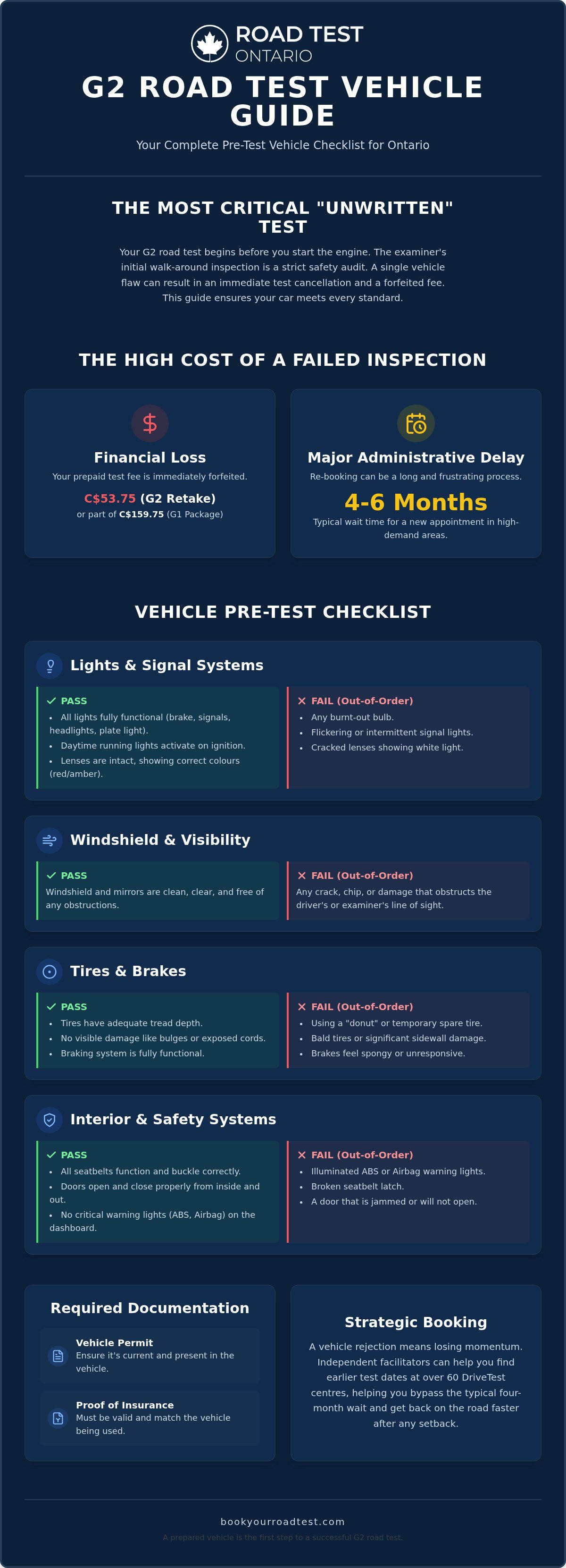
Your vehicle is your first impression; a poorly maintained car signals a poorly prepared driver, making the inspection the most critical "unwritten" part of the exam. Many Ontario drivers arrive at the DriveTest centre only to have their examiner refuse to enter the vehicle because of the strict g2 road test vehicle requirements ontario enforces. A single hairline crack in the windshield or a flickering signal light can result in an immediate "out of order" status, meaning your test is cancelled and your fee is forfeit. It's a frustrating setback that turns a stressful day into a costly administrative nightmare.
We understand that the pre-test inspection often causes more anxiety than the actual driving portion of the exam. You shouldn't have to worry about mechanical technicalities when you've spent weeks perfecting your three-point turns. This guide ensures your vehicle meets every provincial safety standard so you pass the inspector's clipboard with ease. As an independent facilitator, we'll also show you how to bypass four-month wait times to secure your G2 test date much faster. From checking your brake lights to navigating the booking system, you're about to gain the confidence needed to face your examiner with a perfectly prepared vehicle.
Key Takeaways
- Understand why the examiner's initial walk-around is the most critical part of your evaluation and how a simple light check can save your exam.
- Identify the specific mechanical standards within the g2 road test vehicle requirements ontario that often lead to immediate vehicle rejection.
- Discover the exact visibility rules for windshields and mirrors to ensure your car isn't flagged for safety violations before you leave the parking lot.
- Prepare a final documentation checklist to verify your vehicle permit and insurance meet provincial standards for test day.
- Explore strategic methods to bypass typical four-month wait times and secure a confirmed G2 road test date at one of over 60 DriveTest centres.
The G2 Road Test Vehicle Requirements and Why They Matter
Your G2 road test doesn't begin when you put the car in drive. It starts the moment the examiner approaches your window. This initial phase is a rigorous safety audit designed to protect the examiner and the public. Meeting the g2 road test vehicle requirements ontario mandates isn't just a formality; it's a legal necessity. If your car fails to meet these standards, the examiner will label the vehicle "declared out-of-order." This status immediately cancels your appointment. You'll lose the prepaid government fee associated with the attempt. It’s a preventable setback that adds unnecessary stress to an already high-pressure day.
The Examiner’s First Impression
Think of the vehicle inspection as the "zero-point" of your practical exam. While you aren't technically being graded on your driving yet, the condition of your car speaks volumes about your preparation. A clean, well-maintained vehicle builds immediate trust. It signals to the examiner that you take road safety seriously. There's a clear link between vehicle care and defensive driving habits. A driver who ensures their signal lights are crisp and their windshield is clear is usually a driver who pays attention to details on the road. This professional interaction sets a calm tone for the rest of the 20-minute evaluation.
Consequences of a Failed Vehicle Inspection
The fallout from a rejected vehicle is both financial and administrative. When a vehicle is rejected, you lose your booking fee. This currently stands at C$53.75 for a G2 retake or is bundled into the C$159.75 G1 package for your first attempt. Beyond the money, the administrative delay is often the most painful part. In high-demand areas, finding a new appointment can take four to six months. You're forced back into the queue. You may lose the momentum you built during your practice sessions. Realizing that a mechanical failure is a preventable setback is key to your success on test day.
Most rejections happen because of minor, overlooked issues. Ensure you check these common failure points before arriving at the centre:
- A burnt-out brake light, signal, or licence plate light.
- Dashboard warning lights, specifically the ABS or airbag indicators.
- Cracks in the windshield that obstruct the driver's or examiner's view.
- Inoperable seatbelts or doors that won't open from both the inside and outside.
Preparing your vehicle is the easiest part of the test to control. By adhering to the g2 road test vehicle requirements ontario expects, you remove the risk of a sudden cancellation. Our role as an independent facilitator is to help you manage the booking process and find earlier dates. However, the mechanical readiness of your car remains your primary responsibility when you arrive at the DriveTest centre.
Mandatory Mechanical Standards for Your Test Vehicle
Adhering to the g2 road test vehicle requirements ontario demands is about more than just passing; it's about proving your car is safe enough for an examiner to sit in. Before you even leave your driveway, you must verify that every mechanical component functions as intended. Examiners follow a strict checklist. If they find a single defect, they'll halt the process before you've even buckled your seatbelt. This isn't meant to be punitive. It's a fundamental part of the graduated licensing system designed to keep Ontario roads secure.
Lighting and Signal Systems
Every external light on your vehicle must work perfectly. This includes your low and high beams, front and rear turn signals, brake lights, and even the small bulb illuminating your rear licence plate. In 2026, examiners are particularly observant of daytime running lights, which must be functional upon ignition. If a lens is cracked and showing white light where it should be amber or red, the vehicle will be declared out-of-order. It's best to have a friend stand outside the car while you cycle through your hazards and flashers to confirm everything is operational. For a full list of official expectations, you can consult the Official MTO Driver's Handbook.
Tires, Brakes, and Suspension
The examiner will check your tires for adequate tread depth and obvious structural damage. Bulges in the sidewall or exposed cords are immediate grounds for rejection. You cannot use a "donut" or temporary spare tire during the test because these aren't rated for standard driving conditions. Your braking system is equally critical. The examiner will often ask you to engage the parking brake on a slight incline to ensure it holds the vehicle's weight. If your dashboard shows an ABS or Brake System warning light, the examiner won't proceed with the test. They need to know the vehicle's safety systems are fully intact before heading into traffic.
The horn must be audible and function with a single press from the centre of the steering wheel. If you have to hunt for a "sweet spot" to make it sound, it's considered a failure. These standards might feel rigorous, but they ensure that your focus remains on your driving skills rather than a mechanical failure. If you're worried about the timeline for your exam, you can use a G2 road test booking service to find a date that works for your schedule once your car is ready.
Interior Safety and Visibility Requirements
The interior of your car is the examiner's workspace for the duration of your evaluation. While mechanical exterior checks are vital, the cabin environment must meet specific safety and visibility standards before the test can proceed. Examiners are trained to identify risks that could compromise their safety or your ability to see the road clearly. Failing to meet these g2 road test vehicle requirements ontario standards will lead to an immediate cancellation, regardless of how well the engine is running. You must ensure the cabin is a compliant, professional environment that allows for full focus on the road.
Windshield and Visibility Standards
Your windshield is the most scrutinized part of the vehicle's interior. Any "star" cracks, "bullseyes," or long spiderweb fractures that fall within the driver's or examiner's line of sight are grounds for an "out-of-order" declaration. Even a small chip can be rejected if it interferes with visibility or appears likely to shatter under stress. Beyond the glass itself, your wipers and washer fluid must be fully functional to handle variable weather conditions. You should also clear the dashboard and remove any hanging objects from the rearview mirror, such as air fresheners or decorative charms, which can be cited as obstructed view violations. For a complete list of what examiners look for, consult the official G2 Road Test Vehicle Requirements.
Cabin Safety and Cleanliness
Examiner safety is a top priority during the inspection. You must clear the passenger-side footwell of all debris, including loose water bottles, floor mats that slide, or trash. These items can become dangerous projectiles or interfere with the examiner's ability to brace themselves if needed. The passenger seat itself must be secure, and the adjustment mechanism must work perfectly so the examiner can position themselves safely. Verification of seatbelt functionality is also mandatory. Both the driver and passenger seatbelts must fasten securely and retract without hesitation. If a belt is frayed or the locking mechanism is sticky, the examiner will refuse to enter the vehicle.
Finally, check your instrument cluster for specific warning lights. While a low washer fluid light might be ignored, an illuminated Airbag or SRS (Supplemental Restraint System) light is an automatic failure. This indicates that the vehicle's primary safety systems may not deploy in an accident. All windows must also be fully operational. The examiner needs to know that you can use hand signals if the electronic signals fail or if they need to communicate with other drivers during the test. Taking ten minutes to vacuum the interior and test these basic functions can prevent a wasted trip to the DriveTest centre.
A Step-by-Step Preparation Checklist for Test Day
The final sixty minutes before your exam are the most critical for ensuring you meet the g2 road test vehicle requirements ontario mandates. You've spent weeks perfecting your parallel parking and three-point turns, but a simple documentation error or a stuck door handle can end your test before it starts. This checklist serves as your final safeguard against administrative rejection. By following these steps, you ensure that your interaction with the examiner begins on a positive, stress-free note.
The Final Mechanical Walk-Around
Perform a final mechanical walk-around at your home or a nearby quiet street before heading to the centre. Open and close every door. The examiner must be able to enter and exit the vehicle from both the inside and outside without any struggle. Check your fuel level or battery charge if you're driving an EV. A typical road test involves about 20 minutes of driving, but you must account for idling and potential traffic delays. Aim for at least a quarter tank of fuel or 50 kilometres of range. Listen closely for unusual engine noises or loud exhaust leaks. If your car sounds like it's struggling to stay running, the examiner will likely declare it out-of-order for safety reasons.
Essential Documentation Checklist
Your paperwork must be as ready as your vehicle. You need your physical driver's licence on your person. Digital copies, temporary paper printouts, or photocopies are generally not accepted for the road test. Verify that your vehicle permit is in the glove box and that the validation period is current for 2026. Your insurance pink slip must be the original or a clearly printed version that matches the vehicle's VIN and plate number. If you've recently changed vehicles or insurance providers, double-check that the documents reflect the car you're actually using for the test.
Arrive at the examination centre at least 30 minutes before your scheduled slot. This window is essential for finding the correct parking zone and completing the check-in process at the kiosk. If you're late, you risk losing your spot and your fee. Take a moment to clean both the interior and exterior of your vehicle. A car free of mud and clutter projects a professional image. It tells the examiner that you respect the equipment and the rules of the road. If you're still looking for an appointment, our G2 road test booking service can help you find cancellations and secure a date without the standard four-month wait.
Strategic Booking: Securing Your Test Date Efficiently
Once you understand the g2 road test vehicle requirements ontario examiners enforce, the next challenge is actually getting to the DriveTest centre. Wait times for G2 road tests can be substantial at popular examination centres, often stretching between four and six months in high-density urban areas. This delay can be discouraging for new drivers who have already prepared their vehicles and perfected their skills. We act as an independent third-party facilitator to help you bypass these bottlenecks. Remember that our services are autonomous and not affiliated with the Ministry of Transportation or DriveTest. We charge an administration fee to provide a premium, stress-free booking experience that official portals often lack.
The Power of a Cancellation Finder
Manual checking of government portals is often ineffective for busy drivers. New slots appear randomly as other applicants reschedule, but these openings are usually claimed within minutes. Using a road test cancellation finder allows you to identify these new openings automatically. This tool monitors the system constantly, giving you a significant advantage in securing an earlier date. Many drivers prefer to book their test during peak performance times, such as mid-morning, when traffic is lighter and energy levels are high. Our automated service helps you organize your schedule around these ideal windows without the technical stress of constant refreshing.
Facilitated Booking for G2 and M2 Tests
Our platform is designed to be a comprehensive concierge for all your licensing needs. Whether you're scheduling a standard vehicle exam or an M2 road test booking, you can manage the entire process through a single, simplified portal. These administration fees cover the cost of our proprietary search tools and dedicated support team, ensuring you never feel lost in the system. This efficiency is especially valuable when transitioning from your G2 to a full G licence, where timing and highway experience declarations are critical. We provide the professional oversight needed to ensure your booking is secure and your arrival at the centre is confirmed.
By combining a perfectly prepared vehicle with a strategically chosen test date, you maximize your chances of success. Adhering to the g2 road test vehicle requirements ontario mandates ensures you pass the inspection, while our booking service ensures you get to that inspection months sooner than the standard queue allows. This dual approach removes the two biggest obstacles to getting your licence: mechanical failure and administrative delays. You can focus entirely on your driving performance while we handle the logistics of the appointment.
Secure Your G2 Licence With Confidence
You have mastered the rules of the road; now ensure your vehicle doesn't stand in your way. Adhering to the g2 road test vehicle requirements ontario mandates is the foundation of a successful exam day. By verifying your lights, mirrors, and safety systems ahead of time, you eliminate the risk of a costly "out-of-order" declaration. A clean car and organized documentation signal to the examiner that you are a responsible, prepared driver.
Our team acts as an independent concierge for over 60 DriveTest centres. We utilize an expert cancellation finder to help you bypass long queues and secure earlier dates. While we are an autonomous entity separate from the Ministry of Transportation, our transparent administrative fees ensure you receive a streamlined, professional experience. Book your G2 road test through our stress-free administration service today and move one step closer to your full licence. You have the skills and a prepared vehicle; now it's time to get on the road. We look forward to helping you reach your goal.
Frequently Asked Questions
What happens if my vehicle fails the inspection at the DriveTest centre?
If your vehicle is rejected, it's declared "out-of-order" by the examiner. Your test is cancelled immediately and you'll lose the prepaid government fee associated with that attempt. You'll need to book a new appointment and pay the government retake fee. This often results in a significant delay in your licensing timeline. It's essential to check your car against the g2 road test vehicle requirements ontario specifies before arriving to avoid this outcome.
Can I use a rental car for my G2 road test in Ontario?
You can use a rental car, but you must ensure it meets all provincial safety standards. You must be listed as an authorized driver on the rental agreement provided by the company. Some rental agencies have specific policies against using their vehicles for road tests, so you should verify this before booking your appointment. Ensure the insurance and registration documents are present in the vehicle and that you're comfortable with the car's controls.
Is a cracked windshield an automatic failure for a road test?
A cracked windshield is an automatic failure if the damage is in the driver's or examiner's line of vision. Tiny chips outside this area might be permitted, but "star" cracks or long fractures are usually grounds for rejection. Examiners prioritize visibility and structural integrity. If the crack could interfere with your view of the road or mirrors, the examiner will declare the vehicle out-of-order and cancel your session immediately to ensure safety.
Do I need to bring my own vehicle, or does the centre provide one?
You are responsible for providing your own vehicle for the test as DriveTest centres don't provide cars for applicants. Most drivers use their own car, a family member's vehicle, or a car from a driving school. Regardless of who owns the vehicle, it must strictly adhere to the g2 road test vehicle requirements ontario expects. You must also ensure the vehicle has valid insurance and a current vehicle permit during the evaluation process.
What are the specific brake light requirements for the G2 exam?
All three brake lights must function perfectly for the exam to proceed. This includes the left, right, and centre high-mount brake lights. If even one bulb is burnt out, the examiner will not enter the vehicle. These lights allow other drivers to see your intentions clearly during the evaluation. You should have a friend or family member stand behind the car while you press the pedal to verify they are all functional before leaving home.
Can I take the test if my "Check Engine" light is on?
You can often take the test with a Check Engine light on, provided the vehicle is running smoothly and no other safety lights are illuminated. However, warning lights for the ABS or SRS result in an automatic rejection. These systems are critical for safety during an accident. If the engine light is accompanied by loud noises, exhaust leaks, or smoke, the examiner will declare the vehicle unsafe and cancel the test session for safety reasons.
How much is the administration fee for a third-party booking service?
Book Your Road Test charges a convenience fee for managing the scheduling process and providing access to our proprietary cancellation finder. This fee is separate from the standard government fees paid to DriveTest. Because we operate as an independent facilitator, these costs cover our concierge support and automated search tools. We don't publish a single fixed rate because fees can vary based on the specific administrative services you require to secure an earlier date.
What documents must be inside the vehicle on the day of the test?
You must have the original vehicle permit and a valid insurance pink slip inside the car. The permit must show a current validation period for 2026. Photocopied insurance documents are often rejected, so ensure you have the physical or official digital version provided by your insurance company. You also need your physical driver's licence. Having these documents organized in the glovebox helps the check-in process move quickly and prevents unnecessary stress before your exam starts.


