

Could choosing a quieter test centre make passing your G2 easier, or is that the “easiest drivetest locations for g2 test myth” at work? It’s understandable to weigh traffic, unfamiliar roads and centre rankings when a test already feels high-pressure. But a published pass rate describes a group of test-takers, not your personal odds, and it doesn’t prove that a centre applies an easier standard.
This guide separates useful evidence from road-test rumours so you can choose a practical location and prepare with more confidence. You’ll learn what centre-level pass rates can and can’t tell you, how travel and road layouts may affect your practice, and why familiarity with a test area shouldn’t replace core driving skills. The goal isn’t to find a shortcut to a pass. It’s to make a considered choice and arrive ready to demonstrate safe driving wherever you test.
Key Takeaways
- The easiest drivetest locations for g2 test myth is the idea that choosing a centre changes the required driving standard or guarantees a pass.
- Use pass-rate information carefully: it describes a group’s results, not your personal likelihood of passing.
- Compare locations by practical factors such as travel, familiarity with the road environment, appointment options and the reliability of available data.
- Prepare for the skills you’ll need to demonstrate, not a route you hope to get. Practise manoeuvres and sound decisions in varied, lawful conditions.
- Book Your Road Test is an independent third-party booking service, not affiliated with DriveTest or the Ministry of Transportation, and charges an additional administration fee.
The easiest G2 test location myth: what centre choice can and cannot do
No DriveTest centre can guarantee an easier G2 test or a passing result. The “easiest drivetest locations for g2 test myth” is the belief that choosing a particular location changes the driving standard you’re expected to meet. A centre can shape the surroundings and logistics of test day, but it can’t replace the skills you need to demonstrate.
A convenient test location works well for your travel and practice; an “easier” test would require a lower assessment standard. Those are different things. A manageable trip, familiar road conditions and enough time to arrive calmly can make test day feel more straightforward. They don’t mean you’ll be assessed against different expectations for safe driving.
Think of location as a planning choice, not a shortcut. Ask whether you can get there reliably and prepare for the general road environment, rather than whether an online list calls it an easy pass.
Why candidates search for an easier test centre
Test anxiety is understandable. You may be concerned about busy traffic, unfamiliar intersections or making a mistake under pressure. The possibility of failing can make every choice feel consequential.
Online rankings and personal stories can add to that pressure. A candidate’s account describes one route or test-day experience, while a ranking may turn reported pass rates into a simple “best” list. Neither proves that a centre offers an easier assessment for the next person. Use those accounts to identify what you want to practise, not as a promise of what your test will be like.
What choosing a different centre actually changes
A different centre can mean a different commute and local road environment. Traffic, road layouts and your familiarity with the area may affect how comfortable you feel behind the wheel. They can also influence where you practise and how much time you need to reach your appointment. These are real considerations, but they describe the experience around the test, not a change to the skills being assessed.
Wherever you test, be ready to show safe, consistent driving. The G2 assessment considers skills such as vehicle control, observation and following traffic laws, along with required manoeuvres. Practising in a similar general environment may help you feel prepared, but don’t depend on learning or predicting a specific route.
Instead, choose conditions you can prepare for. If unfamiliar roads make you tense, give yourself time to practise in a range of road environments. If the trip itself is stressful or difficult to organize, factor that into your decision too. A practical location can reduce avoidable uncertainty; your preparation equips you to respond safely when conditions or directions differ from what you expected.
What G2 pass rates reveal, and why they do not prove a centre is easier
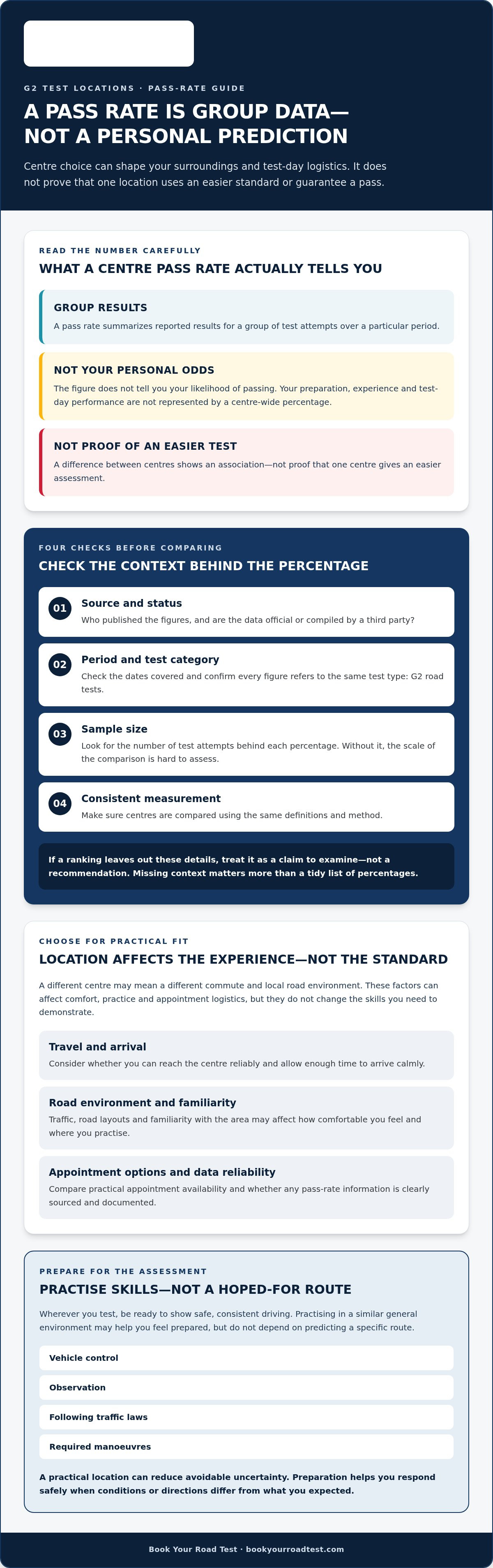
A G2 pass rate summarizes a group’s results over a particular period. It can show what proportion of reported test attempts resulted in a pass, but it doesn’t tell you your personal chance of passing. Your preparation, experience and performance on test day aren’t represented by a centre-wide percentage.
A difference in pass rates between centres shows an association, not proof that one centre gives an easier test. The figure alone doesn’t explain why results differed or whether the assessment standard changed. Candidate readiness, the number of tests included and the reporting period are relevant context, but a table may not explain how these factors were accounted for.
That’s why the easiest drivetest locations for g2 test myth can gain traction: a higher percentage may look like a shortcut when the information behind it is incomplete. Treat rankings as claims to examine, not evidence that you’ll find a more lenient assessment there.
How to read a centre pass-rate comparison
Before comparing percentages, look for the source and dates covered. Confirm that the figures refer to G2 road tests, not another test category, and check whether the data are official or compiled by a third party. A current, clearly documented figure is more useful than an undated ranking, but it still describes past group results rather than your likely outcome.
- Source and status: Identify who published the figures and whether the data are official.
- Period and category: Check the reporting dates and confirm that every figure covers the same test type.
- Sample size: Look for the number of test attempts behind each percentage. Without it, the scale of the comparison is hard to assess.
- Consistent measurement: Make sure centres are compared using the same definitions and method.
If a table leaves out these details, don’t treat its ranking as a recommendation. The missing context matters more than a tidy list of percentages.
Why individual experiences differ
Two candidates testing at the same centre can arrive with different levels of practice and confidence. Traffic and other test-day circumstances can vary too. These factors help explain why individual accounts may not match a centre’s overall results; they don’t prove that the location is lenient or unusually difficult.
Use a pass-rate figure, if it’s well sourced, as limited background information. Choose your location based on practical considerations, then focus on the skills you’ll need to demonstrate. For booking convenience after you’ve chosen a location, Book Your Road Test’s G2 booking assistance provides administrative support. It’s an independent third-party service, not affiliated with DriveTest or the Ministry of Transportation, and it charges an additional administration fee.
How to compare G2 test locations without relying on rankings
Compare the details that will shape your own test day instead of treating a pass-rate ranking as a verdict. The easiest drivetest locations for g2 test myth can make a percentage seem like the deciding factor, but a practical choice is one you can reach, prepare for and book on workable terms. The highest reported pass rate doesn’t automatically make a centre the best fit for you.
Use this table to compare a few possible centres. Appointment options can change, so base your decision on current information rather than an old ranking.
| Factor | What to consider | A useful question |
|---|---|---|
| Commute | Travel time, transport arrangements and the time you’ll need to arrive without rushing. | Will getting there add avoidable pressure on test day? |
| Road environment | How comfortable you are practising in the general driving environment around the centre. | Can you gain reasonable familiarity without relying on a memorized route? |
| Appointment practicality | Current dates and times that work with your schedule and preparation. | Does this option give you time to get ready and plan the trip? |
| Data reliability | The source, date, test category and context behind any published pass-rate figure. | Is the information clear enough to use as background, rather than a promise? |
Which factors make a test location practical for you?
Start with the journey. Consider how you’ll get to the centre, how much time you need to arrive calmly and whether unfamiliar roads on the way could distract you before the test begins. Then consider the road environment where you can practise. Familiarity can build comfort, but no environment should be assumed to be inherently easier to assess. Choose a location that works with your schedule and gives you a sensible opportunity to prepare.
For example, a centre with a higher reported pass rate may involve a long, unfamiliar trip, while another offers a more manageable commute and a suitable appointment. The second option may be more practical for you, even without the higher percentage. That’s a planning decision, not a prediction about the result.
When a pass-rate ranking is useful, and when it is not
A ranking can offer limited context if it has a credible source, a recent reporting date and clear information about how the figures were gathered. Even then, a percentage alone can’t tell you that examiners are less strict, routes are simpler or your outcome is more likely to be a pass. If a table lacks dates or methodology, don’t use it to choose a centre.
If your preferred appointment isn’t workable, flexibility may help you compare other dates or locations. A road test cancellation finder guide explains one way to think about monitoring for newly available appointments. Weigh any new option against commute and preparation needs, not reputation alone.
Prepare for the G2 test you booked, not the route you hope to get
A familiar route can feel reassuring, but a test may take you through roads or situations you didn’t rehearse. Build habits you can use anywhere instead. This is the practical response to the easiest drivetest locations for g2 test myth: prepare for the driving standard, not a rumoured route or hoped-for shortcut.
Use this plan to organize your practice and test-day checks:
- Practise core driving habits. Check mirrors and blind spots, signal at the right time, manage speed, maintain appropriate lane position and respond to signs and changing conditions.
- Repeat the required manoeuvres. Practise parallel parking, three-point turns and an emergency stop. Focus on observation and safe decisions throughout, not just completing a memorized sequence.
- Vary your practice. Drive on different lawful roads and in changing traffic conditions, where permitted. A qualified instructor or experienced supervisor can support practice when appropriate and permitted.
- Review official test-day instructions. Check current requirements before leaving, and make sure you know what documents you need to bring.
- Plan your arrival and vehicle check. Allow time for travel and check that the test vehicle is in good working order, including its lights, brakes and horn. Make sure it has a clear windshield, valid insurance and registration.
Build skills that transfer to unfamiliar roads
Make observation part of every action: scan ahead, check around you before moving, and notice signs, pedestrians and other road users. Practise adjusting speed and lane position as conditions change, rather than relying on landmarks to tell you what to do next. Repeat each manoeuvre until you can carry it out with steady observation and control, even when the surroundings differ from your practice area. Route familiarity may help you feel oriented, but adaptable decisions are more useful than memorizing turns.
Reduce avoidable test-day pressure
Plan your trip in advance and leave a buffer so finding the centre or dealing with a delay doesn’t become a last-minute distraction. Before you go, review official instructions and gather the required documents. Check weather and road conditions on test day. If conditions may affect your appointment, follow official directions rather than relying on assumptions or informal posts.
Preparation can make your skills more consistent, but no practice plan or route guarantees a pass. The aim is to arrive ready to make safe decisions, even if the roads, traffic or directions differ from what you expected. If you still need to arrange your test, get G2 road-test booking assistance through Book Your Road Test. It’s an independent third-party service that charges an additional administration fee and isn’t affiliated with DriveTest or the Ministry of Transportation.
Booking a G2 test: practical next steps and transparent options
Once you’ve chosen a location that works for your travel and preparation, focus on the booking details. The “easiest drivetest locations for g2 test myth” is no reason to rush into a centre that doesn’t suit your circumstances. A clear sequence helps you make a practical choice and understand what booking assistance does and doesn’t provide.
- Choose a practical location. Consider the journey, the general road environment you can prepare for and whether you can arrive without unnecessary pressure.
- Review official requirements. Check current G2 eligibility, test-day instructions and any document or vehicle requirements through official sources.
- Select an available date. Choose an appointment that leaves time for preparation and fits your schedule. Review the appointment details before completing a booking.
- Prepare for the assessment. Practise safe, consistent driving and the required manoeuvres. A booking date or location can’t guarantee a particular route or result.
Choose a date and location that fit your circumstances
Prioritize manageable travel, suitable timing and your readiness over an online claim that a centre is easy. For example, an appointment that leaves you enough time to prepare may be more practical than a date that feels rushed, even if a ranking favours that centre. Review the official booking details so you understand the appointment you’re selecting. If your schedule is flexible, cancellations can create new openings, but one may not appear when you need it.
Book Your Road Test’s cancellation finder monitors for newly available appointments. It’s an option for people seeking flexibility, not a promise that an earlier date will become available.
Know what independent booking assistance means
Book Your Road Test is an independent third-party service that provides administrative assistance with road-test bookings. It isn’t DriveTest or a government service, and it isn’t affiliated with the Ministry of Transportation or DriveTest. Its administration fee is charged in addition to standard government test fees. These are separate charges: the service fee is for booking assistance, while the government fee relates to the road test.
You can also book a G2 road test through official DriveTest channels. Whichever route you use, review the applicable requirements and appointment details, and allow time to prepare. Booking help can assist with scheduling; it doesn’t provide driving instruction, change the assessment or guarantee an earlier appointment or a pass.
If independent administrative support would be useful, you can explore G2 road-test booking assistance from Book Your Road Test. Choose the booking approach that fits your plans, then focus on arriving prepared to drive safely.
Make your next G2 step a practical one
Don’t let the search for the “easiest drivetest locations for g2 test myth” distract you from a choice you can act on: select a location and appointment that fit your plans, then give yourself room to prepare. Confidence comes from knowing what you can control, not from trying to predict the route or the result.
If arranging the appointment is your next task, Book Your Road Test offers independent third-party booking assistance for G2 road tests. Its cancellation finder monitors for newly available appointments, but an earlier opening isn’t guaranteed. The service isn’t affiliated with DriveTest or the Ministry of Transportation, and its administration fee is separate from standard government test fees.
Explore G2 road test booking assistance if you’d like help with scheduling. Then focus on what matters on test day: showing safe, steady driving. Choose carefully, prepare with purpose and take your next step with confidence.
Frequently Asked Questions
Can I book a G2 road test at a different centre from the one where I practised?
Yes, you can consider another available centre, but check the applicable official booking rules and make sure the trip works for you. Practising near a centre may help you feel more at ease with its general surroundings, but it won’t tell you which route you’ll take or determine your result. The easiest drivetest locations for g2 test myth shouldn’t lead you to choose a centre without considering travel and preparation.
What happens if I fail my G2 road test?
If you don’t pass, follow the official instructions provided after your test and consult the relevant licensing authority for current retest requirements and booking rules. Use the experience to identify skills you want to practise before another attempt, without assuming the same situations will happen again. A failed attempt doesn’t show that a different centre would automatically lead to a different result.
Can I change or cancel a booked G2 road test?
Change and cancellation options depend on the booking terms and current official rules. Before taking action, review the instructions associated with your appointment so you understand the available steps. If you booked through an independent service, review its applicable terms as well. Don’t rely on a deadline, penalty or refund expectation shared in an old post; use the current instructions for your specific booking.
How much does it cost to use a third-party road-test booking service?
An independent booking service may charge an administration fee in addition to standard government test fees. The amount can depend on the service and booking selected, so review the current checkout details before deciding. Book Your Road Test is an independent third-party service and isn’t affiliated with the Ministry of Transportation or DriveTest. Its service fee is separate from the government fee for the road test.
Can I use a rental car for a G2 road test?
Check current official test instructions and the rental agreement before planning to use a rental vehicle. Don’t assume that every rental car or agreement permits road-test use, or that a vehicle will meet the applicable requirements. You’re responsible for arriving with an eligible vehicle and any required documentation. If you’re relying on a rental, resolve those details before test day so they don’t become a last-minute obstacle.
Is an earlier G2 test appointment guaranteed by a cancellation finder?
No. A cancellation finder monitors for openings created when other candidates change or cancel appointments, but an earlier date depends on an opening becoming available. It can’t guarantee a particular appointment or an earlier test. The service helps with appointment searching only; it doesn’t affect your eligibility, prepare you for the assessment or change your likelihood of passing. Keep your existing plans until any new appointment is confirmed.


