

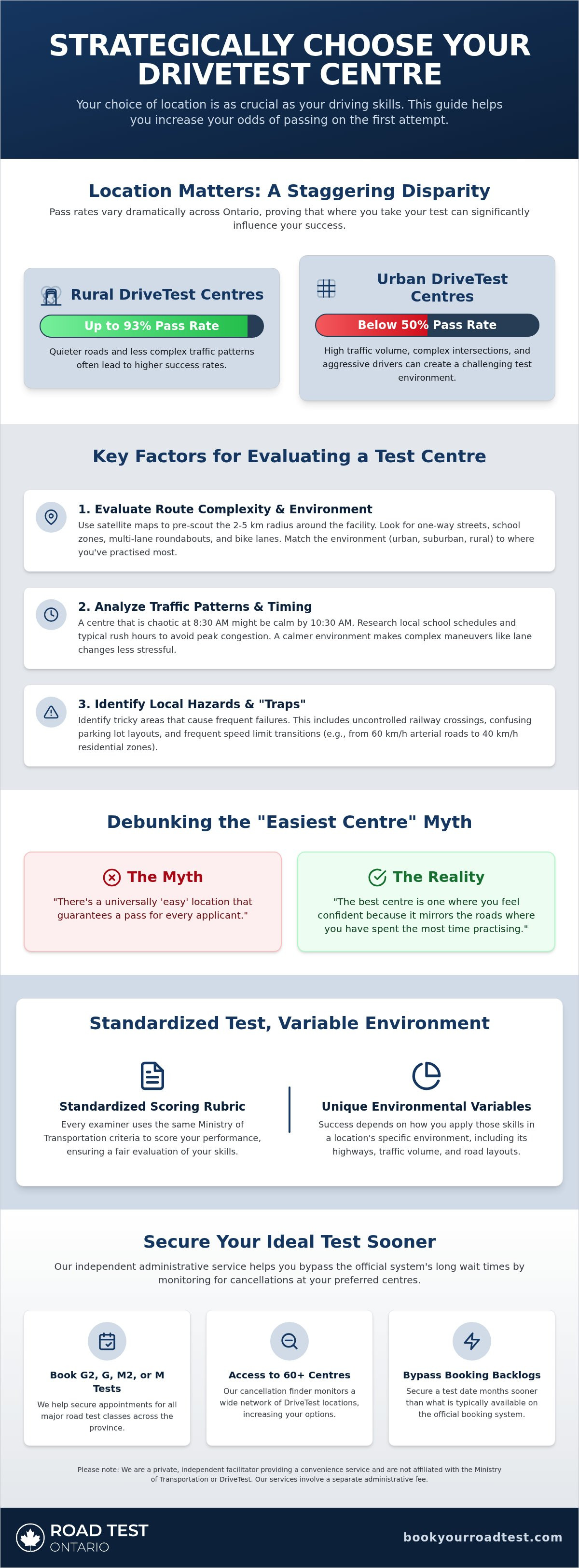
Did you know that while some rural DriveTest centres maintain pass rates as high as 93 percent in 2026, certain urban locations see success rates dip below 50 percent? It's a staggering disparity that proves your choice of location is just as important as your parallel parking skills. We understand the frustration of staring at a multi-month booking backlog or the anxiety of navigating a complex highway route for the first time. Learning how to choose a drive test centre strategically is the most effective way to lower your stress and increase your odds of passing on the first attempt.
In this guide, you'll learn how to evaluate road test routes and traffic volumes to find an environment where you feel truly confident. We'll provide a framework for selecting a location that balances proximity with a high probability of success. You'll also discover how our independent administrative service helps you bypass the official system's delays by monitoring cancellations at over 60 centres. Please note that we are a private facilitator separate from the Ministry of Transportation and DriveTest, and our convenience services for G2, G, M2, or M bookings involve a separate administrative fee.
Key Takeaways
- Evaluate route complexity and traffic patterns to select a testing environment that minimizes your specific driving anxieties.
- Master the criteria for how to choose a drive test centre by balancing your local knowledge against the statistical advantages of quieter regional facilities.
- Learn to identify local speed traps and parking lot hazards that cause many applicants to fail before they even reach the main road.
- Use a specialized cancellation finder to secure G2, G, M2, or M tests at over 60 centres, bypassing months of wait times for a convenience fee.
- Recognize that we operate as an independent facilitator separate from the Ministry of Transportation or official DriveTest centres to provide streamlined administrative support.
Understanding Why Your Choice of DriveTest Centre Matters
A DriveTest centre is a specialized facility for practical driver examinations. Understanding how to choose a drive test centre effectively involves more than just looking at a map. While the testing standards are provincial, the physical surroundings vary from quiet suburban crescents to high-speed multi-lane highways. Understanding Serco's role in Ontario's driver testing helps clarify that while a private entity manages the facilities, the examiners follow a strict government rubric. Success often depends on matching your specific driving confidence with the unique challenges of a location.
Your choice directly affects your stress levels, your familiarity with local road signs, and your ability to react safely to unpredictable traffic patterns. If you feel comfortable in heavy urban traffic, a busy city centre might suit you. However, if you've done most of your learning on rural roads, a metropolitan environment could introduce unnecessary anxiety during your evaluation.
The Myth of the Easiest Centre
There is no universal "easy" location that guarantees a pass for every applicant. What feels simple for a driver trained in a quiet rural setting may feel overwhelming for someone accustomed to dense downtown grids. Many applicants make the mistake of travelling to a "reputed" easy centre they have never visited. They often find themselves confused by unfamiliar intersection layouts or regional speed conventions. When considering how to choose a drive test centre, prioritize environments that mirror where you have spent the most time practising. A centre with a high pass rate on paper won't help if you aren't prepared for its specific topography.
Standardization vs. Environmental Variables
Every examiner uses the same Ministry of Transportation rubric to score your performance. However, "standardized" does not mean "identical." Older centres often feature narrower streets and complex one-way systems. Newer facilities might be situated near high-volume 400-series highways with aggressive merge lanes. Traffic volume remains the most significant variable. Performing a lane change in a high-density urban area requires a different level of assertiveness than doing so on a two-lane country road. These environmental factors significantly influence how you apply your skills under pressure.
Securing a spot at your preferred location can be difficult due to persistent booking backlogs. We act as an independent facilitator to help you navigate these hurdles. Our administrative service allows you to book G2, G, M2, or M road tests at over 60 centres across the province. We aren't the Ministry of Transportation or DriveTest, but we provide a streamlined alternative for a separate administrative fee. Our proprietary cancellation finder is particularly useful for those who have identified their ideal testing environment and need an appointment sooner than the official system allows.
Key Factors for Evaluating a Potential Testing Location
Evaluating a potential testing location requires a systematic approach to identifying specific environmental hurdles. When you're deciding how to choose a drive test centre, look beyond the mailing address. Route complexity is a major factor. You need to analyze whether the surrounding area includes one-way streets, school zones, or bike lanes that require specialized attention. Traffic volume is equally critical. Heavy peak-hour congestion can make simple lane changes significantly more difficult. Speed limit variations are another hidden challenge. Look for routes that transition frequently between residential 40 km/h zones and 60 km/h arterial roads.
Analyzing Road and Route Complexity
Identifying "trap" intersections is essential for success. Some routes include uncontrolled railway crossings or complex multi-lane roundabouts that test your decision-making under pressure. For G2 tests, many examiners prefer residential back-street routes to evaluate parallel parking and three-point turns. Use satellite maps to pre-scout the 2-5 kilometre radius around the facility. This helps you visualize intersection layouts before you ever put the car in gear.
Traffic Patterns and Time of Day
Timing is often as important as location. A centre that feels chaotic at 8:30 AM might be remarkably calm by 10:30 AM. Local school schedules frequently dictate traffic flow. Passing a school bus with flashing lights is an automatic failure, so knowing school zone locations is vital. Weather also plays a role in geographic selection. Some regions are more prone to lake-effect snow or sudden fog, which can complicate visibility during your appointment. Information on official DriveTest services provides context on how these facilities are managed, but they don't always highlight these local nuances.
Pedestrian and Cyclist Density
High-density areas require constant vigilance. If you choose a centre in a busy commercial district, expect a high volume of pedestrians and cyclists. This environment demands more frequent mirror checks and shoulder checks to ensure safety. Dedicated transit lanes also add a layer of navigation difficulty. You must know exactly when you are permitted to enter these lanes for right-hand turns.
Don't ignore the centre's own infrastructure. Evaluate the parking lot layout where your test begins and ends. Some lots are notoriously cramped, making your first and last moments of the test the most stressful. Learning how to choose a drive test centre by analyzing these variables can be the difference between a pass and a fail. Once you've identified your ideal environment, you can secure a booking at your preferred centre through our administrative platform. We are an independent facilitator and are not affiliated with the Ministry of Transportation or DriveTest. We charge a separate administrative fee to help you manage the booking process and monitor for cancellations at over 60 locations.
Balancing Proximity with Road Test Success Rates
Deciding between the convenience of a local centre and the potentially higher pass rates of a distant facility is a core part of learning how to choose a drive test centre. Proximity offers what many call the "Home Court Advantage." Testing in your own neighbourhood reduces anxiety because you've likely driven those streets dozens of times. You already know where the lane markings are faded and which intersections have obscured signs. This familiarity allows you to focus on your driving technique rather than trying to decode a new environment under pressure.
The Psychology of Familiar Roads
Knowing the specific quirks of an intersection prevents simple errors that lead to point deductions. Most driving instructors recommend the centre they use most often because they've memorized the common routes and potential hazards. This familiarity provides a significant confidence boost. You'll know exactly where speed limits change before you see the signs, allowing you to adjust your velocity smoothly. While looking for Washington State Driver Testing Information might provide a general overview of testing standards, local knowledge remains your best asset in a practical exam.
Evaluating Distant Centres for Faster Dates
Sometimes, the "Home Court" isn't an option due to massive backlogs. High-demand urban centres often have wait times stretching several months. In these cases, driving an hour to a quieter, rural centre becomes a valid strategy. These locations often have shorter wait times, but they present different challenges. You might encounter gravel roads, higher rural speed limits, or uncontrolled intersections that aren't common in suburban areas. You must decide if a "fast" date is worth the risk of an unfamiliar environment. If you have your heart set on a specific location but can't find an opening, using a road test cancellation finder ontario can help you secure an earlier date at your preferred centre.
You must balance the cost of travel, including fuel and time, against the risk of failure. According to current 2026 provincial standards, failing a G2 road test results in a $53.75 retake fee, while a G test retake costs $91.25. These costs, combined with the time lost to a second appointment, often outweigh the price of fuel to a distant centre. We act as an independent facilitator to help you manage these logistics. We are not affiliated with the Ministry of Transportation or DriveTest. Our service charges a separate administrative fee to book your G2, G, M2, or M road test and monitor for cancellations at over 60 locations, ensuring you find the best balance between speed and success.
Preparing for Your Selected Centre’s Unique Challenges
Once you've decided how to choose a drive test centre based on your skill level, the focus shifts to tactical preparation. Every location has its own specific "landmines." These are road features or traffic patterns that catch unprepared drivers off guard. Practising the "Start/Stop" zone is a priority. Many applicants fail their road test before even exiting the facility parking lot because they miss a stop sign or fail to yield to a pedestrian. You don't want your evaluation to end before it truly begins.
Mastering the Centre Parking Lot
Examination hubs are often cramped and chaotic. You'll need to navigate tight spaces while observing exit and entrance points for heavy pedestrian traffic. A perfect reverse-park before the examiner even enters the vehicle sets a professional tone for the entire evaluation. It demonstrates control and confidence immediately. If you're a motorcyclist, you can check m2 road test booking for centre advice specifically tailored to the unique balance and space requirements of the M2 exit exam.
Scouting Local Infrastructure
Research where speed limits drop suddenly near the examination facility. These "speed traps" are common on routes that transition from 60 km/h arterial roads into 40 km/h residential zones or community safety zones. For those taking a G test, identify the nearest 400-series highway used for the high-speed portion of the exam. Practice unprotected left turns at intersections within a 5km radius of the centre. These are high-frequency evaluation points that require precise gap selection. Identifying school zones within this same radius is also vital, as these require strict adherence to lower speed limits during certain hours.
Simulate the test by performing a mock exam with a friend or instructor. Have them sit in the passenger seat and remain silent while you navigate the immediate vicinity of the centre. This exercise helps desensitize you to the pressure of the actual evaluation. It also reveals whether you've truly mastered the nuances of your chosen location. Learning how to choose a drive test centre is only half the battle; you must also master the specific terrain you've selected.
We understand that the official system can be difficult to navigate, especially when you're under pressure to secure a specific date. We act as an independent facilitator to help you book your road test at your chosen centre without the usual stress. Please be aware that we are not the Ministry of Transportation or DriveTest. We charge a separate administrative fee for our booking and cancellation finder services, which monitor over 60 locations to help you find an earlier appointment.
Securing Your Appointment and Managing Your Timeline
Navigating the official booking portal can be a source of significant frustration when you've finally decided how to choose a drive test centre that fits your skills. High-demand locations often show zero availability for months. This forces many applicants to settle for less-than-ideal environments just to get a date. We act as a professional concierge to help you bypass these logistical hurdles. It's vital to recognize that BookYourRoadTest.com is an independent facilitator. We are not affiliated with the Ministry of Transportation or DriveTest. We charge a separate administrative fee for our booking and cancellation finder services to provide a more efficient experience than the standard system.
Using a Cancellation Finder to Your Advantage
Automated monitoring is the most effective way to secure a date at a centre with a high pass rate or a preferred layout. Cancellations happen frequently because applicants must reschedule at least 48 hours in advance to avoid losing their fees. However, these openings are often claimed within seconds. Our proprietary search tool monitors these openings constantly across over 60 centres. It eliminates the need for you to manually refresh a portal for hours. This reduces wait-time stress and lets you focus on practising the specific routes and intersections we've analyzed in previous sections.
Final Checklist Before Booking
Before you finalize your appointment, ensure all administrative and mechanical details are in order. A simple oversight can result in a cancelled test and a lost fee. It's better to be over-prepared than to face an immediate disqualification at the kerb.
- Vehicle Condition: Check that all signals, brake lights, and tires meet safety standards. Examiners will refuse to enter a vehicle with mechanical defects like cracked windshields.
- Licence Eligibility: Confirm you've met the mandatory waiting periods. For example, as of July 1, 2026, new residents from non-reciprocal countries must wait 12 months between their G2 and G tests.
- Outstanding Fines: Verify that you don't have any unpaid tickets that could block your licence transaction at the counter.
- Location Accuracy: Double-check the exact address of your chosen examination hub. Note that the Brampton DriveTest Centre moved to Shoppers World Mall on June 8, 2026.
Finalizing your plan involves more than just picking a date. It's about ensuring every detail is handled so you can perform your best. By understanding how to choose a drive test centre and pairing that choice with a reliable booking strategy, you maximize your chances of success. We provide the momentum you need to secure your G2, G, M2, or M road test without the typical delays and anxiety of the official process.
Take the Next Step Toward Your Driver's Licence
Selecting the right environment is the first step toward earning your full licence. By analyzing route complexity and local traffic patterns, you've learned how to choose a drive test centre that aligns with your specific strengths and comfort level. Whether you prefer the familiarity of your home neighbourhood or the lower traffic volumes of a regional facility, your decision should be based on data and personal confidence. Success on the first attempt is often a matter of preparation meeting the right location.
We act as an independent facilitator specializing in appointment administration to remove the anxiety from this process. We provide access to over 60 centres across the province and offer a stress-free cancellation finder service for a separate administrative fee. Please note that we are not affiliated with the Ministry of Transportation or DriveTest. Our goal is to help you manage the logistics so you can focus on your driving performance. Book your road test at your preferred centre today and move forward with total confidence. You've done the research; now it's time to get behind the wheel.
Frequently Asked Questions
Can I choose any DriveTest centre in the province for my road test?
Yes, you're permitted to book your appointment at any of the over 60 centres across the province regardless of your home address. Many applicants look for how to choose a drive test centre outside their local area to find earlier dates or different road conditions. However, you must ensure you have a reliable way to reach the location. We provide administrative support to help you secure these bookings at any facility for a separate convenience fee.
Is there an "easiest" DriveTest centre with a higher pass rate?
While pass rates vary significantly, "easiest" is entirely subjective. In 2026, some rural centres like Espanola show pass rates as high as 93 percent, while urban locations like Port Union may be closer to 54 percent. Success depends on whether the local environment matches your training. If you've only practised in heavy urban traffic, a quiet rural road might actually feel unfamiliar and cause unexpected errors during your evaluation.
How far in advance should I book my road test at a popular centre?
It's recommended to book at least two to three months in advance for high-demand urban hubs. Wait times fluctuate based on the season and specific location backlogs. If your preferred centre has no availability, our cancellation finder service can monitor for openings 24/7. This allows you to claim slots that reappear when other applicants reschedule, which is often the only way to get a date within a few weeks.
What happens if I fail my test at one centre and want to try another?
You're free to book your next attempt at a completely different location. If you fail a G2 road test, the retake fee is $53.75, while a G road test retake costs $91.25 as of 2026. You must wait at least 10 days before trying again. Switching centres can be a strategic move if you feel the previous location's route complexity or traffic volume contributed to your failure.
Do I need to practice on the specific routes of the centre I choose?
While examiners don't publish official maps, practising in the immediate vicinity of your chosen hub is vital. You should become familiar with the local speed limits, school zones, and intersection layouts within a five-kilometre radius. Understanding how to choose a drive test centre involves researching these specific infrastructure challenges. This preparation helps you avoid failing due to a "trap" intersection or a sudden speed limit drop you didn't anticipate.
Can I change my test centre location after I have already booked?
Yes, you can reschedule your appointment to a new location through the booking system. However, you must make this change at least 48 hours before your original time to avoid losing your prepaid test fee. If you're struggling to find a better slot at a different facility, our independent administrative service can help you monitor over 60 centres to find a more suitable environment or an earlier date for a convenience fee.
Why are some centres only for G2 tests while others offer all licence types?
Some locations are "Travel Point" centres or smaller satellite offices that lack the infrastructure for full G or M testing. Larger hubs are equipped to handle complex 400-series highway evaluations required for a full G licence. Before booking, verify that your selected facility offers the specific exam you need. Our administrative platform clearly categorizes these centres to ensure you don't accidentally book at a location that doesn't support your licence class.
How do I find out the wait times for a specific drive test location?
Official wait times aren't always published in real-time, so you usually have to check the booking portal for the next available date. Popular urban centres often have the longest backlogs. We simplify this process by monitoring availability across the province. Our cancellation finder identifies new openings as they happen, giving you a clear picture of which locations offer the fastest path to your road test without requiring manual daily checks.


