

Imagine arriving at the testing centre after months of practice, only to have the examiner point at a small crack in your windshield and cancel the session before you even start the engine. It is a frustrating reality for many drivers, and you are likely wondering what happens if my car is not suitable for road test appointments. A vehicle rejection is not a driving failure; it is a safety delay that can immediately impact your schedule and your wallet. While official requirements are non-negotiable, understanding the protocol helps you manage the administrative fallout effectively.
We realize how stressful it is to face strict inspection standards while worrying about losing your test fees or waiting months for a new opening. This article provides a clear checklist to help you verify your vehicle's suitability before you arrive at the curb. You will learn exactly what to expect regarding financial penalties, such as how certain jurisdictions limit you to three attempts within a 90 day period, and discover the most efficient plan to rebook your G2, G, or M road test immediately. We focus on providing the transparency you need to turn a technical rejection into a quick turnaround.
Key Takeaways
- Understand the official "Out-of-Order" status and why examiners prioritize strict safety standards to protect all road users.
- Learn exactly what happens if my car is not suitable for road test day, including the 50% fee penalty and how your remaining credit is handled.
- Access a practical vehicle suitability checklist to verify your lights, signals, and tires before you arrive at the examination centre.
- Follow a strategic recovery plan to resolve mechanical issues and unlock the booking system for your next G2, G, or M road test.
- Discover the most efficient methods to rebook your appointment and avoid the stress of long waiting lists after a vehicle rejection.
Understanding the 'Out-of-Order' Status for Road Tests
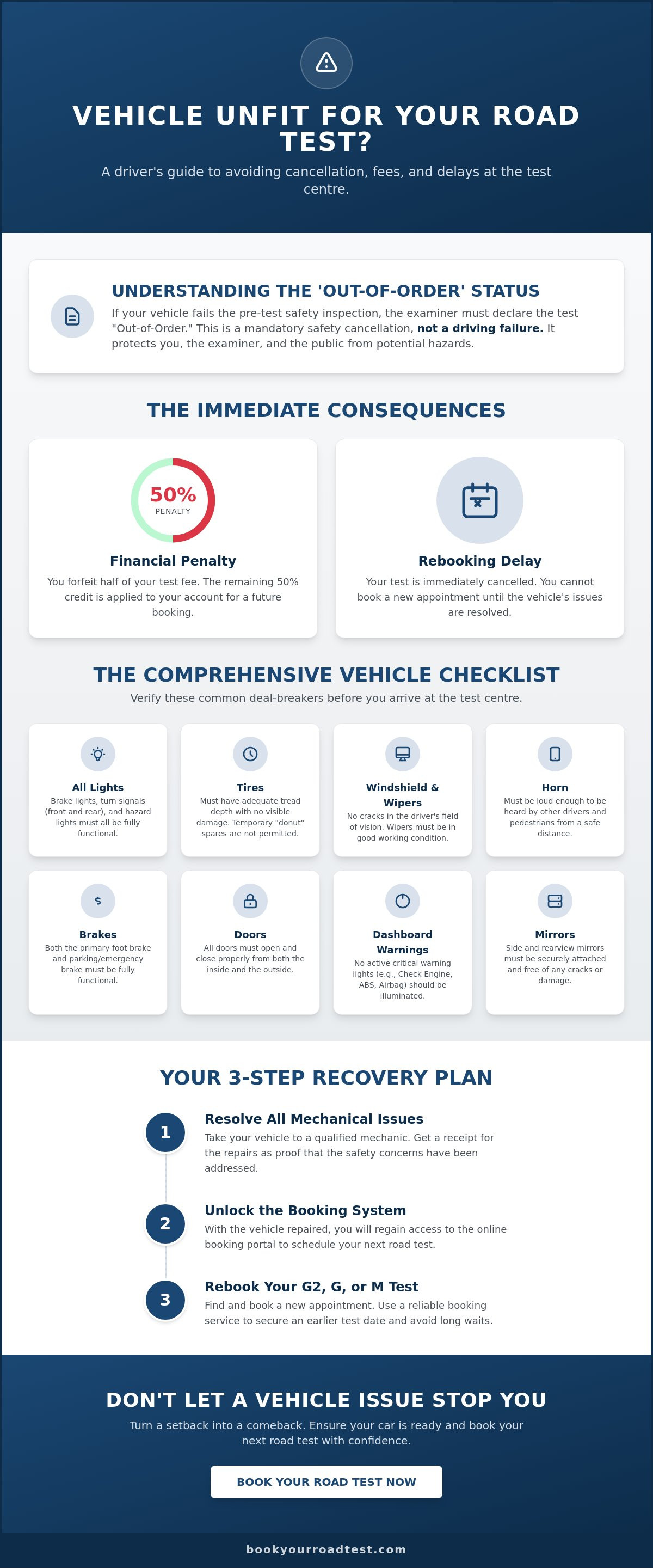
When you arrive at the examination centre, the first hurdle isn't the traffic; it is the vehicle inspection. If your car fails to meet the Ministry of Transportation (MTO) safety standards, the examiner will declare the test "Out-of-Order." This technical status is a mandatory cancellation that stops the process before you even leave the parking spot. While it feels like a major setback, understanding what happens if my car is not suitable for road test day helps you navigate the situation without unnecessary panic. The examiner's priority is the safety of the applicant, the public, and themselves.
The immediate outcome is that the test is cancelled, and no driving score is recorded on your file. This is a crucial distinction to realize. You haven't "failed" the test in the traditional sense. Instead, you have encountered an administrative cancellation. It doesn't reflect your ability to drive, but it does mean the session cannot proceed until the vehicle issues are resolved. Knowing what happens if my car is not suitable for road test protocols helps you stay calm while you focus on the next steps. This status protects you from attempting manoeuvres in a vehicle that might compromise your safety or the safety of the examiner.
The Role of the Driver Examiner
Driver examiners are trained to perform a rapid, systematic vehicle check to ensure the car is fit for purpose. They act as the final authority on vehicle safety for the duration of the exam. You will be asked to assist by activating turn signals, tapping the brake lights, and honking the horn. They also look for visible hazards like bald tires or significant windshield cracks. Their goal is not to be overly strict, but to follow a standardized rubric that ensures every vehicle on the road during a test meets a baseline of operational integrity. If the examiner determines the car is unsafe, they cannot legally proceed with the appointment.
Why Safety Standards are Non-Negotiable
A comprehensive Driving test overview reveals that practical exams require precise control during high-stress moments. You might be asked to perform an emergency stop or navigate a busy intersection. If your brake lights don't work or your tires lack grip, these tasks become dangerous. These safety rules are standardized to ensure every applicant is tested under the same rigorous conditions. Whether you are using your own car, a borrowed vehicle from a friend, or a rental, the requirements remain exactly the same. Consistency is key to maintaining provincial road safety standards for everyone.
The Comprehensive Vehicle Suitability Checklist
To avoid a sudden cancellation, you must ensure your vehicle meets specific mechanical standards. Understanding exactly what happens if my car is not suitable for road test day involves reviewing every major component of your vehicle before you arrive. If any part of the safety inspection fails, the examiner will stop the process immediately. This check is thorough and covers both the exterior and interior of the car.
All exterior lighting must be in perfect working order. This includes front and rear turn signals, brake lights, and hazard lights. If a single bulb is burnt out, the examiner cannot verify your intentions on the road. Examiners also inspect your tires for minimum tread depth and visible damage like bulges or deep cuts. You cannot use a temporary "donut" spare tire for any road test; the vehicle must have four full-sized tires with adequate traction.
Visibility is non-negotiable for a safe exam. A crack in the driver's direct field of vision or non-functional wipers will result in an immediate rejection. You can find a detailed list of DMV vehicle requirements that mirrors the rigorous standards used in Canadian centres. Both your primary foot brake and your emergency or parking brake must function correctly. If your parking brake is located in the centre console, the examiner must be able to reach it easily to intervene if a dangerous situation arises.
Common Mechanical Deal-Breakers
Dashboard warning lights are often overlooked but are critical during the pre-test check. An active "Check Engine" or "ABS" light suggests a potential mechanical failure that could occur during the test. Your horn must be loud enough to be heard from a distance, and all mirrors must be secure and free of cracks. Both the driver and passenger doors must open and close from both the inside and outside to ensure a safe exit in an emergency. If a door handle is broken, the test will not proceed.
Interior and Aesthetic Requirements
Seatbelts must be accessible and latch securely for both the applicant and the examiner. Excessive window tinting that obscures the driver's face or prevents the examiner from seeing your eye movements is a common reason for rejection. Knowing what happens if my car is not suitable for road test appointments saves you time; keep the interior clean and free of clutter. While a little dust is fine, an excessively dirty cabin or a car filled with loose trash can lead to a refusal. If you find your vehicle isn't ready and you need to reschedule, you can use a road test cancellation finder to secure a new date once your repairs are complete.
The Financial and Time Consequences of a Rejected Vehicle
A vehicle rejection is more than just a minor inconvenience; it carries direct financial impacts that can disrupt your budget. If you are wondering what happens if my car is not suitable for road test day, the primary impact is a monetary penalty. Most jurisdictions, including Ontario, apply what is commonly known as the "50% Rule." Under this policy, the Ministry retains half of your original road test fee to cover the administrative costs and the examiner's allocated time. This is a non-negotiable charge that applies the moment the vehicle is declared out-of-order.
The remaining 50% of your fee typically stays on your record as a credit for your next attempt. While you don't lose the entire amount, you'll be required to pay the outstanding balance to bring your account back to a full test fee before the booking system allows you to schedule a new date. Beyond these official government charges, you must also consider the "hidden" costs of a rejection. These include lost wages from taking a day off work, the expense of a car rental if you used a third-party vehicle, and the fuel costs associated with travelling to the centre. When these factors are combined, a simple mechanical oversight becomes an expensive mistake.
Managing Your Test Fees
Verify the specific credit or refund policy for your province before you leave the examination centre. While the 50% credit is standard in many areas, some third-party testing sites may have different administrative structures. Always keep your original receipt as physical proof of the remaining credit on your account. This fee is a government-mandated charge for the examiner's time and cannot be waived due to vehicle neglect. Having your documentation organized ensures that your financial transition to a new appointment is as smooth as possible.
The Hidden Cost: The Rebooking Waitlist
Time is often the most significant loss after a vehicle rejection. Road test centres are frequently booked months in advance, and a cancellation puts you back at the start of the waiting process. You cannot typically rebook on the spot; most systems require a mandatory wait period before you can even access the calendar again. This delay is particularly stressful if you need your license for a time-sensitive job offer or school commute. Using a road test cancellation finder ontario can significantly mitigate this time loss by scanning for earlier openings that appear due to other cancellations. Understanding what happens if my car is not suitable for road test protocols allows you to budget for both the time and expense of a second attempt while seeking out strategic ways to get back on the road sooner.
How to Prevent a Cancellation on Test Day
Preparation is the only way to avoid the administrative headache of an out-of-order status. Knowing exactly what happens if my car is not suitable for road test day should encourage you to perform a "Pre-Test" at least 48 hours before your appointment. This window gives you enough time to visit a mechanic or an auto parts store if you discover a burnt-out signal bulb or a worn wiper blade. A simple walk-around inspection can save you from losing half your fee and waiting weeks for a new slot.
Conduct a second check the morning of your exam. Do this in the parking lot of the testing centre. It is common for a light to fail during the drive to the facility; catching it five minutes before your check-in time might allow you to borrow a vehicle from a friend or family member who drove you there. Ensure your vehicle registration and insurance are physically present and valid. Examiners often refuse to look at digital copies on a phone, so having the original pink slip and permit is essential for a smooth start. If your paperwork is expired or missing, the test will be cancelled immediately.
Consider a "Backup Car" strategy if your primary vehicle has a persistent issue like a cracked windshield or a temperamental parking brake. Having a secondary vehicle on standby can be a lifesaver. If you realize your current vehicle won't pass inspection, it is better to find a replacement early rather than risking a rejection at the curb. This proactive approach ensures that your focus remains on your driving skills rather than mechanical anxiety.
Borrowing or Renting a Vehicle
Borrowing a car from a relative is a common solution, but you must perform the same rigorous safety check on their vehicle as you would on your own. Don't assume their car is perfect just because it is newer. Rental cars are also an option, provided the rental agreement does not have clauses that prohibit unlicensed drivers or use for a driving exam. If you are preparing for a motorcycle licence, ensure the bike meets the specific criteria for your M2 road test booking class. Using a vehicle that doesn't match your testing class will lead to an automatic cancellation.
Professional Help: The Driving Instructor's Advantage
Using a driving school vehicle is one of the most reliable ways to prevent a technical rejection. These cars are maintained to high standards specifically to meet examiner expectations. Many instructors provide vehicles equipped with dual-brake systems, which examiners prefer because they offer an extra layer of safety. This professional edge significantly reduces the stress of a potential rejection. If you want to ensure your vehicle and paperwork are in perfect order, you can book your road test today through a service that understands these strict requirements and helps you navigate the scheduling process with ease.
Your Recovery Plan: Rebooking Quickly After a Rejection
Fixing the mechanical fault is your first priority. Whether it was a burnt-out brake light or a significant crack in the windshield, obtain a receipt for the repair to show you've addressed the examiner's specific concerns. Once the vehicle is safe, you must pay the remaining 50% of the government fee to unlock the booking system. Without this payment, your account remains restricted, and you won't be able to view or select any available dates. This is a critical part of what happens if my car is not suitable for road test day; the system won't let you move forward until the administrative debt is settled.
Don't settle for the first date you see if it's four months away. Many drivers realize that staying flexible with their location can lead to a much faster appointment. If your local centre is fully booked, check nearby towns or cities within a reasonable driving distance. A short trip to a different examination centre could save you weeks of waiting. Staying organized and acting quickly ensures that the technical rejection becomes a minor speed bump rather than a long-term roadblock.
Why Manual Rebooking is Frustrating
The official booking portal requires constant manual refreshing to catch newly opened slots. Because cancellations happen at random times, they are often snapped up in seconds by other lucky searchers or automated systems. It's a competitive environment that turns a simple task into a source of ongoing stress. Your time is valuable, and spending hours every day staring at a loading screen is rarely the most efficient way to secure your licence. Realize that administrative help can simplify this process and remove the guesswork from your recovery plan.
The Book Your Road Test Advantage
Our service actively monitors for cancellations across more than 60 centres, so you don't have to stay glued to your computer. We act as a professional facilitator to help you navigate administrative fees and scheduling challenges across the province. Whether you are looking for a G2, G, or M road test, our proprietary search tool identifies openings the moment they become available. We understand the urgency of your situation and provide a transparent, reliable way to bypass the standard wait times. Don't wait months to try again—book your road test now and get back on the road with confidence. Understanding what happens if my car is not suitable for road test requirements is the first step, but taking action with the right support is what ultimately gets you your licence.
Get Your Driving Goals Back on Track
A vehicle rejection at the testing centre is a setback, but it's one you can quickly overcome with the right strategy. By following a rigorous safety checklist and performing a morning-of inspection, you protect your test fees and your schedule. Understanding exactly what happens if my car is not suitable for road test appointments allows you to manage the 50% fee penalty and administrative requirements with transparency and poise. This knowledge turns a technical delay into a manageable step in your licensing journey.
You don't need to wait months for a new opening or spend hours refreshing the official portal. We provide an automated cancellation finder that monitors more than 60 DriveTest centres to find you an earlier date. Our simplified administrative process handles the scheduling for G2, G, and M licence types, ensuring you can focus on your driving skills instead of logistics. Skip the wait and find an earlier road test date today. You've done the hard work of practicing; now let us handle the scheduling so you can secure your licence and move forward with confidence.
Frequently Asked Questions
What happens if my brake light goes out right before the test?
Your road test will be cancelled immediately if a brake light is non-functional. Examiners perform a full light check before the session begins to ensure safety. If you can't replace the bulb on the spot, the appointment is marked "Out-of-Order," and you'll need to reschedule after fixing the issue.
Can I use a rental car for my G2 or G road test?
You can use a rental car, but you must bring the official rental agreement and proof of insurance. Ensure the contract doesn't explicitly prohibit use for a road test. Some companies have specific clauses for learner drivers, so it's vital to confirm these details at the rental counter before arriving at the centre.
Will a cracked windshield always result in a cancelled road test?
A cracked windshield results in a cancellation if the damage is in the driver's field of vision or is severe enough to be unsafe. Small chips or cracks on the passenger side may be overlooked, but the final decision rests entirely with the examiner. It's best to repair any significant cracks to avoid an administrative delay.
Do I lose my entire test fee if my car is rejected?
You don't lose the full amount, but you will forfeit 50% of the road test fee as a penalty. This charge covers the examiner's time and the administrative costs of the cancelled appointment. The other half remains as a credit on your account, which you can apply toward your next booking once you pay the remaining balance.
Can I borrow a friend's car if mine is not suitable?
Borrowing a vehicle is a great backup plan if your own car fails to meet Ministry standards. Just ensure the friend's car is in perfect working order and that you have the physical registration and insurance documents. Many drivers wonder what happens if my car is not suitable for road test day, and having a reliable borrowed car is a primary solution.
What are the most common reasons a vehicle is declared out-of-order?
The most frequent reasons include burnt-out bulbs, bald tires, and non-functional parking brakes. Examiners also look for doors that won't open from the inside or outside. If any of these safety features fail, the vehicle is declared out-of-order to protect everyone involved in the practical exam.
How soon can I rebook my road test after a vehicle rejection?
You can rebook as soon as your account balance is settled, but finding a new date manually often takes months. Because centres are frequently at capacity, you may need to look at different locations or use a specialized search tool. This is a common part of what happens if my car is not suitable for road test scenarios where time is a major factor.
Is a 'Check Engine' light an automatic failure for a road test?
Yes, a 'Check Engine' light is typically an automatic reason for rejection. Examiners view dashboard warning lights as signs of potential mechanical instability. To ensure the safety of the applicant and the public, the vehicle must be free of active warning lights before the examiner will agree to enter the car and begin the test.


