
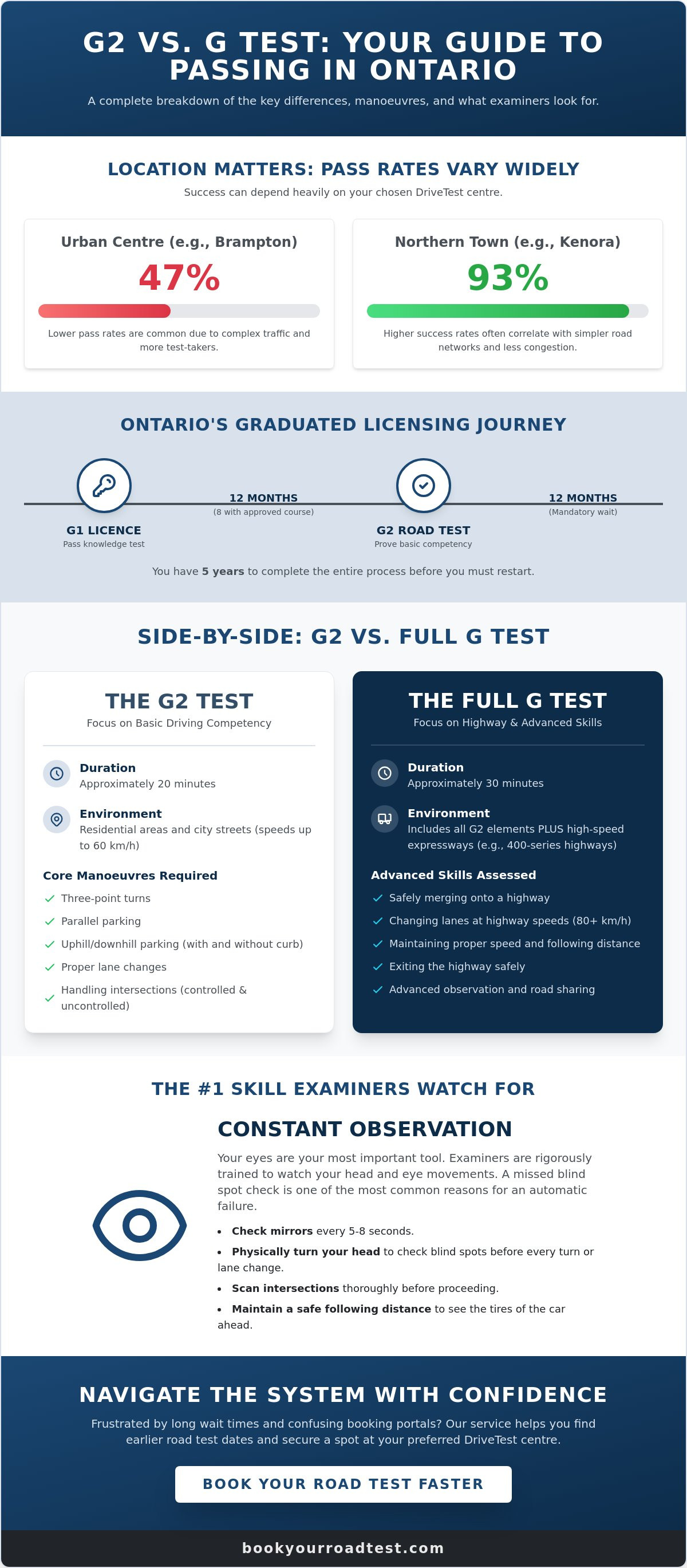
Did you know that the G2 pass rate in Brampton is as low as 47 percent, while northern towns like Kenora see success rates as high as 93 percent? These statistics highlight why understanding the essential g test vs g2 test differences is so vital for your success. You likely feel the pressure of looming licensing deadlines or the anxiety of merging onto a high speed highway for the first time. It's completely normal to feel frustrated by long wait times and the technical requirements of the Ministry of Transportation.
This guide clarifies exactly what examiners look for so you can approach your appointment with absolute confidence and pass on your first attempt. While the G2 test focuses on your ability to control a vehicle in residential areas, the full G test evaluates how well you share the road at higher speeds. We'll break down the specific manoeuvres required for each level, explain the highway components in detail, and share professional strategies to help you book a test date faster.
Key Takeaways
- Identify the primary focus of the G2 road test on residential competency compared to the Full G test's emphasis on advanced expressway skills.
- Learn the specific g test vs g2 test differences in manoeuvres, including why the G test requires higher-speed merging and lane changes.
- Discover why advanced observation and frequent mirror checks are the most critical factors examiners look for during the final licensing stage.
- Gain actionable strategies for navigating the administrative hurdles of booking your road test date efficiently at a DriveTest centre.
Ontario’s Graduated Licensing System: G2 vs G Test Basics
Ontario uses a stepped approach to driving. It's called Ontario’s Graduated Licensing System. This system makes sure you gain experience before hitting major routes like the 401 or the QEW. The transition from a G1 to a full G involves two distinct road tests. Understanding the g test vs g2 test differences is the first step toward securing your full freedom on the road.
The G2 road test is your first vocational exam. It allows you to drive alone on all Ontario roads. The G test is the final step to becoming a fully licensed driver. Both exams require you to bring a safe, roadworthy vehicle and your current licence. Your car must have working signals, brake lights, and a functional horn. While the G2 test usually takes about 20 minutes on local streets, the G test is longer and includes high-speed expressways.
Level One vs. Level Two Licensing
The G2 is a probationary period. You have freedom, but significant rules apply. You must maintain a zero blood alcohol level and no cannabis in your system. If you are 19 or under, you face nighttime passenger restrictions for the first six months. Achieving full G status removes these novice limitations. It also helps lower your insurance premiums. You have a five-year window to complete the entire process. If you don't finish by the expiry date, you may have to restart from the beginning.
The Mandatory Waiting Periods
You cannot rush your way through the system. The Ministry requires a 12-month wait after your G1 before you can attempt the G2 test. You can reduce this to 8 months by finishing a government-approved Beginner Driver Education course. Once you earn your G2, you must wait another 12 months before taking the G test. There is no way to shorten this second gap. Planning for these mandatory waits is a key part of understanding g test vs g2 test differences. These periods ensure you have enough experience to handle everything from city parallel parking to merging into fast-moving highway traffic.
The G2 Road Test: Proving Your Basic Driving Competency
The G2 road test serves as your first major hurdle in Ontario's licensing journey. Unlike the final exam, this test focuses almost exclusively on residential areas and city streets where speed limits rarely exceed 50 or 60 km/h. You have approximately 20 minutes to demonstrate that you can safely operate a vehicle without a supervisor. Examiners aren't just looking for your ability to steer. They monitor your g test vs g2 test differences in terms of city-specific safety. If you demonstrate smooth vehicle handling and strict adherence to every stop sign, you'll earn the right to drive alone on all provincial roads.
Core Manoeuvres You Must Master
To pass, you must execute several technical tasks with precision. The three-point turn requires you to maintain control in tight spaces while showing constant awareness of your surroundings. Parallel parking is another high-stakes requirement. You must park within a reasonable distance from the curb without hitting the vehicles behind or in front of you. Hill parking also appears on the checklist. You need to know exactly which way to turn your wheels when facing uphill or downhill, both with and without a curb, to prevent the car from rolling into traffic.
Observation and Right-of-Way
Technical skills are important, but your eyes are your best tool. The blind spot check is often cited as the most common reason for G2 failure. You must physically turn your head to check your shoulders before every lane change or turn. Examiners also watch how you handle uncontrolled intersections and whether you yield correctly to pedestrians. Maintaining a safe following distance is essential. In city traffic, you should always see the rear tires of the vehicle in front of you when stopped. If you're feeling anxious about these requirements, you can use a G2 road test booking service to find a date at a location where you feel most comfortable.
Passing this level is about proving you aren't a danger to yourself or others in low-speed environments. While the G2 allows you to drive on highways, the test itself stays within the city limits. This is one of the most significant g test vs g2 test differences you'll notice. Once you've mastered these basics, you'll be ready to start the 12-month countdown to your full G licence.
The Full G Road Test: Mastering the Highway and Advanced Skills
The G road test represents the final milestone in your journey toward full driving independence. It's a significantly more comprehensive exam than the G2, typically lasting about 30 minutes from start to finish. This additional time allows the examiner to observe your behaviour in more demanding and complex environments. The primary addition to this exam is the evaluation of high-speed expressway driving. You will be expected to navigate multi-lane highways where speed limits are 100 kilometres per hour. This is where many drivers feel the most pressure. It's no longer just about car control; it's about your ability to safely integrate into fast-moving traffic.
Expressway and Highway Requirements
Merging is the most critical skill tested during this stage. You must reach the flow of traffic speed, which is usually 100km/h, before you leave the acceleration lane. Many applicants fail because they merge too slowly, which forces other drivers on the highway to brake or change lanes. This is a major safety violation. Lane changes at high speeds also require impeccable awareness. You need to signal early, check your mirrors, and perform a clear shoulder check before moving your vehicle. When exiting the highway, you must maintain your speed until you've fully entered the deceleration lane. Braking too early on the highway itself can obstruct following vehicles and lead to a deduction or failure. These high-stakes highway actions represent the most significant g test vs g2 test differences you will encounter.
Advanced Hazard Perception
By the time you take your G test, basic car control is expected to be second nature. The examiner is now looking for advanced hazard perception and proactive scanning. You must show that you're scanning the road 15 to 20 seconds ahead at all times. This involves looking for brake lights in the distance, identifying merging vehicles, or spotting potential hazards like road debris long before they become an immediate problem. You're demonstrating defensive driving. It's about being proactive rather than reactive. In busy urban centres or at complex multi-lane intersections, your ability to anticipate the actions of other drivers is what earns you a full licence. You must show that you can handle higher traffic volumes without hesitation or confusion.
During periods of high demand at DriveTest centres, you might hear this exam referred to as the "G2 Exit" test. While the Ministry of Transportation occasionally modifies specific city manoeuvres, such as parallel parking or three-point turns, to manage higher volumes, the highway component remains the central focus. You must be prepared for a rigorous evaluation of your expressway skills regardless of the current testing format. Passing the G test proves you've moved beyond the basics and possess the maturity to handle any road condition in Ontario. It's the final step that removes your novice status and provides the ultimate peace of mind for your daily commute.
Side-by-Side Comparison: Manoeuvres, Duration, and Expectations
Visualizing the exact g test vs g2 test differences helps eliminate the mystery surrounding your final exam. While the G2 test proves you can handle a vehicle in low-stakes environments, the G test confirms you are a safe driver at high speeds. The scoring sheets reflect this shift. In a G2 exam, the examiner focuses heavily on technical accuracy during parking and basic road signs. By the G road test, they expect these skills to be automatic. They shift their clinical focus to your situational awareness and decision-making speed. You are no longer just being tested on what you do, but on how you perceive the risks around you.
The administrative structure of the exams also varies. A G2 test is a brisk 20-minute evaluation of city basics. The full G test extends to 30 minutes to accommodate the highway portion and a broader range of traffic scenarios. Fail points differ significantly between the two levels. At the G2 level, common mistakes include hitting a curb during parallel parking or failing to come to a complete stop at a red light. On the G test, failures often stem from merging at 80 km/h instead of 100 km/h or failing to check mirrors every five to eight seconds. To ensure you're ready for these specific challenges, you can book your G road test at a centre that fits your schedule and comfort level.
Manoeuvre Breakdown: What Stays and What Goes
Many drivers wonder which technical tasks carry over from their first exam. The G test often skips parallel parking or three-point turns if your previous record and initial city driving show mastery of these skills. Instead, the focus shifts from stationary parking to active lane management and precise speed control. The G test is an evolution of your driving skills rather than a simple repeat of your previous exam. You are being judged on your ability to coexist with high-speed traffic rather than just navigating a quiet residential cul-de-sac. Examiners look for "smoothness" in your transitions between city streets and expressways.
Route Complexity and Speed
Speed is the most obvious differentiator in the graduated system. G2 routes strictly stay within 40 to 60 km/h zones where you have more time to process your surroundings. In contrast, G routes require you to reach 100 km/h quickly and safely on short on-ramps. This higher speed means your expected response times are much shorter. You have less time to react to a sudden brake light or a vehicle merging into your path. The G test also involves more multi-lane left turns and frequent lane changes in heavy traffic. Your ability to maintain a consistent speed while performing shoulder checks is a hallmark of a fully licensed driver.
Booking Your Success: Strategies for G and G2 Test Dates
Finding an available appointment at a DriveTest centre often feels like the most difficult part of the licensing process. Many drivers wait until the very last minute to book their final exam, only to realize that wait times can stretch for several months. To avoid the stress of a looming expiry date, you should look for a slot as soon as your 12-month G2 window opens. If your licence is set to expire before you can secure a date, the Ministry may grant a temporary extension if you have a test already booked. This administrative hurdle is one of the practical g test vs g2 test differences you must manage. While G2 tests are more frequent, G tests often have tighter availability due to their longer duration and highway requirements.
Beating the Wait Times
The standard booking portal often shows no availability for weeks or months. You can bypass this frustration by using a road test cancellation finder Ontario to secure an earlier date. This tool monitors the system for slots that open up when other applicants reschedule. Being flexible with your location is another effective strategy. If you're willing to drive to a nearby town or a different regional centre, you'll often find openings much sooner. Monitoring the system for last-minute openings requires patience, but it's the most reliable way to skip the queue and get your licence faster.
Final Preparation Checklist
Your booking is only successful if you actually get to take the test. Many applicants are turned away because their vehicle fails a basic safety inspection on-site. Before you arrive, check that all tires have proper tread, signals are bright, and the windshield is free of major cracks. You must also ensure you have the correct administrative fees ready. Whether you're handling an m2 road test booking or a standard G test, being financially prepared prevents last-minute delays. Arrive at the centre at least 30 minutes early. This gives you enough time to check in at the kiosk and settle your nerves before the examiner joins you in the car.
Understanding the g test vs g2 test differences extends beyond the road itself. It includes knowing how to navigate the scheduling system and preparing for the administrative expectations of the DriveTest staff. Third-party booking services act as a professional concierge during this high-anxiety period. They handle the search for cancellations and manage the technical side of the booking so you can focus entirely on your driving skills. With the right strategy and early planning, you can secure your test date and move toward your full G licence without unnecessary delays.
Take the Next Step Toward Your Full G Licence
Mastering the g test vs g2 test differences is about more than just passing a single exam; it's about becoming a safe and predictable driver for the long term. You now understand that while the G2 test evaluates your city street competency, the full G test requires you to demonstrate advanced awareness on high-speed expressways. Success depends on your ability to maintain consistent observation and execute precise merges under pressure. It's the final hurdle in your graduated licensing journey, and preparation is your best tool for success.
Administrative delays shouldn't stand between you and your driving freedom. We provide support for over 60 DriveTest centres across Ontario and offer a specialized cancellation finder to help you secure earlier dates. Our service ensures stress-free administrative handling so you can focus entirely on your road skills and preparation. We act as your professional concierge to navigate the Ministry's scheduling complexities on your behalf.
Book Your Road Test Date Now to finalize your licensing requirements. You have the knowledge and the strategy to succeed on your first attempt. We're here to help you cross the finish line with confidence and get you on the road sooner.
Frequently Asked Questions
Is the G road test harder than the G2 road test?
The G road test is considered more comprehensive rather than strictly harder. While the G2 test focus is on basic car control in residential areas, the G test evaluates your ability to handle high-speed environments. You must demonstrate that you can safely merge and change lanes at 100 km/h. Many drivers find the G test more stressful due to the highway component, but the technical manoeuvres are often simpler if you've already mastered the G2 requirements.
Does the G test include parallel parking?
Yes, the full G test can include parallel parking, though the Ministry sometimes modifies the route during high-demand periods. This is one of the common g test vs g2 test differences that depends on current DriveTest protocols and regional traffic volumes. You should always be prepared to perform a parallel park, three-point turn, and emergency stop just in case the examiner includes them in your specific evaluation.
What happens if my G2 licence expires before I can take my G test?
If your G2 licence expires before your test date, you may be eligible for a one-time extension if you have an appointment already booked. If you don't book a test and your licence expires, you will likely have to restart the graduated licensing process from the beginning. It's vital to monitor your five-year deadline and understand the g test vs g2 test differences in booking availability to ensure you secure a slot before your driving privileges end.
Can I take my G test in my own car?
You can absolutely use your own vehicle for the G test as long as it's roadworthy and meets all provincial safety standards. The examiner will conduct a basic inspection of your brake lights, signals, and horn before the test begins. If your vehicle has a mechanical issue, such as a non-functional signal or a major windshield crack, the examiner will cancel the test and you'll lose a portion of your fee.
How many times can I fail the G2 or G road test?
There is no official limit to how many times you can attempt the G2 or G road tests in Ontario. However, you must pay the applicable fee for every retake and wait at least 10 days between attempts. If you fail multiple times, it's often helpful to practice in a different region or use a service to find a centre with higher pass rates to build your confidence.
What is the highway speed requirement for the G test?
The highway speed requirement for the G test is typically 100 km/h, or the posted speed limit for the specific expressway on your route. You are expected to reach this speed on the acceleration lane before merging with traffic. Merging too slowly is a frequent reason for failure because it creates a safety hazard for other high-speed drivers who are forced to brake or swerve.
Do I need to bring my own vehicle for the Ontario road test?
Yes, you must provide your own vehicle for any Ontario road test. DriveTest centres do not have vehicles available for rent or use during the exam. Most applicants use their personal car, a family member's vehicle, or a car provided by a driving school. Ensure the vehicle is fully insured and that you have the ownership documents available if the examiner asks to see them.
How much does it cost to book a G vs G2 road test?
The cost depends on your current licence level and whether it's your first attempt. A G road test attempt costs $91.25. If you are retaking your G2 test after the initial attempt included in your G1 package, the fee is $53.75. These official Ministry fees are separate from any service charges associated with using a professional booking concierge to find earlier dates or manage your appointment scheduling.


