

What if the most stressful three minutes of your G2 road test could actually be the easiest part of your day? It is a common fear for many new drivers in Ontario. You might worry about hitting the curb on a narrow residential street or feel confused about exactly when to signal while traffic watches you. This three point turn g2 test guide is designed to replace that anxiety with a repeatable, professional process that satisfies both the examiner and the new AI-driven evaluation software introduced in 2026.
We understand that you want to pass your test on the first try without the frustration of retake fees or long wait times. This guide provides a clear roadmap to mastering the manoeuvre with clinical precision. You will learn the exact observation patterns required, the three distinct steps of the turn, and the common pitfalls that cause most students to lose marks. By following this structured approach, you will realize how to perform the turn smoothly and safely, ensuring you stay on track to secure your licence with confidence.
Key Takeaways
- Learn why the examiner prioritizes 360-degree awareness over steering speed to ensure you demonstrate maximum safety during the manoeuvre.
- Master the three distinct phases of the turn, including how to use side mirrors as precise visual markers for curb distance.
- Avoid the "Silent Fail" by implementing exaggerated head movements and consistent signaling throughout every stage of the sequence.
- Use this three point turn g2 test guide to find practice zones that accurately mimic the narrow residential streets used during the actual evaluation.
- Identify how securing a timely appointment through a professional booking service prevents skill fade and maintains your test-day readiness.
What is a Three-Point Turn and Why is it on the G2 Test?
Many students view the three-point turn as a technical hurdle, but it is actually a fundamental safety check. To answer the basic question, What is a three-point turn? It is a method used to reverse the direction of your vehicle in a restricted space, typically on a narrow road where a U-turn is impossible. It requires three distinct movements: a forward left turn, a reverse right turn, and a final forward left turn. While the mechanics are simple, this three point turn g2 test guide focuses on the high-level observation skills examiners demand. Mastering this manoeuvre shows you can safely manage the vehicle in residential or low-traffic environments where precision is required.
The Purpose of the Manoeuvre
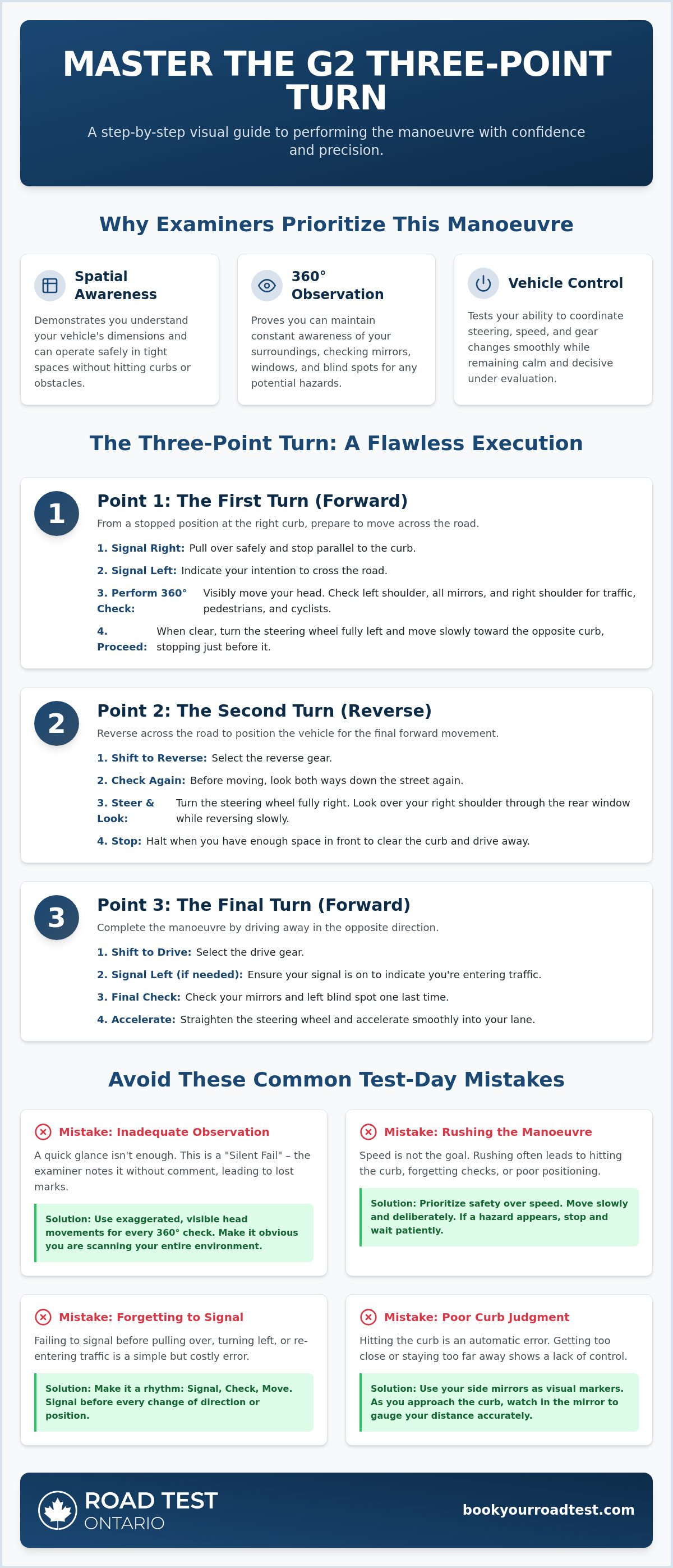
The Ministry of Transportation includes this task to evaluate more than just your steering ability. It serves as a comprehensive test of your spatial awareness. You must prove you understand the physical dimensions of your vehicle to avoid hitting curbs or obstacles. Additionally, the manoeuvre forces you to coordinate multiple actions at once. You are required to manage signals, mirrors, and blind-spot checks while keeping the car in motion. Examiners are specifically looking for your ability to maintain 360-degree awareness. If a hazard appears, your decision-making process is under the microscope. They want to see that you can identify a car or pedestrian entering your "turn zone" and react with appropriate patience. This level of control is vital for safely navigating Ontario's residential streets where unpredictable obstacles often occur.
When the Examiner Will Ask for It
You can generally expect this request during the first half of your G2 road test. Examiners typically choose quiet, residential streets that offer enough width to complete the turn safely. They will avoid areas with busy intersections or hidden driveways to ensure the environment is controlled. The specific instruction you will hear is: "When it is safe, please perform a three-point turn and head back the way we came." This is your cue to begin your observation sequence immediately. Speed is never the goal. In fact, rushing the turn often leads to missed checks or poor positioning. By following this three point turn g2 test guide, you will realize that the examiner prioritizes your ability to spot hazards over how tight or fast you can spin the wheel. They are assessing your composure. A driver who stops to let a cyclist pass before continuing the turn demonstrates much better judgment than one who tries to finish the move before the cyclist arrives.
Step-by-Step Guide: Executing the Perfect Turn
Executing a flawless turn requires a specific rhythm of observation and action. While many students focus on steering, the examiners are primarily watching your eyes. This three point turn g2 test guide breaks the process into four manageable phases to ensure you don't miss a single check. You must demonstrate that you are the most observant person on the road. If you feel ready to demonstrate these skills, you can use our G2 road test booking service to find an earlier appointment and avoid skill fade during long wait times.
Phase 1 & 2: The Approach and First Cut
Start by signaling right to indicate you are pulling over. Check your mirrors and your right blind spot before coming to a stop parallel to the curb. Once stopped, signal left. This is the most critical moment for your score. You must perform a full 360-degree check. This is not a quick glance; it is a systematic scan from your left shoulder, through your mirrors, to your right shoulder. Only when the road is completely clear should you turn the steering wheel sharply to the left and move across the road toward the opposite curb. Stop just before your front bumper reaches the edge of the pavement.
Phase 3 & 4: Reversing and Completing
Shift the vehicle into reverse. Before the car moves an inch, look both ways down the street again. This is a required driving test maneuver that demands constant vigilance during every gear change. Turn the steering wheel sharply to the right while backing up. You should look over your right shoulder while reversing to maintain a clear view of the road behind you. Stop once you have enough room to clear the curb in front of you. Finally, shift to drive, straighten the wheels, and perform one last mirror check before accelerating smoothly in your new direction.
- Rhythm: Always signal before you move.
- Observation: Move your head visibly during every 360-degree check so the examiner sees your effort.
- Control: Keep your speed low; a slow car is easier to steer accurately in tight spaces.
- Safety: If a car approaches while you are mid-turn, stop and wait for them to pass or for the examiner to give further instructions.
Common Pitfalls: Why Most Students Lose Marks
Passing the G2 road test requires more than just knowing the technical steps; it requires avoiding the subtle errors that examiners track on their score sheets. Many candidates perform the movements correctly but lose marks on procedural details. For instance, failing to signal at the start or the very end of the manoeuvre is a frequent point deduction that adds up quickly. While a light touch of the curb might only result in a minor mark, hitting the curb with force is an automatic disqualification. This is considered a major error because it suggests a lack of vehicle control. By studying this three point turn g2 test guide, you can identify these risks and build the habits necessary to avoid them during your 20 to 30-minute evaluation.
The '360-Degree Check' Mistake
A 360-degree check is a continuous scan of all four quadrants of the vehicle. This is often where the "Silent Fail" occurs. Examiners are trained to look for active head movement rather than just eye movement in the mirrors. If you only use your mirrors, the examiner cannot verify that you have actually checked your blind spots. They want to see your chin move toward your shoulder. Many students suffer from "tunnel vision" where they focus so intensely on the steering wheel or the curb that they forget the world around them. This lack of awareness is a significant red flag. You must prove you are still monitoring the environment even while concentrating on how to make a three-point turn accurately.
Handling Live Traffic Mid-Turn
One of the most stressful scenarios is when a car appears while you are perpendicular to the road, blocking both lanes. Most guides don't explain how to handle this, leading to panic and poor decisions. If a vehicle approaches, your first instinct should be to stop. Do not try to rush the move to get out of the way. Rushing often leads to climbing the curb or forgetting your final observation checks. Instead, make eye contact with the other driver. This helps you realize who has the right of way and signals to the examiner that you are in control of the situation. You should wait for the other driver to pass or for them to clearly wave you through before completing the move. Demonstrating patience in this moment shows the examiner that you prioritize safety over speed, which is exactly what they are looking for in a three point turn g2 test guide and on the actual road test.
- The Signal Trap: Always cancel your signal after pulling over and start a new one before moving across the road.
- Curb Awareness: Use your side mirrors to judge distance, but never rely on them exclusively.
- Blocking Traffic: Do not start the turn if a car is already close; wait for a clear gap of at least one block in both directions.
Practice Strategies and Test-Day Readiness
Mastering the mechanics of the turn is only half the battle; the other half is developing the muscle memory to perform under pressure. This three point turn g2 test guide emphasizes that consistent repetition in realistic environments is the only way to eliminate test-day nerves. You should begin your sessions by identifying visual markers that work for your specific vehicle. For example, many drivers find that when the bottom of their side mirror appears to "touch" the curb, they are at the ideal distance to stop. Using these references allows you to judge distance without constantly craning your neck, keeping your focus on the required 360-degree scans.
Weather is another factor you cannot ignore. If your test is scheduled for the winter or a rainy day in 2026, you must practise in those conditions. Wet pavement or snow-covered curbs change your visibility and your car's handling. To keep your head moving during the actual evaluation, develop a simple verbal checklist or "mantra" to say quietly to yourself: "Signal, scan, turn, reverse, scan, finish." This mental tool ensures you don't skip a critical observation step when the examiner is watching your every move.
Where and How to Practise
Choose wide, quiet residential streets without parked cars for your first few attempts. This allows you to focus on the steering rhythm without the fear of hitting another vehicle. As you improve, graduate to narrower streets to realize the exact turning radius of your car. Your goal should be to complete the entire manoeuvre in less than 30 seconds while maintaining perfect observation. If you find yourself struggling to find a local spot, scout the areas surrounding your specific DriveTest centre to find streets that mimic the actual test route.
Mental Preparation for the Examiner
Stay calm if the turn isn't perfect on your first try. Examiners allow for small corrections. It is always better to pause, shift gears, and adjust your position than it is to risk hitting the curb. A controlled adjustment shows maturity and vehicle control, whereas hitting the curb with force results in an immediate failure. If you feel you aren't quite ready after your practise sessions, reviewing your road test cancellation finder Ontario options is a smart way to manage your timeline while you continue to polish your skills.
Once you feel confident in your ability to execute the turn in any environment, it is time to lock in your appointment. You can use our G2 road test booking service to secure a slot at a centre that fits your schedule.
Securing Your Test Date with Confidence
Mastering the technical steps in this three point turn g2 test guide is a major milestone, but your preparation can be undermined by long wait times. Many students experience "skill fade" when they have to wait several months for an available appointment. This gap between practice and evaluation often leads to increased anxiety and a loss of muscle memory. Securing a date while your skills are fresh is the most efficient way to ensure success. If you are ready to test now, you shouldn't have to wait for the standard backlog to clear.
Booking Your G2 Test Simplified
Book Your Road Test acts as an autonomous administrative facilitator to help you navigate the scheduling process. We streamline the search for available slots at more than 60 DriveTest centres across Ontario, saving you the frustration of manual refreshes. Our service is designed for efficiency and transparency. While official MTO fees are standard, our service includes a convenience fee to manage the logistics and monitoring required to find earlier dates. This professional concierge approach is why many students prefer a third-party service to manage their m2 road test booking or G2 appointments. We provide the organization and reliability you need to focus entirely on your driving performance.
What to Bring to the Test Centre
Arriving prepared reduces stress and prevents administrative delays. You must bring a valid G1 licence and a vehicle that is in excellent working order. The examiner will check your lights, signals, and brakes before the test begins. If your vehicle has a mechanical defect, the test will be cancelled immediately and you will lose your fee. Additionally, you must be prepared to sign a "Declaration of Highway Driving Experience." This document confirms you have driven on highways with speed limits of at least 80 km/h on at least five occasions in the three months prior to your test. Having your documentation organized allows you to walk into the centre with the professional mindset required to pass.
By coordinating your booking with your peak performance level, you significantly increase your chances of passing on the first try. Use a reliable booking service to handle the logistics so you can stay focused on the road ahead.
Take the Final Step Toward Your Full G2 Licence
Mastering the three-point turn is about demonstrating safety and control rather than technical speed. By focusing on active head movements and maintaining 360-degree awareness, you prove to the examiner that you are ready for the responsibility of solo driving. This three point turn g2 test guide has outlined the exact steps and common pitfalls to ensure you avoid automatic disqualifications like hitting the curb or failing to signal. Consistency in your observation pattern is the key to passing on your first attempt.
Now that you have the knowledge, don't let long wait times lead to skill fade. We act as an independent third-party booking specialist to help you find earlier test dates through our proprietary cancellation finder. We serve over 60 centres across the province, handling the administrative logistics so you can focus on your final practice sessions. Book your G2 road test date now and move forward with the confidence that you have mastered every required manoeuvre. You have done the work; now it is time to secure your success on the road.
Frequently Asked Questions
Can I fail the G2 test if I hit the curb during a three-point turn?
You can fail the G2 test immediately if you hit the curb with significant force or climb over it. While a light touch during the manoeuvre might only result in a minor point deduction, any impact that suggests a lack of vehicle control is classified as a major error. Examiners prioritize your ability to judge the dimensions of your car accurately in tight spaces without making contact with the infrastructure.
How many points is a three-point turn worth on the G2 road test?
The three-point turn is not assigned a single point value but is evaluated across several scoring categories including observation, signalling, and vehicle control. Each error, such as failing to check a blind spot or forgetting a signal, results in a specific mark against you. Accumulating too many minor marks across the entire test will lead to a failure even if you complete the turn itself without a major error.
Do I need to use my signal for every part of the three-point turn?
You must use your turn signals at two specific points during the manoeuvre. First, signal right to indicate you are pulling over to the curb to begin the sequence. Second, you must signal left before you start the actual turn across the road. Failing to use these signals is one of the most frequent reasons for point loss mentioned in this three point turn g2 test guide.
What happens if a car comes while I am doing my three-point turn?
If a vehicle approaches while you are mid-turn, you should stop immediately and wait for the traffic to pass or for the other driver to wave you through. Do not attempt to rush the manoeuvre to clear the road. Examiners look for your ability to identify the hazard and react safely; stopping to prioritize other road users demonstrates the professional judgment they require for a pass.
Is a three-point turn required on the G test as well as the G2?
A three-point turn is a mandatory requirement for the G2 road test and is frequently requested during a full G road test as well. While the G test focuses heavily on highway driving and higher-speed environments, examiners still need to verify your basic car handling skills in residential areas. Maintaining proficiency in this manoeuvre is essential for progressing through both levels of Ontario's graduated licensing system.
How many seconds should a three-point turn take during the test?
There is no official time limit for a three-point turn, but it typically takes between 30 and 45 seconds to complete safely. The examiner is not timing you for speed; they are looking for a steady, controlled pace that allows for thorough observation. Rushing the process often leads to missed blind-spot checks, which is a much more serious error than taking a few extra seconds to be precise.
Can I use a backup camera during my three-point turn?
You are allowed to use a backup camera as an aid, but you must not rely on it exclusively. The examiner requires you to perform physical head checks and look over your shoulder while reversing. If you stare only at the camera screen during the three point turn g2 test guide evaluation, you will likely lose marks for inadequate observation of your surroundings, as cameras have significant blind spots.
What is the most common reason people fail the three-point turn?
The most common reason for failing this specific manoeuvre is inadequate observation, particularly the failure to perform a full 360-degree check before moving. Many students focus so much on their steering and the curb that they forget to scan the entire environment for pedestrians or other vehicles. Visible head movement is the only way to prove to the examiner that you are actively monitoring all four quadrants of the vehicle.


