
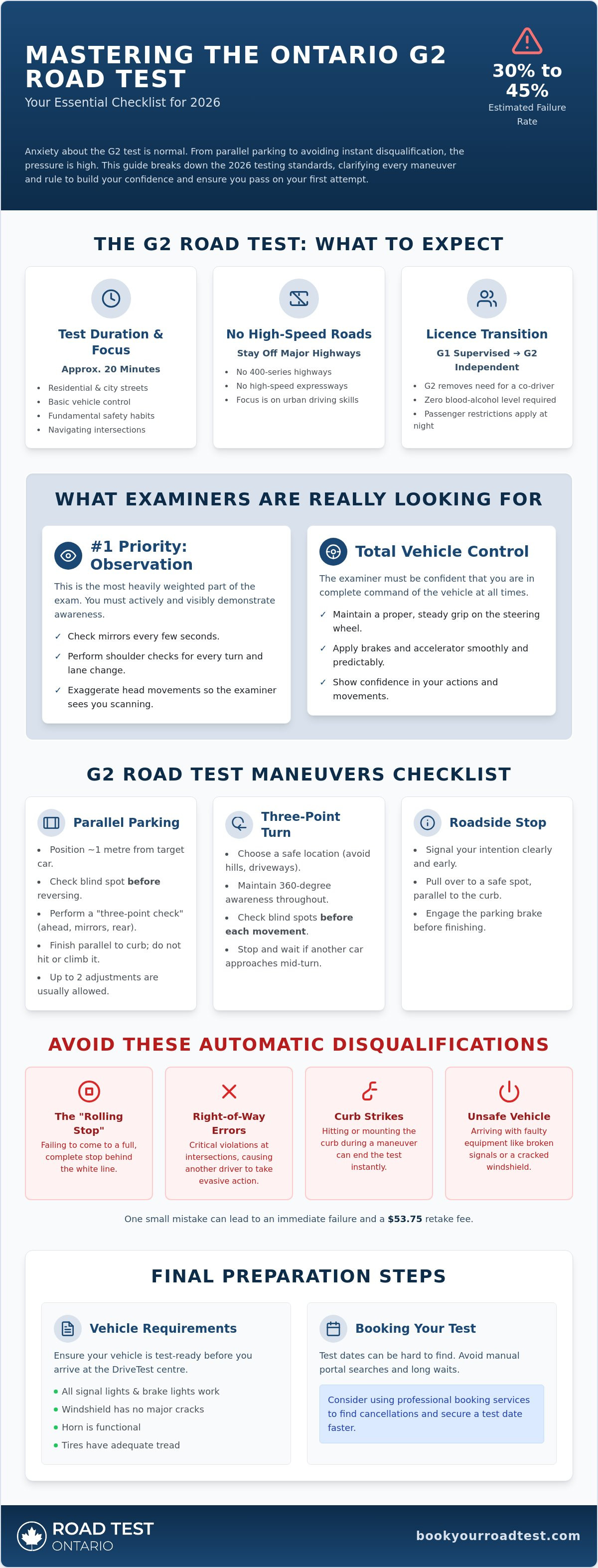
Did you know that failure rates for the G2 road test in Ontario are currently estimated to be between 30% and 45%? It's completely normal to feel a surge of anxiety when you think about parallel parking perfectly or avoiding an automatic disqualification under the examiner's watchful eye. Many applicants find the technical requirements of the test confusing, especially when one small curb strike can end the session immediately and lead to a $53.75 retake fee. You can eliminate that uncertainty and build genuine confidence by using a professional g2 road test maneuvers checklist designed for the 2026 testing standards. We promise to help you master every required movement and avoid the common mistakes that catch most drivers off guard. This guide provides a clear breakdown of every essential skill, from three-point turns to roadside stops, while clarifying the exact rules for right-of-way and observation. You will learn the specific technical criteria examiners use to score your performance and discover how to secure your appointment efficiently once you are ready to succeed.
Key Takeaways
- Identify the technical markers examiners look for during parallel parking and three-point turns to ensure a passing score.
- Use a comprehensive g2 road test maneuvers checklist to focus your practice sessions on the specific skills that matter most for the 2026 exam.
- Learn to recognize and avoid automatic disqualifications, such as the "rolling stop" trap and critical right-of-way violations.
- Ensure your vehicle meets all mechanical requirements, including signal lights and windshield integrity, before arriving at the DriveTest centre.
- Discover how to secure a test date faster by utilizing professional booking services instead of relying on manual portal searches.
The G2 Road Test: What to Expect in 2026
The G2 road test serves as the critical bridge between holding a supervised G1 permit and gaining the independence of a G2 licence. It's the first of two mandatory on-road assessments within the Ontario graduated licensing system. During this 20-minute evaluation, an examiner monitors your ability to handle a vehicle safely on residential and city streets. Unlike the subsequent G test, you won't be required to drive on 400-series highways or high-speed expressways. Instead, the focus remains on basic vehicle control, fundamental safety habits, and your ability to navigate complex intersections. Success requires more than just knowing how to drive; it requires a disciplined approach to the g2 road test maneuvers checklist that examiners use to verify your readiness for solo driving.
Understanding the Level 1 to Level 2 Transition
The Examiner’s Scoring Criteria
Examiners utilize a standardized performance sheet to track your actions throughout the test. They aren't just looking for a lack of accidents; they're looking for active, visible safety habits. Observation is the most heavily weighted component of the exam. You must clearly demonstrate that you're checking your mirrors every few seconds and performing shoulder checks for every lane change or turn. Simply being aware of your surroundings isn't enough. You need to exaggerate your head movements slightly so the examiner can see you're scanning intersections and monitoring blind spots. Using a g2 road test maneuvers checklist during your practice sessions helps you internalize these habits so they become second nature by the time you reach the DriveTest centre. The examiner wants to see that you are in total control of the vehicle at all times, from the way you grip the steering wheel to how smoothly you apply the brakes.
Master the Core Maneuvers: Your Step-by-Step Checklist
The technical execution of each movement is where many applicants lose points or face disqualification. A solid g2 road test maneuvers checklist serves as your training roadmap, ensuring you don't miss the subtle requirements that lead to deductions. Examiners watch for specific sequences that prove you're a safe, predictable driver who understands vehicle physics and spatial awareness. You must display total control while maintaining the natural flow of traffic around you. According to the Official MTO G2 road test requirements, these maneuvers are designed to test your ability to handle the vehicle in everyday urban environments.
Parallel Parking and Roadside Stops
When parallel parking, position your vehicle approximately one metre away from the parked car you're using as a target. Before you shift into reverse, you must check your blind spot. This is a non-negotiable safety step that examiners prioritize. During the maneuver, perform a "three-point" check by looking ahead, checking your mirrors, and looking through the rear window. You need to finish parallel to the curb without hitting it or climbing over the edge. Most examiners allow up to two adjustments to correct your position if you're struggling to align the car. If you find yourself too far from the curb, take the opportunity to pull forward and try again. For roadside stops, remember to signal your intention, pull over to a safe spot, and always engage your parking brake before telling the examiner you're finished.
Three-Point Turns and Reversing
Choosing the right location for a three-point turn is just as important as the turn itself. Avoid performing this maneuver near driveways, busy intersections, or the crest of a hill where visibility is limited. The goal is to turn the vehicle around in three distinct movements while maintaining 360-degree awareness. Check your blind spots before every shift in direction. If another car approaches while you're mid-turn, stop and wait for it to pass unless the driver signals for you to continue. Reversing in a straight line is another core skill often included in the g2 road test maneuvers checklist. You'll be asked to back up for a specific distance, usually about two car lengths, along the edge of the road. Keep your hand steady on the wheel and look over your right shoulder throughout the entire process to show the examiner you're monitoring the path behind you.
Parking and Intersections
When parking on a hill, your wheel direction is vital for safety. Turn your wheels to the left only when parking uphill against a curb. In every other hill scenario, turn them to the right to ensure the car rolls away from traffic if the brakes fail. At intersections, ensure you stop completely behind the stop line or crosswalk. Use a "left-right-left" scanning pattern before entering the intersection to prove you've checked for pedestrians and cyclists. Once you've mastered these technical steps through consistent practice, you might want to use a G2 road test booking service to find an available date at a centre that works for you.
Avoiding Automatic Disqualifications and Common Errors
Understanding what triggers an immediate failure is just as critical as mastering the technical steps on your g2 road test maneuvers checklist. While minor mistakes lead to point deductions, certain actions result in an automatic disqualification, ending your test session instantly. These "major" errors usually involve dangerous actions, direct violations of traffic laws, or any situation that leads to a collision. Examiners prioritize safety above all else. If your driving creates a hazard that requires the examiner to intervene by grabbing the steering wheel or hitting the instructor-side brake, the test concludes immediately. Preparation involves internalizing these non-negotiable rules so they govern every second of your time behind the wheel.
The Difference Between Minor and Major Mistakes
The Ontario scoring system distinguishes between errors that show a need for more practice and those that prove a driver is unsafe. Minor mistakes, such as taking a turn too wide, signaling slightly late, or improper hand positioning on the steering wheel, result in small point deductions. You can accumulate a specific number of these minor errors and still pass the exam, provided your overall performance meets the provincial standard. In contrast, a major mistake is a single incident that demonstrates a lack of fundamental control or legal compliance. According to the Official MTO Driver's Handbook, failing to obey a traffic sign or failing to yield the right-of-way to a pedestrian are primary examples of disqualifying actions. You should aim for a clean sheet, but realizing that one wide turn won't necessarily end your chances can help manage test-day anxiety.
The "Rolling Stop" and Speeding Traps
The most common reason for an automatic fail is the "rolling stop." Many experienced drivers develop the habit of slowing down almost to a halt at stop signs before proceeding, but for your G2 test, this is a violation. You must feel the vehicle's momentum come to a complete, distinct rest behind the stop line. Count to three in your head to ensure the wheels have stopped moving entirely. Speeding is another strict area where examiners show little leniency. Even driving 5 km/h over the posted limit in a residential zone or school corridor can lead to an immediate failure. It's often better to stay 2 or 3 km/h below the limit to ensure a safety buffer, especially in areas where speed limits change abruptly.
Observation Skills: The Mirror-Signal-Shoulder Check
Poor observation is a frequent source of major point deductions that can quickly add up to a failure. You must follow the "MSB" routine (Mirror, Signal, Blind spot) for every single lane change, turn, and roadside pull-over. Don't rely solely on your eyes; physically move your head to show the examiner you're actively scanning. If you only move your eyes, the examiner sitting beside you might assume you aren't checking your mirrors or blind spots at all. This "theatre" of driving is essential for proving your awareness. Missing a blind spot check during a lane change is considered a significant safety breach because it could easily lead to a collision in real-world traffic. Use your g2 road test maneuvers checklist to remind yourself to scan every intersection from left to right before entering, even if you have the green light.
Final Preparation: Vehicle Requirements and Documentation
Mastering every technical skill on your g2 road test maneuvers checklist is a major achievement, but your preparation doesn't end with your driving ability. Before you even put the car in gear, the examiner will perform a mandatory vehicle safety inspection. If your vehicle fails to meet Ontario's safety standards, the examiner can refuse to start the test, and you may forfeit your fee. This initial check ensures that the car is safe for both you and the examiner to operate on public roads. It's a functional hurdle that requires just as much attention as your parallel parking technique.
Is Your Vehicle Test-Ready?
The examiner will walk around the vehicle and ask you to demonstrate that your signals, brake lights, and horn are all in working order. They'll also check the integrity of your windshield. While small stone chips are usually acceptable, large cracks that obstruct the driver's or examiner's view will result in an immediate cancellation. Tire condition is another common sticking point. Ensure your tires have adequate tread and show no visible bulges or damage to the sidewalls. You should also verify that:
- The passenger-side door opens and closes properly from both the inside and outside.
- All seatbelts are functional and accessible for both occupants.
- Windshield wipers and washers work effectively in case of poor weather.
- No dashboard warning lights, such as the "Check Engine" or "ABS" lights, are illuminated.
A tidy car interior also makes a professional impression. While a few crumbs won't cause a failure, a car filled with trash or loose items can be seen as a safety hazard. It also suggests a lack of discipline, which is not the message you want to send before the examiner starts grading your g2 road test maneuvers checklist performance. Take ten minutes to vacuum the floors and clear the dashboard of any clutter.
Essential Documents to Bring to the Centre
Arriving at the DriveTest centre without the correct paperwork is a stressful mistake that is easily avoided. You must present your physical, current G1 licence upon arrival. Ensure it hasn't expired, as an expired licence will prevent you from taking the test. You also need to provide the original vehicle permit (registration) and a valid pink insurance slip for the car you're using. Digital copies of insurance are increasingly accepted, but having a printed backup is a reliable way to avoid technical issues. Finally, keep a copy of your booking confirmation handy, either on your phone or printed out, to speed up the check-in process. Once you have your vehicle and documents in order, you can focus entirely on the road ahead. If you're still looking for an appointment, you can book your G2 road test through a professional service to find an earlier date at a convenient location.
Securing Your Test Date: Booking and Cancellation Strategies
Once you feel confident executing every item on the g2 road test maneuvers checklist, the next hurdle is often the administrative backlog at Ontario DriveTest centres. Popular locations, particularly in the Greater Toronto Area, frequently face wait times that stretch several months into the future. This delay can be incredibly frustrating for those who've just completed their training and want to test while their skills are sharp. Manually checking the official booking portal several times a day is an inefficient use of your time. Slots open up constantly due to last-minute cancellations, but these "hidden" opportunities are often snatched up within seconds by automated systems or lucky individuals who happen to be online at that exact moment.
How to Book Your G2 Road Test Efficiently
Efficiency often means looking beyond your local neighbourhood. If you're willing to travel to a different DriveTest centre, you might find an appointment weeks earlier than what's available nearby. You should also keep the mandatory 10-day waiting period in mind if you need to retake the test after an unsuccessful attempt. This rule is non-negotiable and designed to ensure you have time for further practice. To simplify this process, you can book your road test through our professional concierge service. We focus on identifying the earliest available slots across the province, allowing you to bypass the standard 4-6 month wait times. This approach lets you transition from a G1 to a G2 licence on a timeline that suits your schedule.
Using a Cancellation Finder to Save Time
A road test cancellation finder Ontario works by constantly monitoring the booking system for newly available time slots. When a candidate cancels or reschedules, the tool identifies the opening immediately. This allows you to secure a date weeks or even months earlier than the standard system usually allows. We operate as an autonomous service provider, and we're entirely transparent about our service fees for this convenience. This model ensures you receive a high-speed, reliable alternative to the traditional manual search. By using these strategies, you can stop worrying about the calendar and focus your energy on your final practice sessions with your g2 road test maneuvers checklist. Our goal is to provide a stress-relief tool that handles the administrative burden so you can focus on the driving itself.
Secure Your Independence on the Road
Earning your G2 licence is a major milestone that requires both technical precision and administrative preparation. By following a structured g2 road test maneuvers checklist, you ensure that complex skills like parallel parking and intersection scanning become second nature before you reach the DriveTest centre. You also protect your investment by verifying your vehicle's safety features and documentation ahead of time. Once your skills are sharp, don't let a crowded booking portal delay your progress. Our simplified interface supports over 60 DriveTest centres across Ontario, helping you bypass long wait times. You can Book your G2 road test and find an earlier date today by utilizing our proprietary cancellation finder. We act as an efficient facilitator to handle the scheduling logistics so you can focus on driving with confidence. You've done the hard work of practicing your maneuvers. Now, it's time to secure your spot and get on the road.
Frequently Asked Questions
How many times can I fail my G2 road test in Ontario?
There is no official limit to how many times you can attempt the G2 road test in Ontario. However, you must pay a $53.75 retake fee for every attempt after your initial G1 package attempt is used. You are also required to wait at least 10 days between appointments. This mandatory waiting period ensures you have sufficient time to practise the skills you missed during your previous evaluation.
Do I have to use my own car for the G2 road test?
Can I fail for hitting the curb during parallel parking?
Yes, striking the curb during your parallel parking maneuver will result in an automatic failure. While minor touches or "grazing" might only lead to point deductions, a significant impact is considered a dangerous action that ends the test immediately. Internalizing your g2 road test maneuvers checklist helps you maintain proper spatial awareness to avoid these critical errors and ensure you maintain total control of the vehicle.
What happens if my G1 licence expires before my test date?
If your G1 licence expires before your test date, you are generally not permitted to take the road test. You might have to retake the G1 knowledge exam and pay the associated fees to restart the process from the beginning. It is vital to check your expiry date and book your appointment well in advance to avoid losing your progress and having to pay for a new five-year licence package.
How much does it cost to book a G2 road test in 2026?
The cost for a G2 road test attempt in 2026 depends on whether it is your first time. Your initial attempt is included in the $159.75 G1 licence package fee paid at the start of your licensing journey. If you are retaking the exam, the current fee is $53.75 per attempt. These costs are paid directly to the official testing body to cover the examiner's time and administrative processing.
Is the G2 road test harder in certain areas of Ontario?
While the scoring criteria are standardized across Ontario, local traffic conditions and road layouts can make certain centres feel more challenging. Failure rates for the G2 test range from 30% to 45% depending on the specific region and centre. Using a g2 road test maneuvers checklist while practising in the area around your chosen DriveTest centre is a strategic way to familiarize yourself with the specific routes used by examiners.
What should I do if I need to cancel or reschedule my test?
You must provide at least 48 hours of notice if you need to cancel or reschedule your appointment to avoid losing your money. Failing to provide this notice, or failing to show up for your test, will result in the forfeiture of your prepaid fee. You can manage your booking through the official portal or use a professional service to help find a better time that fits your schedule more effectively.
Can I drive on the highway with a G2 licence immediately after passing?
Yes, you can drive on any Ontario highway, including the 400-series, immediately after you pass your G2 road test. Unlike the G1 permit, the G2 licence removes the requirement for a supervised driver and allows you to drive at any time. However, you must maintain a zero blood-alcohol level and follow specific passenger restrictions if you are 19 or under and driving between midnight and 5:00 a.m.


