
What if your G2 road test success didn't depend on a perfect park, but on how you handle the minor adjustments you make while trying? Most drivers feel a surge of panic the moment an examiner asks them to pull alongside a parked car; you aren't alone if you worry that one slip of the foot or a slight tap against the curb will end your test immediately. Understanding the specific g2 parallel parking requirements ontario examiners look for can turn that anxiety into a controlled, repeatable process that ensures you stay within the mandatory 30-centimetre distance from the curb.
We realize how high the stakes feel, especially when a retake involves a $53.75 fee and the frustration of finding a new appointment. This guide provides a clear checklist of required actions and explains the crucial difference between a minor error and an automatic fail. You will learn exactly how to demonstrate vehicle control and observation skills so you can finish your test with a pass and secure your full driving freedom without delay.
Key Takeaways
- Master the technical g2 parallel parking requirements ontario examiners use to assess your vehicle positioning and spatial awareness.
- Understand why consistent 360-degree observation is frequently more important than the final distance from the curb.
- Learn the specific sequence of signalling and stopping required to execute a controlled manoeuvre without impacting traffic flow.
- Recognize the critical safety hazards and technical errors, such as jumping the curb, that result in an automatic failure.
- Develop a clear checklist of actions that allow you to book your road test with the certainty that you are prepared for every examiner expectation.
Understanding the G2 Parallel Parking Requirements in Ontario
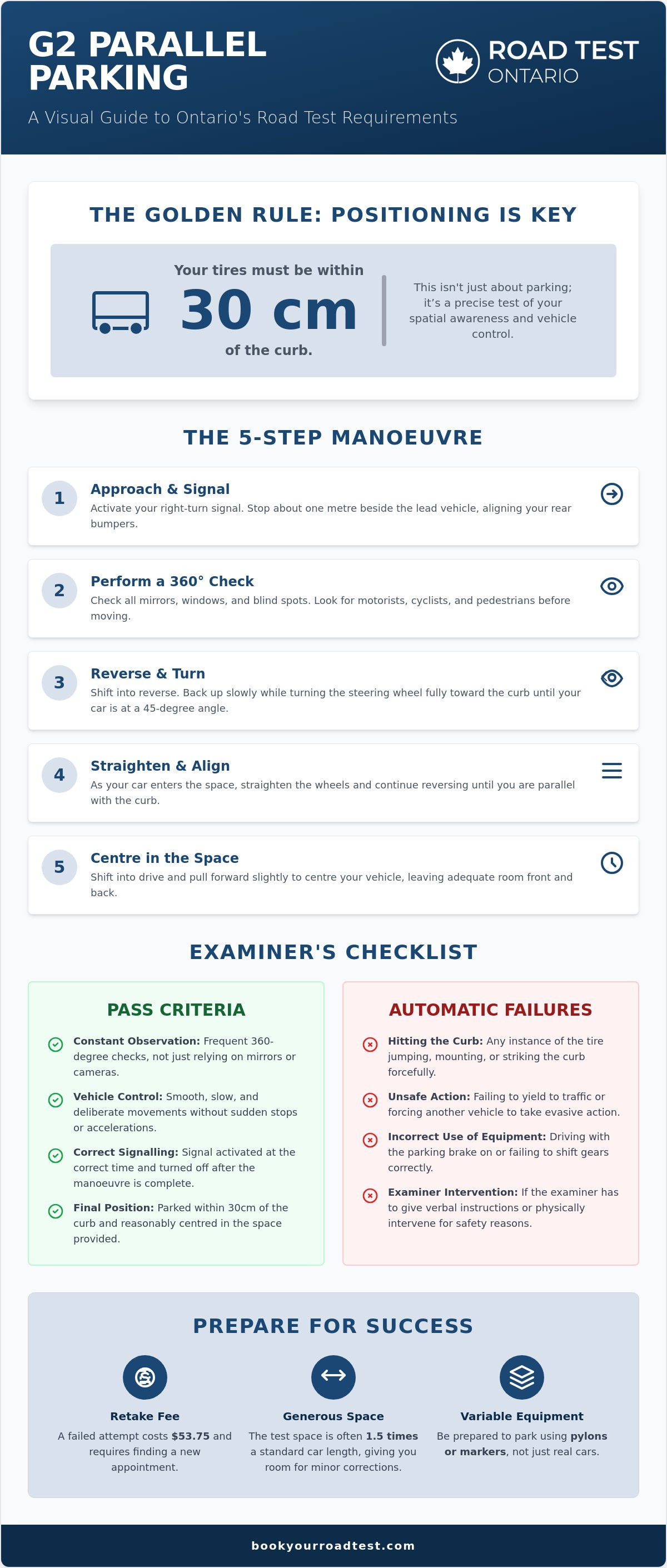
The Ontario G2 road test evaluates your ability to handle a vehicle safely in diverse urban environments. One of the most significant components of this assessment is the demonstration of vehicle control during low-speed manoeuvres. Specifically, the g2 parallel parking requirements ontario examiners follow dictate that you must be able to park your vehicle parallel to the curb, typically between two objects, while maintaining a distance of no more than 30 centimetres from the edge of the road. This isn't just about fitting into a tight spot; it is a clinical test of your spatial awareness and your ability to monitor your surroundings while moving in reverse.
While most drivers practice using two real cars, the reality at DriveTest centres can vary. You might find yourself parking behind a single vehicle, or in some cases, the centre may use concrete markers or orange pylons to simulate a parking space. If you arrive at a centre and see no parked cars on the designated route, don't assume the manoeuvre is cancelled. Examiners use these markers to ensure every candidate faces the same technical challenge regardless of local traffic. You can find a broader overview of these techniques in Wikipedia's guide to parallel parking, which outlines the geometric principles examiners expect you to apply. The g2 parallel parking requirements ontario centres maintain ensure that regardless of the specific equipment used, you are judged on your ability to judge the vehicle's dimensions accurately.
Is Parallel Parking Always on the G2 Test?
You should always prepare as if this manoeuvre is 100% mandatory. While it is a core requirement, an examiner might occasionally skip it due to extreme traffic congestion or severe time constraints. However, relying on this possibility is a high-risk strategy. Most Ontario DriveTest centres utilize a "one-car" setup where you park behind a single vehicle and then reverse into the open space behind it. This is generally considered easier than the "two-car" setup, but it requires even stricter observation skills because there is no rear car to act as a visual boundary to help you gauge depth.
Space and Equipment Requirements
The vehicle you bring to your test must meet basic safety standards, but it also needs to provide the visibility required for this specific task. You can use your own car or a driving school vehicle; however, you must realize that the examiner will check for a clear rear window and functional mirrors before the test begins. Professional instructors at Aceway Driving School often point out that vehicle readiness is just as important as the driver's skill. If your mirrors are cracked or your rear-view is obstructed, the test will be cancelled, and you will forfeit your fee. The parking space itself is usually generous, often measuring about one and a half times the length of a standard sedan. This gives you ample room to adjust if you don't nail the angle on your first attempt.
The Technical Step-by-Step: How to Execute the Perfect Park
Executing a flawless manoeuvre requires more than just luck. It demands a systematic approach that aligns with the g2 parallel parking requirements ontario examiners use to grade your performance. By breaking the process into five distinct steps, you can eliminate the guesswork and focus on maintaining total vehicle control throughout the entire duration of the test.
- Step 1: Signal your intention to pull over by activating your right-turn signal and stop beside the lead vehicle.
- Step 2: Perform a full 360-degree check. You must ensure the area is clear of other motorists, cyclists, and pedestrians before moving.
- Step 3: Shift into reverse and begin backing slowly while turning the steering wheel toward the curb.
- Step 4: Straighten the wheels as your vehicle enters the space and align the car parallel to the curb.
- Step 5: Shift into drive and move forward slightly to centre the vehicle in the allocated space, leaving room for other cars to exit.
The Approach and Signalling
Success begins before you even shift into reverse. You should stop approximately one metre away from the vehicle you are parking behind to allow for a safe turning radius. Activating your right-turn signal early is essential; it alerts following traffic of your intent to stop. The parallel start position is achieved when your vehicle is stopped approximately one metre beside the lead car with your rear bumper aligned with theirs. Before you move an inch backward, you must check your blind spots and mirrors. Examiners often fail students who rely solely on backup cameras rather than performing physical head checks.
Steering and Positioning
Once you begin reversing, use the 45-degree angle rule of thumb to guide your entry. Turn the wheel sharply to the right until your car is at a 45-degree angle to the curb, then straighten the wheels and continue backing. You can judge your distance from the curb by using your side mirrors to look for a gap of approximately 30 to 45 centimetres. According to the Official G2 Test Requirements, your final position must be parallel to the curb and not obstructed by any part of the vehicle. If you find yourself too far away, you are allowed to make minor adjustments, provided you do not hit the curb or create a safety hazard. If you feel confident in your ability to meet these technical standards, you can find a road test appointment that fits your schedule and preferred location.
How Examiners Score Your Parallel Parking Performance
Examiners view parallel parking as a comprehensive safety test rather than a simple parking exercise. While your final position relative to the curb matters, the process you follow to get there is what determines your score. The g2 parallel parking requirements ontario examiners prioritize revolve around your ability to maintain awareness of your surroundings while the vehicle is in motion. You could park perfectly straight, but if you fail to check your mirrors or blind spots even once, you will lose significant marks.
A common point of confusion for many students is the difference between touching the curb and climbing it. You should realize that lightly touching the curb with your tire while adjusting is often recorded as a minor error, resulting in a small demerit. However, if the tire climbs onto the curb or the vehicle jolts because you hit the concrete with force, this is classified as a mounting of the curb. In most cases, mounting the curb is an automatic disqualification because it indicates a lack of vehicle control. This distinction is critical for maintaining your composure during the test.
The 360-Degree Observation Rule
Observation is the most heavily weighted part of this manoeuvre. You must check your mirrors and look over your shoulder every few seconds. If a pedestrian steps onto the road or another vehicle approaches, you must stop immediately and wait for them to pass or for the examiner to provide further instructions. To ensure the examiner sees your effort, make your head movements obvious and deliberate. Don't just move your eyes; turn your head so they can clearly see you are scanning for hazards in every direction.
Minor vs. Major Errors
The scoring system distinguishes between technical mistakes and safety violations. Minor errors include taking more than three manoeuvres to finish the park or ending up slightly crooked. While one minor mistake won't fail you, multiple errors across different parts of the test can add up to a failing grade. Major errors are more severe and can end the test instantly. These include:
- Failing to signal: Not using your right-turn signal upon approach.
- Excessive distance: Finishing more than 50 centimetres from the curb.
- Safety hazards: Failing to check a blind spot before backing up.
- Traffic interference: Forcing another driver to brake or swerve because of your manoeuvre.
Smoothness also plays a role in your final score. Abrupt braking or erratic steering suggests you aren't comfortable with the vehicle's dimensions. By maintaining a slow, steady pace, you give yourself the time needed to perform the required checks without rushing. Mastering the g2 parallel parking requirements ontario examiners look for means demonstrating that you are a safe, predictable driver in all conditions.
Troubleshooting and Avoiding Automatic Failures
While minor errors result in point deductions, certain mistakes end your road test immediately. Understanding these boundaries is essential for staying calm under pressure. The g2 parallel parking requirements ontario examiners enforce are designed to prioritize public safety above all else. If your actions create an immediate hazard, the examiner is required to intervene. This intervention, whether the examiner touches the brake pedal or grabs the steering wheel, results in an automatic disqualification. Similarly, any contact with another vehicle, a pylon, or a concrete marker is considered a collision and will end the test on the spot.
Safety hazards extend beyond physical contact. If you begin your manoeuvre and force an approaching driver to slam on their brakes or swerve to avoid you, you have failed to demonstrate safe vehicle control. You must wait for a completely clear gap in traffic before you start backing up. If a car appears while you are mid-park, stop and wait for them to pass or for them to signal that they are waiting for you. Being patient is never a mistake; being reckless is. Major errors that lead to an immediate fail include:
- Examiner intervention: Any physical or verbal correction required to prevent a hazard.
- Collisions: Any contact with parked vehicles, curb-side markers, or other objects.
- Dangerous actions: Forcing other road users to take evasive manoeuvres because of your positioning.
Touching the Curb vs. Climbing the Curb
Confusion often exists regarding curb contact. You should realize that a gentle tap against the curb is usually just a minor point deduction rather than an instant fail. However, climbing or jumping the curb, where the tire actually mounts the sidewalk or the vehicle's chassis jolts upward, is a critical error. If you feel your tire touch the curb and realize your angle is wrong, don't try to force the car over it. You are allowed to pull out and try again once to correct your position. This "reset" is a valuable tool that shows the examiner you are aware of your surroundings and are willing to correct a mistake safely.
Managing Test Day Nerves
Rushing the manoeuvre is the leading cause of technical errors during the G2 test. When you feel your heart racing, take a second to breathe and check your mirrors again. The examiner isn't timing you with a stopwatch; they are looking for methodical, safe movements. If you find yourself at a bad angle, stop the car and reassess. Focusing on safety over a "perfect" one-shot park will keep the examiner satisfied and keep your score within the passing range. Once you feel confident in handling these high-pressure moments, you can book your G2 road test at a location that suits you best.
Scheduling Your G2 Road Test with Confidence
Mastering the technical g2 parallel parking requirements ontario examiners look for is a major milestone in your driving journey. You've practiced the 360-degree checks and learned exactly how to avoid the critical error of climbing the curb. Now, you must decide when you are truly ready to put those skills to the test in a real-world environment. Readiness comes when you can perform the manoeuvre successfully five times in a row without hesitation or safety lapses. Once you reach this level of consistency, the focus shifts from skill-building to administrative logistics. Book Your Road Test operates as an autonomous booking service designed to simplify this transition, allowing you to focus on your driving while we handle the scheduling details.
Finding the Right DriveTest Centre
The location you choose can significantly impact your test day experience. Some candidates prefer smaller towns with lower traffic volumes, while others choose urban centres where they have done most of their practice. You should realize that road layouts and the specific equipment used, such as pylons versus real vehicles, vary by location. Consistency is key; if possible, practice your parallel parking in the residential streets surrounding your chosen centre. On the day of your appointment, ensure you have your physical G1 licence and a vehicle that meets all safety standards. Arriving 30 minutes early allows you to check in and mentally prepare for the examiner's instructions without feeling rushed.
Securing an Earlier Date
One of the biggest frustrations for Ontario drivers is the standard wait time, which can often stretch between four to six months. This delay can cause your skills to get rusty, especially if you aren't practicing daily. To bypass these long queues, many drivers utilize a road test cancellation finder Ontario. This tool actively monitors the system for newly opened slots that appear when other candidates reschedule or cancel their appointments. By securing an earlier date, you can take your test while the technical g2 parallel parking requirements ontario standards are still fresh in your mind. Our professional booking service manages these logistics for you, providing the peace of mind that comes with an organized and efficient process. You don't have to wait half a year to start your life as a licensed driver; with the right tools, you can get on the road much sooner.
Take Control of Your G2 Road Test
Mastering the technical g2 parallel parking requirements ontario examiners expect means you've already cleared one of the biggest hurdles of the exam. You now understand that clinical observation and steady vehicle control are more valuable than a perfect one-shot park. By avoiding critical errors like mounting the curb and ensuring you maintain a clear 360-degree view of your surroundings, you can approach your test date with genuine confidence. Success is about demonstrating safety and predictability in every move you make.
Don't let long wait times stall your progress while your skills are fresh. We provide simplified booking for over 60 Ontario DriveTest centres and offer professional administrative support to guide your licence journey. You can secure an earlier date using our specialized cancellation finder, which monitors the system for newly available slots. Book your G2 road test today and skip the wait times! Your full driving freedom is well within reach; stay focused, keep practicing, and we'll handle the logistics for you.
Frequently Asked Questions
Is parallel parking mandatory for the G2 test in Ontario?
Yes, parallel parking is a mandatory component of the Ontario G2 road test. While an examiner might occasionally bypass this manoeuvre due to severe weather or extreme traffic congestion, you should always arrive prepared to perform it. Failing to demonstrate this skill when asked will result in an immediate loss of marks or a failed attempt. You must treat it as a certain requirement for success.
How many times can I adjust my car during parallel parking on the test?
You are generally permitted to make up to three manoeuvres to position your vehicle correctly. This typically includes your initial reverse into the space and two additional adjustments to straighten out. If you require more than three movements to meet the g2 parallel parking requirements ontario examiners expect, you will likely receive a minor error deduction on your score sheet rather than an automatic failure.
What happens if I hit the curb while parallel parking during my G2 test?
A gentle tap against the curb is usually recorded as a minor error, but mounting or jumping the curb is an automatic disqualification. If your tire simply touches the concrete without the vehicle jolting or climbing upward, you can usually continue the test. However, any forceful impact that requires the examiner to intervene or results in the car moving onto the sidewalk ends the test immediately.
Do I have to parallel park between two cars or just behind one?
Most DriveTest centres require you to park behind a single vehicle rather than between two cars. This setup provides more space but demands better depth perception because there is no rear vehicle to use as a stopping guide. Occasionally, centres use concrete markers or pylons to simulate the parking space; therefore, you should practice with various objects to ensure your spatial awareness is adaptable.
Can I use a backup camera for parallel parking on my road test?
You may have a backup camera on, but you cannot rely on it as your primary source of information. Examiners look for physical 360-degree head checks and proper mirror usage throughout the manoeuvre. If you stare at the screen instead of looking through your windows and checking your blind spots, you will fail to meet the observation requirements of the test. Always prioritize physical checks over technology.
What is the most common reason people fail parallel parking in Ontario?
The most common reason for failure isn't the park itself; it's a lack of consistent observation. Many students focus so much on their steering that they forget to check for approaching traffic or pedestrians. Failing to perform a full 360-degree check before shifting into reverse or ignoring a car that pulls up behind you during the manoeuvre are frequent causes for automatic disqualification.
How far from the curb should I be when I finish parallel parking?
You should aim to be no more than 30 centimetres away from the curb when you finish. While being slightly further out might only result in a minor point deduction, finishing more than 50 centimetres away suggests a lack of vehicle control. Your car must be parallel to the road and centred within the allocated space to satisfy the examiner's positioning criteria and ensure you don't obstruct traffic.
Will I fail if I don’t check my blind spot before backing up?
Yes, failing to check your blind spot before backing up is considered a major safety violation that can lead to an automatic fail. Observation is the most critical part of the g2 parallel parking requirements ontario examiners grade. You must demonstrate that you are aware of every hazard around your vehicle before and during the movement to ensure you don't create a dangerous situation for other road users.


