
Did you know that in March 2026, the G test pass rate in Brampton was only 57 percent? This statistic highlights the intense pressure drivers face during the final stage of Ontario's graduated licensing system. You likely feel a familiar knot in your stomach when thinking about the g road test highway portion requirements, especially the high-speed merge onto a busy 400-series expressway. It is normal to worry about whether your recent experience qualifies or if you can maintain a steady 100 km/h while an examiner watches your every move.
We understand that the Declaration of Highway Driving Experience form feels like a daunting administrative hurdle, but mastering these criteria is the most efficient way to trade your G2 for a full licence. This guide simplifies the mandatory three-month experience rule and the exact speed targets you must hit to pass. You'll learn which highways count toward your requirement, how to execute lane changes with confidence, and the safety standards your vehicle must meet to avoid disqualification. We provide the professional clarity you need to arrive at the DriveTest centre feeling prepared and organized.
Key Takeaways
- Identify the specific g road test highway portion requirements, including the mandatory 3-month driving history declaration you must complete before starting.
- Learn why matching the flow of traffic at 100 km/h is the most critical skill for a successful highway merge and exit.
- Recognize common automatic disqualifications that catch many drivers off guard during the high-speed evaluation.
- Determine how to verify your vehicle's safety standards and confirm your G2 tenure before you book your final licensing appointment.
The G Road Test Highway Portion: Why It Matters in 2026
The G road test represents the final milestone within Ontario's graduated licensing system. While your G2 test focused on basic vehicle control and residential safety, the full G evaluation is designed to confirm you can handle the complexities of high-speed travel. Understanding the g road test highway portion requirements is essential because this segment is where most candidates feel the highest level of anxiety. It isn't just about driving faster; it's about demonstrating that you can integrate into the existing flow of an expressway without disrupting other drivers.
In 2026, examiners prioritize "expressway flow" over almost everything else. This means your ability to reach 100 km/h on the ramp and find a safe gap is the primary metric of success. If you hesitate or merge too slowly, you create a safety hazard that often leads to an immediate failure. The test ensures you have moved beyond basic operation into a phase of confident, high-speed decision-making.
The Evolution of the G Test: 2026 Update
By 2026, the Ministry has largely standardized the evaluation process following years of temporary modifications. You might find that some centres still omit certain low-speed manoeuvres like parallel parking to focus heavily on highway safety. This shift ensures that the g road test highway portion requirements are the central focus of your 20 to 40-minute appointment. Also, while your car might have advanced blind-spot monitors or lane-keep assist, examiners still require traditional shoulder checks. Relying solely on technology is a common mistake that can lead to point deductions during your evaluation.
G2 vs. G: Understanding the Increased Stakes
The transition from a G2 to a full G licence involves a significant psychological shift. You are moving from 50 km/h city streets to 100 km/h 400-series highways. At these speeds, your reaction time must be replaced by predictive driving. Examiners look for drivers who scan 15 to 20 seconds ahead rather than just reacting to the brake lights directly in front of them. This advanced level of observation is what separates a novice from a fully licensed driver. It is about showing you have the maturity and skill to handle any provincial road, regardless of the speed limit or traffic volume.
The Declaration of Highway Driving Experience: 2026 Requirements
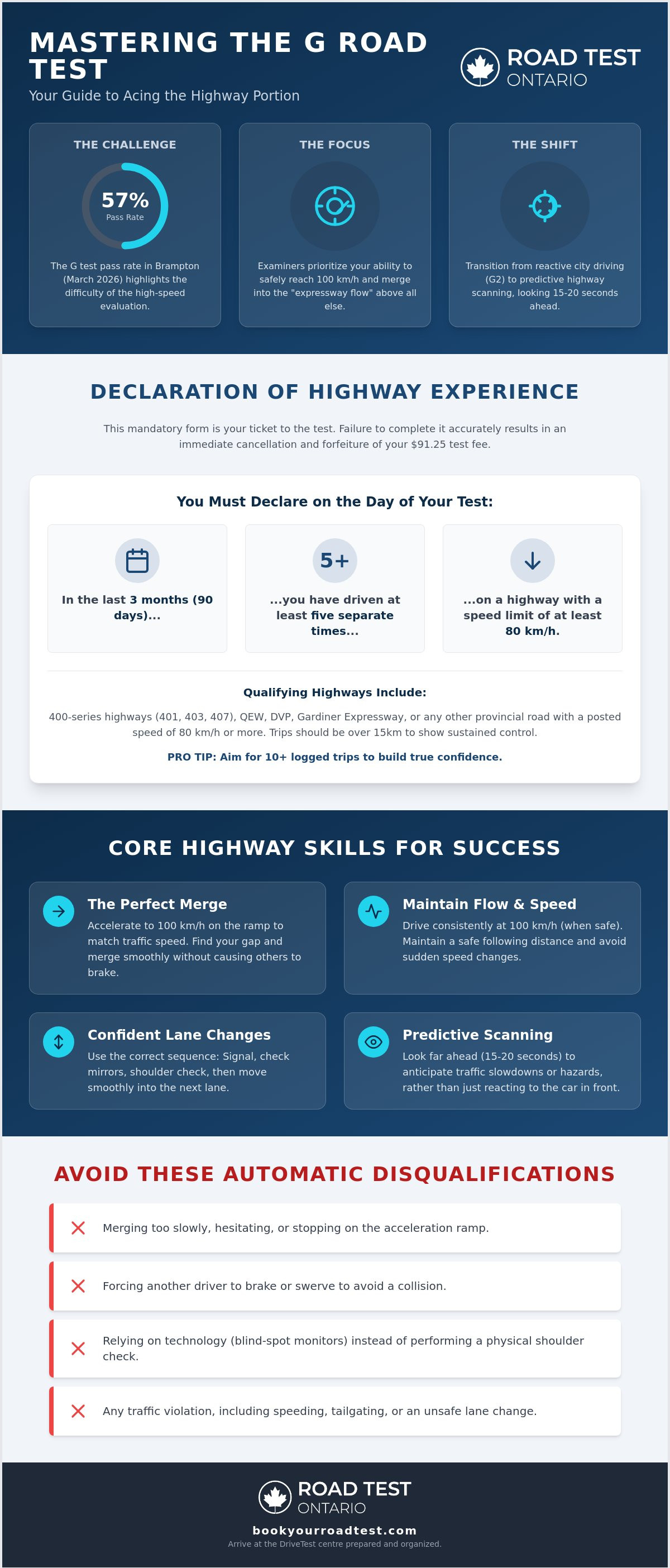
Before you even step into the vehicle with an examiner, you must clear a critical administrative hurdle. The Declaration of Highway Driving Experience is a mandatory document that every candidate must complete upon arrival at the DriveTest centre. This form isn't just a formality; the Declaration is a legal attestation of your readiness for high-speed traffic. If you cannot provide specific details that satisfy the g road test highway portion requirements, your appointment will be cancelled immediately. In such cases, you will forfeit your $91.25 test fee and be required to wait before booking again.
The "3-Month Rule" is the core of this requirement. You are required to declare that you have driven on a highway with a speed limit of at least 80 km/h at least five times in the 90 days preceding your test. While the Official MTO Driver's Handbook outlines the technical skills needed, this form proves you've actually practiced them in real-world conditions. Providing inaccurate information is considered a serious breach of the licensing process. It is always better to reschedule your appointment using a G road test booking service than to sign a form that doesn't reflect your true experience level.
Qualifying Highways and Speed Limits
Not every road with a high speed limit counts toward your declaration. The Ministry specifically looks for experience on "Expressways" or 400-series highways. This includes major routes like the 401, 403, 407, QEW, DVP, and the Gardiner Expressway. If you're testing in a more rural area without access to these major arteries, you must identify roads that have a posted speed limit of at least 80 km/h. To qualify as "sufficient," these trips should ideally be over 15 km in length to demonstrate sustained high-speed control.
Calculating Your "Sufficient Experience"
To ensure accuracy, keep a simple log of your highway entries and exits during your practice sessions. While the minimum requirement is five trips, examiners prefer to see candidates who have completed 10 or more to show true comfort. If you struggle with highway anxiety, start by driving during off-peak hours on Sunday mornings when traffic is lighter. Focus on hitting the 100 km/h mark on the ramp repeatedly until the sensation of speed feels routine. This preparation ensures you can honestly sign your declaration and meet the g road test highway portion requirements with total confidence.
Core Technical Requirements: The Perfect Highway Merge
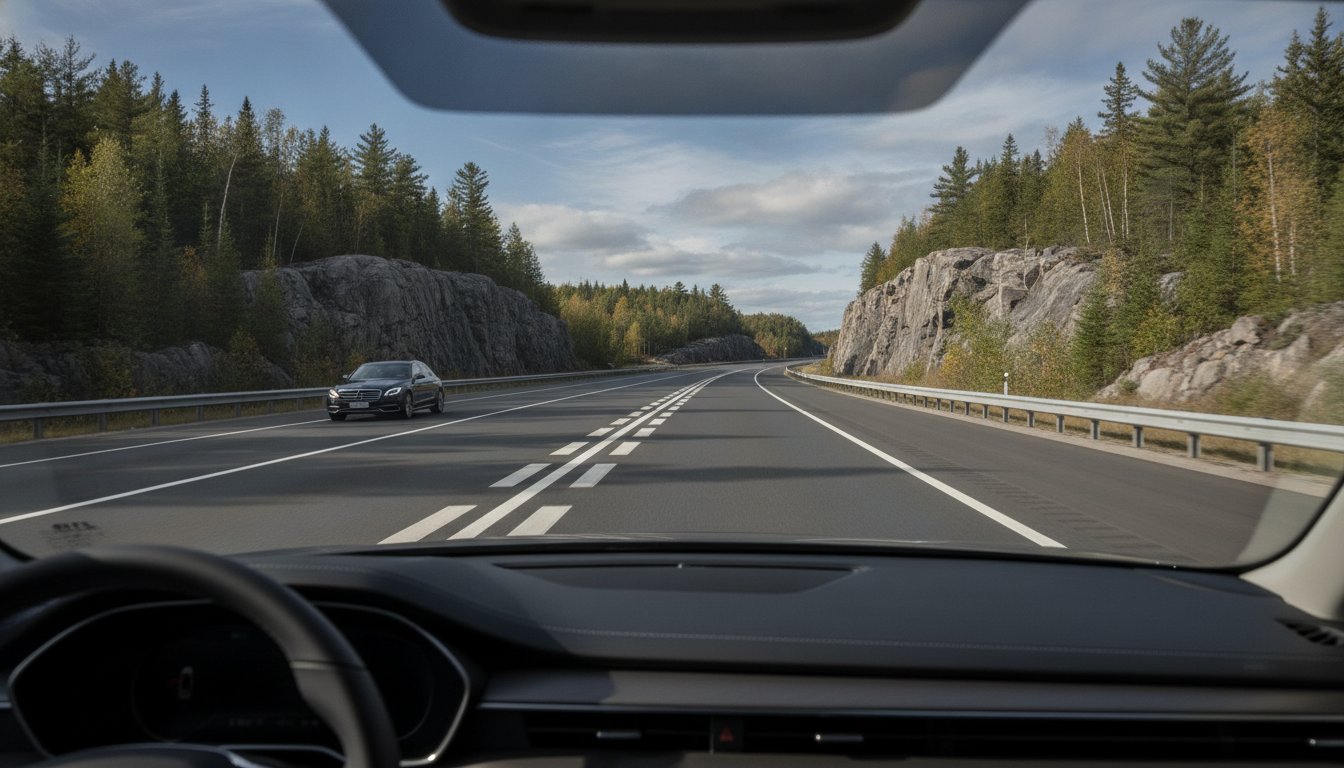
The merge is the most critical component of your evaluation. It often occurs within the first five minutes of your test, setting the tone for the entire encounter. When meeting the g road test highway portion requirements, you must demonstrate the ability to blend seamlessly into traffic moving at 100 km/h. Examiners watch for a lack of hesitation. They want to see you confidently claim your space on the road without forcing other drivers to adjust their speed or change lanes. If you merge at 70 or 80 km/h, you create a dangerous speed differential that results in an immediate failure.
Success starts with using the full length of the acceleration lane. Many nervous drivers try to merge too early, which limits their ability to reach the necessary speed. You should treat the ramp as a dedicated zone for building momentum. Once you have entered the through lane, maintaining a consistent speed is vital. Fluctuating between 90 and 105 km/h suggests a lack of control. Keep your eyes on the horizon and your foot steady on the accelerator. Before Booking your G road test, ensure you have practiced this specific manoeuvre on various 400-series ramps to get a feel for different incline levels and lane lengths.
Step-by-Step: Entering the Expressway
Observation must begin the moment you enter the ramp. Check your rearview and side mirrors immediately to assess the density of highway traffic. Activate your turn signal halfway down the ramp to communicate your intent. This is not a request; it is a notification of your upcoming action. Acceleration is your primary tool here. You must reach 100 km/h (or the posted limit) while still within the acceleration lane. Finally, select your gap. Time your entry so you slide into a space that preserves a safe distance for both you and the driver behind you.
Lane Management and Overtaking
Once you are on the highway, the examiner will likely instruct you to perform at least two lane changes. These are meant to test your "space cushion" management. Always maintain a following distance of at least two to three seconds from the vehicle in front. When you move to the left, ensure you aren't cutting anyone off. Use the passing lane only when instructed or when overtaking a slower vehicle, then return to the right lane promptly. Proper lane discipline shows you understand the g road test highway portion requirements and respect the established rules of expressway travel.
Common Mistakes and Automatic Disqualifications
Distinguishing between a minor point deduction and an automatic disqualification is vital for your peace of mind. A minor error, like failing to signal exactly 30 metres before a turn, will cost you points but won't end the test. However, an immediate fail occurs when your actions force the examiner to intervene or cause another driver to take evasive action. One of the most frequent causes for disqualification involves failing to meet the g road test highway portion requirements regarding speed. Merging at 70 km/h into a 100 km/h zone is a critical error because it forces following traffic to brake aggressively.
Observation is another area where candidates often stumble. It's a "hidden" requirement because the examiner can't read your mind; they can only observe your physical movements. If you check your mirrors with your eyes only, the examiner may mark it as a failure to observe. You must also respond correctly to roadside hazards. If you see an emergency vehicle on the shoulder with its lights flashing, you're legally required to slow down and move over if safe. Failing to do so is an automatic fail. If you feel unready to face these high-stakes scenarios, consider using a G road test booking service to find a later date that gives you more practice time.
Speed Management: The 100 km/h Goal
Hesitation at the end of an on-ramp is a major red flag for examiners. They view this as a lack of confidence and a potential safety risk. Aim to be at exactly 100 km/h by the time you reach the end of the merge lane. While the "5 km/h rule" generally allows for slight fluctuations, don't exceed the limit. Weather is the only exception. If it's raining heavily or there's snow on the ground, driving at the posted limit might be considered unsafe. In these cases, adjust your speed to the conditions, but explain your reasoning to the examiner if they ask.
Observation and the "Head Check"
To pass the highway portion, you must adopt an exaggerated observation style. This means physically turning your head for every mirror check and blind-spot scan. Use the Mirror-Signal-Blindspot (MSB) rhythm for every lane change to show you're following a systematic safety process. You should also be scanning the horizon 12 to 15 seconds ahead. This proactive approach allows you to anticipate traffic slowdowns or lane closures before they become emergencies. Demonstrating this level of awareness proves you've mastered the g road test highway portion requirements and are ready for full driving privileges.
Booking Your G Road Test with Confidence
Securing an appointment is the final logistical hurdle before you can demonstrate your mastery of the g road test highway portion requirements. You must ensure you have held your G2 licence for at least 12 full months before you are eligible to attempt the G exit test. Choosing the right location is also a strategic decision. While you might prefer a local centre, some drivers opt for regional locations with historically higher pass rates. In March 2026, for example, Owen Sound recorded an 89 percent pass rate, which contrasts sharply with the 57 percent seen in Brampton during the same period.
Navigating DriveTest Availability
Slots for G tests in 2026 remain in high demand across the province. If your G2 is nearing its five-year expiry date, the pressure to find an opening increases significantly. Using a road test cancellation finder Ontario allows you to monitor for dropped appointments in real-time. This tool is often the fastest way to bypass months of waiting and secure a date that fits your schedule.
Why Use a Booking Administration Service?
A professional booking service acts as an efficient facilitator for busy drivers. It replaces the often confusing official interfaces with a streamlined, user-friendly experience that prioritizes speed. This reduces the administrative stress of the scheduling process, allowing you to focus entirely on practicing the g road test highway portion requirements. Our service provides a transparent way to manage your appointment without the frustration of constant manual refreshes.
Before you head to the centre, double-check your final requirements. You must bring your physical G2 licence and have valid vehicle insurance ready. Arriving at least 30 minutes early ensures you have time to check in and complete your highway experience declaration. Once you are confident in your high-speed merging and lane change skills, the only thing left is to secure your spot. Book your G road test today to take the final step toward your full, unrestricted licence.
Secure Your Full G Licence with Confidence
Mastering the expressway is about more than just speed; it is about demonstrating mature decision-making under pressure. By prioritizing high-speed flow and proactive observation, you align yourself with the 2026 standards examiners expect. You now understand that meeting the g road test highway portion requirements involves a mix of technical precision and administrative accuracy. From the perfect merge to a flawless experience declaration, these components work together to prove you are ready for unrestricted driving privileges. If you find that the stress of these major life transitions is impacting your personal life, you can find out more about Tammy Laber and her professional relationship counselling to help navigate the pressure.
Managing the logistics of your appointment should be the easiest part of this journey. We support over 60 DriveTest centres across Ontario, offering a stress-free administrative booking experience that saves you time. If you find yourself stuck with a distant date, our cancellation finder is designed to help you secure an earlier slot. Book Your G Road Test Appointment today to finalize your scheduling and focus on your practice. You have the knowledge and the tools to succeed; stay focused and drive safely.
Frequently Asked Questions
How many highway trips do I need for the G road test in 2026?
You must have completed at least five trips on a highway with a speed limit of 80 km/h or higher within the 90 days preceding your appointment. These trips should ideally involve merging and driving for a significant distance to ensure you meet the g road test highway portion requirements. Examiners look for this specific frequency to confirm you are comfortable with high-speed traffic flow.
What happens if I don’t have enough highway experience for the G test?
If you do not meet the minimum experience criteria, the DriveTest examiner will cancel your appointment immediately. You will lose your prepaid test fee and must wait to book a new time. It is essential to be honest on your declaration, as arriving without the required experience is considered an automatic disqualification before the vehicle even moves.
Which highways count for the G road test highway portion?
Qualifying roads include all 400-series highways such as the 401, 404, and 410, as well as the QEW and DVP. In regions without 400-series access, any provincial highway with a posted speed limit of at least 80 km/h is acceptable. Ensure the road you practice on has a merge lane to properly simulate the g road test highway portion requirements.
Is the G road test still modified in 2026?
By 2026, the G road test has largely returned to its standard format, though some centres maintain a heavy focus on highway skills. While residential manoeuvres like three-point turns or emergency stops might be shortened at specific locations, the highway evaluation remains the most rigorous part of the exam. You should prepare for a full evaluation that includes all aspects of expressway driving.
Can I fail the G test for merging at 80 km/h instead of 100 km/h?
Yes, merging at 80 km/h in a 100 km/h zone is often grounds for an immediate failure. This creates a dangerous situation where following vehicles must brake sharply to accommodate your slower speed. You are expected to reach the posted highway speed while still in the acceleration lane to ensure a seamless integration into the flow of traffic.
What is the "Declaration of Highway Driving Experience" form?
This is a mandatory legal document you sign at the DriveTest centre to attest to your recent driving history. It requires you to list the frequency and length of your highway trips over the past three months. The examiner uses this information to verify that you have had enough exposure to high-speed environments to safely attempt the full G evaluation.
How long does the highway portion of the G test typically last?
The highway component usually takes up about 15 to 20 minutes of the overall 20 to 40-minute test duration. This includes the time spent on the on-ramp, merging, performing lane changes, and eventually exiting the expressway. The exact timing depends on traffic conditions and the specific route chosen by your examiner on the day of your test.
Can I use a backup camera or blind-spot sensors during the G test?
You may have these features active, but you cannot rely on them as your primary source of observation. Examiners require you to perform physical shoulder checks and use your mirrors traditionally. If you stare at a screen instead of checking your blind spots, you will lose points for improper observation, even if the technology is working perfectly.


