

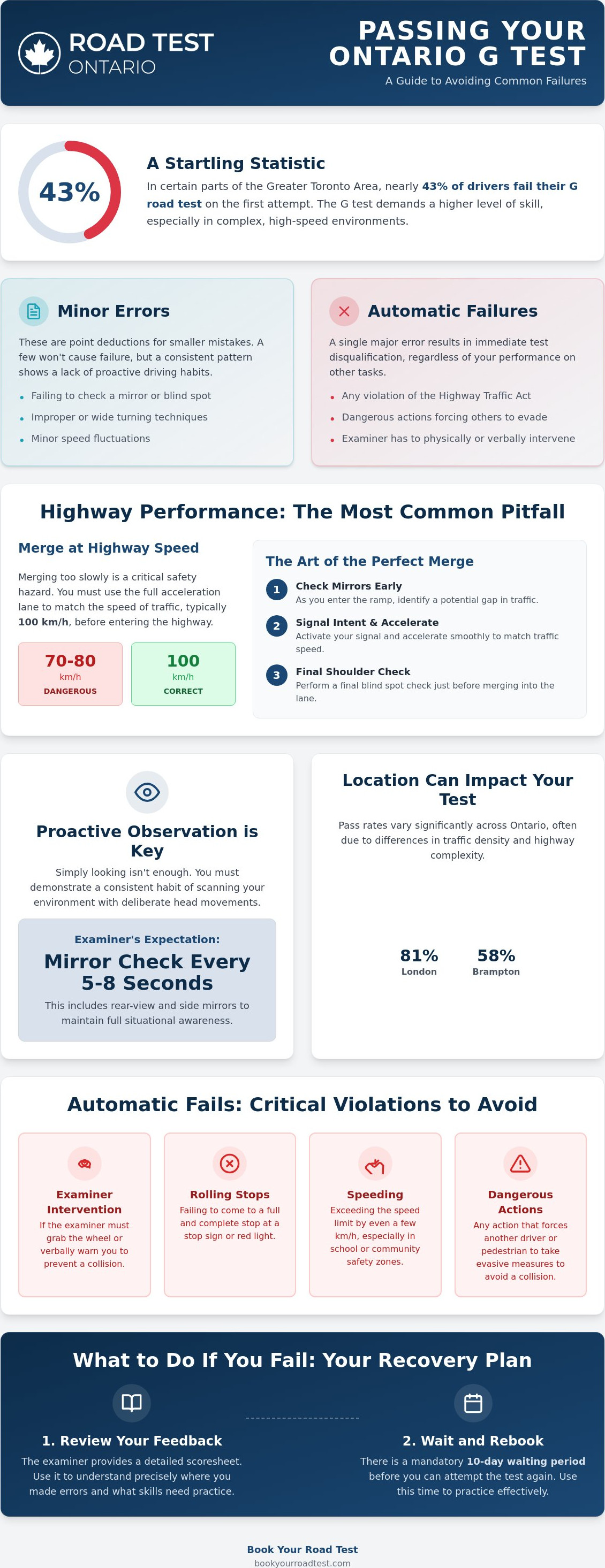
Did you know that in certain parts of the Greater Toronto Area, nearly 43% of drivers fail their G road test on the first attempt? It is a startling figure that highlights how the exit exam demands much more than basic steering skills. We understand the anxiety that comes with merging onto a 400-series highway or the fear that your licence might expire before you can secure a passing grade. Many applicants struggle because the technical expectations for a full G licence are significantly higher than those for the G2 level.
This guide identifies the common reasons for failing g test ontario so you can approach your appointment with total confidence. You will learn the specific driving behaviours and technical requirements needed to satisfy examiners on your first try. We provide a clear breakdown of automatic failure points, strategies for decisive highway merging, and advice on how to navigate the booking process efficiently. By focusing on proactive observation and technical precision, you can finalize your licensing journey and leave the stress of testing behind.
Key Takeaways
- Distinguish between minor point deductions and major technical errors that lead to an immediate failure of your licensing exam.
- Identify the common reasons for failing g test ontario, with a specific focus on the critical requirement of merging onto highways at appropriate speeds.
- Master proactive observation techniques by using deliberate head movements and adhering to the strict 5-to-8 second mirror check rule.
- Recognize automatic failure points such as rolling stops at intersections and exceeding the posted speed limit by even a few kilometres per hour.
- Learn the professional strategy for recovery, including how to utilize examiner feedback sheets and navigate the mandatory 10-day waiting period for a retake.
Understanding the Ontario G Road Test: Points vs. Automatic Failure
The G exit test represents the final milestone within Ontario's graduated licensing system. Unlike the G2 road test, which focuses on basic vehicle control and residential manoeuvres, the G test evaluates your ability to manage high-speed environments and complex traffic patterns. Examiners are not looking for robotic perfection. Instead, they are assessing whether you have developed a consistent habit of safety. In 2026, the test typically lasts between 30 and 40 minutes. It covers residential streets, business districts, and 400-series highways. Understanding the distinction between minor point deductions and major technical errors is vital for anyone looking to avoid the common reasons for failing g test ontario.
Current data from March 2026 shows that pass rates vary significantly across the province. While centres like London report an 81% pass rate, urban hubs like Brampton sit closer to 58%. This discrepancy often stems from how drivers handle the increased pressure of city traffic. You must demonstrate that you can process multiple hazards simultaneously while maintaining complete control of your vehicle. The examiner acts as a professional observer, documenting your behaviours against a strict provincial standard to ensure you are ready for full driving privileges.
How the Scoring System Works
Ontario examiners use a standardized marking sheet to track your performance throughout the drive. Each time you fail to check a mirror, neglect a blind spot, or use improper steering techniques, the examiner records a minor error. These points accumulate. While a few small mistakes will not necessarily end your attempt, a pattern of poor habits suggests you are not yet a proactive driver. Discretionary marks also play a role in the final decision; if an examiner feels you lack the confidence to manage highway traffic safely, they may fail you even if you have not committed a single major violation. Demonstrating "proactive observation" is the core requirement for a successful result.
What Constitutes an Automatic Disqualification?
Major errors lead to immediate failure, regardless of how well you performed during the rest of the drive. The most frequent cause is examiner intervention. If the person in the passenger seat has to grab the steering wheel or verbally instruct you to brake to avoid a collision, the test ends instantly. Dangerous actions are also grounds for disqualification. This includes any move that forces another driver or a pedestrian to take evasive action to avoid you. Finally, any direct violation of the Highway Traffic Act (HTA) results in an automatic fail. Running a red light, failing to stop completely at a stop sign, or exceeding the speed limit are all common reasons for failing g test ontario that lead to an instant disqualification.
Highway Performance: The Most Common G Test Pitfalls
The highway evaluation serves as the definitive segment of the G exit exam. This is where examiners look for high-level decisiveness and the ability to manage high-speed environments. Statistics from 2026 indicate that merging at an insufficient speed remains one of the most common reasons for failing g test ontario. If you enter a 400-series highway at 70 or 80 km/h when traffic is moving at 100 km/h, you create a significant safety hazard. The examiner will likely disqualify you for impeding traffic or creating a dangerous situation. You must treat the acceleration lane as a technical tool to match the flow of vehicles perfectly, as outlined in the Official MTO Driver's Handbook.
Maintaining a consistent speed is just as vital as the initial merge. Examiners watch for drivers who fluctuate their speed or follow other vehicles too closely. You should maintain a minimum three-second following distance under ideal conditions. If you find yourself constantly braking on the highway, it suggests you aren't looking far enough ahead to anticipate traffic changes. Proactive driving requires you to scan the road well in advance, allowing you to adjust your position without abrupt movements.
The Art of the Perfect Merge
Success begins with controlled acceleration. You should reach 100 km/h, or the posted limit, before the acceleration lane ends. Examiners look for a specific "Blind Spot - Signal - Mirror" rhythm. Check your mirrors early to identify a gap, signal your intent, and perform a final shoulder check to ensure the space is still clear. Never stop at the end of a ramp. Slowing down or stopping in the merge lane is a critical error that suggests a lack of technical skill and can lead to an immediate failure. If you are struggling to find an appointment to practice these skills, a G road test booking service can help you secure a time at a centre with more favourable traffic conditions.
Lane Management and Exit Strategy
Once you have merged, your lane position is evaluated. Ontario regulations require drivers to stay in the right-most lane unless they are passing another vehicle. Lingering in the left lane without reason will result in point deductions. When it's time to leave the highway, maintain your cruising speed until you have fully entered the off-ramp lane. Decelerating while still in the live highway lane is dangerous and demonstrates poor exit strategy. Ensure you signal your intent approximately 150 metres before the exit to provide ample notice to the drivers behind you.
Observational Errors: Why "Just Looking" Is Not Enough
Many drivers believe they are observing their surroundings, yet they still receive deductions for poor awareness. The examiner sits in the passenger seat and cannot see your eyes; they must see your head move to confirm you are checking your mirrors and scanning the environment. This lack of visible head movement is one of the most common reasons for failing g test ontario. You must demonstrate a proactive scanning pattern that shows you are aware of hazards before they become emergencies. It is not enough to simply be a safe driver; you must be a visibly safe driver.
Ontario examiners look for the 'Left-Centre-Right-Left' scanning technique at every intersection. Before you enter a junction, look left, then centre, then right, and finally left again. This sequence ensures that the last place you look is the direction where traffic is closest to your vehicle. It is a technical requirement that separates a G2 driver from a fully licensed G driver. Developing this habit ensures you don't miss a vehicle or pedestrian that may have entered your path while you were looking the other way.
Mirror Rhythms and Scanning
Your rearview mirror should be checked every 5 to 8 seconds. This specific rhythm proves you are monitoring the entire traffic environment, not just the bumper in front of you. You also need to check your mirrors every time you touch the brake pedal or prepare to slow down. Scanning intersections remains mandatory even when you have the right of way. A green light does not guarantee safety. A quick head tilt to the left and right shows the examiner you are prepared for a vehicle that might run a red light or a pedestrian stepping off the curb.
Blind Spots and Turns
The 'Great Ontario Shoulder Check' is a non-negotiable requirement for every turn and lane change. When preparing for a right turn, you must check your right blind spot to protect cyclists or pedestrians who might be in your path. This is another of the common reasons for failing g test ontario, as many experienced drivers rely solely on their mirrors after years of driving. You must physically turn your head to check the area that your mirrors cannot see.
Maintaining proper lane discipline is equally important during turns. You must always turn into the lane that corresponds to your starting position. If you are turning right from a curb lane, you must finish the turn in the curb lane. Avoid the 'wide turn' mistake where you drift into the left lane. In busy urban centres, examiners also watch how you interact with pedestrians. You must wait until the pedestrian has completely crossed the road, or is well out of your path, before you proceed with your turn.
Tactical Checklist: Critical Safety Violations to Avoid
Technical precision is often what separates a successful applicant from those who must return for a second attempt. Examiners look for a strict adherence to the Highway Traffic Act that many seasoned drivers have long forgotten. Speeding is a prime example. While you might feel comfortable moving with the flow of traffic, exceeding the limit by even 3 to 5 km/h can result in an immediate disqualification. This is one of the most common reasons for failing g test ontario because it demonstrates a lack of discipline. You must monitor your speedometer constantly, especially when transitioning from high-speed highways to residential zones. Additionally, keep both hands on the wheel at all times. One-handed driving or "palming" the wheel during turns suggests poor vehicle control and will lead to significant point deductions.
Inaccurate steering control often goes unnoticed by drivers until an examiner points it out. You must maintain a steady path and avoid wandering within your lane. Crossing your arms during a turn is technically acceptable in Ontario, but you must return to the 9-and-3 or 10-and-2 position immediately after the manoeuvre. At four-way stops, the pressure of the test can cause confusion. Remember the fundamental rule: the first vehicle to arrive has the right-of-way. If two vehicles arrive simultaneously, the driver on the right proceeds first. Hesitating too long or going out of turn are both common reasons for failing g test ontario because they disrupt the predictable flow of traffic.
The Complete Stop Requirement
A rolling stop is the most frequent technical violation recorded at DriveTest centres across the province. You must ensure a full cessation of motion, where the vehicle's weight settles back on its suspension. The "3-second rule" is an excellent mental tool to ensure you haven't moved too quickly. Your vehicle must stop completely behind the white stop line or before the edge of the sidewalk. Once you have made that initial legal stop, you may creep forward to improve your visibility of cross-traffic. Never skip the first stop just because the intersection appears empty or clear.
Right-of-Way and Pedestrian Safety
Yielding the right-of-way is not a suggestion; it is a legal requirement with zero room for error. Pedestrian crossovers and school zones are high-scrutiny areas where any mistake leads to an automatic fail. If an emergency vehicle approaches with sirens or flashing lights, you must pull to the right and stop immediately. Failure to do so proves you aren't scanning your environment effectively. Managing "stale" green lights is another challenge. If a light has been green for a long time, you should prepare to stop. Entering an intersection on a yellow light when you could have stopped safely is a major error that examiners will not overlook.
If you feel ready to demonstrate these skills and finalize your licensing, you can book your G road test today through our secure and efficient search platform.
What to Do If You Fail: Rebooking and Recovery
The high demand for appointments in 2026 means that standard wait times can often stretch into several months. This is particularly true at busy urban hubs like Toronto or Mississauga, where slots are claimed almost instantly. To avoid these long delays, many applicants utilize a road test cancellation finder Ontario. These tools monitor the system for sudden openings, allowing you to secure a new date much faster than manual checking would allow. This efficiency is vital if you are working against a deadline or simply want to retake the test while your skills are still sharp.
Analyzing Your Results
Once your test is complete, you will receive a digital result that outlines every point deduction and major error. It is vital to distinguish between a "bad day" caused by nerves and a genuine lack of technical skill. If your sheet shows multiple deductions for mirror checks, you need to return to the basics of proactive observation. If the failure was due to a single technical violation like a rolling stop, your focus should be on intersection discipline. Many drivers find success by practicing on the streets surrounding their specific DriveTest centre. This helps you realize local challenges, such as unique lane configurations or high-pedestrian zones, that might have contributed to your initial failure. Regional pass rates, such as the 58% rate in Brampton compared to higher rates in smaller towns, often reflect these local complexities.
Fast-Tracking Your Second Attempt
Securing a G2 road test booking or a full G appointment requires staying organized and being ready to act when a slot appears. Using an autonomous booking service can alleviate the stress of navigating official portals during peak seasons. As you prepare for your second attempt, maintain a calm and methodical approach. Review the examiner's feedback, practice the specific manoeuvres that caused trouble, and remember that thousands of Ontario drivers pass on their second try after refining their habits. Efficiency and preparation are the keys to finalizing your licensing journey.
Finalizing Your Path to a Full G Licence
Achieving your full driving privileges in Ontario depends on your ability to demonstrate a consistent habit of safety. By focusing on the specific highway merging techniques and observational rhythms we have discussed, you can avoid the common reasons for failing g test ontario. Technical precision at intersections and maintaining strict speed control are just as critical as your performance on the 400-series highways. You now have the technical knowledge to navigate the exit exam successfully.
We understand that finding a suitable time for your exam can be difficult during peak seasons. Our team of independent administrative experts supports over 60 DriveTest centres to help you find the right slot efficiently. If you are dealing with a tight deadline or a looming expiry date, our stress-free cancellation finder service can help you secure an earlier date without the need for constant manual checking. We handle the logistics so you can focus on your driving skills.
Book your next G road test appointment with ease and approach your test day with the confidence of a prepared driver. Your journey to a full licence is nearly complete; stay focused and drive safe.
Frequently Asked Questions
How many mistakes are allowed on the G test in Ontario?
Ontario examiners do not use a fixed number of allowed mistakes to determine a pass or fail. Instead, they track minor deductions on a marking sheet for errors like failing to check a mirror every five seconds. While you can accumulate several minor points without failing, a pattern of poor habits suggests a lack of safety. A single major error, however, results in an immediate disqualification.
Is the G road test harder than the G2 test?
The G road test is technically more demanding because it evaluates high-speed driving and complex decision-making. While the G2 test focuses on basic vehicle control in residential areas, the G test requires you to manage 400-series highways and busy business districts. You must demonstrate that you can handle lane changes and merging at 100 kilometres per hour with total confidence and precision.
What happens if I fail my G test and my G2 is about to expire?
If your G2 licence expires, you lose your driving privileges and may have to restart the graduated licensing process from the G1 level. If you have an appointment scheduled before the expiry date, you should visit a DriveTest centre to request a temporary extension. Failing to secure a passing grade before your five-year window closes is a significant risk that requires careful schedule management.
Do I need to bring my own car for the G road test?
You are responsible for providing a safe vehicle for your road test. The examiner will conduct a pre-drive inspection to ensure your signals, brake lights, and tires are in good condition. If your vehicle has a cracked windshield or an active dashboard warning light, the examiner may cancel your test. In this scenario, you would likely forfeit your prepaid fee and need to rebook.
Can I fail for driving too slowly on the highway?
Driving too slowly is a serious safety concern and one of the common reasons for failing g test ontario. If you merge onto a highway at 70 or 80 km/h when traffic is moving at the 100 km/h limit, you create a hazard for other road users. Examiners expect you to utilize the acceleration lane to match the flow of traffic before entering the live lane.
What is the most common automatic fail on the G test?
Technical intervention by the examiner is the most frequent automatic failure point recorded at DriveTest centres. If the examiner has to grab the steering wheel or verbally instruct you to brake to prevent a collision, the test ends instantly. Other common automatic fails include running red lights, failing to obey stop signs, or forcing another driver to take evasive action to avoid you.
How long is the wait time to rebook a failed G test in 2026?
The mandatory waiting period before you can retake the exam is 10 days, but the logistical wait is often much longer. In 2026, appointment availability remains limited at most centres across the province. Many applicants find that standard booking windows are full for several months, which is why using a cancellation finder service is a popular strategy for securing a faster retest date.
Does the G test still include parallel parking and emergency stops?
Parallel parking and emergency stops are no longer part of the G road test as of 2026. The Ministry of Transportation removed these residential manoeuvres to prioritize the evaluation of highway driving and high-speed traffic management. Since you already demonstrated these skills during your G2 test, the final exam focuses almost entirely on your ability to handle complex, high-volume traffic environments safely.


