
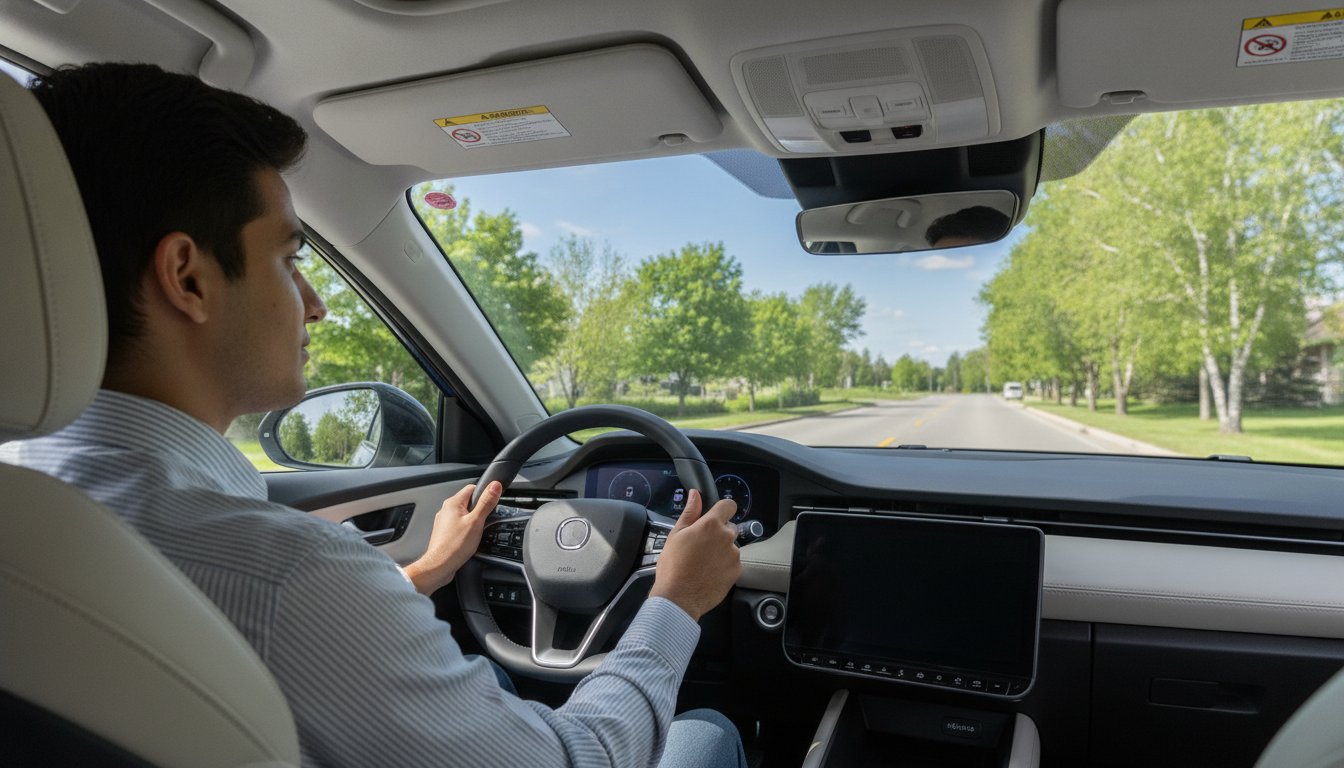
Did you know that in 2026, the G2 road test pass rate at the Brampton centre is only 47%? If that statistic makes your heart race, you are definitely not alone. It's natural to feel stressed about a stern examiner or the pressure of a perfect parallel park, especially when a fail means facing long wait times for a second attempt. We recognize that the anxiety of the unknown is often harder to manage than the driving itself.
The good news is that you can quiet those nerves by applying these specific g2 road test anxiety tips to your preparation routine. This guide will show you how to master the mental and logistical strategies required to secure your licence with total confidence. We will walk through actionable relaxation methods, a checklist to keep you in control, and an efficient way to manage your test booking so you can focus entirely on the road ahead.
Key Takeaways
- Understand that road test anxiety is a natural performance response, allowing you to shift your focus from high-stakes fear to operational control.
- Master immediate calming techniques like the 4-7-8 breathing method and 5-4-3-2-1 grounding exercises specifically adapted for the driver’s seat.
- Eliminate administrative friction by building a "Test Day Kit" 24 hours in advance to ensure you arrive at the centre feeling organized and prepared.
- Implement these g2 road test anxiety tips through mock exams and exposure to varied weather conditions to build long-term driving resilience.
- Reduce pre-test burnout by outsourcing the time-consuming search for a road test date to a professional booking facilitator.
Understanding Why G2 Road Test Anxiety Happens
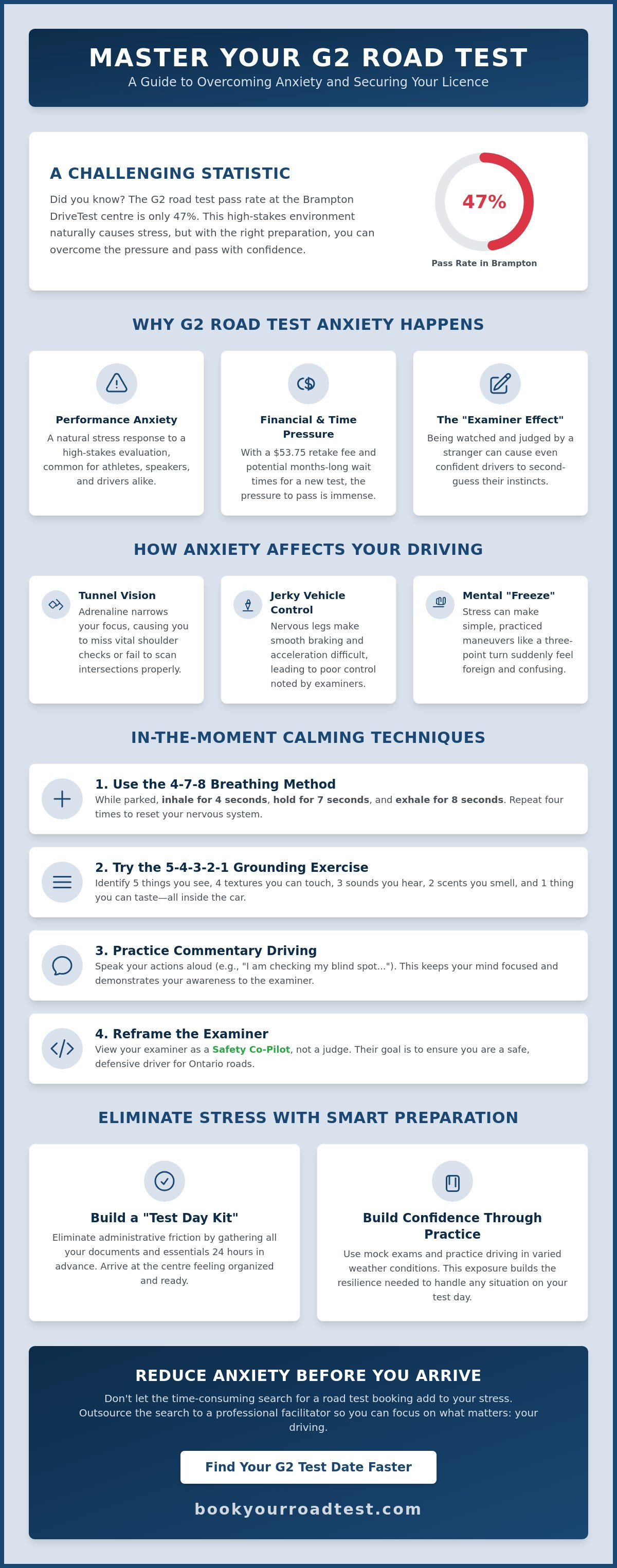
Road test anxiety isn't a sign of poor driving ability; it's a natural performance-based stress response. When you enter the DriveTest centre, your brain perceives the evaluation as a high-stakes event. With a G2 retake fee of $53.75 and the potential for months-long wait times for a new slot, your nervous system often reacts as if you're in physical danger. This triggers performance anxiety, a common experience for athletes, public speakers, and even the most seasoned drivers facing a formal evaluation.
The "Examiner Effect" adds another layer of pressure. Having a stranger with a clipboard watch your every move creates an intense feeling of being judged. This scrutiny can cause even confident drivers to doubt their instincts. It's important to realize that nearly everyone feels some level of nerves during a driving exam. The difference between passing and failing often comes down to how you manage that physiological surge.
The Biological Impact on Driving Performance
Adrenaline is helpful in a crisis but can be detrimental during a road test. It often leads to "tunnel vision," where your focus narrows so much that you forget vital shoulder checks or fail to scan intersections properly. Physical symptoms manifest quickly. Nervous legs can make smooth braking and acceleration difficult, leading to the jerky movements that examiners note as poor vehicle control. In extreme cases, stress causes a mental "freeze." You might know exactly how to execute a three-point turn in practice, but the pressure of the moment makes the steps feel foreign. Applying specific g2 road test anxiety tips helps mitigate these physical interruptions before they compromise your score.
Reframing the Examiner as a Safety Partner
One of the most effective ways to lower your heart rate is to shift your perspective on the examiner. Instead of viewing them as a "judge" looking for reasons to fail you, try to see them as a safety co-pilot. Their primary goal is to ensure you won't be a hazard to yourself or others on Ontario roads. They aren't looking for perfection or professional-level precision; they want to see that you have developed consistent, safe habits. Remember that they value defensive driving over everything else. If you prioritize safety and clear communication through your signals and mirror checks, you're already meeting their core requirements. Utilizing g2 road test anxiety tips like this reframe allows you to approach the test with a collaborative mindset rather than a defensive one.
5 In-the-Moment Techniques to Manage Nerves
The few minutes spent waiting in the DriveTest parking lot can feel like an eternity. Your heart might race as you watch examiners walk toward other vehicles. This is the optimal time to deploy tactical g2 road test anxiety tips that physically force your body to calm down. By managing your physiological response before the engine even starts, you ensure your brain remains clear for the technical tasks ahead.
Start with the 4-7-8 breathing method while you are safely parked. Inhale through your nose for a count of four; hold that breath for seven seconds; then exhale slowly through your mouth for eight seconds. Repeating this cycle four times acts as a biological reset button for your nervous system. You should also perform a quick 5-4-3-2-1 grounding exercise using only items inside the car. Identify five things you see, four textures you can touch, three sounds you hear, two scents, and one thing you can taste. This keeps your focus inside the vehicle rather than on the potential "what-ifs" of the road.
The Power of Commentary Driving
Narrative driving, often called commentary driving, is a highly effective way to prevent your mind from spiralling. By speaking your actions aloud, you occupy the part of your brain that usually generates anxious thoughts. For example, say, "I am checking my blind spot, signalling right, and slowing down for the turn." This practice doesn't just keep you focused; it also demonstrates a high level of situational awareness to the examiner. It shows you are making conscious, safe decisions rather than driving on autopilot. If you find yourself getting overwhelmed, returning to this vocal narrative can quickly bring you back to a state of control.
Physical Grounding in the Driver’s Seat
Anxiety often makes people feel "floaty" or disconnected from their surroundings. To counter this, focus on the physical contact points between your body and the car. Feel the weight of your body pressed firmly into the seat. Ensure your heels are planted on the floor mat to maintain precise pedal control. Before you put the car in gear, perform a "shoulder drop" by inhaling deeply and letting your shoulders fall away from your ears as you exhale. This simple movement releases the upper body tension that often leads to stiff, jerky steering. If you are still feeling the pressure of finding a slot, using a professional G2 Road Test Booking Service can remove the administrative stress so you can focus on these physical techniques.
Finally, practice positive visualization while you wait. Instead of imagining a failed parallel park, close your eyes for thirty seconds and visualize the perfect execution. See yourself checking your mirrors, turning the wheel with confidence, and finishing perfectly parallel to the curb. This mental rehearsal prepares your brain for success. Combine this with a conscious check of your grip on the steering wheel. If you notice you are "white-knuckling," consciously relax your hands. A light but firm touch allows for better feedback from the road and a much smoother driving performance.
Eliminating Logistical Stress: Preparation as Therapy
Logistical certainty acts as a powerful mental safety net during your evaluation. When you eliminate the "what-ifs" regarding your paperwork or vehicle condition, you free up vital cognitive space to focus on the road. Preparation is a practical form of therapy. By organizing your environment, you signal to your brain that you are in control of the situation. One of the most effective g2 road test anxiety tips is to arrive at the DriveTest centre at least 30 minutes before your scheduled appointment. This window allows you to check in, find a designated parking spot, and acclimate to the busy environment without the frantic rush that often triggers a spike in cortisol.
Creating a "Test Day Kit" 24 hours in advance is essential for maintaining your composure. This kit should be a single, organized folder that sits on your passenger seat. Fumbling through a messy glovebox while an examiner watches can cause your heart rate to climb before you even put the car in gear. A clean, well-maintained vehicle also improves your internal sense of control. Remove any trash or clutter from the cabin to create a professional, distraction-free workspace. When your surroundings feel orderly, your mind is more likely to follow suit.
The G2 Test Day Documentation Checklist
Having your physical documents verified and ready provides immense psychological relief. You should confirm that your folder contains your G1 licence, valid proof of Ontario auto insurance, and the original vehicle permit. Beyond paperwork, your vehicle must meet strict Ministry standards to proceed. Check that your brake lights, turn signals, and horn are all functioning perfectly the day before your test. If a bulb is out or a signal is faulty, the examiner will cancel the test immediately. Knowing your equipment is verified removes the fear of a technical disqualification before you even start the engine.
Vehicle Familiarity and Comfort
Familiarity breeds confidence during high-pressure evaluations. You should never use a vehicle for your road test that you have not driven extensively during your practice sessions. A "new-to-you" car has different blind spots, pedal sensitivities, and steering weights that can significantly increase your stress levels. Spend time adjusting your mirrors and seat to your exact preferences before the examiner enters the vehicle. You should also control your environment by setting the cabin temperature to a comfortable level. Shivering from a cold air conditioner or sweating from a lack of airflow can mimic the physical symptoms of anxiety. Applying these environmental g2 road test anxiety tips ensures you stay physically comfortable so you can remain mentally sharp.
Building Confidence Through Simulation and Exposure
Confidence on the road is built through familiarity rather than just repetition. While you might feel comfortable driving with a parent or friend, the presence of a silent examiner changes the mental dynamic. One of the most effective g2 road test anxiety tips is to conduct full mock exams with a licensed driver who can act as a neutral evaluator. Have them sit in the passenger seat with a clipboard and remain silent except for giving directions. This simulates the professional atmosphere of the DriveTest centre and helps you get used to the specific pressure of being observed.
Resilience is also a product of exposure to varied conditions. If you only practise in perfect weather, a sudden rainstorm on the morning of your test could cause your stress levels to skyrocket. Make an effort to drive in heavy traffic, during light snowfall, and at dusk. This variety builds a mental library of successful experiences that you can draw upon when nerves kick in. If you are struggling to find a slot that gives you enough time to prepare, using a road test cancellation finder ontario can help you secure a date that aligns with your readiness level.
Simulating the "Silent Examiner"
Examiners are trained to be objective and professional, which often results in a very quiet cabin. Many students interpret this silence as a sign that they are failing, which leads to a downward spiral of anxious thoughts. To counter this, practise driving for at least 20 minutes without any music, podcasts, or conversation. Learning to handle the quiet without assuming the worst is a vital skill. Remember that the examiner's silence is a tool they use to stay focused on your safety habits, not a critique of your driving ability.
Mastering the Fear of Specific Manoeuvres
Parallel parking and three-point turns are the most common sources of performance dread. You can neutralize this fear by turning these tasks into "drill sessions" where you perform the manoeuvre ten times in a row until it becomes muscle memory. When a movement is automatic, it requires less conscious thought, making it harder for anxiety to interfere. If you do make a minor mistake during the test, adopt a "One-and-Done" mindset. Correct the error if it's safe to do so, but then move on immediately. Dwelling on a past mistake is the fastest way to lose focus on the road ahead.
Ready to put your skills to the test? Use our G2 Road Test Booking Service to find an available appointment at a centre that works for you.
Reducing Anxiety Through Seamless Test Scheduling
Administrative friction is a significant but often overlooked source of pre-test burnout. Spending hours navigating technical glitches or refreshing booking pages drains the mental energy you need for the road. By the time you finally secure a date, you might already feel exhausted by the process. Effective g2 road test anxiety tips must include strategies for managing this administrative burden. When you outsource the search for a time slot to a professional facilitator, you eliminate the specific frustration associated with full calendars and complex official systems.
Securing a test date when you feel "peak ready" is a vital component of your success. If you are forced to wait months for an appointment, your technical skills can begin to rust and your initial confidence may waver. We operate as an autonomous service provider to help you bypass these long wait times. By acting as a professional concierge, we provide a level of convenience and speed that standard systems often struggle to match. This transparency regarding our status as an independent entity ensures you know exactly who is managing your scheduling logistics.
Why a Cancellation Finder is a Stress-Relief Tool
A major risk for many Ontario drivers is the "4-month wait." These long delays between finishing your lessons and taking the actual exam allow nerves to fester. A Road Test Cancellation Finder serves as a powerful stress-relief tool by monitoring the system for newly available slots in real time. This keeps your training fresh and your confidence high because you can take the test while your muscle memory is at its sharpest. Using a professional service to handle the search allows you to avoid the repetitive stress of manual booking, keeping your mind clear for the driving tasks ahead.
Focus on Driving, Not Paperwork
Outsourcing the administrative burden allows you to dedicate 100% of your focus to actual practice. Instead of worrying about the technicalities of the booking portal, you can spend your time mastering the g2 road test anxiety tips mentioned earlier, such as commentary driving and physical grounding. The peace of mind that comes with a confirmed, managed appointment is invaluable. It removes a massive layer of "logistical noise" from your life, allowing you to approach the DriveTest centre with a singular focus on safety and vehicle control.
We understand that the path to your G2 licence involves both mental preparation and logistical efficiency. Our goal is to handle the search so you can handle the steering wheel. By choosing a service that prioritizes speed and reliability, you ensure that the only thing you have to worry about on test day is your driving performance. Book your road test with ease and leave the scheduling stress to us.
Step Into Your G2 Test With Confidence
Mastering the road involves more than just technical steering; it requires managing the mental hurdles that come with a formal evaluation. By integrating these g2 road test anxiety tips into your routine, you transform the exam from a high-stress event into a manageable task. You now have the practical tools to regulate your physical response, organize your documentation, and simulate the test environment to build genuine resilience. Success on test day is the result of combining your driving skills with a calm, focused mindset.
We are here to facilitate the logistical side of your journey so you can concentrate on your performance. As an independent third-party provider, we manage booking logistics for over 60 centres and use an active cancellation finder to help you get on the road sooner. Our transparent administrative fees ensure a premium, hassle-free experience from start to finish. Secure your G2 road test date today and skip the booking stress. You've done the hard work; now it's time to realize your goal and earn your licence with confidence.
Frequently Asked Questions
What should I do if I start panicking during my G2 road test?
Focus on your breathing immediately and use the 4-7-8 method while stopped at a red light or stop sign. You can also narrate your actions aloud to keep your mind grounded in the present moment. Remember that minor errors won't necessarily cause a failure; keep your focus on the road ahead rather than dwelling on a mistake that happened seconds ago.
Is it normal to fail the G2 test because of nerves?
Yes, many candidates fail due to performance anxiety rather than a lack of driving skill. High stress can lead to "tunnel vision," causing you to miss shoulder checks or scan intersections poorly. This is why applying g2 road test anxiety tips early in your preparation is vital. Realizing that your physical response is a natural reaction to a high-stakes evaluation helps you manage it more effectively.
How can I stay calm if the examiner seems unfriendly?
Maintain a strictly professional mindset and remember that the examiner is there to evaluate safety, not to be your friend. Their neutral or stern demeanor is often a requirement of their professional training to ensure an unbiased assessment. Focus on your driving tasks and treat them as a safety co-pilot who is simply checking that you follow the rules of the road correctly.
Can I take a break during the road test if I feel too anxious?
You cannot take a formal break or pull over for a rest once the test has begun. However, you can take a few seconds to reset your breathing while you are parked during the parallel parking or three-point turn manoeuvres. Use these brief stationary moments to drop your shoulders and relax your grip on the steering wheel before proceeding to the next instruction.
Does practicing on the actual test route really help with anxiety?
Practising on the actual test route is highly beneficial because it removes the stress of navigating unfamiliar roads. When you know the speed limits, lane configurations, and hidden stop signs in the area, you can dedicate more mental energy to your driving habits. This familiarity is one of the most practical g2 road test anxiety tips for building confidence before you arrive at the centre.
How does booking a test date sooner help reduce my driving stress?
Booking an earlier date prevents your driving skills from becoming "rusty" and stops anxiety from festering over several months. Taking the test while your training is fresh ensures that safe habits are still top-of-mind. Using a professional booking service to find an earlier slot allows you to maintain your momentum and reduces the long-term stress of waiting for a standard opening.
What is the best time of day to book a road test to avoid traffic anxiety?
The best time to book is typically between 10:00 a.m. and 2:00 p.m. to avoid rush-hour traffic and school-zone congestion. Lower traffic volume reduces the complexity of lane changes and turns, which can significantly lower your anxiety levels. Avoiding the frantic pace of the morning and afternoon commute allows you to focus entirely on demonstrating your technical skills to the examiner.
Can I bring a friend or family member for support during the test?
No, you are not allowed to have anyone else in the vehicle during the road test except for the examiner. This rule ensures that there are no distractions and that the evaluation remains fair for every candidate. You should prepare for this solitary environment by conducting mock tests with a licensed driver who remains silent to simulate the actual exam conditions.


